Airbus To Trial In-flight Auxiliary Power Entirely Generated By Hydrogen
The title of this post, is the same as that of this press release from Airbus.
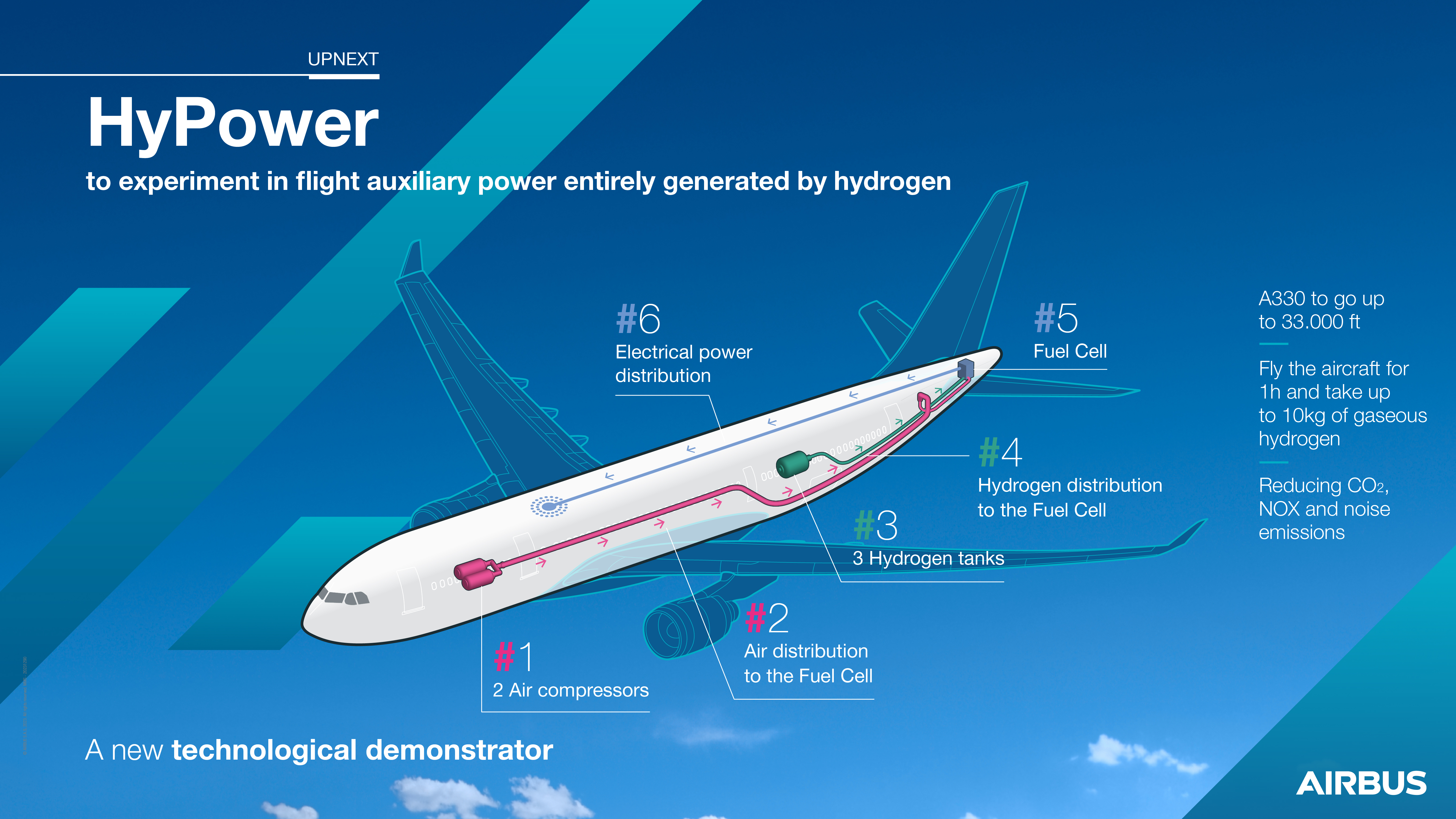
Airbus UpNext has launched a new demonstrator programme to explore, on the ground and in flight, a new architecture for the generation of non propulsive energy through the use of hydrogen fuel cells.
On conventional airliners, the APU (Auxiliary Power Unit), a small additional engine that runs on traditional jet fuel, provides together with the engines the energy required to power a number of non-propulsive aircraft functions, such as air conditioning, onboard lighting and electric power for avionics. With this new technology demonstrator, led from its facilities in Spain, Airbus UpNext will replace the actual APU of an A330 with a hydrogen fuel cell system that will generate electricity. Known as HyPower, the hydrogen fuel cell demonstrator also aims to reduce the emissions of CO2, nitrogen oxides (NOx) and noise levels associated with a traditional APU.
New design features and integration techniques will also contribute to maturing the safety and operations of future hydrogen-powered aircraft and will demonstrate the stable operation of a fuel cell in-flight, including its restart.
This Airbus infographic describes the system.
This looks to be a well-thought out project and I suspect Airbus will learn a lot about hydrogen and how to use it.
I have some thoughts.
The Noise Factor
Reduction of noise is mentioned in both the text and the infographic, so it must be important.
Years ago, I remember a take-off from St. Lucia, where on the previous day, there had been an engine failure on the flight from London. This meant we were treated to the view of a rare site of a five-engined Jumbo Jet, as the next day’s flight brought in a spare engine on the spare mounting under the wing. Engineers then worked all night to put this engine on the previous day’s stricken plane, whilst we had an extra night in the Carribean.
When it eventually came to leaving, we were on the absolutely crammed-full rescue plane, which was an almost new 747-300.
I remember the plane being positioned at the very Western end of the runway and we waited a long time before take-off. From our position towards the rear of the plane, I couldn’t see if they topped up the fuel tanks but they may have done. The pilot then gave us the good news, that we would be going to Heathrow without the usual intermediate stop at Barbados to take on fuel.
We had no problems, but I suspect the airport’s neighbours on the island didn’t like the screaming noise of the APU (Auxiliary Power Unit) disturbing the peace, whilst we waited for take-off.
A hydrogen fuel cell-powered APU could have advantages in some take-offs from perhaps smaller airports. The plane would be towed into position for take-off by a battery-electric aircraft tug, with all aircraft systems running on the hydrogen-powered APU. When everything was ready, the first engine would be started by the power from the APU and then after all engines were started and everything was ready, the plane would take off.
It looks to me, that a hydrogen-powered APU and a zero-carbon aircraft tug, could work together to reduce pre-take off pollution, carbon-dioxide emissions and noise at airports.
The Inflight Restart
Two air incidents, illustrate the need for an inflight restart of the APU.
The Wikipedia entry for the flight describes the crash like this.
British Airways Flight 38 was a scheduled international passenger flight from Beijing Capital International Airport in Beijing, China, to London Heathrow Airport in London, United Kingdom, an 8,100-kilometre (4,400 nmi; 5,000 mi) trip. On 17 January 2008, the Boeing 777-200ER aircraft operating the flight crashed just short of the runway while landing at Heathrow. No fatalities occurred; of the 152 people on board, 47 sustained injuries, one serious. It was the first time in the aircraft type’s history that a Boeing 777 was declared a hull loss, and subsequently written off.
Wikipedia gives this as the cause of the accident.
Ice crystals in the jet fuel were blamed as the cause of the accident, clogging the fuel/oil heat exchanger (FOHE) of each engine. This restricted fuel flow to the engines when thrust was demanded during the final approach to Heathrow.
Suppose this problem had occurred earlier and shut the engines down in the middle of Russia. At the 40,000 feet, they were flying, they could have probably been able to glide into the nearest suitable airport and land without main engine power. But the APU would have been needed to power the aircraft’s systems like instruments and air-conditioning.
One of my favourite books is All Four Engines Have Failed by Betty Toothill, who was a passenger on BA 009 on the 24th June 1982.
The Wikipedia entry of the flight starts like this.
British Airways Flight 009, sometimes referred to by its callsign Speedbird 9 or as the Jakarta incident, was a scheduled British Airways flight from London Heathrow to Auckland, with stops in Bombay, Kuala Lumpur, Perth, and Melbourne.
On 24 June 1982, the route was flown by the City of Edinburgh, a Boeing 747-200 registered as G-BDXH. The aircraft flew into a cloud of volcanic ash thrown up by the eruption of Mount Galunggung around 110 miles (180 km) south-east of Jakarta, Indonesia, resulting in the failure of all four engines. Partly because the event occurred at night, obscuring the cloud, the reason for the failure was not immediately apparent to the crew or air traffic control. The aircraft was diverted to Jakarta in the hope that enough engines could be restarted to allow it to land there. The aircraft glided out of the ash cloud, and all engines were restarted (although one failed again soon after), allowing the aircraft to land safely at the Halim Perdanakusuma Airport in Jakarta.
In this incident, the APU would have been needed to start the engines.
These incidents show how important the APU is to safe flying.
Some might even argue that a hydrogen fuel cell-powered APU running on its own independent hydrogen supply would be preferable than an APU based on a small gas turbine using the same fuel as the main engines.
Irish Offshore Wind Developer Teams Up With Norwegian Seaweed Farming Company
The title of this post, is the same as that of this article on offshoreWIND.biz.
This is the sub-heading.
Ireland-headquartered Simply Blue Group and Norwegian seaweed farming company, Arctic Seaweed, have signed a memorandum of understanding (MoU) under which they will jointly explore solutions for co-locating seaweed farms and offshore wind farms.
Simply Blue Group has an informative web site.
This news item on the Simply Blue Group web site gives full details of the project.
Arctic Seaweed has a web site, with this philosophy on the home page.
At Arctic Seaweed, our philosophy revolves around leveraging disruptive technology to revolutionize the seaweed cultivation industry.
We believe that by embracing scale and cutting-edge innovations, we can drive a transformative shift in the market.
Through our commitment to pushing boundaries and fostering collaborations, we are paving the way for a future where disruptive technology creates unprecedented opportunities in seaweed cultivation.
Both companies seem to be very professional.
Scotland’s Largest Offshore Wind Farm Stands Complete
The title of this post, is the same as that of this article on offshoreWIND.biz.
This is the sub-heading.
The final turbine has been installed at Scotland’s largest offshore wind farm, Seagreen, off the coast of Angus.
These two paragraphs describe the wind farm.
Once fully operational, the Seagreen project, owned by TotalEnergies and SSE Renewables, will reach almost 1.6 GW.
76 of the 114 Vestas V164-10.0 MW turbines are now energised at the site, which is located 27 kilometres from the Angus coast.
The article also says, that the units are now producing more than two-thirds of Seagreen’s full capacity power to the grid.
It seems like the Seagreen wind farm has got off to a good start.
Riveting Television
I’ve just watched an episode of Fred Dibnah’s Made In Britain, which was entitled Mechanics and Riveters.
It was fascinating stuff, but how do you decarbonise an industry like the making of rivets without using hydrogen?
30 MW Offshore Wind Turbines Being Considered For New Project In Sweden
The title of this post, is the same as that of this article on offshoreWIND.biz.
This is the sub-heading.
Freja Offshore, a joint venture between Hexicon and Mainstream Renewable Power, has submitted an application for an offshore wind farm in Sweden that could have an installed capacity of between 2 GW and 2.5 GW and, according to the project’s consultation document, could feature wind turbines of up to 30 MW per unit.
This paragraph, indicates how turbines have grown over the last two decades.
The wind turbines in the future will probably be taller, the rotor diameter larger and the turbines more powerful, the joint venture says in the consultation document, and compares the largest wind turbines launched in 2011, which have a rotor diameter of 164 metres and an installed capacity of 8 MW, with those launched 10 years later, featuring a rotor diameter of 236 metres and an output of 15 MW.
Moving on a few years to 2030 and it doesn’t seem unreasonable that turbine size will double again to 30 MW.
I could see them becoming the standard turbine, providing they aren’t too heavy for the fixed foundations or floats.
It would be an interesting exercise to model the costs of wind farms, as the turbines get bigger.
With North Sea oil and gas, I was told several times, by Artemis users, that as cranes got larger, which allowed bigger lifts, the costs of offshore infrastructure decreased.
Note.
Eviation Still Progressing Even As Alice Remains Earthbound
The title of this post, is the same as that of this article on Flight Global.
The article is a full summary of the status of the Eviation Alice project and very much a must-read.
This article on Skies Magazine, which is entitled Eviation Announces New Order For Up To 50 Alice All-Electric Commuter Aircraft, also gives this information about the order status.
In addition to the latest order from Aerolease, Eviation has also received orders from U.K.-based regional aircraft lessor MONTE (30 aircraft), U.S.-based Cape Air (75 aircraft), U.S.-based Global Crossing Airlines (50 aircraft), Germany-based EVIA AERO (25 aircraft), Australia’s Northern Territory Air Services (20 aircraft), Mexico-based Aerus (30 aircraft), Air New Zealand (up to 23 aircraft), and DHL Express for 12 Alice planes in the eCargo configuration.
Whatver, your view on electric aircraft, the total of 315 orders is impressive for a start-up.
Why Should I Pay For The ULEZ Scrappage Scheme?
The Mayor’s pet anti-pollution project the ULEZ scheme is controversial to say the least.
This article on the BBC is entitled ULEZ: Labour MPs In London Call For ULEZ Scrappage Scheme Review.
So even MPs in his own party don’t agree with the current policy!
Consider.
- I am a non-driver after a stroke ruined my eyesight.
- The only possible benefit, that I might get, is slightly less pollution around where I live.
- But the jury is out on that and the current evidence is dubious, as the Mayor has paid for it to be collected.
- In 2021, the population of London had the chance to remove Sadiq Khan, but decided to re-elect him, despite his ULEZ policy.
- So I have no sympathy for those, who have to rely on a non-compliant car or van to go about their daily business.
- They knew they had to either get a compliant vehicle, pay the £12.50 per day or move to somewhere with a friendlier transport policy.
- If the Mayor wanted to cut pollution in London, he could at least have a hydrogen policy, which allowed large trucks based in London to use this clean fuel.
We have another Mayoral election in 2024!
I shall not be voting for any candidate, who proposes to use London taxpayers’ hard-earned money for a scrappage scheme or who doesn’t have a feasible hydrogen policy.
 The Anonymous Widower