Azuma Test Train Takes To The Tracks As LNER Trials Possible New Route
The title of this post, is the same as that of this article on Rail Technology Magazine.
This is the first paragraph.
London North Eastern Railway (LNER) completed a test run from Cleethorpes in Lincolnshire and London King’s Cross, with the view to operating a direct service in the future.
These two paragraphs describe how the tests were carried out.
A first test train travelled from Doncaster on 26 June which called at Grimsby Town, Cleethorpes, Barnetby and Market Rasen. At each station, a series of platform and train validations were performed to ensure that a service could be compatible in the future.
On the journey itself, a specialist team travelled onboard, carried out a number of checks and assessments which is required for any potential new route or extension. A detailed assessment was undertaken. The findings will now be reviewed by the stakeholders.
The test run was in four sections.
- 5Q80 – Departed Doncaster Carr Lane Depot at 0817 and arrived Cleethorpes Platform 4 at 1000.
- 5Q81 – Departed Cleethorpes Platform 3 at 1054 and arrived Lincoln Central Platform 5 at 1219.
- 5Q82 – Departed Lincoln Central Platform 5 at 1226 and arrived Cleethorpes Platform 2 at 1355.
- 5Q83 – Departed Cleethorpes Platform 2 at 1528 and arrived Doncaster Carr Lane Depot at 1654.
Note.
- These details came from Real Time Trains.
- It looks like three platforms 2, 3 and 4 at Cleethorpes station were checked.
- The route between Cleethorpes and Lincoln Central was checked both ways.
- The route between Doncaster Carr Lane Depot and Cleethorpes was checked both ways.
- Typically, each station stop took around 10-12 minutes, which probably gave adequate time for the specialist team to make their checks and assessments.
- Class 800 trains run six times a day between Lincoln Central and King’s Cross, so I must assume that section is well-checked and has the correct clearances.
- Lincoln Central station is 16.7 miles from the electrified East Coast Main Line at Newark Northgate station.
- Cleethorpes station is 52.1 miles from the electrified East Coast Main Line at Doncaster station.
- The distance between Lincoln Central and Cleethorpes stations is 47.2 miles.
- The timing between Lincoln Central and Cleethorpes appears to be just under one hour and thirty minutes.
It looks like a thorough test has been performed.
I have a few thoughts.
Platforms At Cleethorpes Station
According to the Wikipedia entry for Cleethorpes station, the station has three platforms, which are numbered 1, 2 and 3.
These three pictures show Cleethorpes station in 2020.

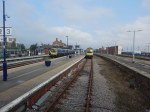
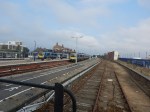
Note.
- The two trains are Class 185 trains of TransPennine Express.
- The train in the left is in Platform 1.
- Platform 2 appears to be empty.
- The train on the right is Platform 3.
I would assume Platform 4 could be the derelict platform shown in the third picture at the right. Or it might be a typo!
But if it is felt that LNER will need their own platform, it would surely be a good idea to do all testing at the same time.
Initial Service Pattern
I would expect that the initial service pattern would follow that used for many new services.
- There will be an early morning train up to London.
- There will be a late afternoon or early evening return train.
Journey time could be around three hours and twenty minutes.
Once the demand is proven, extra trains to and from London might be added in the middle of the day.
Could This Service Be Served By Battery-Electric Class 800 Trains?
From a picture on this article on the BBC, the test run appears to have been carried out by a bi-mode Class 800 train.
The full route from Doncaster to King’s Cross has four sections.
- Doncaster and Cleethorpes – 52.1 miles – Unelectrified
- Cleethorpes and Lincoln Central – 47.2 miles – Unelectrified
- Lincoln Central and Newark Northgate – 16.7 miles – Unelectrified
- Newark Northgate and King’s Cross – 120.1 – Electrified
To go between King’s Cross and Doncaster via Cleethorpes would need a battery-electric train with a range of 116 miles.
In What Will Be The Range Of A Hitachi Class 800 Battery Train?, I came to this conclusion about the battery range of a Class 800 train.
The first version of the battery-electric train will have a range of around a hundred miles, so that they can handle the Great Northern and Great Eastern Joint Line diversion on battery power.
But fairly soon after introduction into service, I will be very surprised if they don’t claim the Guinness world record by running farther than the Stadler FLIRT Akku’s 139 miles.
Note.
- Trains would be charged using the existing electrification of the East Coast Main Line.
- No new infrastructure would be required.
But for service recovery reasons, it could be prudent to add electrification to Platform 4 at Cleethorpes station.
Could TransPennine’s Service Between Doncaster and Cleethorpes Be Served By Battery-Electric Class 802 Trains?
As it is only a round trip of 104.2 miles, I don’t see why this couldn’t be done by say 2028.
Could LNER’s Service Between King’s Cross and Lincoln Be Served By Battery-Electric Class 800 Trains?
As it is only a round trip of only 33.4 miles, this is the easy trip to decarbonise.
What Will Be The Range Of A Hitachi Class 800 Battery Train?
I feel now, I have enough information to make an educated, at what the distance a five-car Class 800 or Class 802 train will travel on batteries.
Previous Battery-Electric Trains
These are examples of previous distances.
- A Bombardier engineer told me eight years ago, that the battery-electric Class 379 had a range of sixty miles.
- Stadler’s FLIRT Akku has a Guinness world record of 139 miles on one battery charge. See this page on the Stadler web site.
- Even Stadler’s Class 777 trains for Merseyrail have a range of 84 miles on battery power. See New Merseyrail Train Runs 135 km On Battery.
It does appear that five-car battery-electric trains will have ranges in excess of a hundred miles.
Engineering Ambition
Several times in my life, I’ve got fired up about engineering or software projects and I like to think, I’ve produced the best and fastest solution.
For this reason, I believe that Hyperdrive Innovation, who are now part of Turntide Technologies, and Hitachi will set themselves three objectives with the design of the the battery packs for the Class 800 or Class 802 train.
- The battery-electric Class 802 will outperform the Stadler FLIRT Akku in terms of speed and distance.
- The battery packs will be plug-compatible with the diesel engines, so there will only be minor software modification to the trains.
- The train will be able to be handle all Great Western Railway’s routes without using diesel.
- I wouldn’t be surprised that on many routes the train will cruise at over 110 mph on batteries.
I also suspect they want the Akku’s Guinness world record, which will mean the range will be in excess of 139 miles.
More On LNER’s Ten New Bi-Modes
I wrote about these trains in LNER Seeks 10 More Bi-Modes.
This was my conclusion.
There is a lot of scope to develop LNER’s services.
I think it is likely that the order will go to Hitachi.
But as I indicated, I do believe that there is scope for a manufacturer to design a zero-carbon train, that was able to serve Aberdeen and Inverness.
- I suspect a fleet of ten trains would be sufficient.
- Trains would use the 25 KVAC overhead electrification, where it exists and hydrogen or battery power North of the wires.
The trains would also be capable of being upgraded to higher speeds, should the East Coast Main Line be turned into a High Speed Line.
I also think, that whatever trains are bought, there will be a large upgrading of the existing Hitachi fleet, which will add batteries to a lot of trains.
In the July 2023 Edition of Modern Railways, there is an article, which is entitled LNER Embraces Pioneering Spirit, which takes the form of an interview with LNER’s Managing Director; David Horne.
In a section, which is entitled ‘225’ Replacement, this is said.
Meanwhile, Mr Horne is looking to what might replace the InterCity 225 fleet, now smartly repainted in a scheme which pays homage to the original ‘Swallow’ livery. While there were fears this fleet may be withdrawn as an economy measure, the ‘225s’ are now on lease until at least next summer.
But Mr Horne says obsolescence issues are a real challenge and LNER will struggle to maintain the fleet beyond 2025, and from the May 2023 timetable change the number of daily diagrams was reduced from five to four to conserve the fleet’s mileage. Much of the heavy maintenance work had previously been carried out at Wabtec’s Doncaster site, but this facility is no longer available, and while a recent reliability improvement programme is bearing fruit, the challenges remain. The crunch point comes with the transition to ETCS at the southern end of the ECML as part of the East Coast Digital Programme – Mr Horne says LNER does not want to fit cab signalling on the ‘225s’.
The solution to this issue is to procure additional trains to run alongside the 65 Azumas, and LNER went out to tender in October 2020 for a fleet of 10 trains with self-power capability.
While a preferred bidder has been identified, the business case to proceed with the procurement is awaiting approval, but Mr Horne is still hopeful this project can be progressed.
The current plan envisages the new trains broadly replacing the ‘225s’ on Leeds and York diagrams, but a major benefit with the new fleet would be during engineering work – at present LNER has to withdraw services to places such as Harrogate and Hull to concentrate its bi-mode Azumas on services using non-electrified diversionary routes, and having more stock with self-power capability would ease the issue.
Currently, LNER has these Azumas and InterCity 225s in its fleet.
- Five-car bi-mode Class 800 trains – 10
- Nine-car bi-mode Class 800 trains – 13
- Five-car electric Class 801 trains – 12
- Nine-car electric Class 801 trains – 30
- Nine-car electric ImterCity 225 trains – 8
Note.
- There are 23 bi-mode trains and 50 electric trains.
- There are 167 bi-mode carriages and 302 electric carriages.
- Currently 31.5 % of the trains are bi-mode.
- With ten new bi-mode trains and no InterCity 225 trains, 44 % of the fleet will be bi-mode.
Is this increase in the percentage of the fleet, that are bi-mode acceptable?
LNER’s Two Needs
Let’s look at LNER’s needs, which are actually two separate sub-needs.
- There is a need for ten new trains to replace the InterCity 225 trains.
- There is a need to increase the size of the bi-mode fleet to be able to use the Great Northern and Great Eastern Joint Line and other non-electrified routes to by-pass engineering works.
Note.
- I suspect that as Mr Horne explained, there are only five or possibly four InterCity 225s diagrammed on a particular day, then perhaps ten five-car bi-mode Class 800 trains, might be able to cover for the retirement of the InterCity 225s.
- These trains would work as pairs to Leeds and York to replace the InterCity 225 capacity.
- If required they could split and join at Leeds and York to serve other destinations.
- The diversion route of the Great Eastern Joint Line has an unelectrified distance of 93.7 miles and the route is electrified at both ends.
- Would a battery-electric Class 800 train handle this distance? I suspect if Stadler can do it, then Hitachi and Turntide Technology will be able to do it too!
LNER will have replaced the InterCity 225s and acquired ten new five-car blockade runners.
As an order for ten new five-car battery-electric trains, is not to be sneezed at, I suspect Hitachi will make sure that their new battery-electric variants have enough range.
So this would mean that the range of a five car battery-electric Class 800 train, should be in excess of 93.7 miles.
Advantages Of Converting Class 800 and Class 802 Trains To Battery-Electric Operation
It should be noted that the five-car and nine-car Class 800 and Class 802 trains have specific advantages when it comes to converting them to battery-electric operation.
- They are modern trains, that are still in production, so every bit of information about the train is known down to the last nut, bolt and plastic clip.
- Like most modern trains, hey have a sophisticated computer system controlling the train.
- They have spaces for three, four or maybe even five diesel engines under the floor, which could be used for a battery-pack in every car designed to hold a diesel engine.
- The train has an electric bus between nose and tail.
- As is shown, when the trains change between diesel and electric, the pantograph can go up and down with all the alacrity of a whore’s drawers.
- The trains can be converted between bi-mode and electric, by adding or removing diesel packs. I doubt this feature will be removed, as batteries replace diesels.
With my Electrical and Control Engineer’s hard hat on, I doubt there is anything to stop a Class 800 or Class 802 train being fitted with three or more batteries to create a 125 mph train, with a range approaching two hundred miles on battery power.
The initial name of these Hitachi trains was the Hitachi Super Express. Is this train the Hitachi Super Battery Express?
But it would appear, that for their initial needs, LNER, just need a range to handle the near hundred miles of the Great Northern and Great Eastern Joint Line.
Inverness and Aberdeen will come later.
Conclusion
The first version of the battery-electric train will have a range of around a hundred miles, so that they can handle the Great Northern and Great Eastern Joint Line diversion, which is 93.7 miles on battery power.
But fairly soon after introduction into service, I will be very surprised if they don’t claim the Guinness world record by running farther than the Stadler FLIRT Akku’s 139 miles.
No-one likes being second!
 The Anonymous Widower