North-East-Based Turntide Receives Initial Battery Production Order From Hitachi Rail For Arriva’s Grand Central Intercity UK Battery Trains
The title of this post, is the same as that of this news item from Turntide Technologies.
This is the sub-heading.
New batteries to enable greener train operations to remove over 600 engines on existing trains, offering lower cost of operations, more range, and path to zero-emissions travel.
These are the initial three paragraphs, that add more detail.
Turntide Technologies (Turntide), a global leader in electrification and hybridisation solutions and a long-standing North East manufacturer, received its first order from Hitachi Rail to begin production of its next-generation modular battery system for the first U.K.-manufactured battery trains for Arriva’s Grand Central.
First announced on July 2, 2025, this partnership involved an R&D component and has officially moved into production with the potential to support either new battery trains or retrofitting over 600 engines on existing Hitachi Rail U.K. fleets.
This new battery system will allow for lower cost of operations, extended range, and a path to zero-emission travel, while reducing reliance on fossil fuels and improving air quality and noise pollution. Turntide’s bespoke batteries are designed to deliver even greater power density in the same footprint of a diesel engine. This battery production is an advanced manufacturing milestone for Arriva’s Grand Central new fleet, which is being built in Newton Aycliffe, County Durham by Hitachi Rail.
In Are Hitachi’s Tri-Mode Trains Exceeding Expectations?, I said this.
I asked Google AI, the question in the title of this post and received this answer.
Yes, Hitachi’s tri-mode (battery-hybrid) trains are exceeding expectations, particularly following successful trials in the UK in late 2024. Trials of the battery-equipped Class 802/2 demonstrated superior performance to initial forecasts, leading to a £300 million order for a new fleet to be delivered in 2028.
Key findings from trials and operational expectations:
Performance Exceeded: The trial, conducted with TransPennine Express and Angel Trains, showed fuel cost savings of 35%–50%, surpassing initial predictions of up to 30%.
Operational Capability: The battery technology enabled trains to reach speeds greater than 75 mph and provided enough range for zero-emission, silent running in and out of stations, significantly reducing noise and improving air quality.
Energy Efficiency: The battery matched the weight of a diesel engine, meaning no extra track degradation.
Future Impact: The success of the trial led to an order from Arriva Group for a new fleet for Grand Central services, which will increase seating capacity by 20% and are expected to significantly reduce carbon emissions.
These trains, designed to run on electric, battery, or diesel power, are part of a push to modernize rail services, with the technology allowing for the gradual elimination of diesel-only operation on certain routes.
In The Data Sheet For Hitachi Battery Electric Trains, I came to these conclusions.
- The battery pack has a capacity of 750 kWh.
- A five-car train needs three battery-packs to travel 100 miles.
- A nine-car train needs five battery-packs to travel 100 miles.
- The maximum range of a five-car train with three batteries is 117 miles.
- The maximum range of a nine-car train with five batteries is 121 miles.
Hitachi have seen my figures and told me they’re not far out.
As battery technology gets better, these distances will increase
What Battery Range Do Arriva Grand Central Trains Need?
Arriva Grand Central Trains currently run services to Bradford Interchange and Sunderland and hope of adding services to Cleethorpes.
All services would go between Doncaster and Kings Cross, with some stopping additionally at Peterborough.
The lengths of unelectrified track on each route is as follows.
- Bradford Interchange – Shaftholme junction and Bradford Interchange is not electrified – 47.8 miles
- Cleethorpes – Doncaster and Cleethorpes is not electrified – 52.1 miles
- Sunderland – Northallerton and Sunderland is not electrified – 47.4 miles
Note.
- Bradford Interchange station is on a tightly hemmed-in site and putting charging infrastructure in the station might be difficult.
- All Bradford Interchange services will soon be passing electrification at Mirfield station, so there may be scope for a quick charge and continue.
- Cleethorpes station is an open-air station with four platforms.
- I believe it is likely, that Cleethorpes station will also be a destination station for other battery-electric trains from LNER, Northern Trains and TransPennine, so I would suspect that charging facilities will be installed.
- Cleethorpes station could be an ideal location for one of Siemens’ Rail Charging Converters.
- Sunderland station is underground and has a unique layout where both platforms are electrified for the Metro. It is all explained in the Wikipedia entry for the station.
- The Wikipedia entry shows an open-air siding without electrification. One possibility would be for the Class 820 trains to park there and use their on-board diesel to top-up the batteries, so they could reach Northallerton.
- It appears that Grand Central visit Ryhope Grange Sidings between arriving and leaving for King’s Cross. The trains could have their batteries topped up there if needed.
It does look like a five-car train with a battery range of at least 105 miles would be able to handle these three routes.
The Arriva Grand Central Trains Fleet Are Now Class 820 trains
They have a Wikipedia entry.
The order was for nine trains of five cars.
- Wikipedia describes them as tri-mode trains.
- I believe they will have three battery packs and one diesel generator.
- Three battery packs should give a range of 117 miles.
- Google AI says that on one diesel generator, these trains can limp home at 60 miles per hour.
- Google AI says that the diesel generator will be able to charge the batteries at the destination station?
- From comments on the Internet, it appears that Hitachi have a very clever train control system, that ekes out the available power.
It looks to me that Hitachi have designed a train that can handle an unelectrified branch line of up to 60 miles or 120 miles if there are charging facilities at the destination station.
Did LNER And TransPennine Express Not Want To Be First With Battery-Electric Intercity Trains?
Consider.
- TransPennine and LNER are under government control.
- TransPennine provided the train for the testing, so they must know all the results and their drivers, who were probably involved certainly do.
- LNER must have the best initial route in King’s Cross and Lincoln, where only the last 16.6 miles, between Newark and Lincoln is not electrified.
- Surely, both companies should have been given at least one of the first batteries, so they could start training staff in how to use and service the batteries.
I have also totalled how many existing diesel power-packs are in existing Hitachi trains and it is 759.
This figure surprised me, as the sub-heading in the Turntide news item said the number of engines in existing trains was over 600. But then East Midlands Railway are still introducing their fleet of 33 x Class 810 trains, which have a total of 132 engines, and 627 could be described as over 600 engines.
How Much Would A Turntide Battery-Pack Cost?
Consider.
- This is a bespoke product for Hitachi.
- Hitachi have stated that the weight is the same as a diesel-pack, so that track-access rules and charges won’t change.
- As a Control Engineer, I wouldn’t be surprised, that the battery-pack is designed to tell the train control system, that it is a diesel power pack. So it acts just like one!
- In the 1960s, I was designing, building and installing transisterised control systems to replace electronic valve and relay equipment in a rolling mills. The two generations of control systems were interchangeable. Are diesel-packs and battery-packs the same?
- Why did Hitachi choose a small supplier in Gateshead, rather than one of a number of capable companies in Japan? You don’t go halfway around the world, if the quality is available locally.
- Deployment of these trains, will avoid the cost of scores of miles of overhead electrification.
- A lot of routes won’t even need chargers at the remote destination, as the range will be sufficient for an out and back journey from the current electrification.
- Fuel cost savings of 35%–50% were achieved in development testing.
- I have ridden in three battery-electric trains. All were mouse quiet. Will that increase ridership?
I believe these batteries are no ordinary batteries. So they won’t come cheap!
I wouldn’t be surprised that the cost of each battery-pack between a half-a-million pounds and a million pounds, with support.
Will These Trains Create Growth In The Economy?
I have ridden in all current variants of the Hitachi Intercity Express Trains, with the possible exception of the Class 805 train and as each version has been introduced, they are no worse, but often better than previous versions.
I have had two or maybe three return trips to Nottingham and Sheffield in the latest variant, which is East Midlands Railway’s Class 810 train.
This is without doubt the pick of the bunch.
I therefor believe that if this continuous improvement carries on, that the new Class 820 train, that has been ordered by Grand Central will be even better.
- My experience of battery-electric trains, says it will be quieter.
- The environment of stations will be improved.
- Train fuel costs will be reduced.
- I believe that ridership will be increased, as people will be intrigued by a 125 mph train running on batteries.
- The trains will have the ability to divert via Lincoln using the GNGE Diversion on the East Coast Main Line during engineering works.
- Because of their regenerative braking, the trains should be able to do very quick extra stops at intermediate stations.
- New routes will be developed.
- Less ugly electrification will be erected on scenic routes like Settle and Carlisle, and across the Highlands of Scotland.
I believe strongly, that at the end of the day, that battery-electric trains will increase the profits of operators and Network Rail, and reduce the cost to the taxpayers of the railways.
Grand Central’s New Trains Will Improve Services
All these stations will be served by the new Class 820 trains.
- Barnetby
- Bradford Interchange
- Brighouse
- Cleethorpes
- Doncaster
- Eaglescliffe
- Grimsby
- Habrough
- Halifax
- Hartlepool
- Low Moor
- Mirfield
- Northallerton
- Peterborough
- Pontefract Monkhill
- Scunthorpe
- Seaham
- Sunderland
- Thirsk
- Wakefield Kirkgate
- York
Passengers should notice the following from the new Grand Central trains.
- A quieter ride.
- Less vibration.
- Slightly faster services due to faster stops at stations.
- No diesel smoke and much less noise from trains in stations.
Note.
- Cross Country, Hull Trains, LNER, Lumo, TransPennine Express and other operators will come under pressure to follow suit.
- Batteries, will not have the power for freight trains, so will we see a new generation of hydrogen freight locomotives?
But will the improved services bring that exclusive growth to the economy?
Only time will tell!
Private And Public Operators
In the UK, we have.
- Private open access operators like Grand Central, Hull Trains and Lumo, who can buy trains on a loan from a leasing company.
- Public operators like LNER and TransPennine Express, who probably have to get sign off from the Treasury.
- Several companies like Great Western Railways and East Midlands Railway, who are soon to be taken over by Great British Railways, who are stuck in a sort of limbo.
My late friend ; David, who rose to the highest level in banking in the UK, would have come up with a solution.
He would probably have said, that there’s is very little difference between the groups of operators.
- The train services they offer vary only on destinations and prices.
- The ticketing system is now unified, so if you turn up at the last minute and want to go to Newcastle and Lumo and LNER both have tickets, you are offered a choice and you can pick the one that’s best for you.
- All services will soon be running similar battery-electric trains, fprobably from the same Hitachi factory in Newton Aycliffe.
- Food and beverage service is not competitive and could be improved.
- Staff are probably on similar employment agreements.
So why shouldn’t Great British Railways be able to lease trains and even battery packs from companies like Angel Trains, who are funding the trains for Grand Central?
It might get more battery trains running on tracks all over Great Britain sooner than it appears they will now!
Creating More Capacity At King’s Cross Station
I took these pictures as I walked through King’s Cross station today.


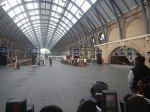
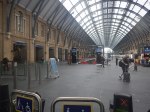
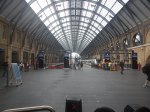
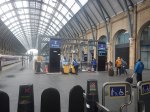
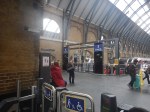
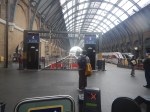
Note.
- Each of the eight platforms in the main train shed, has been formally divided into a and b sections.
- In the first picture, a sign to the right of the clock, showing 0a and 0b, indicates that Platform 0 has been similarly divided.
- I would assume, that any services run by 10-car trains would use both the a and b platforms.
- Services run by 5-car trains, can use any free ‘a’ or ‘b’ platform.
It would appear to me, that 18 x 5-car platforms must be able to handle more trains than 9 x 10-car platforms.
This information screen, which is one of several, explains what has been done.
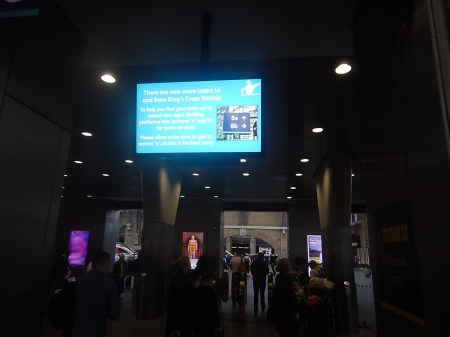
This is the message on the screen, which is only visible about once every ten minutes.
- There are now more trains to and from King’s Cross station.
- To help you find your train we’ve added new signs dividing platforms into sections ‘a’ and ‘b’ for some services.
- Please allow extra time to get to section ‘a’, as this is furthest away.
It’s not a good way to present information.
It is one of the worst examples of mushroom management, I’ve seen in a long time.
I suspect, that experienced travellers will understand it, but will the less experienced?
Will It Increase The Capacity?
I believe it is a well-known rule, that you get more bricks in a box, if they are all the same size and they are a fraction of the size of the box.
So by having five- and ten-car trains and platforms, Network Rail are minimising wasted space in the station, which is increasing the capacity.
The new digital signaling gives precise control of the trains and theoretically, would obtain the maximum number of trains in the station.
But all trains, that will use the station must follow these rules.
- Five- or ten-cars long.
- Trains must have a digital-signalling capability.
- Be able to cruise at 125 mph, so they can keep up with other trains.
Terminal stations on the East Coast Main Line, like Aberdeen, Bradford Forster Square, Edinburgh, Harrogate, Hull, Inverness, Leeds and others must also be capable of handling five- or ten-car trains.
New Chiltern Railways Trains Set To Unlock 10,000 More Seats A Day
The title of this post is the same as that of this press release from Chiltern Railways.
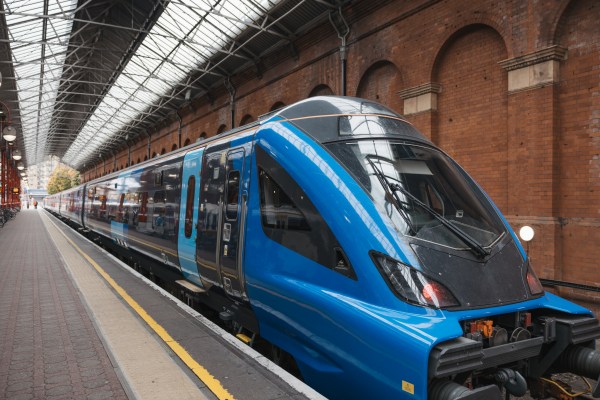
This picture from Chiltern Railways shows the train at Marylebone.
These three paragraphs are from the press release and add more details.
Chiltern Railways today (Tuesday 14 October) showcased for the first time its newest (Mark 5A) trains, set to add 10,000 more seats for customers each weekday from December 2026.
The trains, to be introduced between London to West Midlands from early 2026, will enable Chiltern to deliver more capacity across each of its West Midlands, Aylesbury, and Oxford routes as part of the operator’s efforts to deliver better journeys for customers.
The newest fleet will consist of 13 modern trains set to transform customer journeys during 2026. The trains will replace Chiltern’s oldest carriages, which are nearly 50 years old, with state-of-the-art equivalents, and provide a significant improvement to the on-board experience.
Today, I also received an update from Modern Railways, which was entitled Chiltern Railways Mk 5As To Enter Traffic Early Next Year, and included this delivery schedule.
From December 2026 there will be ten Mk 5A sets in traffic each day, with one ‘hot spare’ and one undergoing maintenance. That leaves one extra set which, CR has suggested, could eventually be pressed into traffic.
I have a few thoughts.
How Do The Trains Compare Physically?
These are basic figures for the two different types of train sets.
- The current Mark 3 are five-car sets of 23 metres coaches, that weigh about 36 tonnes. The driving van trailer is 18.83 metres and 43.7 tonnes
- The future Mark 5A are four-car sets of 22.2 metres coaches, that weigh about 43 tonnes. The driving trailer is 22.37 metres and 43 tonnes.
Lengths and weights of various sets will be as follows.
- Mark 3 – five-car and driving van trailer – 133.83 metres and 223.7 tonnes.
- Mark 5A – four-car and driving trailer – 111.17 metres and 215 tonnes
- Mark 5A – five-car and driving trailer – 155.57 metres and 258 tonnes
Note.
- Chiltern Railways and TransPennine Express use the same Class 68 locomotives.
- The five-car Mark 3 and the four-car Mark 5A sets are quite similar in length and weight
- This could mean that both sets would perform similarly with the same locomotives on the same route.
- I wouldn’t be surprised that the new Platform 4 at Birmingham |Snow Hill station will be able to handle all configurations.
I almost feel that when CAF designed the Mark 5A sets for TransPennine Express, they also had Chiltern in mind as another possible sale.
How Many Trains Would Be Needed To Run Between London Marylebone And Birmingham?
Consider.
- Trains currently run half-hourly on the route between 06:00 to 23:30, which is up to 36 services per day.
- When Platform 4 is operational at Birmingham Snow Hill station, all services could probably stop at both Birmingham Moor Street and Birmingham Snow Hill stations.
- A round trip between London Marylebone and Birmingham Snow Hill stations currently takes about five hours.
I’m fairly certain that to run a half-hourly core service would need ten trains.
Could Chiltern Develop Another Network On The Other Side Of Birmingham?
Consider.
- Trains could run twice an hour from 06:00 to 23:30, which is up to 36 services per day.
- When Platform 4 is operational at Birmingham Snow Hill station, all services could probably stop at both Birmingham Moor Street and Birmingham Snow Hill stations.
- Chiltern Railways already run several services a day to Stourbridge Junction.
- Chiltern Railways have run services to Kidderminster station in the past.
- Wrexham & Shropshire used to run locomotive-hauled Mark 3 four-car sets with driving van trailers, as far as Wrexham via Shrewsbury.
It looks to me, that with the right rolling stock configurations, Chiltern’s network can be developed on the other side of Birmingham.
- Destinations could include Stourbridge Junction, Kidderminster, Shrewsbury, Wolverhampton, Chirk, Ruabon and Wrexham General.
- Some services would need longer trains.
Obviously services would only be run if they were viable.
Would It Help Growth In A Town Or Area, If It Had A Rail Connection To London And/Or The Nearest Major City?
I know Lincoln is on the other side of the country, but I asked Google AI if Lincoln’s rail link to London has brought growth to the city and received this answer.
Yes, Lincoln’s rail link to London has brought significant growth by improving tourism, business travel, and student mobility, and is expected to spur further economic benefits through faster journey times and increased services. The direct link has made Lincoln more accessible for visitors and is a key part of the city’s long-term strategy for economic growth and development.
That was fairly definite.
How would that apply to an extended Chiltern Main Line.
- Politicians are always saying growth is important.
- An extended Chiltern Main Line servicewould improve connections of a lot of places to London and Birmingham.
- Shrewsbury is the easiest connection for West Wales.
- Surely a rail connection to a major city, might tempt someone to open a branch or a new factory.
Would a rail service make people feel more included?
RWE Opens ‘Grimsby Hub’ For Offshore Wind Operations And Maintenance
The title of this post, is the same as that of this article on offshoreWIND.biz.
This is the sub-heading.
RWE officially opened its ‘Grimsby Hub’ offshore wind operations and maintenance (O&M) facility in the UK on 9 July. From the new O&M base, located at Associated British Ports’ (ABP) Port of Grimsby, RWE’s teams will maintain and operate the Triton Knoll and Sofia offshore wind farms.
These are the first two paragraphs.
The Grimsby Hub also houses RWE’s new UK Centralised Control Room (CCR), which has been set up to provide 24/7 monitoring of the company’s UK offshore wind farms and can provide services such as marine coordination, turbine operations, alarm management, high voltage monitoring and Emergency Response services with a team of twelve operatives, the developer says.
The O&M facility is already employing over 90 Full-Time Equivalents (FTEs), according to RWE, and is expected to employ around 140 RWE staff by 2027, as well as create approximately 60 new locally sourced jobs through the development of the CCR and ongoing offshore operations.
Note.
- Does RWE’s new UK Centralised Control Room control all their UK offshore wind farms?
- I have added them all up and there are almost 12 GW around our shores.
- I’ve read somewhere, that RWE are the UK’s largest power generator. From these figures, that would not surprise me.
This Google Map shows the location of RWE’s facilities in Grimsby.
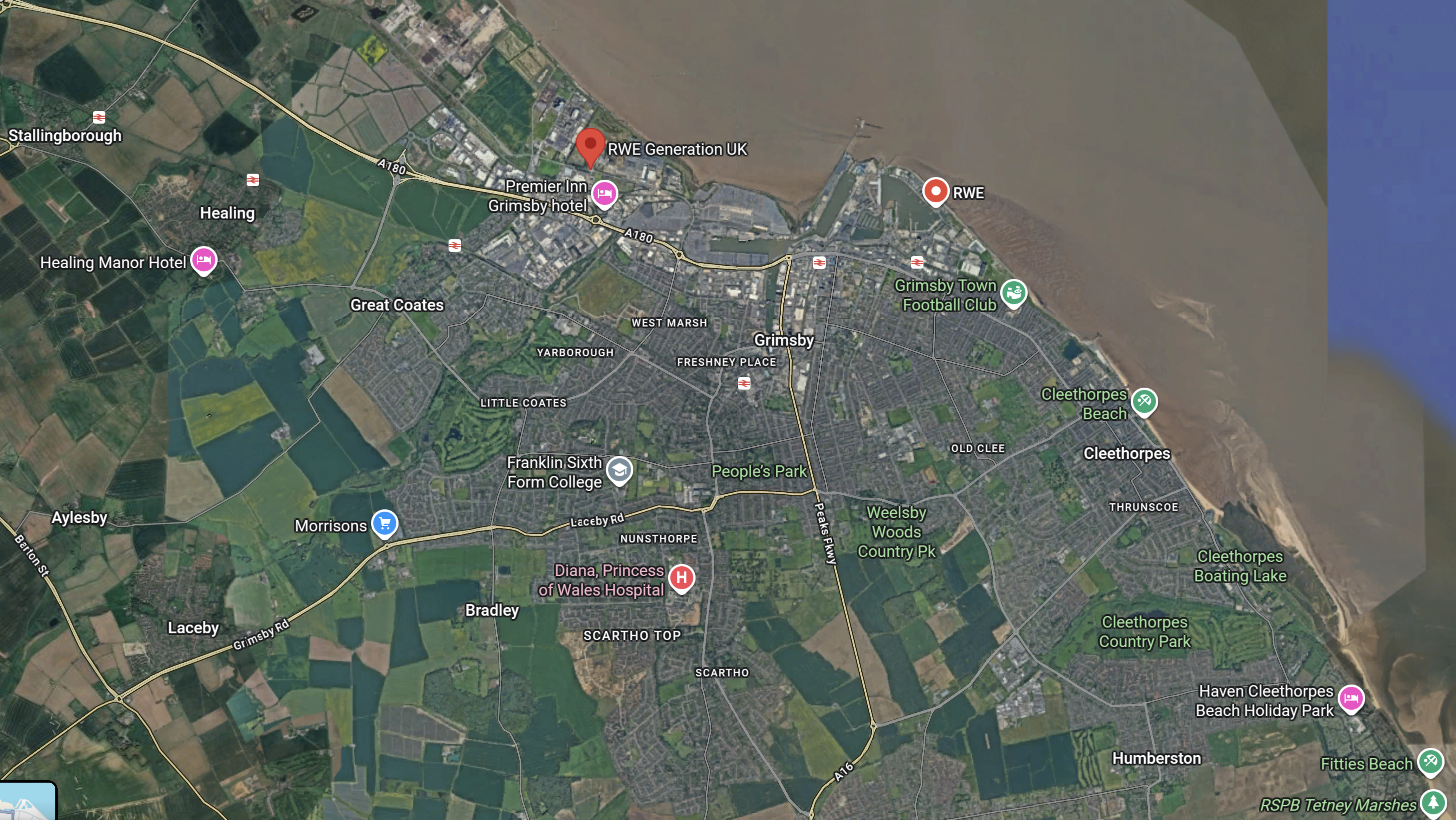
Note.
- The bright red arrow at the top of the map indicates RWE Generation UK in Grimsby Docks.
- There is another RWE location to the right of the bright red arrow.
- There is a line of stations along the coast, which from left-to-right are Stallingborough, Healing, Great Coates, Grimsby Town, Grimsby Docks, New Clee and Cleethorpes.
- Cleethorpes is not shown on the map.
- Doncaster and Cleethorpes are 52.1 mile apart, which is within the range of a battery-electric Hitachi and other trains.
- Charging would be at Doncaster, which is fully electrified and at Cleethorpes, by a short length of electrification.
This OpenRailwayMap shows the layout of and the railways around Grimsby Dock.

Note.
- Cleethorpes station is indicated by the blue arrow, in the South-East corner of the map.
- Cleethorpes station has four platforms, but no electrification.
- Grimsby Docks are to the North of the railway to Cleethorpes.
- This Wikipedia entry for Cleethorpes station, shows other railways and light railways served the area. Some were even electric.
These are a few of my thoughts on the development of railways between Sheffield and Cleethorpes.
RWE Will Be A Large Driver Of Employment In Grimsby
Earlier I wrote.
- Does RWE’s new UK Centralised Control Room control all their UK offshore wind farms?
- I have added them all up and there are almost 12 GW around our shores.
- I’ve read somewhere, that RWE are the UK’s largest power generator. From these figures, that would not surprise me.
It’s a long time, since I’ve added resources to a large project, so I asked Google AI, “How many people are needed to support a 1 GW offshore wind farm in the UK?”, and received this answer.
Direct & Indirect Support: For a large-scale project, this often breaks down into approximately 100–150 direct, permanent, high-skilled roles (technicians, engineers, management) and hundreds more in indirect, contracted, or supply chain roles (vessel crews, port operations, logistics).
Industry Average: Studies suggest that for operations and maintenance (O&M), around 50–100 full-time equivalent (FTE) jobs are generated per GW of installed capacity in terms of direct, permanent staff.
Key Takeaways for a 1 GW Farm:
- Direct Technicians/Operators: ~100–200+ (working on-site, turbines, or in control rooms).
- O&M Support Services: ~300–400+ (vessel operators, port logistics, supply chain).
- Total Operations Personnel: 300–600+ people.
Google AI appeared to have borrowed the figure from Ørsted and Hornsea 1 and 2.
So if it’s correct, there will be a total of 7,200 personnel supporting RWE’s wind farms in the UK. Even if only a third were employed in Grimsby, that is still a lot of people to accommodate and who will need to travel to work.
I also think a lot of personnel will come in by train, as the station is close to RWE’s locations.
Will Grimsby Have An Aberdeen-Sized Office-Shortage Problem?
One of the biggest problems, I was always hearing in the 1970s, was the shortage of offices in Aberdeen for the use of the oilmen.
In RWE Goes For An Additional 10 GW Of Offshore Wind In UK Waters In 2030, I talked about RWE’s plans for the future and published this table of new wind farms.
- Sofia – 1,400 MW
- Norfolk Boreas – 1380 MW
- Norfolk Vanguard East – 1380 MW
- Norfolk Vanguard West – 1380 MW
- Dogger Bank South – 3000 MW
- Awel y Môr – 500 MW
- Five Estuaries – 353 MW
- North Falls – 504 MW
Note.
- Sofia is nearly complete.
- Only the three Norfolk and the Dogger Bank South wind farms are on the East side of England and suitable to be serviced from Grimsby., but they still total 7,140 MW.
Has Grimsby got the office-space for all the people needed?
Could The Cleethorpes And Liverpool Lime Street Service Be Run By Battery-Electric Rolling Stock?
The various sections of this route are as follows.
- Cleethorpes and Doncaster – No Electrification – 52.1 miles
- Doncaster and Meadowhall – No Electrification – 15.2 miles
- Meadowhall and Sheffield – No Electrification – 3.4 miles
- Sheffield and Dore & Totley – No Electrification – 4.2 miles
- Dore & Totley and Hazel Grove – No Electrification – 29.2 miles
- Hazel Grove and Stockport – Electrification – 3.3 miles
- Stockport and Manchester Piccadilly – Electrification – 5.9 miles
- Manchester Piccadilly and Deansgate – Electrification – 0.8 miles
- Deansgate and Liverpool South Parkway -Not Electrified – 28.2 miles
- Liverpool South Parkway and Liverpool Lime Street – Electrified – 5.7 miles
Adding the sections together gives.
- Cleethorpes and Hazel Grove – No Electrification – 104.1 miles
- Hazel Grove and Deansgate – Electrification – 10 miles
- Deansgate and Liverpool South Parkway -Not Electrified – 28.2 miles
- Liverpool South Parkway and Liverpool Lime Street – Electrified – 5.7 miles
Note.
- To cover the 104.1 miles to Hazel Grove battery-electric trains would probably need to leave Cleethorpes with full batteries.
- Doncaster is a fully-electrified station and passing trains may be able to have a quick top-up.
- In South Yorkshire Now Has Better North-South Connections, I calculated that Doncaster is a very busy station with 173 express trains per day calling at the station or one every 8.5 minutes.
- Will trains be able to stop for a long period to charge batteries?
- It may be prudent to electrify between Meadowhall and Sheffield, under the Midland Mainline Electrification.
- Sheffield and Dore & Totley is shown that it will be electrified, under the Midland Mainline Electrification.
- Do we really want to have electrification marching along the Hope Valley Line?
- I believe that hydrogen-hybrid locomotives will be a better solution for freight trains on scenic lines like the Hope Valley, as they are zero-carbon, powerful and with a range comparable to diesel.
I believe CAF, Hitachi and Siemens have off the shelf rolling stock and factories in this country, who could build trains for the Cleethorpes and Liverpool Lime Street route.
How Would You Charge Battery-Electric Trains At Cleethorpes?
This picture shows Cleethorpes station
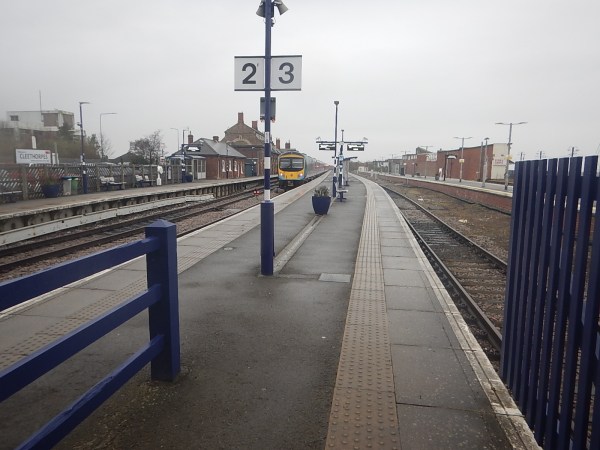
Note.
- The four long platforms without electrification.
- The platforms have recently been refurbished.
- The train in Platform 2 is a TransPennine Express Class 185 Siemens Desiro diesel train.
The simplest way to electrify the station would be to put up enough 25 KVAC overhead wires, so that battery-electric trains needing a charge could put up a pantograph and have a refreshing drink.
In Technology Behind Siemens Mobility’s British Battery Trains Hits The Tracks, I wrote about Siemens Rail Charging Converter.
This is a visualisation of a Siemens Rail Charging Converter in action.
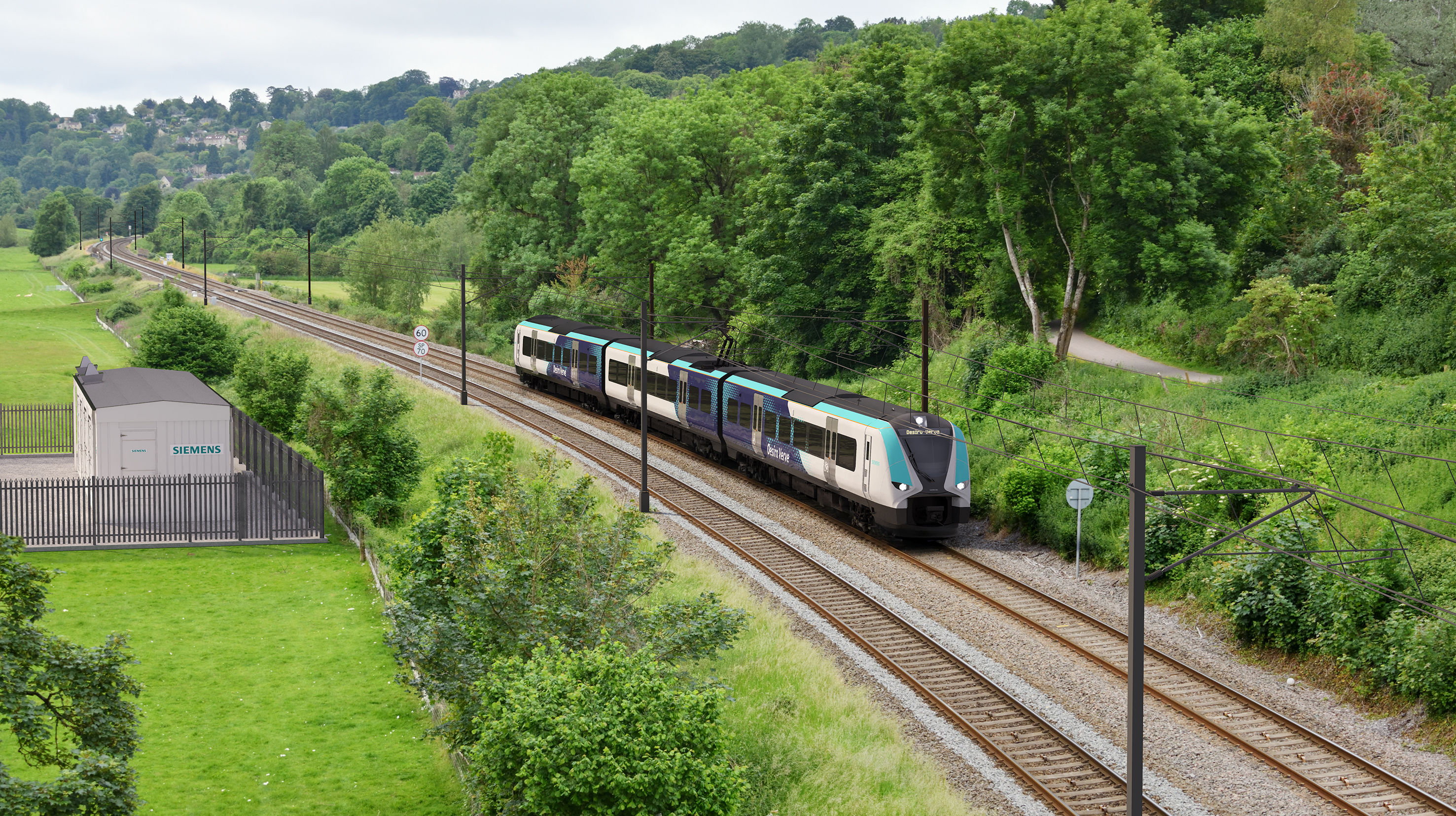
Note.
- The track is electrified with standard 25 KVAC overhead electrification.
- The train is a standard Siemens electric or battery-electric train.
- Siemens Rail Charging Converter, which is the shed in the compound on the left is providing the electricity to energise the catenary.
- I suspect, it could power third rail electrification, if the Office of Rail and Road ever allowed it to be still installed.
- The Siemens Rail Charging Converter does have one piece of magic in the shed. I suspect it uses a battery or a large capacitor to help power the electrification, as it can be powered from any typical domestic grid supply.
- I also wonder, if it has safety devices that cut the power outside the shed if track workers or intruders are detected, where they shouldn’t be?
- It could even cut the power, when trains are not running to save power and increase safety.
This looks to me, that a Siemens Rail Charging Converter could be a superb example of out-of-the-box thinking.
Could The Cleethorpes And Barton-on-Humber Service Be Run By Battery-Electric Rolling Stock?
This OpenRailwayMap shows the railways of North-East Lincolnshire.
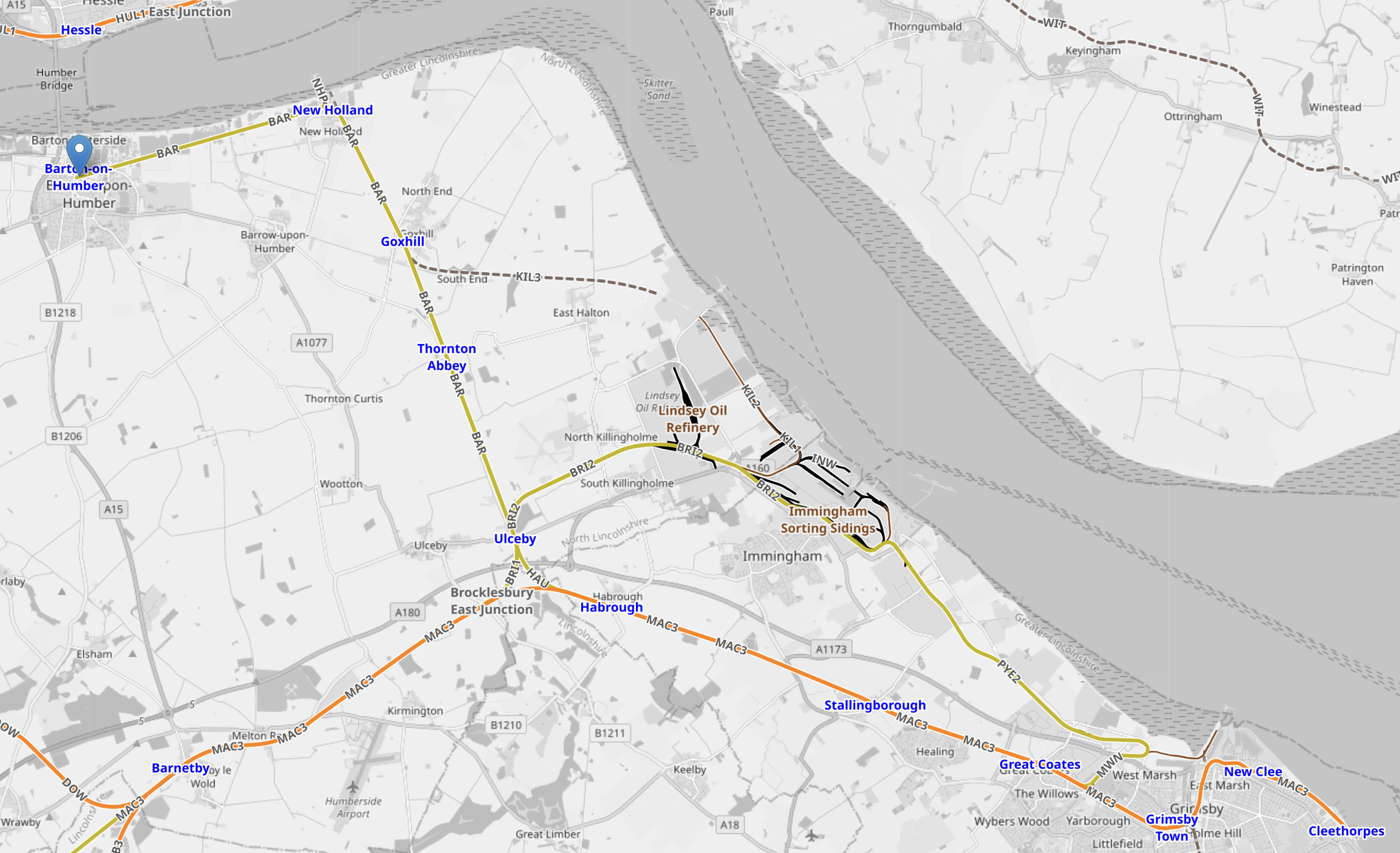
Note.
- Cleethorpes is in the South-East Corner of the map.
- Barton-on-Humber is in the North-West corner of the map and marked by a blue-arrow.
- Stations from South to North would be New Clee, Grimsby Docks, Grimsby Town, Great Coates, Healing, Stallingborough, Habrough, Ulceby, Thornton Abbey, Goxhill, New Holland and Barrow Haven.
- The line is double track.
- Cleethorpes and Barton-on-Humber is just 22.8 miles.
- A round trip would be under fifty miles, which would be well within range of a full-charge at one end.
- Service is one train per two hours (tp2h), which would only need a single train, shuttling between Cleethorpes and Barton-on-Humber.
- Two trains could provide an hourly service.
I would expect, that well-designed, solid and reliable German engineering could build a Siemens’ Rail Charging Connector that could charge four trains per hour (tph) at Cleethorpes station.
At present services are.
- TransPennineExpress – 1 tph to Liverpool Lime Street.
- East Midlands Railway – 1 tp2h to Barton-on-Humber
- East Midlands Railway – 1 tp2h to Matlock via Lincoln and Nottingham
- Northern Trains – 1 train per day (tpd) Sheffield via Brigg.
That is probably only about two tph.
Could The Cleethorpes And Sheffield Service Be Run By Battery-Electric Rolling Stock?
This is a description of the current Cleethorpes and Sheffield service.
- It is run by Northern Trains.
- The morning train leaves Sheffield at 09:54 and arrives in Cleethorpes at 11:40.
- The afternoon train leaves Cleethorpes at 13:20 and arrives in Sheffield at 15:10.
- The train is a Class 150 diesel train, which is a bit of a Joan Collins of a train – Of a certain age, but still scrubs up extremely well!
- Intermediate stations are Worksop, Retford, Gainsborough Central, Kirton Lindsey, Brigg, Barnetby and Grimsby Town
- The route length is 71.6 miles
- Trains take about 45-50 minutes.
It is also a parliamentary train.
The Wikipedia entry for parliamentary train gives this description of the Cleethorpes and Sheffield service.
Via Kirton Lindsey & Brigg. Became a parliamentary service when weekday services were withdrawn in 1993. Regular trains have operated between Gainsborough and Sheffield for most timetable periods since. Suspended January 2022 by Northern, who cited COVID-19 and staffing issues , but the service was reinstated in December 2022. Changed in May 2023 to be one return journey on weekdays only.
In the 1950s and 1960s I lived in Felixstowe part of the time and in the 1970s and 1980s I lived near Woodbridge and I observed first hand the development of the Port of Felixstowe and the effects it had on the surrounding countryside.
The development of the Port of Felixstowe, has brought the following.
- Improved roads and railways.
- Ipswich is now an hour from London by train.
- Ipswich is now a University town.
- New housing and other developments, both in Ipswich and Felixstowe and the surrounding countryside.
- Employment also has increased considerably, both in the Port and in surrounding towns.
- Ipswich’s football team is very much respected all over Europe and has won the English top division, the FA Cup and the UEFA Cup.
When you consider the jobs that RWE could create in the Port of Grimsby, I believe that this could have similar effects in Grimsby and Cleethorpes, as the Port of Felixstowe had in East Suffolk.
Already, the following are being talked about.
- A direct rail link between Cleethorpes and Grimsby to London.
- Battery-electric trains between Cleethorpes and Grimsby and Doncaster, Manchester and Liverpool Lime Street.
I believe that an improved rail link between Cleethorpes and Sheffield could be the catalyst for much needed housing along the route, which would be to the benefit of Cleethorpres, Grimsby, Sheffield and all the intermediate towns and villages on the route.
and the affects this will have on the countryside around the town, I believe that a strong case can be made out for a more frequent service between Cleethorpes and Sheffield.
Cleethorpes-London Service Delayed At Least A Year
The title of this post, is the same as that of this article on the BBC.
This is the sub-heading.
The reintroduction of a direct rail service between North East Lincolnshire and London has been delayed for at least another year
These are the first three paragraphs.
Train operator LNER planned to introduce the route from Cleethorpes via Grimsby, Lincoln and Market Rasen to the capital last month.
It is now hoped the service will be available when the East Coast mainline timetable changes are brought at the end of this year.
However, it could be longer due to required improvements to Market Rasen station, which could cost up to £20m.
It looks to me, that to paraphrase a well known project management phrase, LNER got their ducks in the wrong order.
According to the BBC article, the local MPs are not amused.
Do LNER Have Plans For Lincolnshire?
I ask the question in the title of this post, for two reasons.
- In Azuma Test Train Takes To The Tracks As LNER Trials Possible New Route, I talked about how LNER had run a test train to Cleethorpes.
- In First Tri-Mode Long Distance Trains For The East Coast Main Line, I talked about LNER’s order for tri-mode long distance trains.
Note.
- London King’s Cross and Cleethorpes via Newark and Lincoln is just over 200 miles.
- Around eighty miles between London King’s Cross and Cleethorpes is not electrified.
- The Cleethorpes/Grimsby area is doing well because of all the offshore wind and the power stations at Keadby.
- I am fairly sure, that Lincolnshire will attract more energy-related businesses or ones that need a lot of energy.
- Lincoln is a city that is becoming more important for business and education.
- Lincoln probably needs a train service to the capital of at least one train per hour (tph).
For a train to do the round-trip between London King’s Cross and Cleethorpes, without refueling or charging the batteries at Cleethorpes, needs a train with a range without electrification of over 150 miles.
It seems to me, that LNER’s new CAF tri-mode long distance trains would be ideal to run a one train per two hours (tp2h), between London King’s Cross and Cleethorpes.
- The service could call at Stevenage, Peterborough, Grantham, Newark Northgate, Lincoln, Market Rasen, Barnetby and Grimsby Town.
- I estimate that the trip would take about 0ne hour and 55 minutes to Lincoln and two hours and 55 minutes to Cleethorpes.
- The CAF tri-mode long distance trains could probably easily handle the 160 miles without wires.
- Cleethorpes can handle a ten-car train.
The current London King’s Cross and Lincoln service and the future London King’s Cross and Cleethorpes would be timed to give Lincoln an hourly service to and from London King’s Cross.
Serving Sleaford And Spalding
It must surely be possible to route the Cleethorpes trains to the South of Lincoln, via Sleaford, Spalding and the new Werrington dive-under, so that Sleaford and Spalding would have a direct service to London.
Don’t Forget Skegness And Boston
Consider.
Skegness, Boston and other places are connected to the East Coast Main Line, by an hourly train to Nottingham via Grantham.
They are also connected to Lincoln and Peterborough at Sleaford.
This OpenRailwayMap shows the lines at Sleaford.
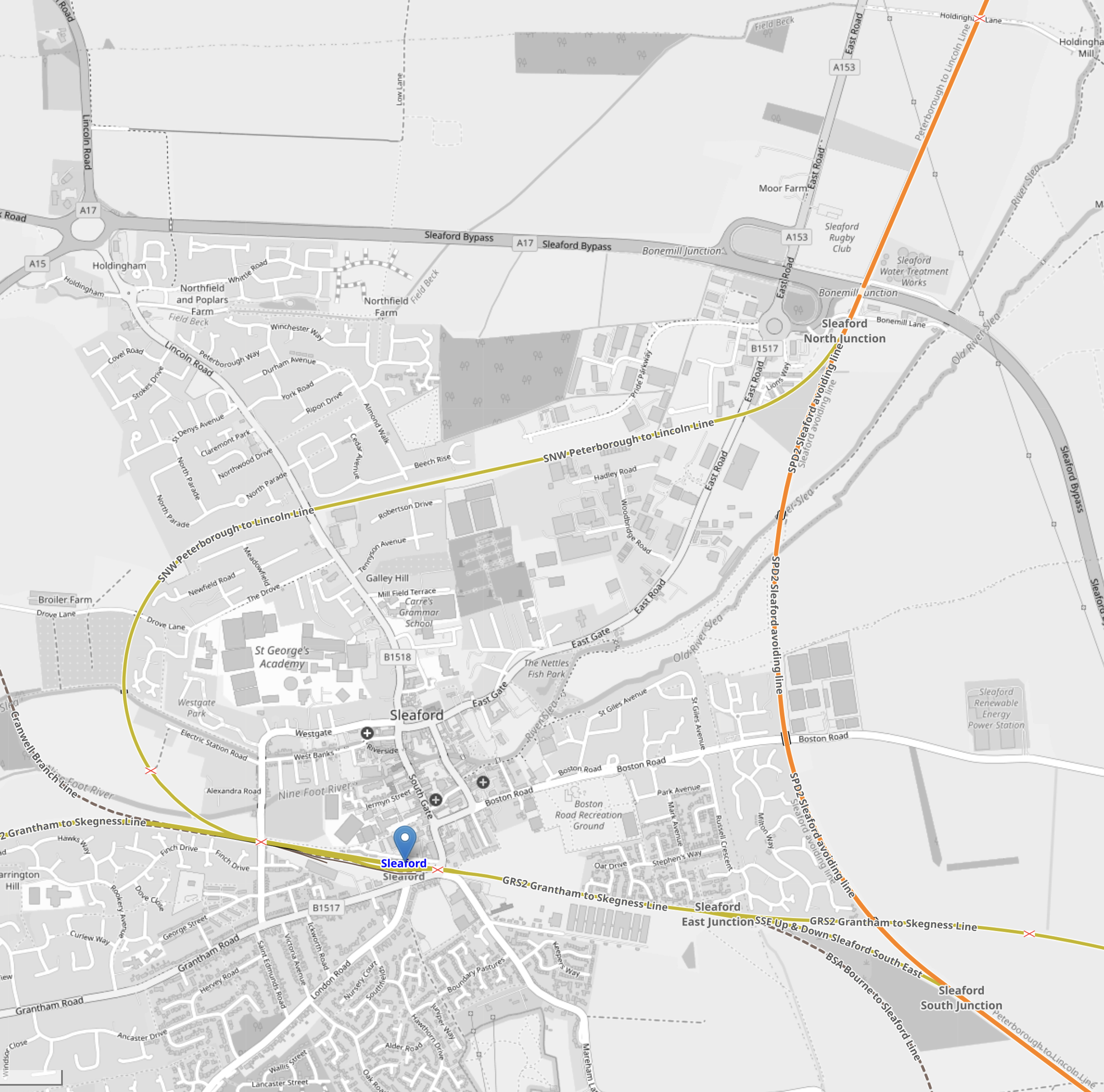
Note.
- Sleaford station is marked with the blue arrow.
- The orange track is the Peterborough and Lincoln Line, that avoids Sleaford.
- The yellow track going East-West is the Grantham and Skegness Line.
- There is a loop from the Peterborough and Lincoln Line, so that passenger trains can go through Sleaford station.
I think that there are possibilities to improve the experience at Sleaford.
One possibility must be to build a Park-and-Ride station, where the two lines cross.
How Many Trains Would Be Needed For London King’s Cross and Cleethorpes Via Peterborough?
I estimate that the journey time could be around two hours and 45-50 minutes, so perhaps a six-hour round trip would be possible.
To run an hourly service would need six trains, with three needed for one tp2h.
New Infrastructure Required
The only new infrastructure required, might be some method of refuelling the CAF tri-mode long distance train at Cleethorpes.
LNER’s New Sunday Timetable
LNER’s new Sunday timetable, that starts on the 10th December 2023 is now available to view on this page of the National Rail web site, where this is said.
Sundays are now one of the most popular days to travel on LNER’s network.
To support this increase in demand, LNER is introducing three additional Sunday services into its timetable starting in December 2023 – two (one each way) between Leeds and London Kings Cross and one between Doncaster and London.
There will also be more seats added to some trains with eight existing Sunday services becoming longer trains. The current five carriage services will be replaced with either nine or ten carriage Azuma trains for destinations including Leeds, Harrogate and Lincoln.
This equates to more than 3,000 additional seats on a Sunday and will help reduce overcrowding and increase connectivity for more people between Yorkshire and London.
To provide additional Sunday seating capacity, due to the lengthening of some London Kings Cross to Harrogate services on Sundays, two northbound station calls at Horsforth need to be removed on Sundays only. The impacted services are the 09.05 and 17:05 London Kings Cross to Harrogate trains.
Note.
- Horsforth looks to have short platforms.
- Last Sunday, Harrogate to London services were three nine-car and three five-car trains.
- In September 2023, I wrote Yorkshire To See More LNER Services And Longer Trains.
LNER certainly seem to be fulfilling the last promise.
Additionally, in this article on Modern Railways, which is entitled LNER Orders CAF Tri-mode Sets, this is said.
Modern Railways understands the new fleet will be maintained at Neville Hill depot in Leeds and, like the ‘225’ sets, will be used predominantly on services between London and Yorkshire, although unlike the ‘225s’ the tri-modes, with their self-power capability, will be able to serve destinations away from the electrified network such as Harrogate and Hull.
So are LNER gradually moving towards the new timetable they will use after the CAF tri-mode trains are delivered?
Extra Luggage Racks For Lumo
The title of this post, is the same as a small article in the November 2023 Edition of Modern Railways.
Thiese are the first two paragraphs.
Lumo is to remove eight seats from each of its five Class 803 EMUs to make way for additional luggage racks.
Two seats will be removed from four of the five vehicles in each unit to make space for the luggage racks. The move has required a variation of Lumo’s track access agreement, with the Office of Road and Rail, which as originally approved specified that each train must have 400 seats.
The article also states that Lumo has stopped carrying bikes and the bike areas are now used for luggage.
Batteries For Lumo?
The article finishes with this paragraph.
Lumo celebrated its second birthday in late October and was also set to mark the carriage of its two-millionth passenger. It is understood Lumo is interested in augmenting its fleet, such has been the success of the service; while many operators favour bi-mode units, Lumo is proud of its all-electric credentials so straight EMUs are still preferred, although the possibilities of including batteries which could power the trains may be pursued (the ‘803s’ have on-board batteries, but only to provide power to on-board systems if the electricity supply fails).
I find this development very interesting.
As an electrical engineer, I’ve always believed that the emergency batteries in the Class 803 trains are very similar to the traction batteries that Hitachi are developing for the Class 802 trains.
- One design of battery must surely save time and costs in design and testing.
- The difference between the two batteries might be only software and the total capacity of the lithium-ion cells.
- In service testing under real operating conditions can be carried out in Lumo’s Class 803 trains.
- Traction and emergency batteries would be interchangeable, so some operators, who didn’t always need traction but wanted emergency on-board power could be setup as required for the route.
If traction batteries gave the train a range of perhaps 15-20 miles, this might well be enough range, for the train to get through or to the next station, if there was to be an incident like catenary failure or a derailed freight train blocking the line. Obviously, Lumo will have records of all external failures that have affected them.
Consider.
- I have calculated that Peterborough and Doncaster via Lincoln is 88.5 miles.
- I also believe it is likely that in the future, there may be some electrification at Lincoln to charge battery-electric trains.
- Lincolnshire is flat.
Would it be possible for Lumo trains to use a single traction battery to take the Great Northern and Great Eastern Joint Line to get round engineering works on the East Coast Main Line?
What Length Of Trains Could Lumo Run?
In Ten-Car Hull Trains, I talked about Hull Trains running ten-car trains to Hull.
I would expect that all Lumo’s stops are possible with ten-car trains.
As the trains are all Plug-and-Play, Lumo could either run pairs of trains or perhaps lengthen all trains to any size between six and nine cars.
Could Lumo Piggy-Back An Aberdeen Service On An Edinburgh Train?
The line between Edinburgh and Ladybank is being electrified and Ladybank is just 91.4 miles South of Aberdeen.
- A pair of Class 803 trains could leave King’s Cross running as a ten-car formation.
- The leading train would be a Class 803 train equipped with a traction battery.
- The trailing train would be a Class 803 train equipped with the normal emergency battery.
- Aberdeen passengers would get in the leading train.
- The train would run as normal to Edinburgh.
- At Edinburgh the two trains would split with the leading train going on to Aberdeen and the trailing train getting ready to return to London.
The train going to Aberdeen would need sufficient battery range to cover the 91.4 miles to Aberdeen, where it would recharge to make the journey back to Ladybank, Edinburgh and the South.
What About Inverness?
Dunblane is the nearest electrified station to Inverness, but it is 146.2 miles away over a route with lots of steep climbs.
I doubt that a battery-electric train could handle that route.
Conclusions
Luggage seems to be getting more of a problem on trains and buses.
It does appear that a very innovative battery philosophy from Hitachi is emerging.
London North Eastern Railway Runs Trial Train To Liverpool Street
The title of this post, is the same as that of this article on Rail Advent.
These two paragraphs, describe why this was done.
In an effort to mitigate the effect on passengers during disruption to services, London North Eastern Railway (LNER) ran one of its Azuma trains from Finsbury Park to London Liverpool Street during the early hours of this morning, Friday, 14th July.
The trial run took place to determine the long-term feasibility of diverting services during periods of planned disruption or when significant engineering works were taking place.
There doesn’t seem to have been any problems.
- The route in from Finsbury Park station went through Canonbury, Dalston Kingsland, Hackney Central, Homerton, Hackney Wick, Stratford and Bethnal Green stations, which was a distance of 9.6 miles.
- The route out to Finsbury Park station went through Bethnal Green, Cambridge Heath, London Fields, Dalston Kingsland and Canonbury, what was a distance of 5.8 miles.
Note.
- Two different routes were checked.
- The Class 800 train had five cars.
- Platform 4 at Liverpool Street station was used, which is normally used by London Overground and Cambridge services.
As this comes so soon after the test run to Cleethorpes, that I wrote about in Azuma Test Train Takes To The Tracks As LNER Trials Possible New Route, I wonder if Network Rail and the train operating companies are planning for some worst case scenario, where the two or more of the West Coast Main Line, Midland Main Lone and East Coast Main Line are blocked.
LNER and Network Rail have shown the following.
- Azumas can use Cleethorpes station.
- Azumas can use Liverpool Street station.
We also know that Cleethorpes has a direct TransPennine train service across the North of England to Doncaster, Sheffield, Manchester and Liverpool.
So if say Euston has to be shut for perhaps fourteen days during the construction of High Speed Two, a service between Liverpool Street and Cleethorpes via Colchester, Ipswich, Cambridge, Peterborough and Lincoln could be used to get some passengers to and from the North.
The other big problem is the removal of the problems of the Newark Crossing, which if it results in a long blockade of the East Coast Main Line, might need services to go into an alternative London terminal.
The Powerhouse In The East
Consider.
- The importance of Cambridge to the economy of the UK is growing fast.
- The city suffers from a shortage of commercial premises, housing and staff at all levels.
- I have just looked at the non-passenger traffic on the West Anglia Main Line for all of yesterday and there were just six freight trains through Bishop’s Stortford.
I wonder, if it would be possible to run a Liverpool Street and Cleethorpes service via Cambridge, Ely, Peterborough, Spalding, Sleaford, Lincoln, Market Rasen, Barnetby and Grimsby Town?
- The service avoids the East Coast Main Line, except through Peterborough, where it would use the separate Werrington lines.
- Liverpool Street is in the heart of one of the world’s major financial centres.
- Liverpool Street is on the Elizabeth Line.
- The service could call at Stansted Airport, but a reverse would be needed.
- Peterborough is sometimes promoted in Cambridge as a city, that could be developed, to provide support for Cambridge.
- A reverse would be needed at Lincoln.
- Lincoln is developing as a university city with character.
- Grimsby and Cleethorpes are close to the fast expanding Humberside renewable energy and hydrogen cluster.
The service could be paired with a Liverpool Street and Norwich service, via Ely, Thetford, Attleborough and Wymondham.
The services could alternate every half hour or perhaps leave London as a pair and split and join at Cambridge.
Platform Availability At Kings Cross And Liverpool Street
Consider.
- Digital signalling on the East Coast Main Line will increase the number of possible trains between London and the North.
- LNER have said they want to increase services to the North and have identified a possible service to Cleethorpes.
- Grand Central would like to increase services to Bradford.
- Lumo have started services to Newcastle and Edinburgh from Kings Cross.
- The Elizabeth Line now runs less services into Liverpool Street station.
- The Elizabeth Line connects to Liverpool Street, but doesn’t connect to King’s Cross.
- Liverpool Street is to undergo a major refurbishment, which should increase the overall passenger capacity of the station.
Would it be sensible to move a small number of services from King’s Cross to Liverpool Street?
Surely, the logical service to move to Liverpool Street would be the new Cleethorpes service.
- It would route via Cambridge, Cambridge North, Ely, Peterborough, Spalding, Sleaford, Lincoln, Market Rasen, Barnetby and Grimsby Town.
- It would use the Werrington Lines through Peterborough.
- It would not need a path on the East Coast Main Line.
- The service would provide a much needed direct link between Cambridge and Lincoln via Peterborough.
- The service could also be hourly or two-hourly.
I also believe that a Liverpool Street and Cleethorpes service could be run by a battery-electric Azuma.
- The route is electrified between Liverpool Street and Ely and through Peterborough.
- Ely and Peterborough is 30 miles.
- Peterborough and Lincoln is 56.9 miles.
- Lincoln and Cleethorpes is 47.2 miles.
- There would need to be a charging station or a few miles of electrification at Cleethorpes.
- There may be 134.1 miles of unelectrified track, but there can be a Splash and Dash at Peterborough.
A Stadler Akku would be able to handle this route, so I suspect that a similar-sized battery-electric Azuma should also be able to handle the route.

