May The Maths Be With You!
It was a bit of a surprise, when in the November 2023 Edition of Modern Railways, in an article, which was entitled Extra Luggage Racks For Lumo, I read this closing paragraph.
Lumo celebrated its second birthday in late October and was also set to mark the carriage of its two-millionth passenger. It is understood Lumo is interested in augmenting its fleet, such has been the success of the service; while many operators favour bi-mode units, Lumo is proud of its all-electric credentials so straight EMUs are still preferred, although the possibilities of including batteries which could power the trains may be pursued (the ‘803s’ have on-board batteries, but only to provide power to on-board systems if the electricity supply fails).
I find this development very interesting.
Surely the obvious way to increase capacity would be to acquire some extra identical trains and run the busiest services as ten-car trains. I talked about Hull Trains running ten-car trains in Ten-Car Hull Trains. Both companies have five trains, so I suspect that this number would allow for occasional ten-car trains.
If not, then add a few identical trains to the fleet, so capacity can be matched to the demand.
- Some services would be ten-car instead of five-car.
- Platforms at Edinburgh, King’s Cross and Newcastle already handle nine and ten-car trains, so infrastructure costs would be minimal.
- No extra paths would be needed, as a ten-car train can run in a path, that normally has five-car trains, as Hull Trains have shown.
A simple spreadsheet should probably predict, when and how many extra trains need to be added to the fleet.
Lumo And Traction Batteries
But why does the Modern Railways’s article talk about traction batteries?
In the two years since Lumo started their service, there have been days, when the East Coast Main Line has been closed for engineering works, bad weather or an incident. I wrote about an incident in Azumas Everywhere!.
Some of these engineering works have been able to be by-passed by using diversions. But not all of these diversion routes are fully-electrified, so are not available for Lumo.
There would appear to be three viable diversions for the East Coast Main Line.
- Werrington Junction and Doncaster via Lincoln – Not Electrified – 85.4 miles
- Doncaster and York via Leeds – Being Electrified – 55.5 miles
- Northallerton and Newcastle – Not Electrified – 56.8 miles
If all or some of Lumo’s five-car trains had a battery-range of a hundred miles, they would be able to divert around some blockades.
Note.
- A traction battery could also provide power to on-board systems if the electricity supply fails.
- A traction battery would allow the train to skip past some catenary problems.
- I would be interested to know how much diversions, bad weather and incidents have cost Lumo in lost sales and refunds.
As an electrical engineer, I believe, that the emergency-only and the traction batteries could be the same design, but with different software and capacity.
The extra cost of the larger capacity traction battery, might deliver a better service and also pay for itself in the long term.
Extending Lumo’s Route
Lumo will want to maximise revenue and profits, so would it be possible to extend the route North of Edinburgh?
Consider.
- Edinburgh and Aberdeen is 131.4 miles
- Ladybank is a station to the North of the Forth Bridge, which is under 40 miles from Edinburgh.
- The line between Edinburgh and Ladybank is being electrified.
- Ladybank is just 91.4 miles South of Aberdeen.
At some point in the next few years, I believe that one of Lumo’s trains fitted with a hundred mile traction battery could reach Aberdeen on electric power.
The train would need to be charged at Aberdeen before returning South.
How would Aberdonians like that?
Unfortunately, Inverness is 146.1 miles from the nearest electrification at Dunblane, so it is probably too far for a hundred mile traction battery.
It does appear to me that if Lumo’s trains were fitted with a hundred mile traction battery, this would enable them to take some non-electrified diversions and provide a service to Aberdeen.
How Useful Would A Hundred Mile Range Battery-Electric Train Be To Other Operators?
I take each operator in turn.
Hull Trains
Consider.
- It appears that Hull Trains change between diesel and electric power at Temple Hirst junction, which is between Doncaster and Selby, on their route between King’s Cross and Hull/Beverley.
- The distance between Temple Hirst junction and Beverley is 44.3 miles.
- It would appear that an out-and-return journey could be possible on a hundred mile traction battery.
- The hundred mile traction battery would also allow Hull Trains to use the Lincoln diversion, either when necessary or by design.
To ensure enough range, a short length of overhead electrification could be erected at Hull station to combat range anxiety.
The Modern Railways article also says this.
The co-operation between sister East Coast Main Line open access operators Lumo and Hull Trains continues, with one recent move being the use of Hull Trains ‘802’ on Lumo services to cover for a shortage of the dedicated ‘803s’ while one was out of action for repairs following a fatality. although the two types are similar, there are notable differences, most obviously that the Hull Trains units are bi-modes while the Lumo sets are straight EMUs, and a training conversion course is required for Lumo drivers on the ‘802s’. There are also challenges from a passenger-facing perspective – the Hull trains units have around 20 % fewer seats and a First Class area.
If Hull Trains used traction batteries rather than diesel engines could the trains be identical to Lumo’s trains from the driver’s perspective?
This would surely appeal to First Group, who are the owner of both Hull Trains and Lumo.
TransPennine Express
These are TransPennine Express services.
- Liverpool Lime Street and Newcastle – Fully Electrified
- Liverpool Lime Street and Hull – Part Electrified – Hull and Micklefield – 42 miles
- Manchester Airport and Saltburn – Part Electrified – Saltburn and Northallerton – 33.6 miles
- Manchester Piccadilly and Newcastle – Fully Electrified
- Manchester Piccadilly and Scarborough – Part Electrified – York and Scarborough – 42.1 miles
- York and Scarborough – Not Electrified – 42.1 miles
- Manchester Piccadilly and Huddersfield – Fully Electrified
- Huddersfield and Leeds – Fully Electrified
- Liverpool Lime Street and Cleethorpes – Part Electrified – Hazel Grove and Cleethorpes – 104.6 miles
Note.
- I am assuming that the TransPennine Upgrade has been completed and Manchester and Leeds is electrified.
- Liverpool Lime Street and Cleethorpes will need some form of charging at Cleethorpes and a slightly larger battery.
All of these TransPennine Rxpress routes would be possible with a battery-electric train with a hundred mile traction battery.
LNER
These are distances from the electrification of the East Coast Main Line.
- Aberdeen via Ladybank – 91.4 miles – Charge before return
- Bradford Forster Square – Electrified
- Carlisle via Skipton – 86.8 miles – Charge before return
- Cleethorpes via Newark and Lincoln – 63.9 miles – Charge before return
- Harrogate via Leeds – 18.3 miles
- Huddersfield via Leeds – 17.2 miles
- Hull via Temple Hirst junction – 36.1 miles
- Lincoln via Newark – 16.7 miles
- Middlesbrough via Northallerton – 22.2 miles
- Scarborough via York – 42.1 miles
- Skipton – Electrified
- Sunderland via Northallerton – 47.4 miles
Note.
- The first place after the ‘via’ is where the electrification ends.
- Carlisle could be a possibility during High Speed Two upgrading of the West Coast Main Line or for an enthusiasts’ special or tourist train.
- Cleethorpes is a possible new service for LNER. I wrote about this in LNER To Serve Cleethorpes.
- Scarborough must be a possible new service for LNER.
- ‘Charge before return’ means the train must be charged before return. Carlisle is electrified, but Cleethorpes is not.
- The only new infrastructure would be the charging at Cleethorpes.
All of these LNER routes would be possible with a battery-electric train with a hundred mile traction battery.
The hundred mile traction battery would also allow LNER to use the Lincoln diversion.
Grand Central
These are distances from the electrification of the East Coast Main Line for Grand Central’s services.
- Bradford Interchange via Shaftholme junction – 47.8 miles
- Cleethorpes via Doncaster – 52.1 miles – Charge before return
- Sunderland via Northallerton – 47.4 miles
Note.
- The first place after the ‘via’ is where the electrification ends.
- Cleethorpes is a possible new service for Grand Central.
- ‘Charge before return’ means the train must be charged before return.
All of these routes would be possible with a battery-electric train with a hundred mile traction battery.
The hundred mile traction battery would also allow Grand Central to use the Lincoln diversion.
Avanti West Coast
These are distances from the electrification of the West Coast Main Line for Avanti West Coast’s services.
- Chester via Crewe – 21.1 miles
- Gobowen via Wolverhampton – 47.7 miles
- Holyhead via Crewe – 105.5 miles – Charge before return
- Shrewsbury via Wolverhampton – 29.7 miles
- Wrexham via Crewe – 33.3 miles
Note.
- The first place after the ‘via’ is where the electrification ends.
- Gobowen is a possible new service for Avanti West Coast.
- ‘Charge before return’ means the train must be charged before return.
All of these routes would be possible with a battery-electric train with a hundred mile traction battery.
Great Western Railway
These are distances from the electrification of the Great Western Main Line for Great Western Railway’s services.
- Bristol Temple Meads via Chippenham – 24.4 miles
- Carmarthen via Cardiff Central – 77.4 miles – Charge before return
- Cheltenham Spa via Swindon – 43.2 miles
- Exeter St. Davids via Newbury – 120.4 miles – Charge before return
- Great Malvern via Didcot East junction – 76.1 miles – Charge before return
- Hereford via Didcot East junction – 96.9 miles – Charge before return
- Oxford via Didcot Parkway – 10.3 miles
- Paignton via Newbury – 148.7 miles – Charge before return
- Pembroke Dock via Cardiff Central – 121.6 miles – Charge before return
- Penzance via Newbury – 172.6 miles – Charge before return
- Plymouth via Newbury – 120.4 miles – Charge before return
- Swansea via Cardiff Central – 53 miles – Charge before return
- Weston-super-Mare via Chippenham – 43.8 miles
- Worcester Foregate Street via Didcot East junction – 68.2 miles – Charge before return
- Worcester Shrub Hill via Didcot East junction – 67.6 miles – Charge before return
Note.
- The first place after the ‘via’ is where the electrification ends.
- ‘Charge before return’ means the train must be charged before return.
- Partial electrification through Hereford, Great Malvern, Worcester Foregate Street and Worcester Shrub Hill, could possibly be used to charge services from Hereford and Worcester.
- Partial electrification through Penzance, Plymouth and Exeter St. Davids, could possibly be used to charge services from the South West.
- Partial electrification West of Swansea, could possibly be used to charge services from West Wales.
All routes, except for Hereford and Worcester, the South-West and West Wales, would be possible with a battery-electric train with a hundred mile traction battery.
I’ll now look at the three groups of services in more detail.
Services To Hereford And Worcester
These are distances from the electrification of the Great Western Main Line for Great Western Railway’s Hereford and Worcester services.
- Great Malvern via Didcot East junction – 76.1 miles
- Hereford via Didcot East junction – 96.9 miles
- Worcester Foregate Street via Didcot East junction – 68.2 miles
- Worcester Shrub Hill via Didcot East junction – 67.6 miles
Note.
- All services join the Great Western Main Line at Didcot East junction.
- Some services will be probably need to have, their batteries charged at the Hereford and Worcester end.
At the present time, the electrification finishes at Didcot East junction, but if it were to be extended to Charlbury station, these would be the distances without electrification.
- Great Malvern via Charlbury – 52.3 miles
- Hereford via Charlbury – 73.1 miles
- Worcester Foregate Street via Charlbury – 44.4 miles
- Worcester Shrub Hill via Charlbury – 43.8 miles
Note.
- Some of the track between Oxford and Charlbury is only single track, which may give advantages, when it is electrified.
- It might be possible with a hundred mile traction battery for all Worcester services to charge their batteries between Charlbury and London Paddington and not need a charge at Worcester to return.
- A larger traction battery or extending the electrification to perhaps Morton-in-Marsh could see Great Malvern in range of battery-electric trains from London Paddington without a charge.
- Hereford would probably be too far to get away without charging at Hereford.
This OpenRailwayMap shows the layout of Hereford station.
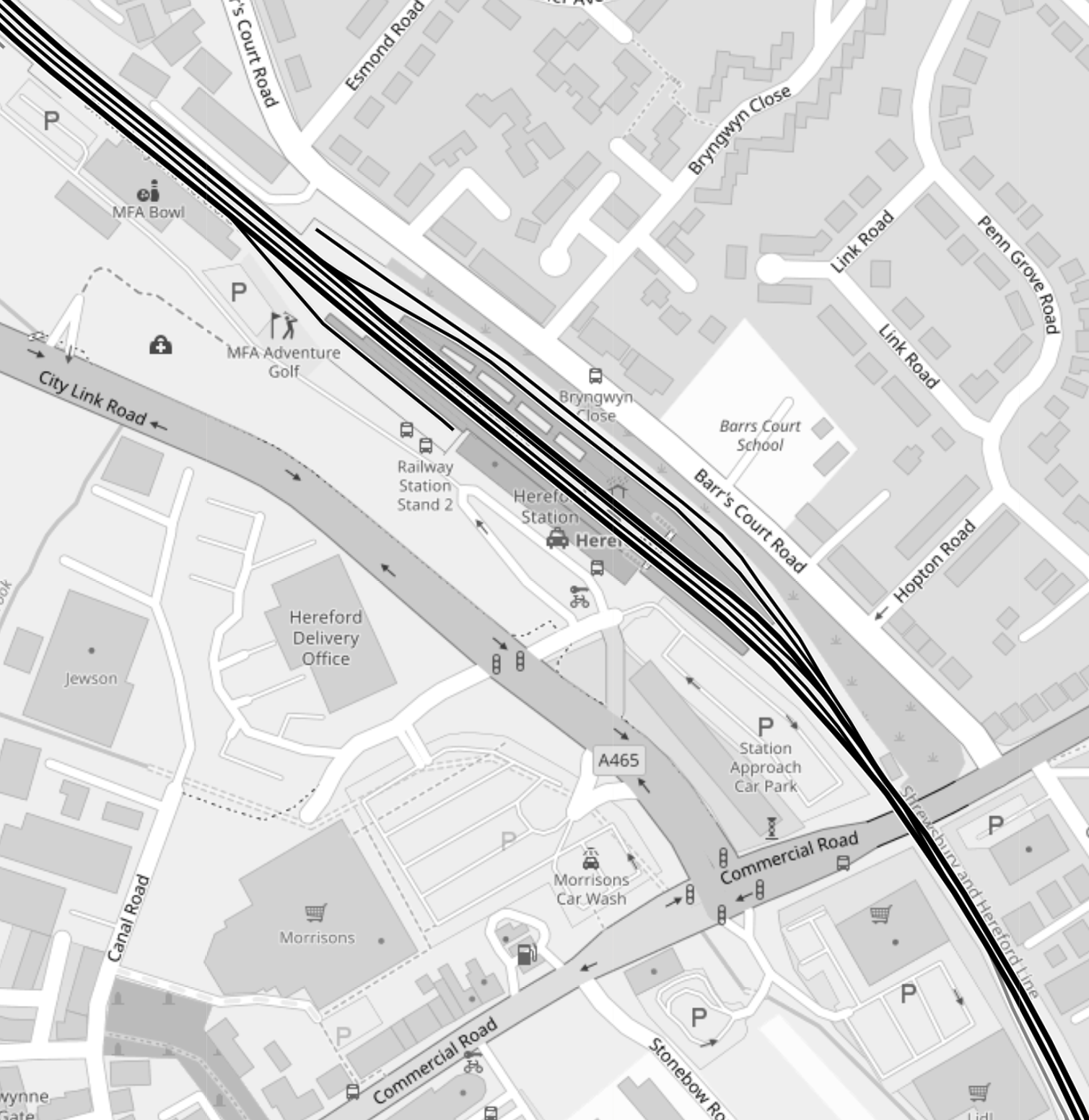
I’m certain that a platform can be found, where there is space for a charger, which could also be used for other trains serving the station.
Services To The South West
In the August 2023 Edition of Modern Railways, there is an article, which is entitled GWR Seeks Opportunities To Grow.
This is the sub-heading.
Managing Director Mark Hopwood tells Philip Sherratt there is plenty of potential to increase rail’s economic contribution.
This is two paragraphs.
The desire to provide electrification to support aggregates traffic from the Mendip quarries could also benefit GWR , says Mr. Hopwood. ‘Having an electric loco would massively help with pathing heavy freight trains through the Thames Valley. If you could electrify from Newbury to East Somerset Junction, a big chunk of the Berks and Hants route would be wired.
Then you can ask how much further you could get on battery power on an IET without running out of juice.’
Newbury to East Somerset Junction would be 53.5 miles of electrification, so I can build this table of services to the South-West
- Exeter St. Davids via Newbury – 120.4 miles – 66.9 miles
- Paignton via Newbury – 148.7 miles – 95.2 miles
- Penzance via Newbury – 251.9 miles – 198.5 miles
- Plymouth via Newbury – 172.6 miles – 119 miles
Note.
- The distance between Penzance and Plymouth is 79.5 miles.
- The first figure in the table is the distance to Newbury.
- The second figure in the table is the distance to East Somerset junction.
A possible way of running these four services to London on battery power is emerging.
- Exeter St. Davids via Newbury – Charge before return – Run on battery for 66.9 miles to East Somerset junction.
- Paignton via Newbury – Charge before return – Run on battery for 95.2 miles to East Somerset junction.
- Penzance via Newbury- Charge before return – Run on battery for 79.5 miles to Plymouth – Charge at Plymouth – Run on battery for 119 miles to East Somerset junction.
- Plymouth via Newbury – Charge before return – Run on battery for 119 miles to East Somerset junction.
Once at East Somerset junction, it’s electrification all the way to Paddington.
This is the corresponding way to run services from London.
- Exeter St. Davids via Newbury – Run on electrification to East Somerset junction, charging the battery on the way – Run on battery for 66.9 miles to Exeter St. Davids.
- Paignton via Newbury – Run on electrification to East Somerset junction, charging the battery on the way – Run on battery for 95.2 miles to Paignton.
- Penzance via Newbury – Run on electrification to East Somerset junction, charging the battery on the way – Run on battery for 119 miles to Plymouth – Charge at Plymouth – Run on battery for 79.5 miles to Penzance.
- Plymouth via Newbury – Run on electrification to East Somerset junction, charging the battery on the way – Run on battery for 119 miles to Plymouth.
More electrification or a larger than a hundred mile traction battery would be needed, as Plymouth and East Somerset junction is 119 miles.
But if a Stadler Akku can do 139 miles on a charge, why shouldn’t a Hitachi battery-electric train?
Services To West Wales
It seems that the current timetable is already setup for battery-electric trains to run to and beyond Swansea.
- Carmarthen and Swansea is almost exactly 32 miles.
- Pembroke Dock and Swansea is 73.4 miles.
- Swansea and Cardiff Central is 45.7 miles.
Note
- All these sections could be run by a battery-electric train, with a fully-charged hundred mile traction battery.
- All trains going to or from Carmarthen or Pembroke Dock reverse at Swansea, where a generous time of more than eleven minutes is allowed for the manoeuvre.
- During the reverse at Swansea, there is sufficient time to charge the batteries, if overhead wires were present.
Battery-electric services could serve Wales Wales with overhead electrification at Carmarthen, Pembroke Dock and Swansea.
Conclusion
We will go a long way, if we embrace battery-electric trains.
Most routes can be handled with a train with a traction battery range of 100 miles.
Exceptions are.
- Hazel Grove and Cleethorpes – 104.6 miles
- Plymouth and East Somerset junction – 119 miles
But if a Stadler Akku can do 139 miles on a charge, why shouldn’t a Hitachi battery-electric train?
No comments yet.
 The Anonymous Widower
Leave a comment