Smart Train Lease Aims ‘To Make Renting Trains As Easy And Simple As Renting A Car’
The title of this post, is the same as that of this article on Railway Gazette International.
These four paragraphs outline the scheme.
Siemens Mobility has established a leasing subsidiary that would enable train operators to use its Mireo Smart battery, hydrogen and electric multiple-units without needing to make long-term investment commitments.
Smart Train Lease GmbH would make available at short notice multiple-units already approved for operation. These could be short or medium-term leases, with services such as maintenance available as part of the package. The aim is to provide operators with an economical way to quickly and flexibly expand their fleets and try out more sustainable traction technologies.
‘We want to make renting trains as easy and simple as renting a car, and thus help accelerate the mobility transition’, the leasing company’s CEO Benjamin Dobernecker explained on February 14.
Smart Train Lease will initially operate in Germany, although it plans to expand throughout Europe in the medium term.
I like this idea and I think it will work.
Metier Management Systems And Artemis
When four of us started Metier Management Systems in 1977 to sell our mini-computer-based project management system; Artemis, we generally rented or leased our systems, although we did sell some as the years progressed.
- For a fixed fee per month, a company got a project management computer and all the software.
- The fixed fee included installation, first line support, training and software updates.
- We could also supply extra training and project management consultancy at appropriate rates.
- The only extra costs to the client were the electricity to power the hardware and the paper to put in the printer.
- We also allowed clients to convert leases into outright sales.
This simple sales model appealed to a lot of our clients.
- The cost of the system was easy to budget.
- Many of our clients were happy with leasing or renting computer equipment.
- As the system was desk-sized, it easily fitted the average office.
But the leasing model was very advantageous to us.
- Most of our clients were large high-value quality organisations like big oil companies, nationalised industries and engineering consultancies.
- Our Finance Director and our Bank Manager at Lloyds Bank devised a plan, whereby we bundled a number of high-quality leases together and sold the bundle to Lloyds Bank’s leasing company.
The money we received gave us a healthy cash flow.
- The cash flow was then used to fund Research and Development and to finance more sales.
- If say someone like BP or Shell should phone up or send a fax, wanting a system immediately, we were generally able to fulfil their request.
I am sure that Siemens Mobility will be using a similar model.
They will aim to have trains in stock to fulfil clients needs.
So if Deutsche Bahn phone up saying have you got a three-car battery-electric train that works with 15 KVAC and has a range of 100 kilometres for next Monday, Siemens Mobility can generally say yes.
What helps is that the modular Mireo Smart multiple unit comes in battery, hydrogen and electric versions.
Extras could include full servicing a driver.
So Siemens Mobility will plug the train together and deliver it.
How Would Siemens Use The Leasing Model In Great Britain?
Consider.
- There are a lot of routes that need to be decarbonised in Great Britain.
- Many of these routes have electrification at one or both ends.
- Often these routes terminate in a bay platform.
- On most of these routes a two-, three-, four- or five-car train will be sufficient capacity.
- In the Desiro City, Siemens have a train, that is acceptable to Great Britain.
- If routes in Great Britain are to be electrified, they must be electrified with 25 KVAC overhead wires.
- Trains would be 100 mph, so they wouldn’t be limited as to routes.
- A Mireo-B has a range of between 80-100 kilometres or 49.7-74.6 miles.
I am sure Siemens Desiro City or its European equivalent; Mireo can be developed into a family of trains suitable for GB!
- The basic train would be two driving cars.
- Length would be increased by coupling trailer cars between the two driving cars.
- Hydrogen power would be in one of the trailers.
- Batteries would be under an appropriate number of cars.
Battery trains would be able to use a simple automatic charger, similar to the one, that I described in GWR Trialling Transformative Ultra-Rapid Charging Train Battery.
An Example – Mid-Cornwall Metro
This map shows the Mid-Cornwall Metro.

Consider.
- Newquay and Par is 20.8 miles.
- Falmouth Docks and Par is 30.8 miles.
- Newquay and Falmouth Docks is 51.6 miles.
- The maximum speed between Par and Newquay is around 30 mph
- The maximum speed between Par and Falmouth Docks is around 50-70 mph
- There are twelve intermediate stations.
- There is a reverse at Par station.
- Charging would be easy to install at Falmouth Docks, Newquay and Par.
- In Par Station – 10th February 2024, I suggested that Par station could be fully-electrified, so that expresses could have a Splash-and-Dash on their way to London and Penzance. If all platforms at Par were electrified the Mid-Cornwall Metro trains could charge from the electrification, as they reversed.
There are two main ways that the Mid-Cornwall Metro might operate.
- There would be chargers at Newquay and Falmouth Docks and trains would shuttle the 51.6 miles between the two stations.
- There would only be charging at Par and trains would after charging at Par go alternatively to Newquay and Falmouth Docks.
The first might need smaller batteries and the second would only need one charger.
An Example – Uckfield Branch
The Uckfield branch is in Southern England.
- It is not electrified between Hurst Green Junction and Uckfield, which is 24.7 miles.
- There are eight intermediate stations.
- The line can accommodate ten-car trains.
There is space at Uckfield station for a charger.

Charging would be at Uckfield station and North of Hurst Green Junction, where it will use the existing electrification.
Conclusions
This leasing/rental model will surely encourage train operators to replace diesels with appropriate zero-carbon alternatives on routes that need to be decarbonised.
Hydrogen Refuelling Site Could Attract Businesses To City – Meeting Told
The title of this post, is the same as that of this article on Yahoo News.
These are the first three paragraphs.
A hydrogen fuelling station planned for Bradford could play a key part in attracting new businesses to the city – councillors have been told.
The HyBradford facility is due to open on a former gas storage site off Bowling Back Lane in 2025, and late last year the scheme received millions worth of Government funding.
It is hoped the scheme will make Bradford a leader in the new, greener energy at a time when many companies are looking to wean themselves off fossil fuels.
What sort of businesses will the City attract?
- In Cadent’s Hydrogen-Hybrid Solar Toilet, I talked about how the sun and hydrogen backup are used to provide quiet, zero-carbon facilities for a building site.
- In Cummins Agrees To Integrate Its Hydrogen ICE Technology Into Terex® Advance Trucks, I talked about hydrogen-powered ready-mixed concrete trucks. These will help to reduce pollution levels on building sites and city streets and a local electrolyser would allow ready-mixed concrete suppliers to be located conveniently, where major contracts are in city centres.
- In £77 Million Investment For UK Heavy Duty And Commercial Vehicle Projects, I talked about a series of hydrogen transport projects being developed with Government and industry money. One project was one by Ford to develop a hydrogen-powered Transit van, which will be trialled by Ocado. If these catch on, then we will need more convenient electrolysers.
Bradford could be the first city, where companies try out ideas, that need a reliable supply of hydrogen.
It should also be noted that Bradford and Leeds are about fifteen miles apart, so Bradford’s electrolyser will probably be an ideal location for any business based in the Leeds/Bradford area.
Wylfa: UK Government In Talks To Buy Nuclear Site – Report
The title of this post, is the same as that as this article on the BBC.
This is the sub-heading.
The UK government is reportedly in talks to take control of a site in north Wales where a planned nuclear project was scrapped in 2019.
These paragraphs outline the story.
State-owned Great British Nuclear is “in early discussions” with Hitachi, which owns the land at Wylfa, on Anglesey, the Financial Times reported.
A government spokesman said Wylfa was one of many “potential sites” that could host nuclear projects.
Hitachi abandoned its plans there in January 2019.
An unnamed minister told the FT that “tentative negotiations” with Hitachi had already begun, but said a deal might not be reached until after a general election expected later this year.
Tom Greatrex, chief executive of the Nuclear Industry Association and Virginia Crosbie, MP for Ynys Môn both welcomed the talks.
These are my thoughts.
Where Is Wylfa?
This Google Map shows Anglesey.
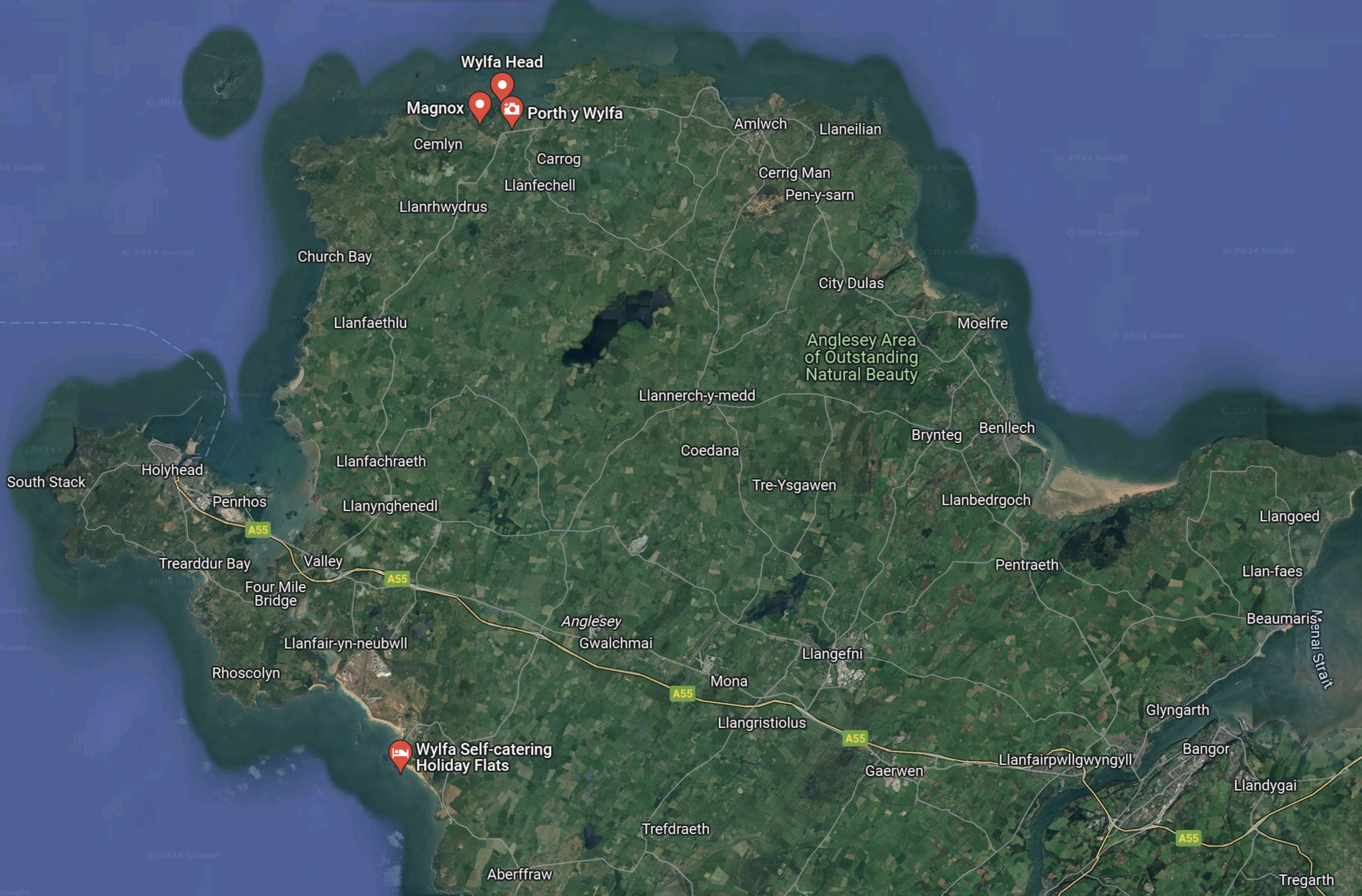
Wylfa power station is near Wylfa Head at the top of the map, where they are indicated by the cluster of red arrows.
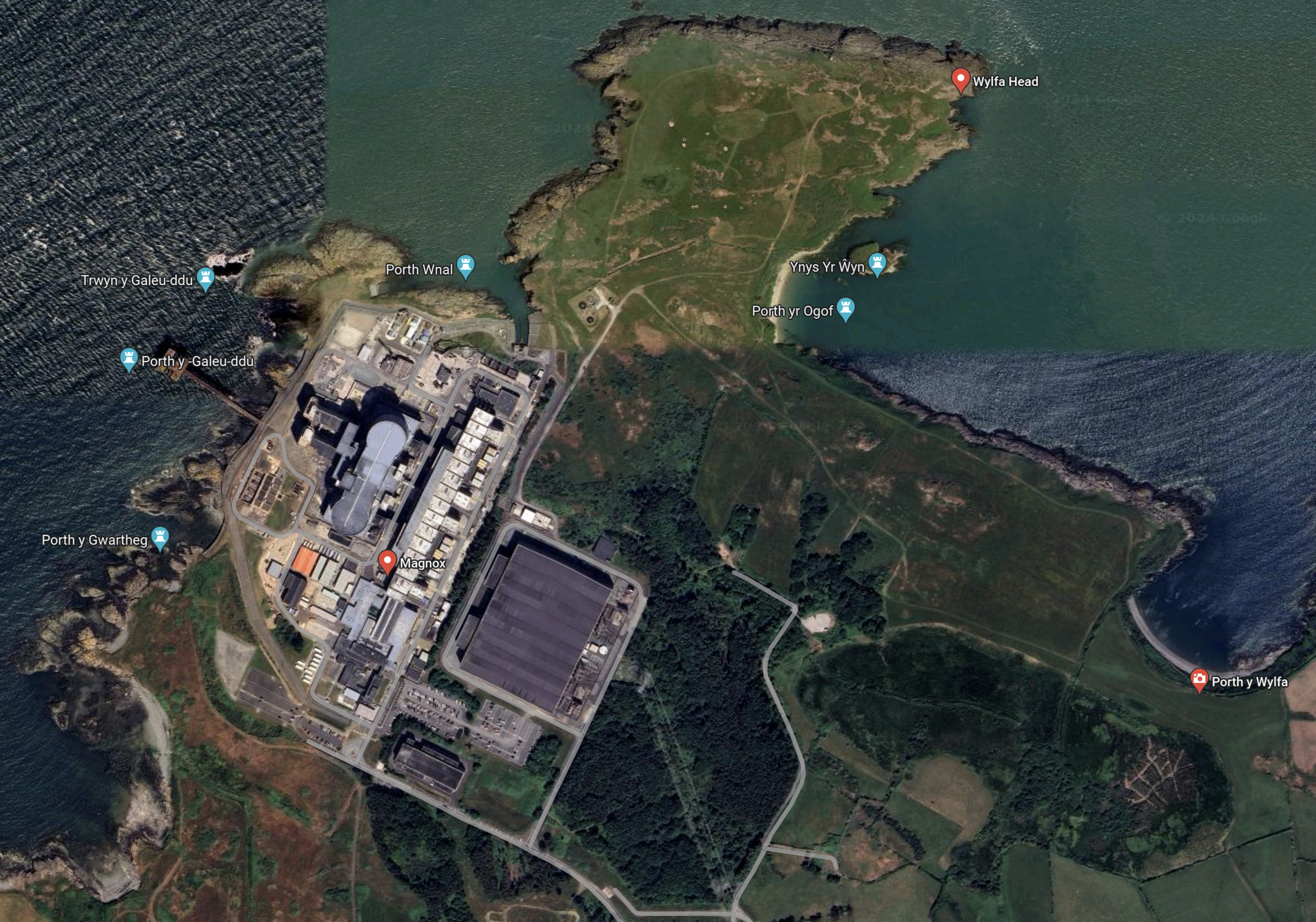
This Google Map shows the power station to a larger scale.
Note.
- The red arrow named Magnox marks the decommissioned Magnox power station.
- The topmost red arrow marks Wylfa Head.
- The rightmost red arrow marks Porth y Wylfa, which looks like a small harbour.
- On some maps the square building to the East of the power station is marked as Wylfa sub-station.
- There certainly appears to be an overhead transmission line leading South from the power station complex.
Virginia Crosbie, MP for Ynys Môn, also said this according to the BBC article.
The nuclear industry is unanimous that Wylfa is the best site in Europe for large-scale nuclear,” she said, adding that it would be “the largest inward investment” in Welsh history and “transformational” for the people of north-west Wales.
But I do wonder, if when you have cleared the Wylfa site leaving the sub-station, that it could be a site where renewables could come ashore and be fed into the grid.
Why Is Wylfa The Best Site In Europe For Large-Scale Nuclear?
Given the protests about putting new power transmission lines across Norfolk and Suffolk, I feel that Wylfa’s largest asset could be its high capacity connection to the UK’s grid.
According to the Wikipedia entry for Wylfa power station, this is said about Wylfa B.
Horizon Nuclear Power, originally an E.ON and RWE joint venture, bought by Hitachi in 2012, announced in 2009 intentions to install about 3,000 MWe of new nuclear plant at Wylfa. Horizon planned to build two advanced boiling water reactors (ABWRs) at a site to the south of the existing Wylfa station.
It would seem that the high capacity connection to the UK’s grid, is capable of handling a 3 GW power station at Wylfa, which could be very useful in the grand scheme of things.
This is also said in the Wikipedia entry for Wylfa power station.
On 4 April 2017, Horizon submitted a Site Licence Application to the Office for Nuclear Regulation. The scheme was extended to include a tunnel under the Menai Strait to carry the power cables to protect the conservation worth of the Strait and the Area of Outstanding Natural Beauty.
Horizon certainly seemed to try hard to get Wylfa B under construction.
As I said earlier, the Wylfa site could be an ideal site to connect offshore renewables to the grid.
 The Anonymous Widower