Brand New Battery Technology To Be Trialled On TransPennine Train
The title of this post, is the same as that of this press release from Hitachi.
These three bullet points, act as sub-headings.
- First-ever trial in the UK to replace a diesel engine with a battery on an intercity train is underway.
- Pioneering collaboration between Angel Trains, TransPennine Express, Turntide Technologies and Hitachi Rail.
- Hitachi Rail has built a battery using the North East supply chain, with one battery unit predicted to reduce emissions and fuel costs by as much as 30%.
These are my thoughts on some of the paragraphs in the press release.
The First Paragraph
This is the first paragraph.
Testing of the UK’s first intercity battery train commenced earlier today. The battery, which generates a peak power of more than 700kw, has now been successfully retrofitted onto a TransPennine Express ‘Nova 1’ train (five-carriage intercity Class 802), ahead of the trial on Transpennine routes this summer.
Each of the three diesel power packs in on of TransPennine Express’s Class 802 trains can generate 700 kW, so the battery packs can provide the same power as the current Rolls-Royce mtu diesel power packs.
The Third Paragraph
This is the third paragraph.
The single battery unit is incredibly powerful, storing enough electricity to power more than 75 houses for a day. This impressive energy and power density will deliver the same levels of high-speed acceleration and performance, while being no heavier than the diesel engine it replaces.
This equity of high-speed acceleration and performance is to be expected, as the train power and weight is the same, if the power is diesel engines or batteries.
The Fourth Paragraph
This is the fourth paragraph.
The installation of a battery will reduce emissions and improve energy efficiency. It is predicted to reduce emissions and fuel costs by as much as 30% on a Hitachi intercity train.
I would assume that this improvement in emissions and fuel costs, is due to the use of regenerative braking to recharge the batteries, when the train slows down.
The Fifth Paragraph
This is the fifth paragraph.
Most importantly for passengers, the trial will test how intercity trains can enter, alight and leave non-electrified stations in zero-emission battery mode to improve air quality and reduce noise pollution.
As the trains enter a non-electrified station, the regenerative braking will recharge the batteries to both power the train in the station and accelerate the train on its way.
The Seventh Paragraph
This is the seventh paragraph.
The trial will provide real-world evidence to inform the business case for a 100% -battery-electric intercity train, capable of running up to 100km in battery mode. This remarkable range means this battery technology could be deployed to cover the final non-electrified sections of intercity routes in the coming years. It will also demonstrate how battery technology can reduce infrastructure costs by reducing the need for overhead wires in tunnel sections and over complex junctions.
Note that 100 kilometres is 62.1 miles.
You can never do too much real world testing!
These are my further thoughts.
Acceleration And Braking Under Battery Power
This graph from Eversholt Rail, shows the acceleration and deceleration of a five-car Class 802 electric train.
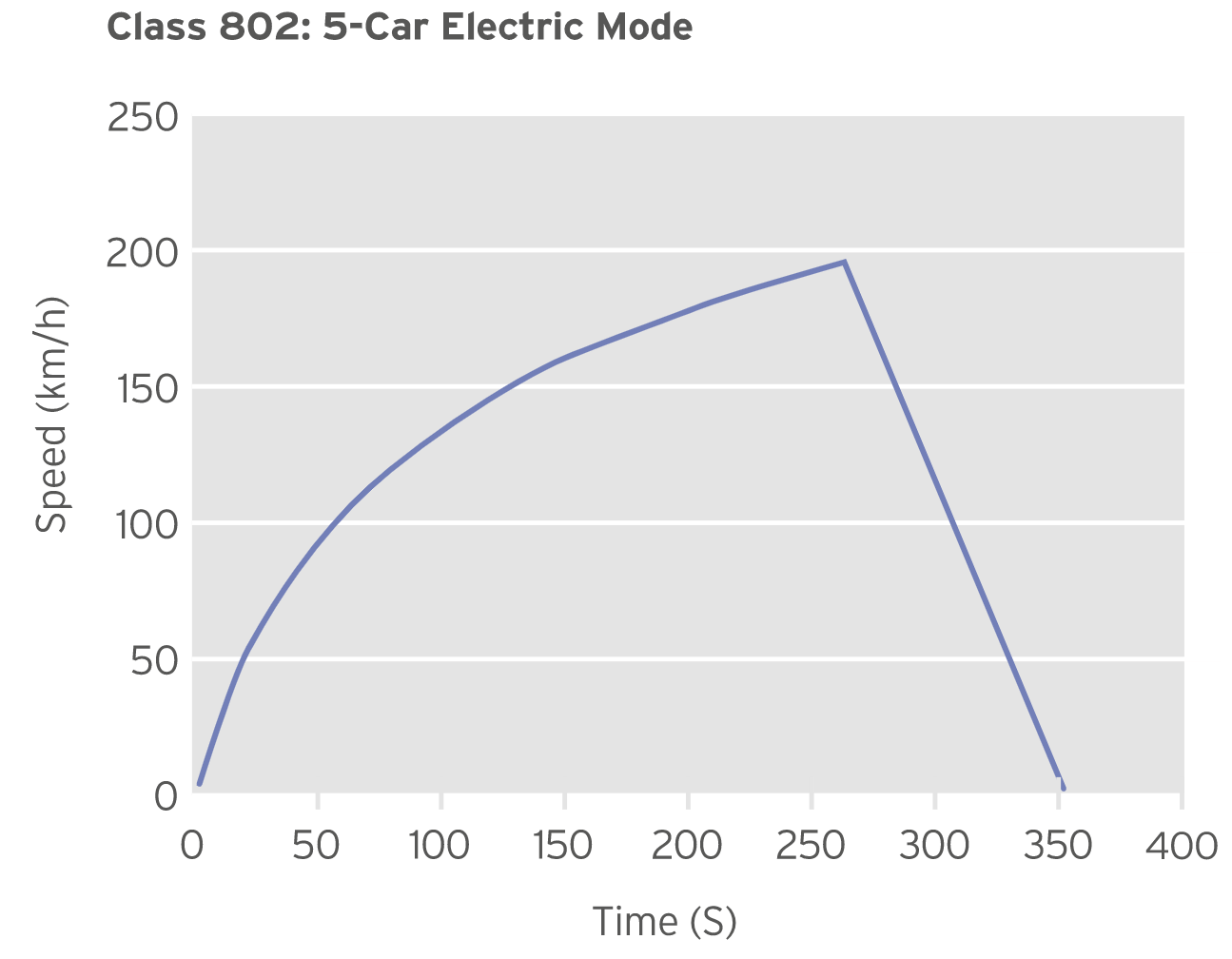
As Hitachi have said in the press release that.
- The weight of a battery pack is the same as a diesel engine.
- The power of a battery pack is the same as a diesel engine.
The acceleration and braking curve for a Class 802 train, with a single traction battery will surely be the same.
Would this mean, that if a battery-electric train replaced a diesel-electric train, the timetable would be the same?
What would be the effects, if a second diesel engine were to be replaced with a battery pack?
- The train would still weigh the same.
- The train’s performance would still be the same.
- The train would have 1400 kW of power available, but I doubt this could be used efficiently, as it might exceed the train’s performance limits.
- The train would have enough electricity for a 200 kilometre or 124.3 mile range.
There might be a need for a sophisticated control system to set the power mode, but in my experience of riding in the cab of an InterCity 125 and a Boeing 747, drivers or pilots have enough intelligence and fingers to control systems with multiple engines.
What would be the effects, if a third diesel engine were to be replaced with a battery pack?
- The train would still weigh the same.
- The train’s performance would still be the same.
- The train would have enough electricity for a 300 kilometre or 186.4 mile range.
The range is sufficient for a lot of routes.
London And Beverley
Consider.
- This route has 44.3 miles of unelectrified track between Temple Hirst Junction and Beverley.
- One battery range is 100 kilometres or 62.1 miles.
- As the trains have three slots for battery packs or diesel engines, they could always carry a diesel engine for emergencies.
The route could be run in one of two ways.
- By using one battery, that would be charged at Beverley.
- By two batteries, that would be charged on the main line to the South of Temple Hirst Junction. One battery would be used in each direction.
Note.
- The second method would not require any new infrastructure at Beverley or Hull.
- All batteries would be identical 100 km batteries.
- Trains would just swap an appropriate number of diesel engines for batteries.
The service could run as soon as the trains had the power transplants.
Using The Lincoln Diversion
In Extra Luggage Racks For Lumo, I also talked about Lumo taking the diversion via Lincoln.
Consider.
- This route is 88.5 miles of unelectrified track.
- It would be possible to be handled by a Class 802 train with two battery packs.
- Hull Trains will need battery packs to get to Beverley.
- Some LNER services will use battery packs.
Perhaps trains will use one battery to Lincoln and one from.
Crewe And Holyhead
In October 2023, the government said, that the North Wales Coast Line would be electrified.
Consider.
- Crewe and Holyhead are 105.5 miles apart.
- The route currently has no electrification.
- It has been planned to electrify the 21.1 miles between Crewe and Chester for some time.
- A lot of the route West of Chester may arouse the wrath of the Nimbies and be politically difficult to electrify, as castles and electrification don’t mix.
- Llandudno Junction station might be a station, where trains could be charged.
- Shotton and Chester stations need rebuilding.
- The line is not short of electric power, because of Electric Mountain and the windfarms along the coast.
- The route will soon be served by Hitachi Class 805 trains.
I believe the North Wales Coast Line could be one of those routes, which Hitachi’s partial electrification might be ideal.
I also believe that, it could be an extension of High Speed Two from Crewe, which provided a zero-carbon route between London and Ireland.
Conclusion
I can see if the tests perform as expected, that there will be some battery express trains running soon.
No comments yet.
 The Anonymous Widower
Leave a comment