EU, France Grant EUR 126 Million For BW Ideol’s Floating Foundation Factory
The title of this post, is the same as that of this article on offshoreWIND.biz.
This is the sub-heading.
BW Ideol has signed the final grant agreement for up to EUR 74 million from the EU Innovation Fund for a factory in Fos-sur-Mer, France, that will produce concrete floating wind foundations. The factory, dubbed Fos3F, has also secured up to EUR 52 million from the French State.
These three paragraphs add more detail.
The final agreement for the EU Innovation Fund grant was signed on 19 March, after BW Ideol revealed in November 2025 that the Fos3F was selected for up to EUR 74 million in funding by the European Commission.
The French government awarded support for the project at the end of 2025 through the C3IV tax credit scheme, dedicated to supporting leading French companies in the Green Industry. The funding from the French State will cover up to EUR 52 million to partially fund development and capital expenditures.
According to BW Ideol, if built, the Fos3F will be a first-of-its-kind factory dedicated to the serial production of concrete floating wind foundations based on the company’s patented Damping Pool.
The factory is stated to have a capacity of thirty foundations per year.
This Google Map shows the location of Fos-sur-Mer.
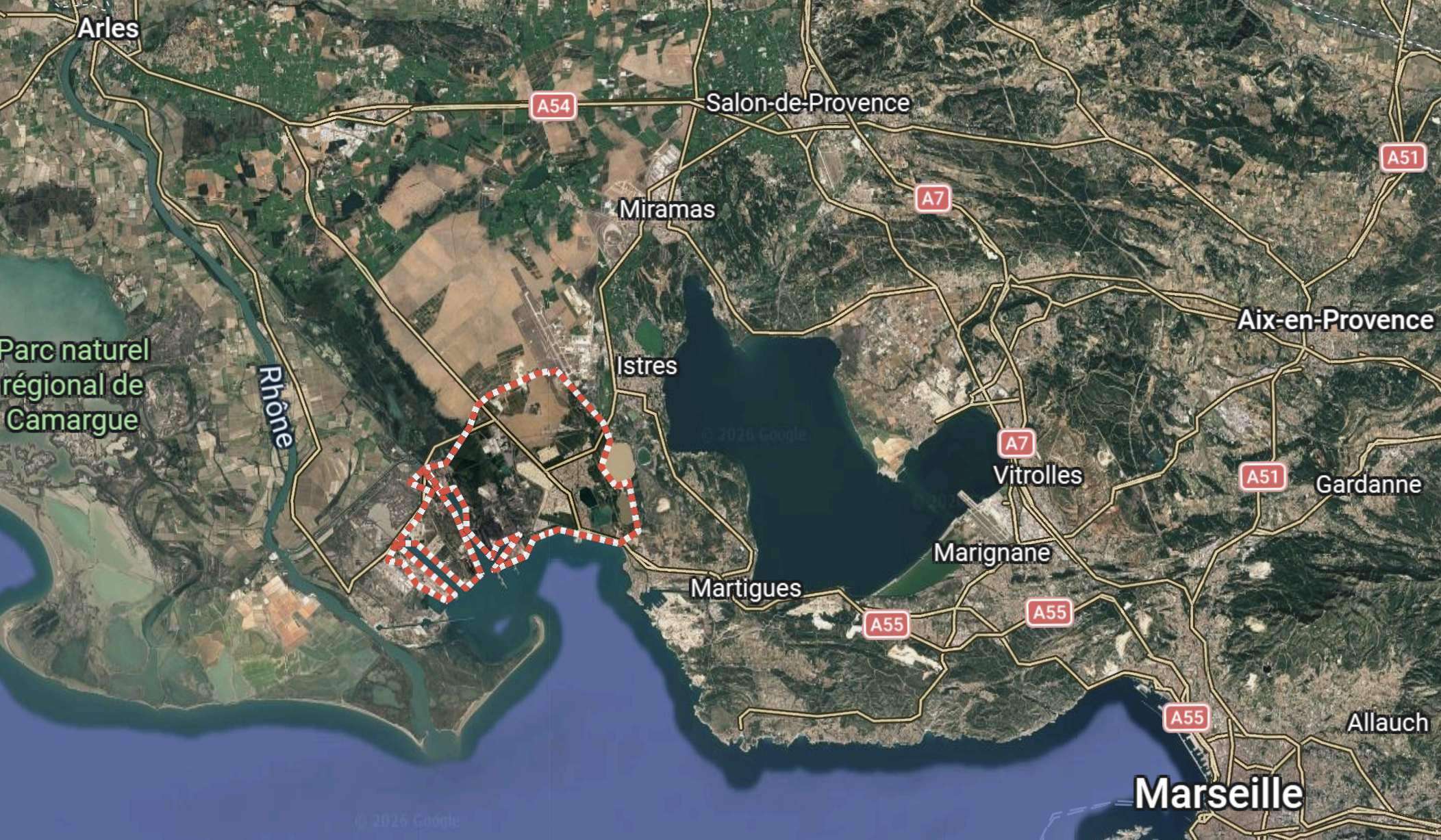
Note.
- Arles is in the North-West corner.
- Marseille is in the South-East corner.
- The mouth of the Rhône River is in between.
- Fos-sur-Mer is outlined by the red-and-white border.
Google AI says there is significant steel making at the mouth of the Rhône River.
I also asked Google AI, “What turbines will BW Ideol floating foundations support? and received this reply.
BW Ideol’s floating foundations are designed to be universal, supporting all major 15 MW+ offshore wind turbines currently on the market, with scalability to future 20 MW+ platforms. Their concrete barge-type technology—using the Damping Pool® design—is compatible with both existing and next-generation turbine manufacturers.
Key Compatibility Details:
15 MW+ and 20 MW+ Turbines: The foundations are engineered for current large-scale turbines (15 MW+) and are ready to accommodate upcoming 20 MW+ turbines, with designs already certified by DNV.
Proven Technology: The technology has been in operation since 2018 at the Floatgen site in France (using a Vestas V80 2 MW turbine) and in Japan, covering both shallow and deep-water applications.
Universal Application: The design is tailored for diverse metocean conditions and is designed to support the commercial deployment of large turbines in projects like the Buchan Offshore Wind project in Scotland.
Production Scalability: The concrete floating platforms are designed for mass production, capable of being manufactured quickly in a factory setting, such as the proposed Fos-sur-Mer site, to meet the schedules of major developers.
These foundations have received Design Certification from DNV, confirming their suitability for large-scale, commercial floating wind farms.
My Thoughts:
Concrete v. Steel: I used to work with someone, who was a big advocate of concrete yachts. Also check out the Wikipedia entry for the Troll A platform, which is a concrete Norwegian gas platform.
Zero-Carbon: I wouldn’t be surprised if concrete manufacture emits less carbon, than steel.
Port Talbot: Will BW Ideol build a similar factory at Port Talbot? I wrote about the Port Talbot factory in Port Talbot To Become Offshore Wind Hub For Celtic Sea. Both sites are next to a large bay, which would be ideal for parking completed floats and a world-class steelworks.
Buchan: Buchan’s web site says it will use seventy BW Ideol floats and generate I GW, 75 km. to the North-East of Fraserburgh. Google AI said the floats will be built at the Port of Ardersier.
Will A Mini-Steel Mill Be Built At The Port Of Ardersier?
I asked Google AI, the question in the title of this section and received this reply.
Yes, a £300 million green steel mill is planned for the Ardersier Port redevelopment as part of its transformation into a circular Energy Transition Facility. This facility aims to process scrap steel from decommissioned oil rigs into new materials to support offshore wind developments, alongside creating a concrete production plant.
Key details regarding the development:
Purpose: The mill is intended to process scrap from offshore decommissioning.
Technology: It is planned as a green steel plant.
Integration: It is aimed to be integrated into a new, fully circular “Energy Transition Facility”.
Context: While the facility aims for circular steel production, the port is primarily focused on becoming a hub for offshore wind and manufacturing.
Recent developments as of March 2026 suggest a focus on a “scaled back,” more achievable vision by new owners/managers, focusing on floating concrete wind turbine bases. Additionally, recent UK government intervention restricted a large Chinese-backed manufacturing plan at the site due to security concerns.
No comments yet.
 The Anonymous Widower
Leave a comment