EU, France Grant EUR 126 Million For BW Ideol’s Floating Foundation Factory
The title of this post, is the same as that of this article on offshoreWIND.biz.
This is the sub-heading.
BW Ideol has signed the final grant agreement for up to EUR 74 million from the EU Innovation Fund for a factory in Fos-sur-Mer, France, that will produce concrete floating wind foundations. The factory, dubbed Fos3F, has also secured up to EUR 52 million from the French State.
These three paragraphs add more detail.
The final agreement for the EU Innovation Fund grant was signed on 19 March, after BW Ideol revealed in November 2025 that the Fos3F was selected for up to EUR 74 million in funding by the European Commission.
The French government awarded support for the project at the end of 2025 through the C3IV tax credit scheme, dedicated to supporting leading French companies in the Green Industry. The funding from the French State will cover up to EUR 52 million to partially fund development and capital expenditures.
According to BW Ideol, if built, the Fos3F will be a first-of-its-kind factory dedicated to the serial production of concrete floating wind foundations based on the company’s patented Damping Pool.
The factory is stated to have a capacity of thirty foundations per year.
This Google Map shows the location of Fos-sur-Mer.
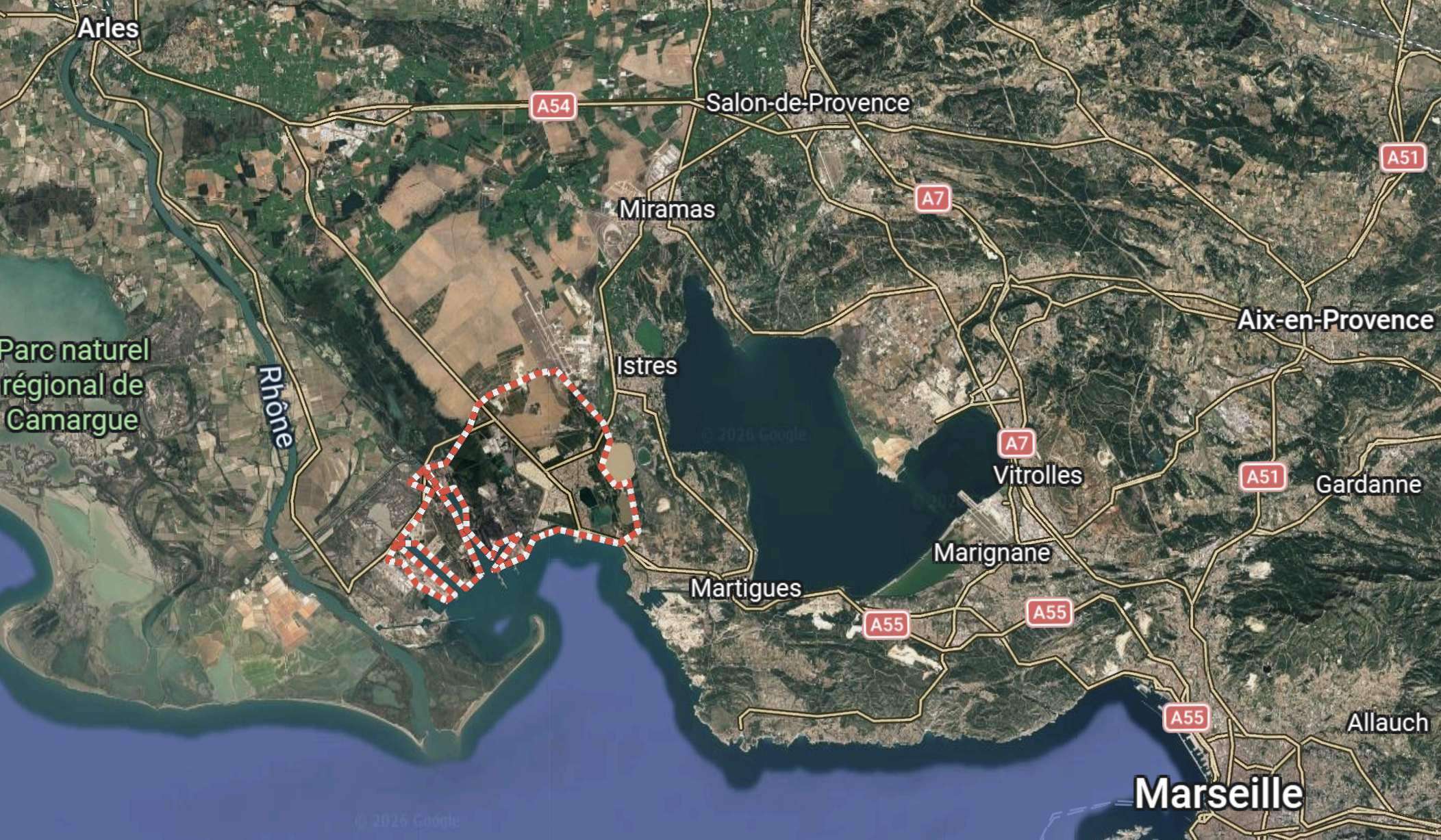
Note.
- Arles is in the North-West corner.
- Marseille is in the South-East corner.
- The mouth of the Rhône River is in between.
- Fos-sur-Mer is outlined by the red-and-white border.
Google AI says there is significant steel making at the mouth of the Rhône River.
I also asked Google AI, “What turbines will BW Ideol floating foundations support? and received this reply.
BW Ideol’s floating foundations are designed to be universal, supporting all major 15 MW+ offshore wind turbines currently on the market, with scalability to future 20 MW+ platforms. Their concrete barge-type technology—using the Damping Pool® design—is compatible with both existing and next-generation turbine manufacturers.
Key Compatibility Details:
15 MW+ and 20 MW+ Turbines: The foundations are engineered for current large-scale turbines (15 MW+) and are ready to accommodate upcoming 20 MW+ turbines, with designs already certified by DNV.
Proven Technology: The technology has been in operation since 2018 at the Floatgen site in France (using a Vestas V80 2 MW turbine) and in Japan, covering both shallow and deep-water applications.
Universal Application: The design is tailored for diverse metocean conditions and is designed to support the commercial deployment of large turbines in projects like the Buchan Offshore Wind project in Scotland.
Production Scalability: The concrete floating platforms are designed for mass production, capable of being manufactured quickly in a factory setting, such as the proposed Fos-sur-Mer site, to meet the schedules of major developers.
These foundations have received Design Certification from DNV, confirming their suitability for large-scale, commercial floating wind farms.
My Thoughts:
Concrete v. Steel: I used to work with someone, who was a big advocate of concrete yachts. Also check out the Wikipedia entry for the Troll A platform, which is a concrete Norwegian gas platform.
Zero-Carbon: I wouldn’t be surprised if concrete manufacture emits less carbon, than steel.
Port Talbot: Will BW Ideol build a similar factory at Port Talbot? I wrote about the Port Talbot factory in Port Talbot To Become Offshore Wind Hub For Celtic Sea. Both sites are next to a large bay, which would be ideal for parking completed floats and a world-class steelworks.
Buchan: Buchan’s web site says it will use seventy BW Ideol floats and generate I GW, 75 km. to the North-East of Fraserburgh. Google AI said the floats will be built at the Port of Ardersier.
Will A Mini-Steel Mill Be Built At The Port Of Ardersier?
I asked Google AI, the question in the title of this section and received this reply.
Yes, a £300 million green steel mill is planned for the Ardersier Port redevelopment as part of its transformation into a circular Energy Transition Facility. This facility aims to process scrap steel from decommissioned oil rigs into new materials to support offshore wind developments, alongside creating a concrete production plant.
Key details regarding the development:
Purpose: The mill is intended to process scrap from offshore decommissioning.
Technology: It is planned as a green steel plant.
Integration: It is aimed to be integrated into a new, fully circular “Energy Transition Facility”.
Context: While the facility aims for circular steel production, the port is primarily focused on becoming a hub for offshore wind and manufacturing.
Recent developments as of March 2026 suggest a focus on a “scaled back,” more achievable vision by new owners/managers, focusing on floating concrete wind turbine bases. Additionally, recent UK government intervention restricted a large Chinese-backed manufacturing plan at the site due to security concerns.
Port Talbot To Become Offshore Wind Hub For Celtic Sea
The title of this post, is the same as that of this article on the BBC.
This is the sub-heading.
Port Talbot will become the first dedicated hub for floating offshore wind in the Celtic Sea.
These four introductory paragraphs add some detail.
Associated British Ports (ABP) will begin detailed design and engineering work on new port infrastructure after securing grant funding of up to £64m from the UK government.
The project will support the assembly and deployment of floating turbines that will operate in deeper waters off the Welsh coast. ABP said the development could support thousands of jobs and attract hundreds of millions of pounds in further investment.
The UK government said the new port would help deliver clean, homegrown electricity, protect households from volatile fossil fuel markets and create up to 5,000 new jobs.
Redeveloping the port to handle the assembly of wind turbines could position Port Talbot at the centre of a fast-growing clean energy sector.
I have some thoughts.
How Much Wind Power Is Planned For The Western Approaches?
In Ocean Winds Enters Lease Agreement With Crown Estate For 1.5 GW Celtic Sea Floating Wind Project, I published this Google AI estimate of the wind power, that could be developed in the Western Approaches.
How Much Wind Power Is Planned For The Western Approaches?
I asked Google AI, the title of this section and received this answer.
The UK has a target of 50 GW of offshore wind by 2030, with significant projects planned for the Celtic Sea (part of the Western Approaches), which is a key area for 5 GW of floating wind. Total UK offshore wind pipeline capacity exceeds 93 GW, with major developments in this region focusing on floating technology.
Key details regarding wind power in the Western Approaches (specifically the Celtic Sea) include:
Celtic Sea Developments: The area is a primary focus for floating wind projects, designed to capitalize on deep-water potential, with 5 GW of floating wind expected to be deployed across the UK by 2030.
Pipeline and Capacity: The total UK pipeline for offshore wind, which includes the Western Approaches, is 93 GW, and the government is aiming for 43-50 GW of installed offshore capacity by 2030.
Project Status: The region is expected to benefit from the Crown Estate’s leasing rounds aimed at accelerating floating wind, with 15.4 GW of new projects submitted across the UK in 2024.
Wales/South West England Context: Wales has 1.4 GW of projects in the pre-application stage, with some potential for developments off the South West coast.
For more detailed information on specific projects and their development status, you can visit the RenewableUK website and RenewableUK website.
It looks like about 20 GW of offshore wind could be installed in the Western Approaches.
I would expect, a lot of work will be generated in the Port Talbot area.
A Lot Of Steel Will Be Needed
Earlier in the weeek, the UK Government backed the steel industry in Port Talbot, with a press release entitled UK Steel Industry Backed By Major New Trade Measure And Strategy.
Port Talbot Is A Comprehensive, Well-Connected Site
This Google Map shows the site.
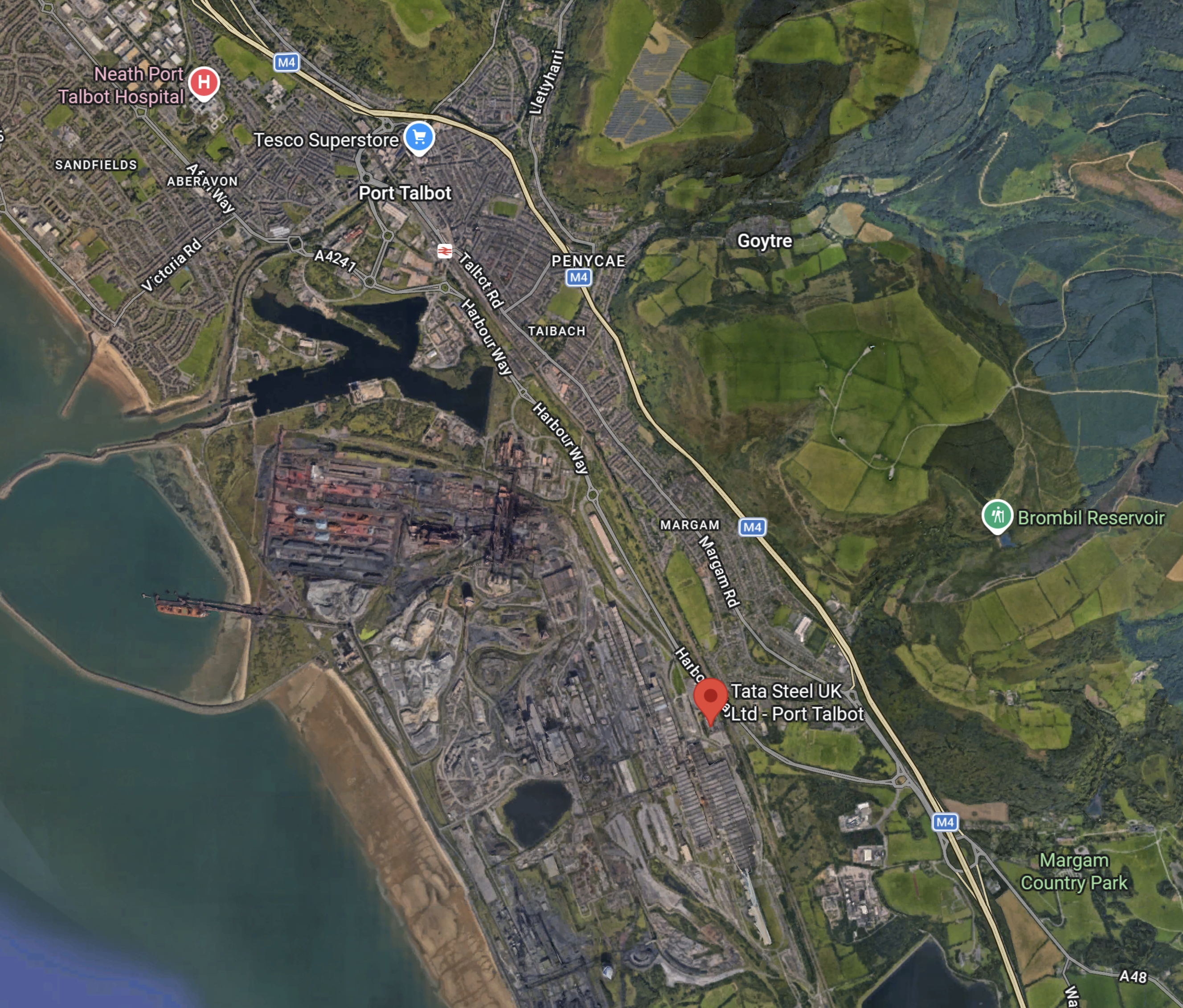
Note.
- The M4 running along the site.
- The South Wales Main Line running along the site, with Port Talbot Parkway serving the site.
- The harbour by the station.
- The Tata steelworks marked by the red arrow.
I hope the up to £64 million grant from the government is sufficient for Associated British Ports (ABP) to turn the harbour into a world-class floating wind facility and that the Treasury haven’t been too mean.
BW Ideol, ABP To Explore Serial Production Of Floating Wind Foundations At Port Talbot
I wrote a post with this name in December 2023, before the leases for the Celtic Sea windfarms had been awarded. As one has been awarded to EDf Renewables, BW Ideol seem to have made a good move.
BW Ideol have a web page, which describes their concrete floating wind foundations manufacturing line.
I hope South Wales has got enough concrete?
Welsh Government Backs Marine Power Systems’ Floating Wind Tech With GBP 8 Million
The title of this post, is the same as that of this article on offshoreWIND.biz.
This is the sub-heading.
The Welsh government has invested GBP 8 million (approximately EUR 9.4 million) in Marine Power Systems (MPS) to support the commercialisation of its floating offshore wind technology.
These three paragraphs add more detail to the story.
According to the company, the funding will accelerate the deployment of its PelaFlex platform, a floating wind solution designed for deep-water sites where conventional fixed-bottom foundations are not viable.
Marine Power Systems said the investment will help move the technology from advanced development towards commercial-scale deployment and manufacturing. The company also plans to expand its industrial and assembly capabilities in the UK.
The PelaFlex platform has been designed to simplify fabrication, installation and long-term operations while enabling wind farms to be located further offshore where wind speeds are typically stronger and more consistent, MPS says.
The offshore wind industry in Wales seems to be gearing up for a big expansion.
Gwynt Glas is the collective name for the three 1.5 GW floating wind farms in the Western Approaches and in Gwynt Glas And South Wales Ports Combine Strength In Preparation For Multi-Billion Floating Wind Industry, I describe the initial agreement that started the Gwynt Glas project.
To my mind, Associated British Ports and the wind farm developers are making sure they can carpet the Western Approaches, with offshore wind farms.
In Ocean Winds Enters Lease Agreement With Crown Estate For 1.5 GW Celtic Sea Floating Wind Project, I talk in general about the progress of the first three 1.5 GW floating wind farms in Gwynt Glas and in particular about leasing of the third wind farm.
These two posts, indicate that the Port of Port Talbot is preparing itself to produce the floaters for floating wind turbines.
- BW Ideol, ABP To Explore Serial Production Of Floating Wind Foundations At Port Talbot
- Two Ports Advance To Next Stage Of UK Gov Funding For Floating Wind
It certainly appears, that South Wales will be able to build the heavyweight gubbins for floating offshore wind.
According to Was South Wales Once The World’s Largest Coal Exporter? it was, and in 1913, the region produced 57 million tons of coal, with more than half exported.
It does look like South Wales is going to repeat the economic success with offshore energy.
I’ve heard tales from elderly Welshmen talking of the coal ships in the docks of South Wales and will we be seeing gas tankers in the docks of South Wales?
Ocean Winds Enters Lease Agreement With Crown Estate For 1.5 GW Celtic Sea Floating Wind Project
The title of this post, is the same as that of this article on offshoreWIND.biz.
This is the sub-heading.
Ocean Winds has entered into an agreement for lease with the Crown Estate for a 1.5 GW floating offshore wind project, for which the developer secured a site in the Round 5 seabed auction last year.
These two paragraphs add detail to the story.
Offshore Wind Leasing Round 5, the UK’s first dedicated floating wind seabed leasing round, was launched in February 2024, offering three areas. In June 2025, the Crown Estate announced Equinor and Gwynt Glas, a joint venture between EDF and ESB, as preferred developers for two project sites and said it was working to ensure the delivery of the full potential capacity of Round 5, which is up to 4.5 GW.
Equinor and Gwynt Glas entered into lease agreements for their floating wind projects in October 2025 and, the following month, the Crown Estate said Ocean Winds had secured the third floating offshore wind site in the Celtic Sea.
This map shows the three wind farms, that make up the Glynt Glas wind farm.
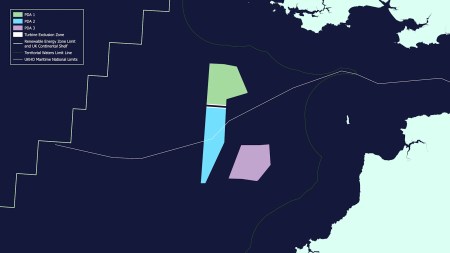
Note.
- It is expected to be built from and connect to the grid at Port Talbot in South Wales.
- The three sites are expected to be commissioned by the early-to-mid 2030s.
- The elongated white dot to the East of the wind farms would appear to be Lundy Island.
- The large bay to the North of Lundy is Carmarthen Bay with Caldey Island at its West end and Llanelli on its East.
- The Gower separates Swansea Bay from Carmarthen Bay.
This Google Map shows the Bristol Channel from the wind farms in the West to Cardiff and Hinkley Point.
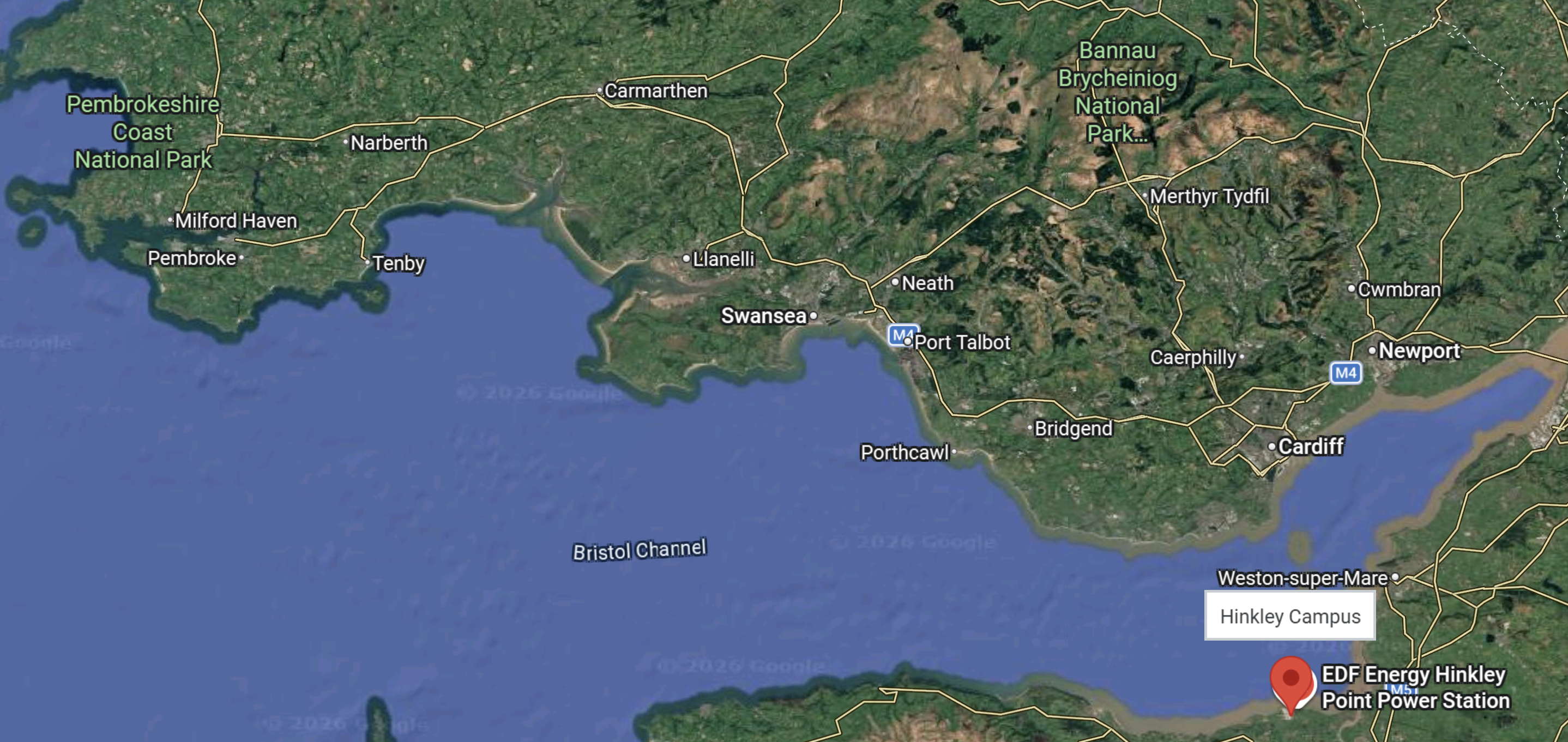
Note.
- Along the North coast of the Bristol Channel, working from West to East, my 78-year-old eyes can pick out Milford Haven, Pembroke, Caldey Island, Tenby, Llanelli, Swansea, Port Talbot, Porthcawl, BridgendCaerphilly, Cardiff and Newport.
- Coming back along the South Coast, I can see Weston-super-Mare, Hinkley Point C and the tip of Lundy Island in line with Tenby.
- The three sections of Glynt Glas will each generate 1.5 GW, making a total of 4.5 GW.
- Hinkley Point C when completed, will be a 3.26 GW nuclear power station.
- There is also a 2.2 GW gas-fired power station at Pembroke.
Nearly 8 GW of renewable electricity should be enough to convert Port Talbot steelworks to the manufacture of green steel.
How Much Wind Power Is Planned For The Western Approaches?
I asked Google AI, the title of this section and received this answer.
The UK has a target of 50 GW of offshore wind by 2030, with significant projects planned for the Celtic Sea (part of the Western Approaches), which is a key area for 5 GW of floating wind. Total UK offshore wind pipeline capacity exceeds 93 GW, with major developments in this region focusing on floating technology.
Key details regarding wind power in the Western Approaches (specifically the Celtic Sea) include:
Celtic Sea Developments: The area is a primary focus for floating wind projects, designed to capitalize on deep-water potential, with 5 GW of floating wind expected to be deployed across the UK by 2030.
Pipeline and Capacity: The total UK pipeline for offshore wind, which includes the Western Approaches, is 93 GW, and the government is aiming for 43-50 GW of installed offshore capacity by 2030.
Project Status: The region is expected to benefit from the Crown Estate’s leasing rounds aimed at accelerating floating wind, with 15.4 GW of new projects submitted across the UK in 2024.
Wales/South West England Context: Wales has 1.4 GW of projects in the pre-application stage, with some potential for developments off the South West coast.
For more detailed information on specific projects and their development status, you can visit the RenewableUK website and RenewableUK website.
It looks like about 20 GW of offshore wind could be installed in the Western Approaches.
Gwynt Glas And South Wales Ports Combine Strength In Preparation For Multi-Billion Floating Wind Industry
The title of this post, is the same as that of this news item from the Gwynt Glas wind farm.
The news item starts with a spectacular image of a port, that is assembling floating wind turbines and these three paragraphs.
Gwynt Glas Offshore Wind Farm has signed a Memorandum of Understanding (MoU) with the UK’s largest port operator, Associated British Ports, and Wales’ largest energy port, the Port of Milford Haven, to ready the ports for the future needs of floating offshore wind in the Celtic Sea.
Gwynt Glas is a joint venture partnership between EDF Renewables UK and DP Energy. The proposed floating offshore wind farm would generate 1GW of low carbon green energy in the Celtic Sea.
Under the MoU, information and industry knowledge will be shared to investigate the potential opportunities for manufacture, assembly, load-out and servicing for the Gwynt Glas project from the key South Wales Ports of Port Talbot and Milford Haven. This collaborative approach demonstrates a major commitment to supporting economic growth, investment and maximising social value in the region.
Equinor, EDF-ESB Joint Venture Secure 1.5 GW Sites In UK Floating Wind Leasing Round
The title of this post, is the same as that of this article on offshoreWIND.biz.
This is the sub-heading.
The Crown Estate has selected Equinor and Gwynt Glas, a joint venture between EDF Renewables UK and ESB, as preferred bidders in the seabed leasing round for floating wind projects in the Celtic Sea.
These two paragraphs give more details.
Selected on 12 June, each of the two developers was awarded 1.5 GW of capacity in their respective project development area (PDA) for an annual option fee of GBP 350/MW (approximately EUR 410/MW).
The Crown Estate launched the floating wind leasing round (Offshore Wind Leasing Round 5) in February 2024, offering three areas off the coasts of Wales and South West England for a total of up to 4.5 GW of installed capacity.
Note.
- It looks like the Crown Estate are working to get a contract for the third site.
- The ports of Bristol and Port Talbot could be handling the assembly of the floating turbines.
- The Crown Estate has also established a new strategic approach with the National Energy System Operator (NESO).
Given the problems some wind and solar farms have had to get connected, the Crown Estate’s link up with NESO could be attractive to developers?
Conclusion
This looks a good bit of business by the Crown Estate in the Celtic Sea.
Did they get NESO to be helpful, by asking senior people for tea with Charles and Camilla at Highgrove?

