Does Scotland Have A Plan To Build A Railway With Invisible Electrification?
There is an article in Rail Technology Magazine, which is entitled £20m Upgrade Secures Future Of Scotland’s First Electrified Railway.
This is the sub-heading.
A £20 million investment is underway to renew overhead power infrastructure on Scotland’s original electrified railway, safeguarding one of the country’s most operationally critical commuter networks for decades to come.
These two paragraphs give more details.
The programme focuses on key sections of the North Clyde lines, which operate from Helensburgh, Balloch and Milngavie through Glasgow’s west end and low‑level stations. As the busiest suburban railway outside London, the corridor plays a pivotal role in keeping Scotland’s wider rail network moving.
First electrified in 1960, the North Clyde routes marked the beginning of modern rail travel in Scotland. More than six decades on, that early investment continues to influence today’s network, underpinning electric services on routes including East Kilbride and Barrhead, with further electrification projects progressing across Fife and the Scottish Borders.
Surely at over 65-years-old, the electrification needs pensioning off and replacing with the best that the mid-2020s can provide.
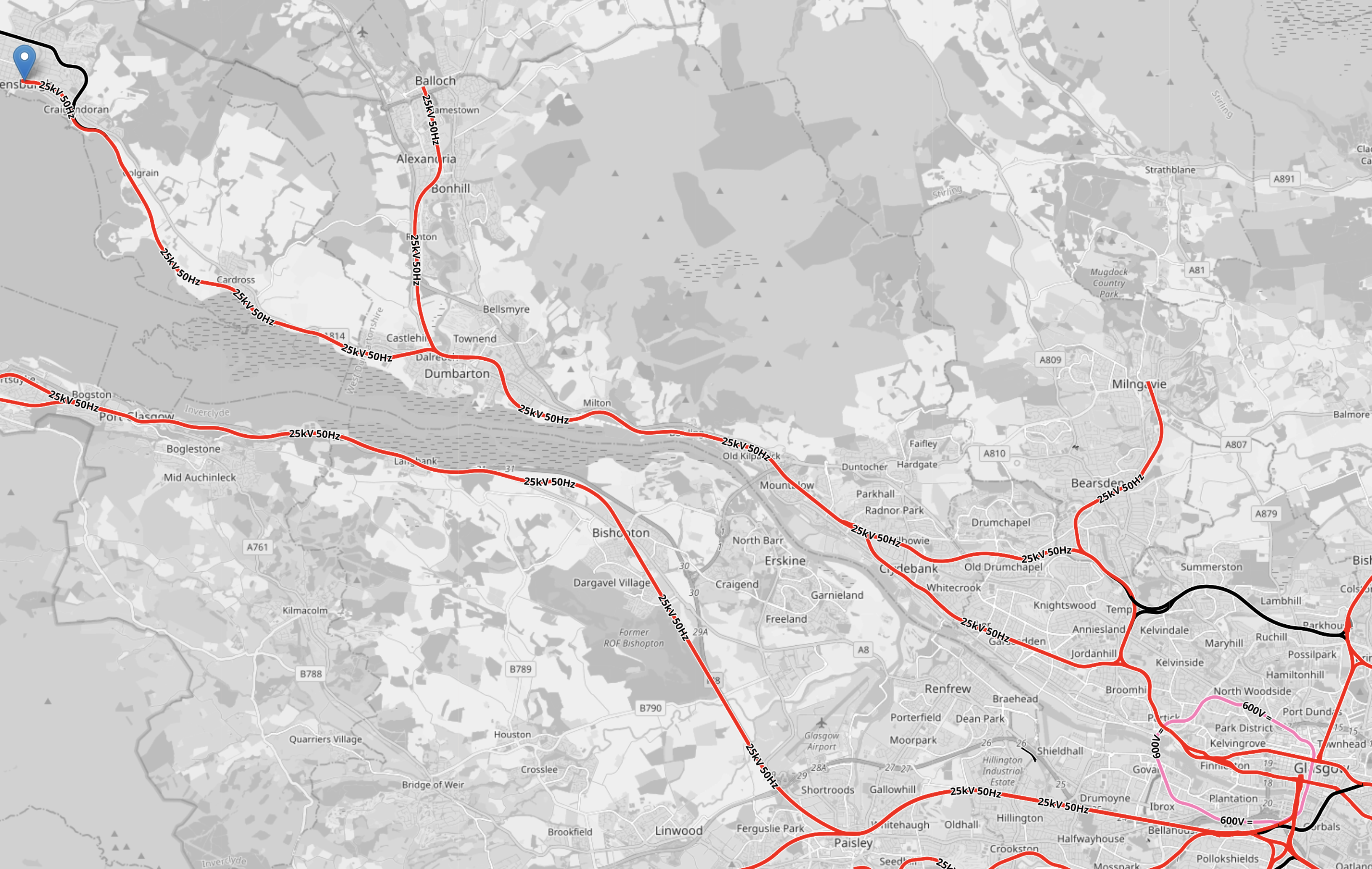
This OpenRailwayMap shows the 1960s electrification.
Note.
- The red tracks are electrified with 25 KVAC overhead electrification.
- The black tracks are not electrified.
- Helensburgh Central station is in the North-West corner of the map and marked with a blue arrow.
- The City of Glasgow is in the South-East corner of the map.
- The branch going North in the middle of the map terminated at Balloch station.
- Milngavie station is the terminus of the branch going North from the Glasgow area.
- The circular pink track is the Glasgow Underground.
I wonder if this is the start of a cunning Scottish electrification extension , that has been designed by Baldrick’s Scottish cousin?
Onward From Helensburgh
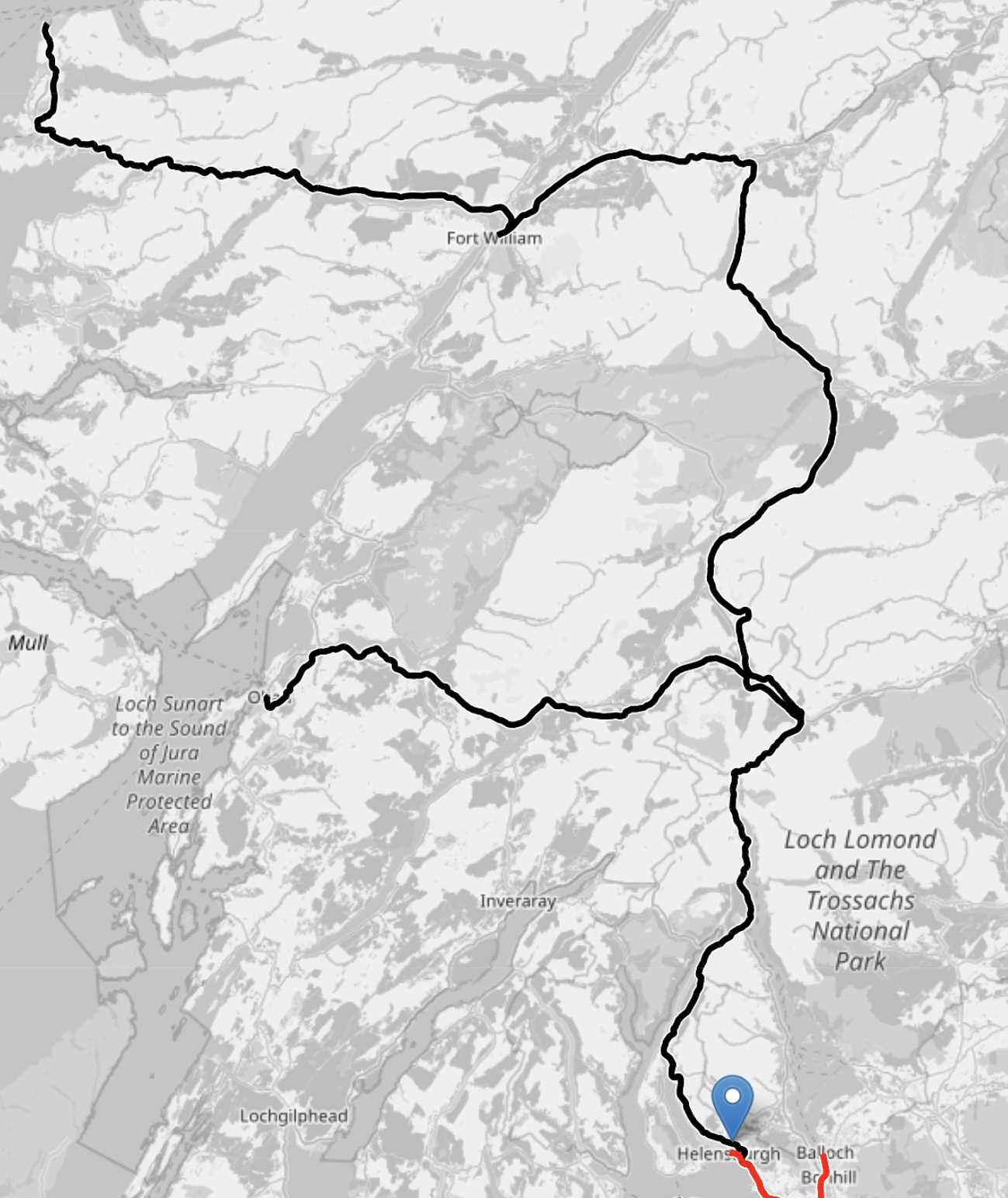
This OpenRailwayMap shows the tracks North of Helensburgh.
Note.
- The red tracks are electrified with 25 KVAC overhead electrification.
- The black tracks are not electrified.
- Helensburgh Upper station is in the South-East corner of the map and marked with a blue arrow.
- The two electrified lines from Glasgow to Helensburgh Central and Balloch stations are just visible in red.
- Oban station is at the Western end of the first branch line going North.
- Mallaig station is at the Western end of the first branch line going North.
- Helensburgh Upper and Oban stations are 76.1 miles apart.
- Mallaig station is at the Western end of the second branch line going North.
- Helensburgh Upper and Mallaig stations are 137.5 miles apart.
- The Mallaig branch also goes through Fort William station.
- Helensburgh Upper and Fort William stations are 97.4 miles apart.
- There is a Caledonian Sleeper that runs both ways between Helensburgh Upper and Fort William stations, which is hauled by a Class 66 diesel locomotive.
- There also appear to be paths for MOD trains hauled by GB RailFreight.
I feel that at some point in the next ten years, battery-electric trains or hydrogen locomotives, will be taking passengers and/or cargo to Cruachan, Fort William, Mallaig and Oban.
- Battery-electric trains and battery locomotives will charge their batteries between Helensburgh Upper and Glasgow at the Southern end of the route.
- Battery-electric trains and battery locomotives will charge their batteries at terminal stations at the Northern end of the route, using offshore wind power.
- Hydrogen trains and locomotives would probably fill up in the Glasgow area.
It could be a zero-carbon line. What would be the effect of a zero-carbon line on tourism?
Could Class 99 Locomotives Be Used On The Caledonian Sleeper?
Ever since the Class 99 locomotive was announced, there has been speculation, that these powerful bi-mode locomotives could handle the routes without an engine change.
I asked Google AI the question in the title of this section and received this reply.
Yes, Class 99 locomotives could eventually be used on the Caledonian Sleeper, as the bi-mode locomotives were designed with potential passenger use in mind. However, the standard Class 99 models cannot currently pull the sleeper trains off-the-shelf and would require specific modifications to do so.
The main factors influencing their deployment on the route include:
Equipment Needs: To haul sleeper carriages, the locomotives must be fitted with Electric Train Supply (ETS/ETH) to power lighting, heating, and air conditioning, as well as specific Dellner couplers to mate with the modern Mk5 carriages.
Sub-Class Fleet Order: While GB Railfreight (GBRf) ordered 30 Class 99s, the standard versions have a top speed of 75 mph (intended strictly for freight).
A specific sub-class (the 99/4) has been proposed to include passenger-standard acceleration, higher speeds of 100 mph to fit into existing timetable paths, and the required ETS equipment.
Bi-Mode Flexibility: Because they operate as bi-mode (using 25kV overhead electric wires and an onboard diesel engine), Class 99s could potentially run the entire route—from London to the Scottish Highlands—without requiring a locomotive change at electrified/non-electrified boundaries.
In Cummins Fuel-Agnostic X Series Platform, there is a Cummins video, which explains their philosophy of building engines that can run on diesel, hydrogen or natural gas.
With those engines, Class 99 locomotives could take the Caledonian Sleeper, or any other luxury or heavy freight train for that matter, anywhere.


they could use the stored 769’s now but Scotland doesnt like taking any cast offs from England
Comment by Nicholas Ronald Lewis | May 29, 2026 |