Can Old Scars Hurt In Hot Weather?
I asked Google AI, the question in the title of this post, and received this answer.
Yes, old scars can absolutely hurt or feel irritated in hot weather. Because scar tissue is different from normal skin, it doesn’t have the same elasticity, sweat glands, or ability to regulate temperature, making it highly sensitive to environmental changes.
Is This The Problem At Bedford With The East West Railway?
The East West Railway certainly has problems at Bedford.
These two posts seem to be creating an impasse on getting the railway built and/or operational.
So I took a quick look at the rail lines in the rail around and trough Bedford, as shown in this OpenRailwayMap.

Note.
- The Midland Main Line runs down the left hand side of the map.
- Bedford station is marked by the blue arrow,
- The East Coast Main Line runs down the right hand side of the map.
- Stations on the East Coast Main Line from North to South are St. Neots, Sandy, Biggleswade and Arlesey.
- The East West Railway is planned to connect to the East Coast Main Line at a new station at Tempsford , which will be South of St. Neots.
- The original connection was to be at Sandy.
- There used to be a railway between Bedford and Sandy.
- This railway between Bedford and Sandy, was the Varsity Line and I write about its current status in Is The Varsity Line Trackbed Between Bedford And Sandy Still There? – No, is the only answer.
- In Did Beeching Recommend Closure Of The Varsity Line?, I find out that he didn’t and it was totally the fault of Labour Politicians; Barbara Castle and Tom Fraser, with perhaps some help from Harold Wilson. Were they jealous that Oxford and Cambridge had a better link than the non-existent one across the North?
Did Beeching Recommend Closure Of The Varsity Line?
I asked Google AI, the question in the title of this post, and received this answer.
No, Dr. Richard Beeching did not recommend the closure of the Varsity Line in his 1963 report The Reshaping of British Railways.
In fact, the report recommended retaining the line with only minor curtailments.However, despite surviving the initial “Beeching cuts,” the line was ultimately closed a few years later following separate reviews by the government.
Key Details of the Line’s Demise
The First Hit (1966): Local freight facilities and minor sections were withdrawn.
Total Passenger Closure (1967): The passenger service between Bedford and Cambridge was officially withdrawn by then-Minister of Transport Tom Fraser.
The Oxford-Bletchley Segment: The passenger services between Oxford and Bletchley avoided complete closure at that time but were eventually heavily scaled back.
The closure of the Bedford to Cambridge section is largely attributed to Transport Minister Barbara Castle’s decision, as she authorized the withdrawal of services due to the route’s heavy operating losses.
Is The Varsity Line Trackbed Between Bedford And Sandy Still There?
I asked Google AI, the question in the title of this post, and received this answer.
The trackbed between Bedford and Sandy largely survives as an open, walkable alignment, but the original tracks themselves were removed decades ago.
Today, much of this section of the old Varsity Line (often referred to as the Bedford-Cambridge route) operates as National Cycle Route 51, though a few specific areas have seen modern development.
The status of the trackbed varies depending on the specific location:
:Bedford to Sandy (General): The rails and sleepers are long gone, but the formation is still clearly visible.
A large section of the trackbed between Bedford and Sandy has been repurposed as a traffic-free path for cyclists and walkers (National Cycle Route 51).
Sandy Station Area: The former Varsity Line platforms at Sandy were cleared after the line closed in 1968.
New housing has been built over parts of the route through the town, altering the original alignment.Because the original alignment was interrupted by modern housing and other developments in certain areas, the upcoming East West Rail project—which aims to re-establish a direct railway between Oxford and Cambridge—will bypass the original trackbed for the central section (Bedford to Cambridge).
The new railway is slated to follow a slightly different route.
Conclusion
Council Says ‘No’ To East West Rail Demolitions
The title of this post, is the same as that of this article on the BBC.
This is the sub-heading.
A council has strengthened its opposition to houses being demolished to make way for a huge railway project.
These three parargraphs add more details to the story.
Bedford Borough Council said any demolitions for the East West Rail line, from Oxford to Cambridge, would be “unacceptable”.
The Conservative-led authority’s response to the latest consultation on the project, external was finalised at a meeting on Wednesday.
The East West Railway Company (EWRC) said the demolitions were necessary to speed up construction time.
In February, I wrote Delays To Opening Makes Station A ‘Laughing Stock’ and if Winsford station was a laughing stock then, it now appears that the whole East West Rail Line, is one gigantic omnistambles.
In the linked post, I said this.
My feeling is that this project has been badly affected by too many adverse factors.
- A lack of overall leadership at the top of the project.
- Too many changes of Government in the UK.
- Are all these governments committed to the project?
- No Overall Control In Bedford Council
- The uncertainty about the Aylesbury Spur, which I wrote about in East-West Rail: Aylesbury Spur.
- The inability to reach a sensible compromise on route through Bedford, with the large number of Nimbys in the area.
- I used to live near Newmarket and their ideas for the town will arise the anger of the horse-racing industry.
- The theme-park I wrote about in ‘Rollercoasters In My Back Yard’: Welcome To Universal Studios Bedford, hasn’t exactly helped.
- Stories like East West Rail: Could A New Rail Link ‘Tear Apart’ A Village?, don’t help.
The planning for East West Rail hasn’t been good.
I can see Universal Studios Bedford with the backing of Donald Trump, suing Bedford Council for all the money they’ve wasted.
They’re Only A Five-Pack Of Mens’sTrunks
With all this hot weather, I needed some more Marks and Spencer’s trunks to keep myself comfortable and cool.
I liked the overall packaging, so I took these pictures.
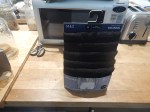
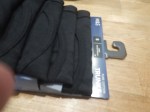

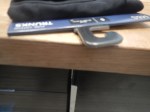

Note.
- Most of the packaging is a piece of carefully cut and folded cardboard.
- It was probably done with love by a robot.
- It’s almost folded into a pair of crocodile’s jaws, so the product is held safely.
- All five pairs were still in the packaging, when I brought them home.
But then as the product was made in Bangladesh, where crocodiles are native, I would expect them to get this type of packaging right.
In some ways the hook, is the most interesting part of the packaging, as it appears to have been stamped out of a sheet of quality laminated cardboard.
My father was a letterpress printer in the 1950s and one of the specialties of his business was stamping out components like these on one of his two Original Heidelberg printing machines.
Around the turn of the last century, I had a friend, who could design origami packaging like this. Quality and sustainable ideas like these will keep going around and around.
Does Scotland Have A Plan To Build A Railway With Invisible Electrification?
There is an article in Rail Technology Magazine, which is entitled £20m Upgrade Secures Future Of Scotland’s First Electrified Railway.
This is the sub-heading.
A £20 million investment is underway to renew overhead power infrastructure on Scotland’s original electrified railway, safeguarding one of the country’s most operationally critical commuter networks for decades to come.
These two paragraphs give more details.
The programme focuses on key sections of the North Clyde lines, which operate from Helensburgh, Balloch and Milngavie through Glasgow’s west end and low‑level stations. As the busiest suburban railway outside London, the corridor plays a pivotal role in keeping Scotland’s wider rail network moving.
First electrified in 1960, the North Clyde routes marked the beginning of modern rail travel in Scotland. More than six decades on, that early investment continues to influence today’s network, underpinning electric services on routes including East Kilbride and Barrhead, with further electrification projects progressing across Fife and the Scottish Borders.
Surely at over 65-years-old, the electrification needs pensioning off and replacing with the best that the mid-2020s can provide.
This OpenRailwayMap shows the 1960s electrification.
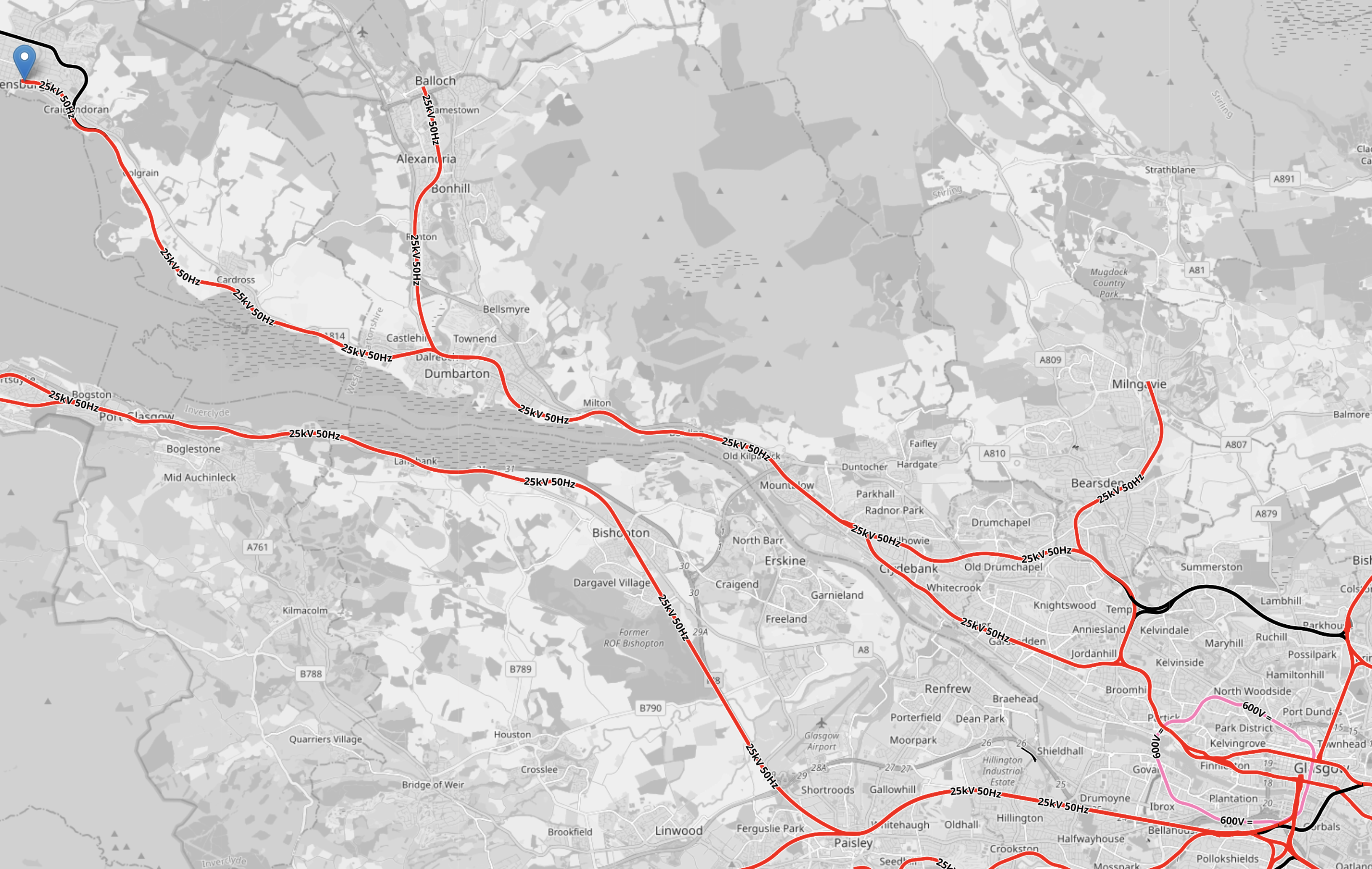
Note.
- The red tracks are electrified with 25 KVAC overhead electrification.
- The black tracks are not electrified.
- Helensburgh Central station is in the North-West corner of the map and marked with a blue arrow.
- The City of Glasgow is in the South-East corner of the map.
- The branch going North in the middle of the map terminated at Balloch station.
- Milngavie station is the terminus of the branch going North from the Glasgow area.
- The circular pink track is the Glasgow Underground.
I wonder if this is the start of a cunning Scottish electrification extension , that has been designed by Baldrick’s Scottish cousin?
Onward From Helensburgh
This OpenRailwayMap shows the tracks North of Helensburgh.
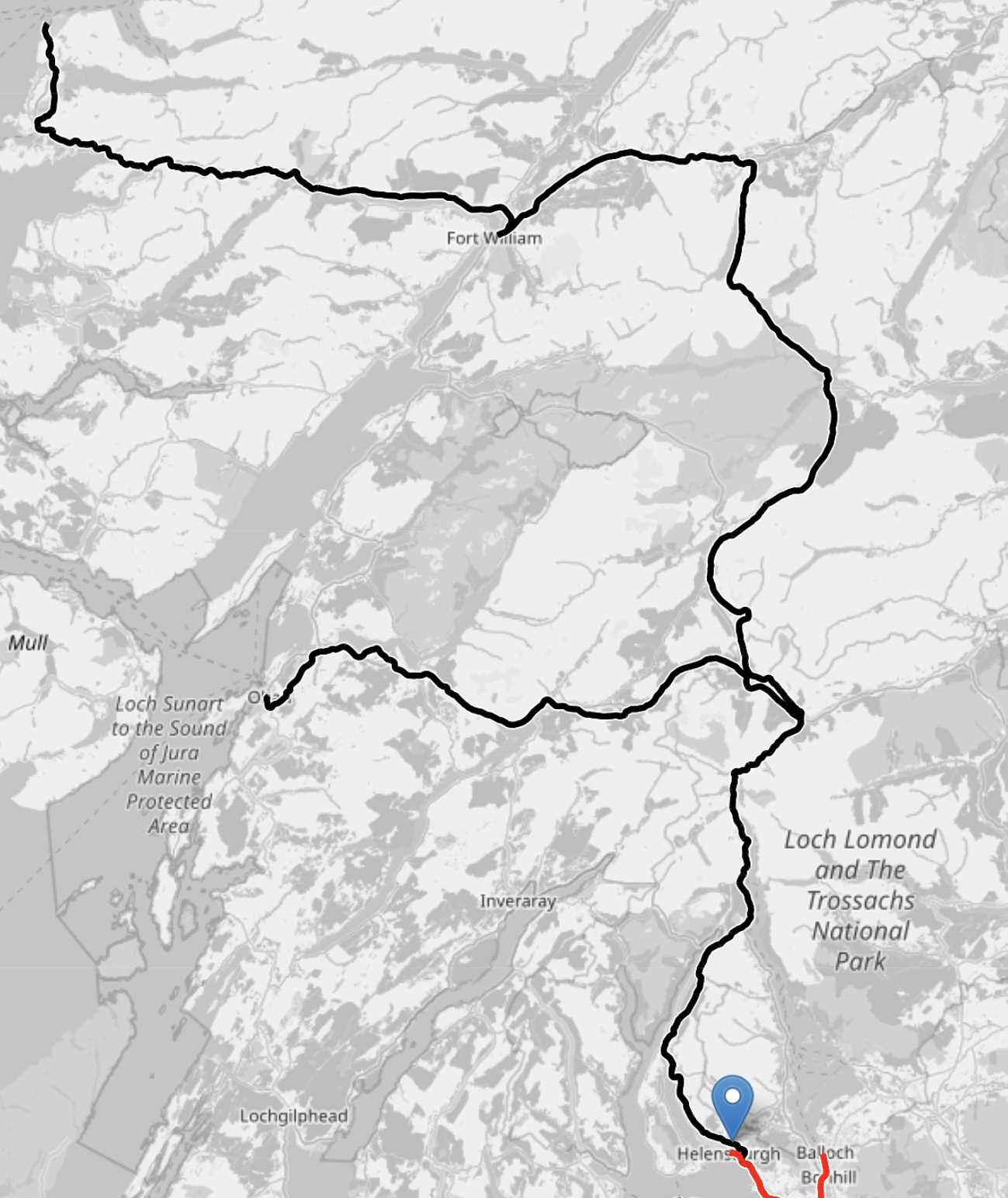
Note.
- The red tracks are electrified with 25 KVAC overhead electrification.
- The black tracks are not electrified.
- Helensburgh Upper station is in the South-East corner of the map and marked with a blue arrow.
- The two electrified lines from Glasgow to Helensburgh Central and Balloch stations are just visible in red.
- Oban station is at the Western end of the first branch line going North.
- Mallaig station is at the Western end of the first branch line going North.
- Helensburgh Upper and Oban stations are 76.1 miles apart.
- Mallaig station is at the Western end of the second branch line going North.
- Helensburgh Upper and Mallaig stations are 137.5 miles apart.
- The Mallaig branch also goes through Fort William station.
- Helensburgh Upper and Fort William stations are 97.4 miles apart.
- There is a Caledonian Sleeper that runs both ways between Helensburgh Upper and Fort William stations, which is hauled by a Class 66 diesel locomotive.
- There also appear to be paths for MOD trains hauled by GB RailFreight.
I feel that at some point in the next ten years, battery-electric trains or hydrogen locomotives, will be taking passengers and/or cargo to Cruachan, Fort William, Mallaig and Oban.
- Battery-electric trains and battery locomotives will charge their batteries between Helensburgh Upper and Glasgow at the Southern end of the route.
- Battery-electric trains and battery locomotives will charge their batteries at terminal stations at the Northern end of the route, using offshore wind power.
- Hydrogen trains and locomotives would probably fill up in the Glasgow area.
It could be a zero-carbon line. What would be the effect of a zero-carbon line on tourism?
Could Class 99 Locomotives Be Used On The Caledonian Sleeper?
Ever since the Class 99 locomotive was announced, there has been speculation, that these powerful bi-mode locomotives could handle the routes without an engine change.
I asked Google AI the question in the title of this section and received this reply.
Yes, Class 99 locomotives could eventually be used on the Caledonian Sleeper, as the bi-mode locomotives were designed with potential passenger use in mind. However, the standard Class 99 models cannot currently pull the sleeper trains off-the-shelf and would require specific modifications to do so.
The main factors influencing their deployment on the route include:
Equipment Needs: To haul sleeper carriages, the locomotives must be fitted with Electric Train Supply (ETS/ETH) to power lighting, heating, and air conditioning, as well as specific Dellner couplers to mate with the modern Mk5 carriages.
Sub-Class Fleet Order: While GB Railfreight (GBRf) ordered 30 Class 99s, the standard versions have a top speed of 75 mph (intended strictly for freight).
A specific sub-class (the 99/4) has been proposed to include passenger-standard acceleration, higher speeds of 100 mph to fit into existing timetable paths, and the required ETS equipment.
Bi-Mode Flexibility: Because they operate as bi-mode (using 25kV overhead electric wires and an onboard diesel engine), Class 99s could potentially run the entire route—from London to the Scottish Highlands—without requiring a locomotive change at electrified/non-electrified boundaries.
In Cummins Fuel-Agnostic X Series Platform, there is a Cummins video, which explains their philosophy of building engines that can run on diesel, hydrogen or natural gas.
With those engines, Class 99 locomotives could take the Caledonian Sleeper, or any other luxury or heavy freight train for that matter, anywhere.
FlixBus Launches New Coach Services For Luton DART Parkway
The title of this post, is the same as that of this article on Luton Today.
These paragraphs describe the service.
Coach brand FlixBus is announcing the launch of a new service between Norwich and Luton DART Parkway from 25 May.
Tickets between Norwich and Luton DART Parkway start at £8.99, while tickets between Thetford and Luton DART Parkway start at £8.49, and tickets between Cambridge and Luton DART Parkway start at £6.99.
Six daily departures each way will offer travellers a convenient, affordable link between East Anglia, Cambridgeshire and Luton airport, ahead of the busy summer season.
Could This Service Be Run By A Hydrogen-Powered Coach?
Luton and Norwich is around 160 km.
So six round trips would be under 2,000 km, which could be run, by two coaches having one fill-up per day.
The Coach Calls At The University Of East Anglia
This will be very convenient for some.
Should The Coach Stop At Newmarket?
Because of the horse racing industry, there are a lot of people travelling between Newmarket and the Dublin area, and the most convenient route is to fly between Luton and Dublin.
Conclusion
This service will be a winner.

