On The Bonnie, Bonnie Banks o’ Loch Lomon’
I couldn’t resist using the first line of one of the most famous Scottish traditional songs, as the title of this post.
But a very significant power station project, is to be undertaken in the area.
These are the opening few sentences of the Wikipedia entry for the Loch Sloy Hydro-Electric Scheme.
The Loch Sloy Hydro-Electric Scheme is a hydro-electric facility situated between Loch Sloy and Inveruglas on the west bank of Loch Lomond in Scotland. It is also within the Arrochar Alps. The site was originally suggested as the location of a huge pumped-storage scheme in 1936 by Edward MacColl, but this was rejected as being uneconomic. After the North of Scotland Hydro-Electric Board was created in 1943, it became the first of their proposed schemes.
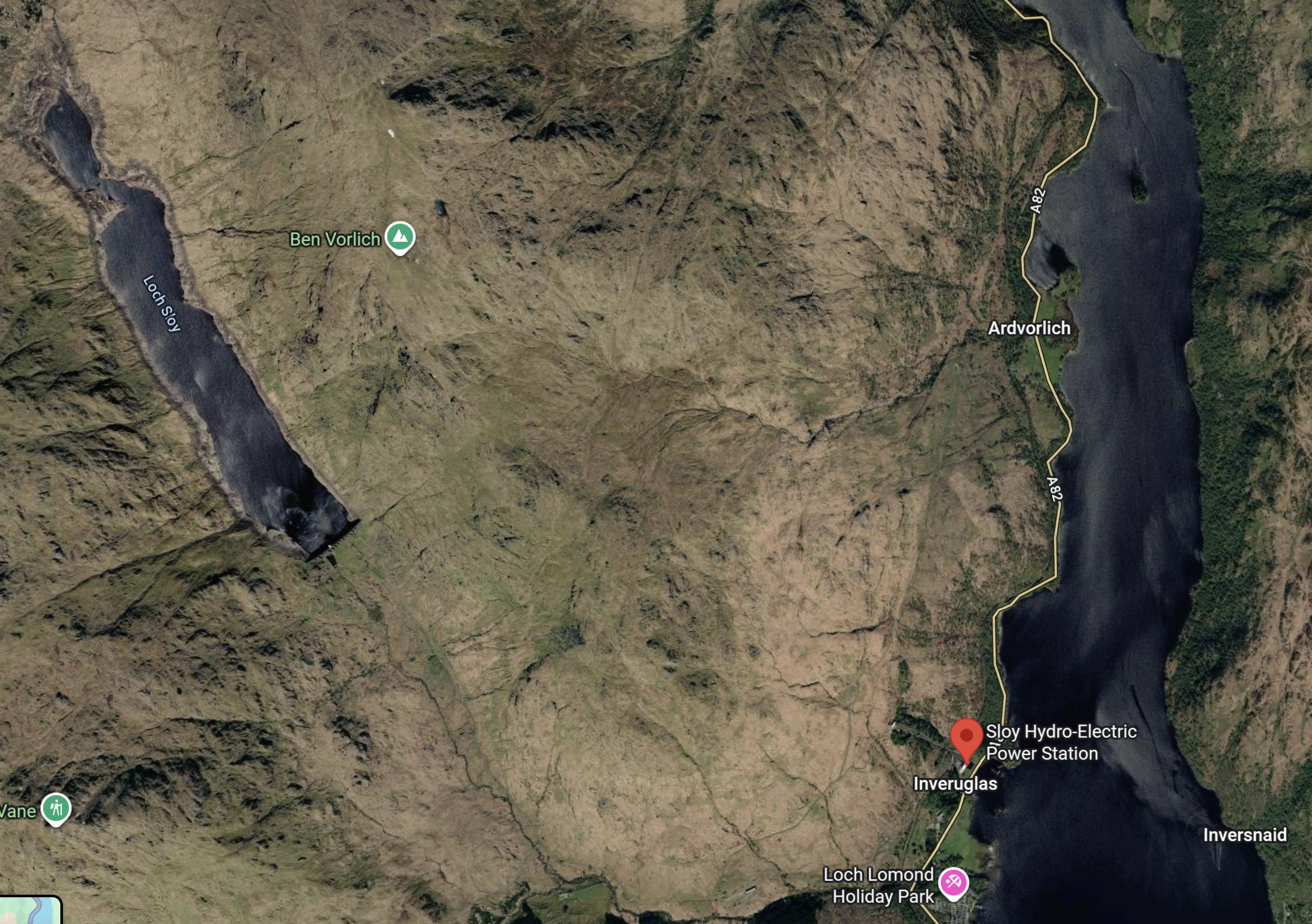
This Google Map shows Loch Lomond and Loch Sloy.
Note.
- Loch Sloy is in the North-West corner of the map.
- Loch Lomond is on the Eastern side of the map.
- The red arrow indicates the main buildings of the LochSloy Hydro-Electric Power Station.
- Loch Sloy is eight-hundred feet above Loch Lomond.
- The total generating capacity of the power station is 152.5 MW.
The facility is operated by Scottish and Southern Energy, and is normally in standby mode, ready to generate electricity to meet sudden peaks in demand. It can reach full capacity within 5 minutes from a standing start.
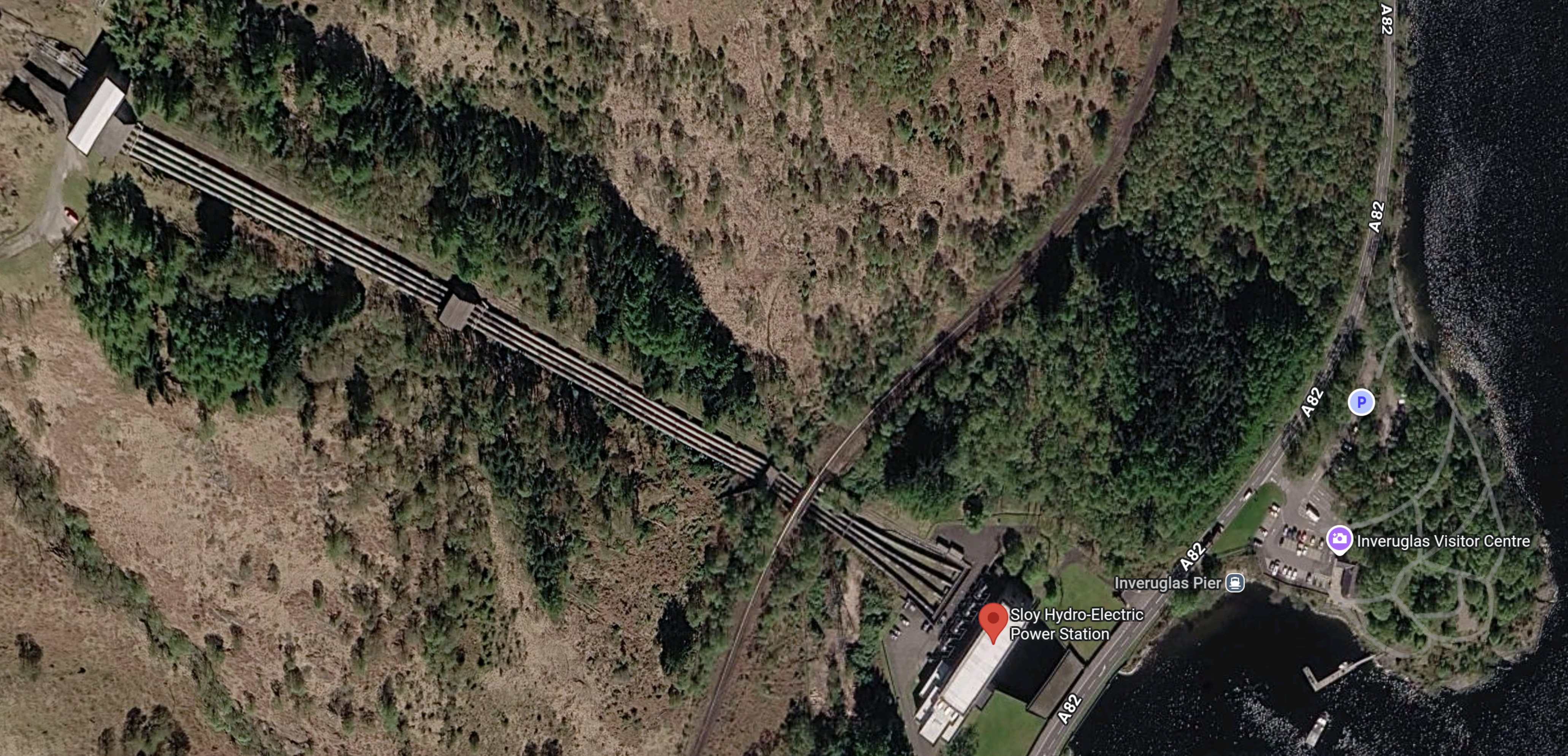
This second Google Map shows the power station to a larger scale.
Note.
- Loch Sloy is to the North-West of the North-West corner of the map.
- Loch Lomond is on the Eastern side of the map.
- The red arrow indicates the main buildings of the Loch Sloy Hydro-Electric Power Station.
- The four pipes carry water from Loch Sloy to the actual power station.
- The single-track West Highland Line crosses over the four pipes at their South-Eastern end.
The design of Loch Sloy Hydro-Electric Power Station is typical of many hydro-electric stations all over the world.
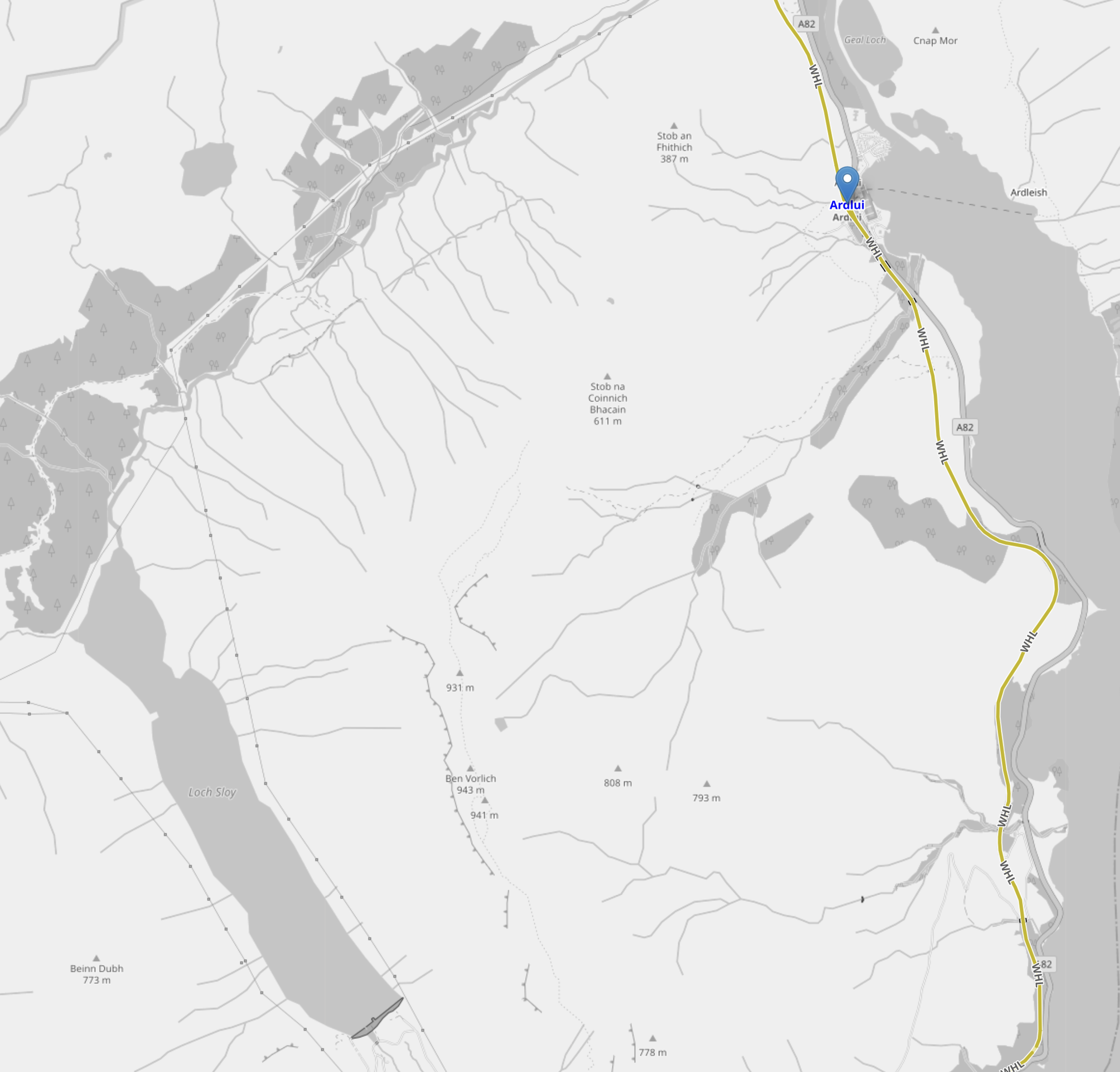
This third map is an OpenRailwayMap of the area.
Note.
- Loch Sloy is on the Western side of the map.
- Loch Lomond is on the Eastern side of the map.
- The yellow track is the single-track West Highland Line between Glasgow and Mallaig via Fort William
- The blue arrow indicates Ardlui station.
The railway goes close to the power station.
A Platinum Celebration for Sloy Power Station!
The title of this section is the same as this must-read web page on the SSE web site, which dates from 2020.
Sloy Power Station Development Plans
This second must read web page on the SSE web site is entitled Sloy Power Station.
This is the sub-heading.
We’re Proposing To Convert Our Iconic 1950s Hydro Station To Pumped Storage Hydro
This is the introduction to the development.
In April 2025, we submitted a planning application to the Scottish Government to convert the iconic Sloy Power Station into a pumped storage hydro scheme.
Our proposals would bolster energy security and help provide the large-scale and flexible renewable energy back-up needed in a future UK net zero power system, helping meet the UK Government’s ambition of Clean Power by 2030.
If approved for delivery, the converted Sloy scheme would be capable of delivering up to 16GWh of long-duration electricity storage capacity.
It could provide firm, flexible renewable energy for up to 100 hours non-stop.
It appears that the upgraded power station will effectively become a 160 MW/16 GWh long duration energy store.
Currently, the UK’s largest pumped storage power station is the 1727 MW/9.1 GWh Electric Mountain in North Wales.
The updated Sloy power station will have less output, but more storage capacity, than Electric Mountain.
Should There Be A Railway Station At Loch Sloy Power Station?
Google AI gives this answer in reply to “Loch Sloy Railway Station”.
There was never a permanent public railway station called Loch Sloy, but temporary private platforms like Inveruglas railway station and Faslane Platform railway station served the area. These stops were built in 1945 by the London and North Eastern Railway (LNER) to haul materials and workers—including prisoners of war—for the construction of the Loch Sloy Hydro-Electric Scheme.
Note.
- Surely, similar reasons to those in 1945 could apply to the development of the power station. Materials and workers could be brought in by rail.
- Given, the power station’s historic significance, I believe that it could become a tourist attraction and/or education centre.It could be a stop for the Caledonian Sleeper.
I believe that as time passes, the power station’s historic significance will increase.
Are There Any Other Hydro Power Stations, That Can Be Upgraded To Pumped Storage Hydro?
Google AI can’t find anything at present.
Does Scotland Have A Plan To Build A Railway With Invisible Electrification?
There is an article in Rail Technology Magazine, which is entitled £20m Upgrade Secures Future Of Scotland’s First Electrified Railway.
This is the sub-heading.
A £20 million investment is underway to renew overhead power infrastructure on Scotland’s original electrified railway, safeguarding one of the country’s most operationally critical commuter networks for decades to come.
These two paragraphs give more details.
The programme focuses on key sections of the North Clyde lines, which operate from Helensburgh, Balloch and Milngavie through Glasgow’s west end and low‑level stations. As the busiest suburban railway outside London, the corridor plays a pivotal role in keeping Scotland’s wider rail network moving.
First electrified in 1960, the North Clyde routes marked the beginning of modern rail travel in Scotland. More than six decades on, that early investment continues to influence today’s network, underpinning electric services on routes including East Kilbride and Barrhead, with further electrification projects progressing across Fife and the Scottish Borders.
Surely at over 65-years-old, the electrification needs pensioning off and replacing with the best that the mid-2020s can provide.
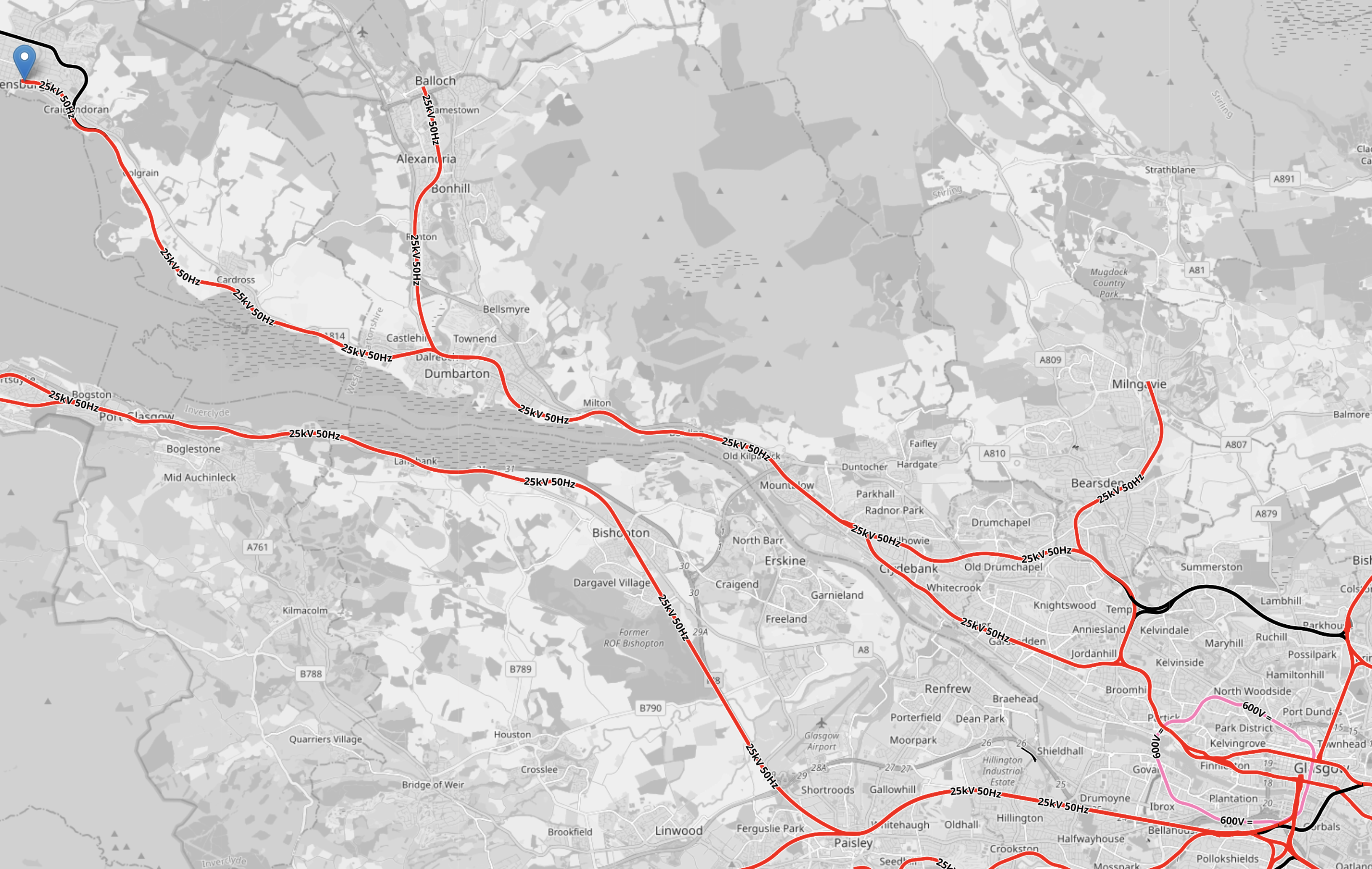
This OpenRailwayMap shows the 1960s electrification.
Note.
- The red tracks are electrified with 25 KVAC overhead electrification.
- The black tracks are not electrified.
- Helensburgh Central station is in the North-West corner of the map and marked with a blue arrow.
- The City of Glasgow is in the South-East corner of the map.
- The branch going North in the middle of the map terminated at Balloch station.
- Milngavie station is the terminus of the branch going North from the Glasgow area.
- The circular pink track is the Glasgow Underground.
I wonder if this is the start of a cunning Scottish electrification extension , that has been designed by Baldrick’s Scottish cousin?
Onward From Helensburgh
This OpenRailwayMap shows the tracks North of Helensburgh.
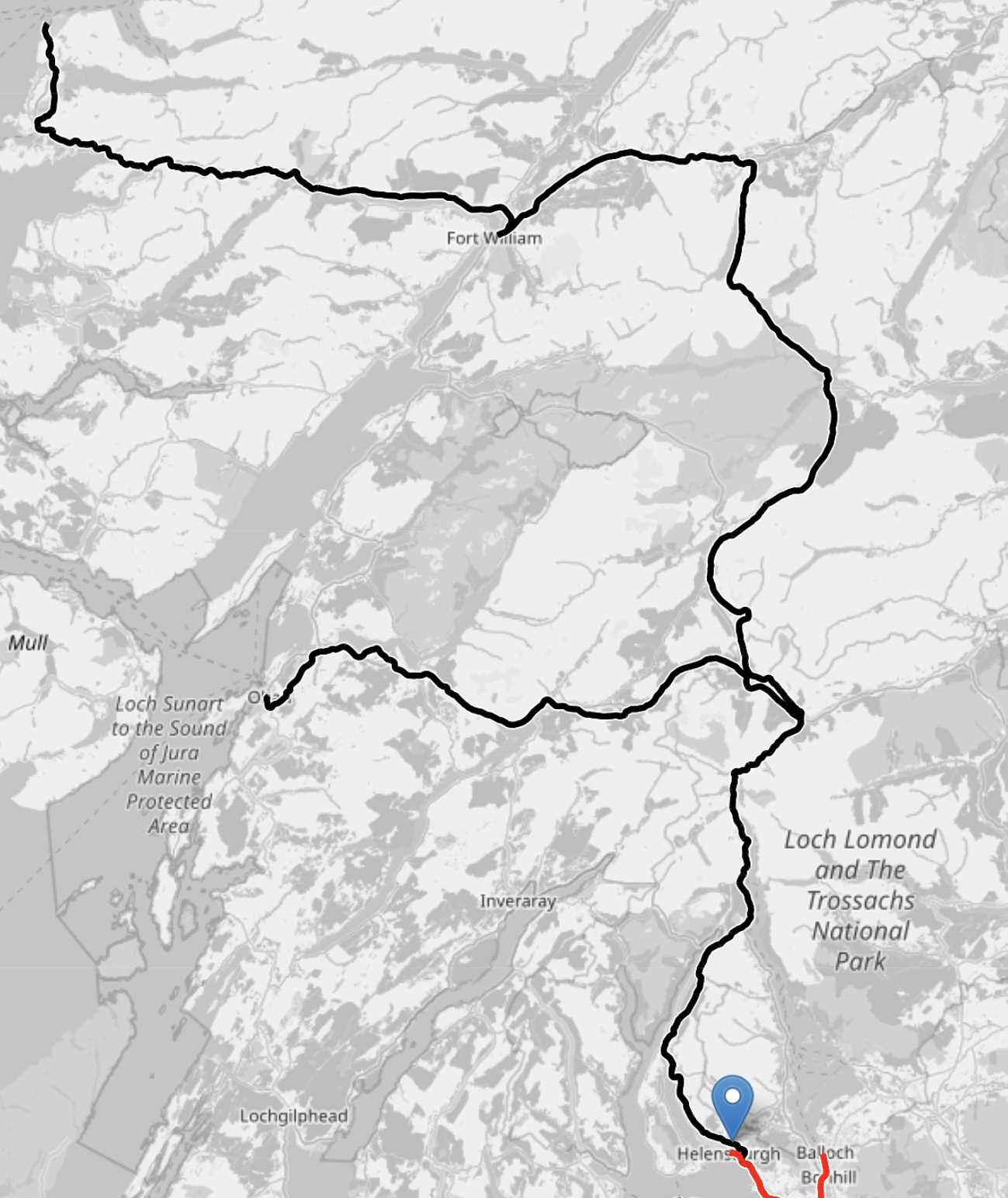
Note.
- The red tracks are electrified with 25 KVAC overhead electrification.
- The black tracks are not electrified.
- Helensburgh Upper station is in the South-East corner of the map and marked with a blue arrow.
- The two electrified lines from Glasgow to Helensburgh Central and Balloch stations are just visible in red.
- Oban station is at the Western end of the first branch line going North.
- Mallaig station is at the Western end of the first branch line going North.
- Helensburgh Upper and Oban stations are 76.1 miles apart.
- Mallaig station is at the Western end of the second branch line going North.
- Helensburgh Upper and Mallaig stations are 137.5 miles apart.
- The Mallaig branch also goes through Fort William station.
- Helensburgh Upper and Fort William stations are 97.4 miles apart.
- There is a Caledonian Sleeper that runs both ways between Helensburgh Upper and Fort William stations, which is hauled by a Class 66 diesel locomotive.
- There also appear to be paths for MOD trains hauled by GB RailFreight.
I feel that at some point in the next ten years, battery-electric trains or hydrogen locomotives, will be taking passengers and/or cargo to Cruachan, Fort William, Mallaig and Oban.
- Battery-electric trains and battery locomotives will charge their batteries between Helensburgh Upper and Glasgow at the Southern end of the route.
- Battery-electric trains and battery locomotives will charge their batteries at terminal stations at the Northern end of the route, using offshore wind power.
- Hydrogen trains and locomotives would probably fill up in the Glasgow area.
It could be a zero-carbon line. What would be the effect of a zero-carbon line on tourism?
Could Class 99 Locomotives Be Used On The Caledonian Sleeper?
Ever since the Class 99 locomotive was announced, there has been speculation, that these powerful bi-mode locomotives could handle the routes without an engine change.
I asked Google AI the question in the title of this section and received this reply.
Yes, Class 99 locomotives could eventually be used on the Caledonian Sleeper, as the bi-mode locomotives were designed with potential passenger use in mind. However, the standard Class 99 models cannot currently pull the sleeper trains off-the-shelf and would require specific modifications to do so.
The main factors influencing their deployment on the route include:
Equipment Needs: To haul sleeper carriages, the locomotives must be fitted with Electric Train Supply (ETS/ETH) to power lighting, heating, and air conditioning, as well as specific Dellner couplers to mate with the modern Mk5 carriages.
Sub-Class Fleet Order: While GB Railfreight (GBRf) ordered 30 Class 99s, the standard versions have a top speed of 75 mph (intended strictly for freight).
A specific sub-class (the 99/4) has been proposed to include passenger-standard acceleration, higher speeds of 100 mph to fit into existing timetable paths, and the required ETS equipment.
Bi-Mode Flexibility: Because they operate as bi-mode (using 25kV overhead electric wires and an onboard diesel engine), Class 99s could potentially run the entire route—from London to the Scottish Highlands—without requiring a locomotive change at electrified/non-electrified boundaries.
In Cummins Fuel-Agnostic X Series Platform, there is a Cummins video, which explains their philosophy of building engines that can run on diesel, hydrogen or natural gas.
With those engines, Class 99 locomotives could take the Caledonian Sleeper, or any other luxury or heavy freight train for that matter, anywhere.

