First Engine Start For First Hydrogen-Powered Locomotive
The title of this post, is the same as that of this article in the Windhoek Observer.
These three paragraphs add more details.
CMB.TECH Namibia’s has said the engine start for Namibia’s first hydrogen-powered locomotive represents an important step in the project’s development.
It is the first hydrogen dual fuel engine to be started in Africa and the first hydrogen dual fuel engine to be started in a locomotive worldwide.
The company revealed that a combined team of eight electrical, mechanical and software engineers, together with the engine commissioning engineer, worked into the night to prepare the locomotive for its first engine start.
These are a few points from the rest of the article.
- During the initial run, the BeHydro engine idled for approximately 30 minutes while the team carried out a series of checks.
- This 2,250-horsepower BeHydro dual fuel engine can operate on both diesel and green hydrogen, with the hydrogen to be produced locally at CMB.TECH Namibia’s facility in Walvis Bay.
- Namibia has a large fleet of idled locomotives that can be repowered with this cost-effective and future proof technology.
I first wrote about the Belgian BeHydro dual fuel engine in Green Tugboats? ‘Revolutionary’ Hydrogen Ship Engine Unveiled In Belgium.
Is History Repeating Itself?
Thirty or forty years ago, I was friendly with a steam locomotive enthusiast called Dick.
- Dick and his mates were helping various African countries, get their steam locomotives running again.
- The Chinese had sold Africa lots of diesel locomotives to replace European steam locomotives, that often dated from before the Second World War.
- But now these Chinese diesels were falling apart.
My friend and his mates were dragging the old steam locomotives out of the sidings and getting them going again.
So with a little help from the Belgians, are the Namibians bringing the ancient Chinese diesel locomotives into the net-zero world of the twenty-first century?
More About The Project
These paragraphs in the Windhoek Observerer describe the project.
- The project is the result of a strategic partnership between three companies firmly rooted in Namibia including TransNamib Holdings Limited, Africa Global Logistics and CMB.TECH Namibia.
- TransNamib is responsible for managing and operating the national rail network and freight services.
- Africa Global Logistics (AGL) is an established logistics operator active in Namibia, playing a key role in freight, transport and logistics operations across the country, with a strong focus on strengthening strategic transport corridors.
- AGL also manages operations at the Walvis Bay Multipurpose Bulk Terminal and operates one of Africa’s largest integrated logistics networks, with a presence in over 50 countries connecting ports, corridors and multimodal supply chains.
- These partners will operate Namibia’s first heavy‑duty freight service running on locally produced green hydrogen.
- Initially, 50 round trips will be covered between the Port of Walvis Bay and the Container Depot near Windhoek during the trial period, with the option to extend operations.
- Green hydrogen for the project will be produced off‑grid at CMB.TECH Namibia’s hydrogen plant in Walvis Bay.
Note.
- It seems very much a Namibian project.
- Namibia has plenty of wind and sun to make the green hydrogen.
- Would they be using an efficient process like HiiROC?
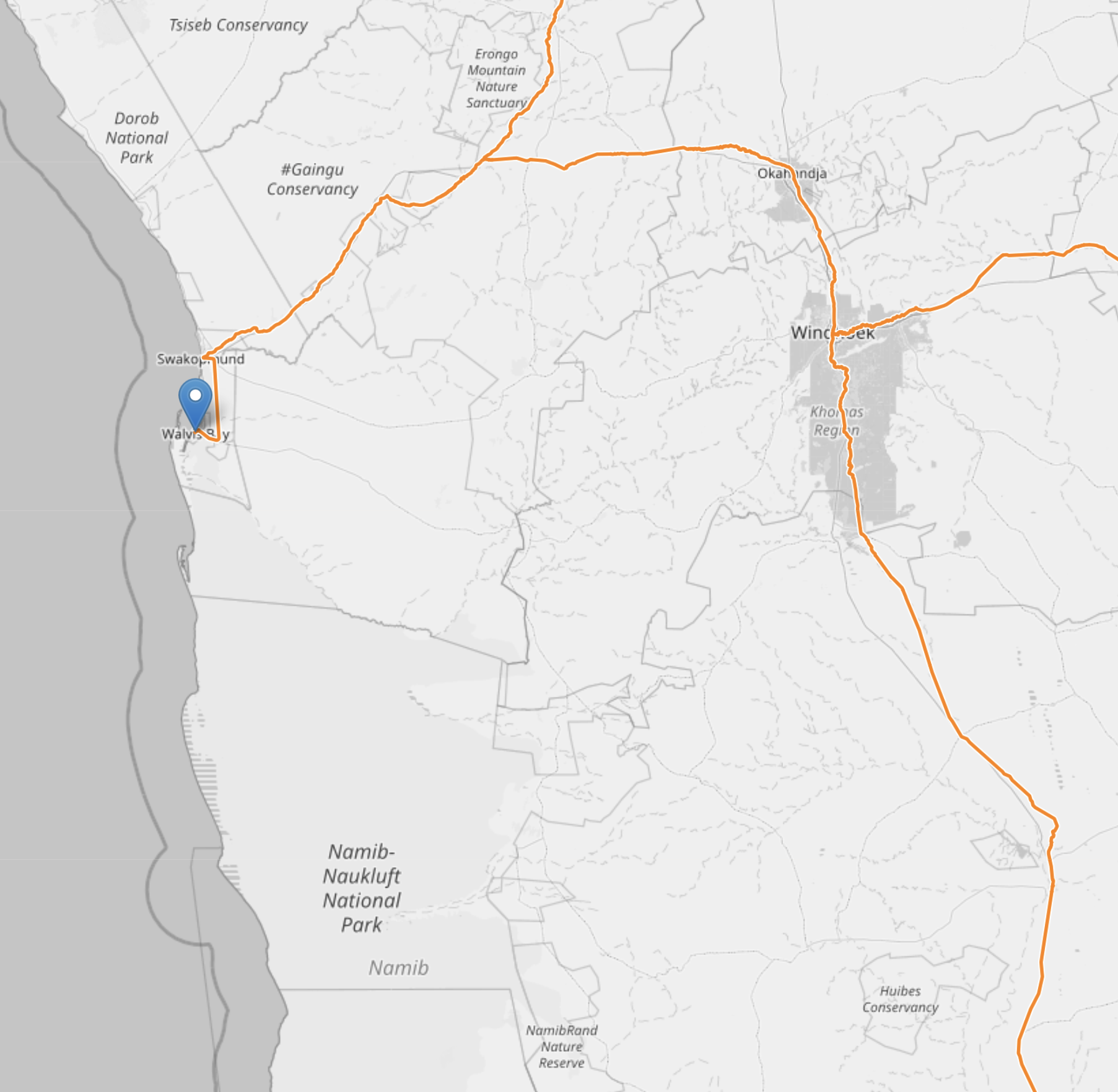
This OpenRailwayMap shows the location of Walvis Bay and Windhoek.
Note.
- Walvis Bay is indicated by the blue arrow.
- Windhoek is East of Walvis Bay, where there is a major railway junction.
- Windhoek and Walvis Bay are about 224 miles apart and a train journey takes between 9 and 11 hours.
It will probably be one of the longest hydrogen-powered rail journeys in the world.
No comments yet.


Leave a Reply