First Engine Start For First Hydrogen-Powered Locomotive
The title of this post, is the same as that of this article in the Windhoek Observer.
These three paragraphs add more details.
CMB.TECH Namibia’s has said the engine start for Namibia’s first hydrogen-powered locomotive represents an important step in the project’s development.
It is the first hydrogen dual fuel engine to be started in Africa and the first hydrogen dual fuel engine to be started in a locomotive worldwide.
The company revealed that a combined team of eight electrical, mechanical and software engineers, together with the engine commissioning engineer, worked into the night to prepare the locomotive for its first engine start.
These are a few points from the rest of the article.
- During the initial run, the BeHydro engine idled for approximately 30 minutes while the team carried out a series of checks.
- This 2,250-horsepower BeHydro dual fuel engine can operate on both diesel and green hydrogen, with the hydrogen to be produced locally at CMB.TECH Namibia’s facility in Walvis Bay.
- Namibia has a large fleet of idled locomotives that can be repowered with this cost-effective and future proof technology.
I first wrote about the Belgian BeHydro dual fuel engine in Green Tugboats? ‘Revolutionary’ Hydrogen Ship Engine Unveiled In Belgium.
Is History Repeating Itself?
Thirty or forty years ago, I was friendly with a steam locomotive enthusiast called Dick.
- Dick and his mates were helping various African countries, get their steam locomotives running again.
- The Chinese had sold Africa lots of diesel locomotives to replace European steam locomotives, that often dated from before the Second World War.
- But now these Chinese diesels were falling apart.
My friend and his mates were dragging the old steam locomotives out of the sidings and getting them going again.
So with a little help from the Belgians, are the Namibians bringing the ancient Chinese diesel locomotives into the net-zero world of the twenty-first century?
More About The Project
These paragraphs in the Windhoek Observerer describe the project.
- The project is the result of a strategic partnership between three companies firmly rooted in Namibia including TransNamib Holdings Limited, Africa Global Logistics and CMB.TECH Namibia.
- TransNamib is responsible for managing and operating the national rail network and freight services.
- Africa Global Logistics (AGL) is an established logistics operator active in Namibia, playing a key role in freight, transport and logistics operations across the country, with a strong focus on strengthening strategic transport corridors.
- AGL also manages operations at the Walvis Bay Multipurpose Bulk Terminal and operates one of Africa’s largest integrated logistics networks, with a presence in over 50 countries connecting ports, corridors and multimodal supply chains.
- These partners will operate Namibia’s first heavy‑duty freight service running on locally produced green hydrogen.
- Initially, 50 round trips will be covered between the Port of Walvis Bay and the Container Depot near Windhoek during the trial period, with the option to extend operations.
- Green hydrogen for the project will be produced off‑grid at CMB.TECH Namibia’s hydrogen plant in Walvis Bay.
Note.
- It seems very much a Namibian project.
- Namibia has plenty of wind and sun to make the green hydrogen.
- Would they be using an efficient process like HiiROC?
This OpenRailwayMap shows the location of Walvis Bay and Windhoek.
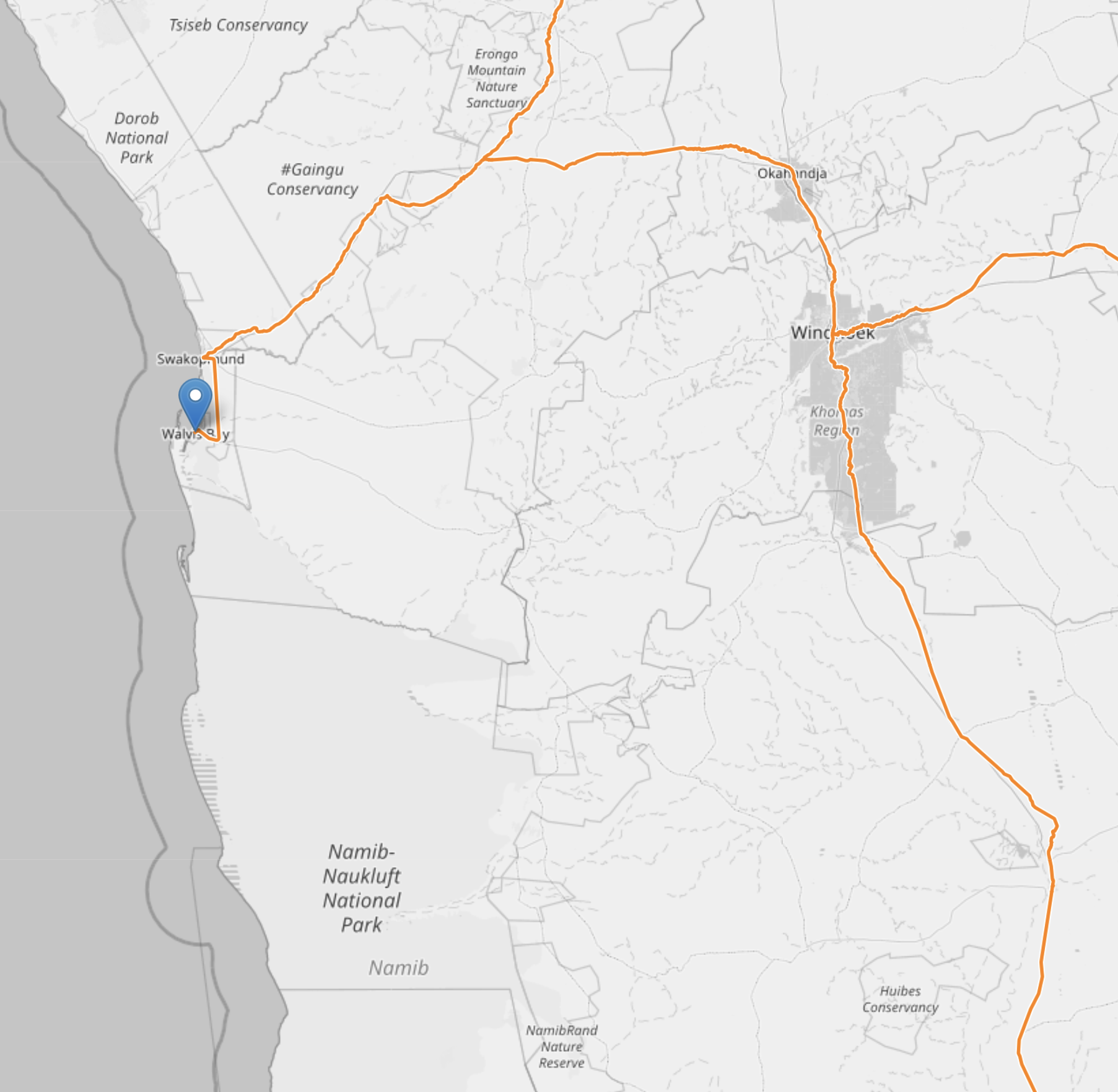
Note.
- Walvis Bay is indicated by the blue arrow.
- Windhoek is East of Walvis Bay, where there is a major railway junction.
- Windhoek and Walvis Bay are about 224 miles apart and a train journey takes between 9 and 11 hours.
It will probably be one of the longest hydrogen-powered rail journeys in the world.
Will We See More Multi-Country Renewable Energy Deals?
In this blog, I have talked about various deals, where two or more countries and/or companies are getting together to generate electricity in one country and transfer it to another, either as electricity or as hydrogen
Examples include.
- The Asian Renewable Energy Hub, which I first wrote about in Vast Australian Renewable Energy Site Powers BP’s Ambitions.
- The Australia-Asia PowerLink, which I first wrote about in Sun Cable’s Australia-Asia PowerLink.
- Fortescue Future Industries will convert cattle stations in Western Australia into renewable power stations.
- The EuroAfrica Interconnector is a HVDC interconnector and submarine power cable between the Greek, Cypriot, and Egypt power grids, which I first wrote about in The EuroAfrica Interconnector.
- The EuroAsia Interconnector is a proposed HVDC interconnector between the Greek, Cypriot, and Israeli power grids via the world’s longest submarine power cable, which I first wrote about in The EuroAsia Interconnector.
- Icelink is a proposed electricity interconnector between Iceland and Great Britain, which I first wrote about in Is Iceland Part Of The Solution To The Problem Of Russia?
- The Morocco-UK Power Project, which I first wrote about in Moroccan Solar-Plus-Wind To Be Linked To GB In ‘Ground-Breaking’ Xlinks Project.
- Namibian Green Hydrogen, which I first wrote about in Namibia Is Building A Reputation For The Cheapest Green Hydrogen.
There are also all the hydrogen deals done by Fortescue Future Industries.
Where Are There Possibilities Of More Multi-Country Renewable Energy Deals?
These are a few serious possibilities.
Argentina
This is an extract from this page on Wind Energy International, which is entitled Argentina.
Argentina has an estimated technical wind energy potential of 300 GW. In southern Patagonia (Chubut and Santa Cruz provinces), average wind speeds range between 9.0 and 11.2 m/s, whereas in the north (Neuquén and Río Negro provinces), wind speeds range from 7.2 to 8.4 m/s. The general average capacity factor for Argentina is 35% and in the Patagonia region it ranges between as much as 47% and 59%. Especially in Northwest Patagonia, locally known as the Comahue region, hydro and wind may seasonally complement each other and.benefit both technologies. One other promising region for wind power development is the Atlantic sea coast.
As I wrote in Australia’s FFI Plans $8.4 Billion Green Hydrogen Project In Argentina, it appears that Andrew Forrest and FFI are already on the ground.
Australia
There are already three major schemes based on Australia and I am certain they will be more. Especially, as Japan, Korea, Malaysia and Singapore will need the zero-carbon energy.
It would appear that except for the Australia-Asia PowerLink, the energy will be transferred as liquid hydrogen or liquid ammonia.
Bangladesh
Bangladesh wouldn’t be on the lists of many, where ideal countries for renewable energy are being discussed.
But, this report on Energy Tracker Asia is entitled The Renewable Energy Potential of Bangladesh, where this is said.
A report investigating the renewable energy technical capacity of Bangladesh found that the country could deploy up to 156 GW of utility-scale solar on 6,250 km2 of land and 150 GW of wind. Offshore wind power would account for 134 GW of this total capacity.
I wouldn’t be surprised to see Bangladesh, supplying renewable energy to the East, with international companies and organisations developing the renewable infrastructure.
I think it should be noted that international companies flock to countries, where the investment opportunities are good. That has happened in the UK, with offshore wind, where many wind farms have been developed by companies such as Equinor, Iberola, RWE and Wattenfall.
Chile
Chile has started to develop the 100,000 square kilometres of the Atacama Desert for solar power and I wrote about this in The Power Of Solar With A Large Battery.
This sentence in the Wikipedia entry for Energy In Chile, illustrates the potential of solar power in the Atacama Desert.
In 2013, Total S.A. announced the world’s largest unsubsidised solar farm would be installed with assistance from SunPower Corp into Chile’s Atacama desert.
I also wrote Chile Wants To Export Solar Energy To Asia Via 15,000km Submarine Cable, about Chile’s ambitions to supply Asia with energy.
Ethiopia
Andrew Forrest of Fortescue Future Industries is on the case, as I wrote in Fortescue Future Industries Enters Ethiopia to Produce Green Energy.
North Africa
Consider.
- The major North African countries of Morocco, Algeria, Tunisia, Libya and Egypt, all have and depend on to a certain extent on fossil fuels.
- There are gas pipelines to Spain and Italy.
- Morocco will be the Southern end of the Morocco-UK Power Project, if it gets developed.
- All five countries have some nuclear power stations.
- All five countries have lots of sun for solar power.
- Some Saharan countries to the South of Morocco, Algeria and Libya could also provide energy from the sun.
- Egypt has substantial hydro-electric power on the River Nile.
- Egypt will be connected to Greece through the EuroAfrica Interconnector.
I believe that a well-designed and co-ordinated project could generate a lot of electricity and hydrogen for Europe and bring much-needed income and employment to North Africa.
I feel that if the Morocco-UK Power Project can be successfully built, then this could create a flurry of activity all over North Africa.
Saudi Arabia
Saudi Arabia has a problem. As the rest of the world moves away from fossil fuels in the next few decades, they will see the revenues from oil and natural gas come under pressure.
But as a rich country, with 2.15 million km² of land and lots of sun, they must have some potential to generate solar electricity.
In the Wikipedia entry for Solar Power In Saudi Arabia, this is said.
The Saudi agency in charge of developing the nations renewable energy sector, Ka-care, announced in May 2012 that the nation would install 41 gigawatts (GW) of solar capacity by 2032.[2] It was projected to be composed of 25 GW of solar thermal, and 16 GW of photovoltaics. At the time of this announcement, Saudi Arabia had only 0.003 gigawatts of installed solar energy capacity. A total of 24 GW of renewable energy was expected by 2020, and 54 GW by 2032.
Wikipedia also says that Saudi Arabia also has nuclear ambitions.
I can see that Saudi Arabia will replace some of their oil and gas exports with green hydrogen.
Green Hydrogen Namibia
The title of this post, is the same as that of this web site.
This is the mission statement on the home page.
With its abundant, world-class renewable energy resources and increasing demand for green hydrogen worldwide, Namibia is quickly emerging as an early entrant in this new market and has ambitions of becoming the leading exporter of Green Hydrogen in Africa.
Namibia is serious about green hydrogen.
Namibia Proposes Green Hydrogen Supply To EU To Replace Russian Oil And Gas
The title of this post, is the same as that of this article on H2 Fuel News.
These paragraphs explain the plan.
The African country has considerable wind and sunshine resources available, providing the opportunity to use renewable energy for the production of H2. Namibia is located along the African South Atlantic coastline and is among the world’s driest countries. Its 3,500 hours of sunshine per year mean that solar panels will be able to absorb a tremendous amount of energy, without much unexpected downtime.
That energy will be used for producing yellow H2, a form of green (renewable) H2 made using electrolysers powered by solar electricity. The electrolyser will split seawater, another abundant resource for the country due to its position on the map. As a result, it has the potential to offer the European Union a clean fuel source that can help it to simultaneously combat the energy crisis and the climate crisis.
Note.
- Liquid hydrogen will be shipped to Europe by tanker.
- I don’t think Vlad the Mad will like the plan!
- How many other countries have the resources like Namibia to become hydrogen exporters?
This plan was proposed at the World Economic Forum at Davos.
The African Nation Aiming To Be A Hydrogen Superpower
The title of this post, is the same as that as this article on the BBC.
It is a fascinating tale of how Namibia aims to modernise its economy, by becoming a major producer of hydrogen using electricity generated by wind and solar power.
Conclusion
Could other countries follow Namibia’s lead?
Namibia Is Building A Reputation For The Cheapest Green Hydrogen
The title of this post, is the same as that of this article on Hydrogen Fuel News.
This paragraph explains the deal that Germany and Namibia have done.
Germany, the largest economy in Europe, has just closed a partnership with Namibia, for a supply of the cheapest green hydrogen. The Southern African country is aiming to produce its H2, made with renewable energy, for prices as low as $1.8/kg. The European nation intends to import massive volumes of what it believes will be the most affordable renewable H2 in the world. It has signed a deal with Namibia that steps up the worldwide scramble to secure the best options for H2 supply connected with substantial renewable installations.
Note.
- Namibia has the ability to produce large amounts of solar and wind energy.
- I suspect the hydrogen will be converted to liquid ammonia for shipment to Germany.
The Gremans are building a large hydrogen terminal at Wilhelmshaven, which I wrote about in Uniper To Make Wilhelmshaven German Hub For Green Hydrogen; Green Ammonia Import Terminal.
Although, Namibia has now been an independent country since 1990, from 1884 to 1915 it was the German colony of German South West Africa.
Hopefully, this deal will work out to the benefit of both Germany and Namibia.

