First Engine Start For First Hydrogen-Powered Locomotive
The title of this post, is the same as that of this article in the Windhoek Observer.
These three paragraphs add more details.
CMB.TECH Namibia’s has said the engine start for Namibia’s first hydrogen-powered locomotive represents an important step in the project’s development.
It is the first hydrogen dual fuel engine to be started in Africa and the first hydrogen dual fuel engine to be started in a locomotive worldwide.
The company revealed that a combined team of eight electrical, mechanical and software engineers, together with the engine commissioning engineer, worked into the night to prepare the locomotive for its first engine start.
These are a few points from the rest of the article.
- During the initial run, the BeHydro engine idled for approximately 30 minutes while the team carried out a series of checks.
- This 2,250-horsepower BeHydro dual fuel engine can operate on both diesel and green hydrogen, with the hydrogen to be produced locally at CMB.TECH Namibia’s facility in Walvis Bay.
- Namibia has a large fleet of idled locomotives that can be repowered with this cost-effective and future proof technology.
I first wrote about the Belgian BeHydro dual fuel engine in Green Tugboats? ‘Revolutionary’ Hydrogen Ship Engine Unveiled In Belgium.
Is History Repeating Itself?
Thirty or forty years ago, I was friendly with a steam locomotive enthusiast called Dick.
- Dick and his mates were helping various African countries, get their steam locomotives running again.
- The Chinese had sold Africa lots of diesel locomotives to replace European steam locomotives, that often dated from before the Second World War.
- But now these Chinese diesels were falling apart.
My friend and his mates were dragging the old steam locomotives out of the sidings and getting them going again.
So with a little help from the Belgians, are the Namibians bringing the ancient Chinese diesel locomotives into the net-zero world of the twenty-first century?
More About The Project
These paragraphs in the Windhoek Observerer describe the project.
- The project is the result of a strategic partnership between three companies firmly rooted in Namibia including TransNamib Holdings Limited, Africa Global Logistics and CMB.TECH Namibia.
- TransNamib is responsible for managing and operating the national rail network and freight services.
- Africa Global Logistics (AGL) is an established logistics operator active in Namibia, playing a key role in freight, transport and logistics operations across the country, with a strong focus on strengthening strategic transport corridors.
- AGL also manages operations at the Walvis Bay Multipurpose Bulk Terminal and operates one of Africa’s largest integrated logistics networks, with a presence in over 50 countries connecting ports, corridors and multimodal supply chains.
- These partners will operate Namibia’s first heavy‑duty freight service running on locally produced green hydrogen.
- Initially, 50 round trips will be covered between the Port of Walvis Bay and the Container Depot near Windhoek during the trial period, with the option to extend operations.
- Green hydrogen for the project will be produced off‑grid at CMB.TECH Namibia’s hydrogen plant in Walvis Bay.
Note.
- It seems very much a Namibian project.
- Namibia has plenty of wind and sun to make the green hydrogen.
- Would they be using an efficient process like HiiROC?
This OpenRailwayMap shows the location of Walvis Bay and Windhoek.
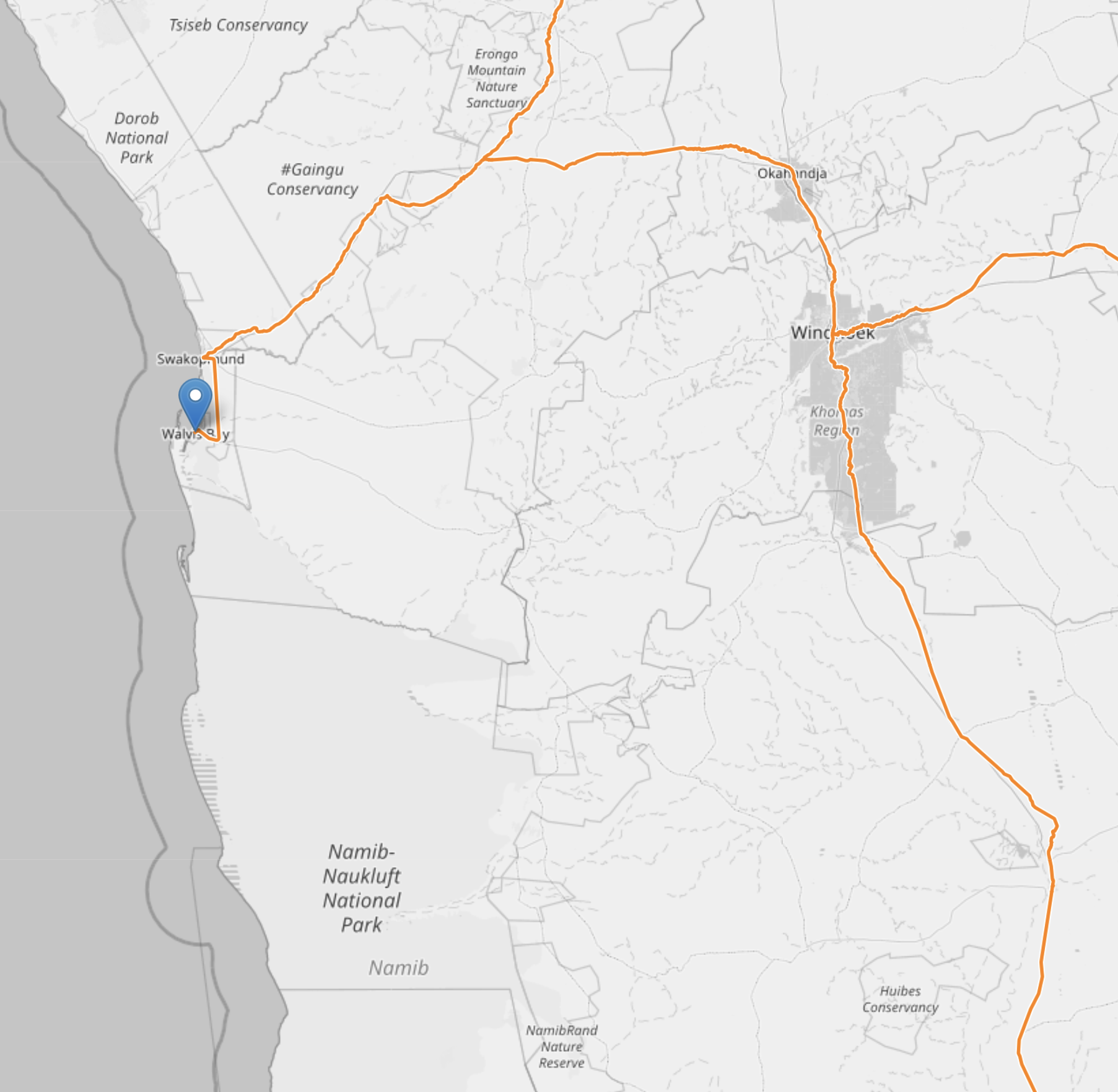
Note.
- Walvis Bay is indicated by the blue arrow.
- Windhoek is East of Walvis Bay, where there is a major railway junction.
- Windhoek and Walvis Bay are about 224 miles apart and a train journey takes between 9 and 11 hours.
It will probably be one of the longest hydrogen-powered rail journeys in the world.
Engine Development At ABC Shaped By Sustainability
The title of this post, is the same as that on this article on Riviera Maritime Media.
This is the introductory paragraph.
Belgian engine manufacturer ABC is supplying the power for a new ‘green’ oceanographic research vessel, while it continues development of a hydrogen engine.
The article then gives a good summary of the progress being made by ABC in developing diesel, dual and hydrogen power for ships, based on their existing diesel technology.
- Their diesel engines will be powering the new Belgian maritime research ship; Belgica.
- They are developing hydrogen engines up to 10 MW.
- They aim to have a hydrogen engine working by Q2 2021.
- They have the capacity to build up to a hundred engines a year.
The company seems to be following an alternative route to decarbonisation, by converting existing large diesel designs to hydrogen.
The article is very much worth a read.
New Four Stroke Engine: Turning Hydrogen Sceptics Into Believers
The title of this post, is the same as that of this article on Riviera Maritime Media.
This is the introductory paragraph.
A new medium-speed, dual-fuel engine will underpin the use of hydrogen as fuel for coastal shipping and cold ironing applications.
Coastal shipping I understand, but what is cold ironing?
Thank heaven for this Wikipedia entry, which has this introduction.
Cold ironing, or shore connection, shore-to-ship power (SSP) or alternative maritime power (AMP), is the process of providing shoreside electrical power to a ship at berth while its main and auxiliary engines are turned off.
The article says this under a heading of Cleaner Cold Ironing.
Mr Saverys believes ports can also benefit from using Behydro engines for cold ironing applications: “We actually think that a mobile electricity solution along the quay is much, much cheaper and more flexible than pulling electricity cables at every single terminal.”
He envisages the mobile solution as either land-based or barge-based: “More and more, we have to go to zero emissions in port. In Rotterdam, Hamburg and Antwerp, we realised we should look at a more flexible and cheaper solution.”
The article also says that the dual fuel (hydrogen and diesel) engines have marine, rail and power generation applications and they can build engines up to 10 MW.
Green Tugboats? ‘Revolutionary’ Hydrogen Ship Engine Unveiled In Belgium
The title of this post, is the same as that of this article on Business Green.
This is the first paragraph.
A “revolutionary” hybrid ship engine powered by green hydrogen and diesel has been unveiled today in Belgium, with developers claiming the innovation could cut CO2 emissions from ships, trains and electricity generators by up to 85 per cent.
The engine has been given the name BeHydro.
The first order has been received by the developers; ABC, for two 2MW dual fuel engines that will be installed on a hydrogen-powered tug for the Port of Antwerp.
Motors up to the size of 10 MW are under development.
This is the last sentence of the article.
In theory, any large diesel engine can be replaced by a BeHydro engine. The hydrogen future starts today.
It is a quote from the CEO of one of the companies involved.
Conclusion
This is a development to follow.
The BeHydro engine, with its dual-fuel approach, is claimed to cut carbon emissions by 85 %.
In the Wikipedia entry for ABC or Anglo Belgian Corporation, there is a section called Products. This is a paragraph.
The engines are found in use on large river barges such as those found on the Rhine, coastal freighters, fishing boats, ferries, tugboats (which typically use 2 engines), and other ships. Other applications include electricity generation, and pumping engines, engines for cranes, and locomotives (including the Belgian Railways Class 77 and Voith Maxima), as well as dual fuel (gas/oil) DZD engines.
I feel that that the BeHydro engine will keep the company busy.

