How Much Water Vapour Is In A Cubic Metre Of Air at A Given Temperature And Relative Humidity?
I needed to know this as if I knew the temperature and relative humidity in my bedroom, when I went to bed and got up, I could work out how much water vapour had transferred to or from the air during my sleep.
One of my friends at school is an expert on these sort of calculations for industrial clients.
He came round on Friday night and we discussed it through, but I don’t think I got more than a basic grasp.
The reason is that he works from charts, whereas all my working life, I’ve started with proven formulae and worked everything out from first principles. But then I trained as a Control Engineer.
A problem I had with the psychometric charts he uses, is that they are all in a measurement system, that is totally foreign to me – Imperial. This is because most of the publishers are across the pond and they still use units, I last used in my early teens. When I went to work at ICI in the late sixties, the company had metricated in 1955 or so.
At least after our meeting and discussion, I now know what I’m searching for.
I finally found this web page, which gives a table of saturated vapour density for water in air. Although, it’s an American web site, at least it gives this in gm/cu. m.
The web page gives the SVP in gm/cu. m. at various temperatures
- 0°C – 4.85
- 10°C – 9.4
- 15°C – 12.83
- 20°C – 17.3
- 25°C – 23
- 30°C – 30.4
- 37°C – 44
- 40°C – 51.1
As an illustration, suppose you have a temperature of 25°C and a relative humidity of 50%. I measure it on my Maplin meter.
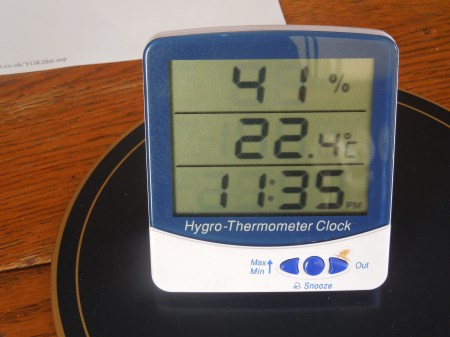
Maplin Hygro-Thermometer
At that temperature a cubic metre of water can hold 23 grams of water. But as the relative humidity is 50%, it is actually only holding 11.5 grams of water. As my bedroom is about five metres square and two and a half metres high, that means the room contains over 719 grams of water.
Now look at 30°C and the same relative humidity of 50%.
The same calculation gives 950 grams of water in the room.
So if with the central heating, the electric blanket and the fact that each person probably is equivalent to a one bar electric fire, your bedroom, about the same size as mine, goes from say 25°C to 30°C, the air will need another 230 grams of water to be in equilibrium, or in layman’s terms, happy with how it relates to everything.
So from where does the air get this water it needs?
You!
No wonder a lot of people go to bed with a night bucket, so they can replenish the fluid they’ve lost to the air.
Scatty Middle-Aged Mum ‘Reborn As Jihacker’s Wife’
This is the headline to a large piece in the Sunday’s Times, describing how a white female convert to Islam is tweeting offensively from land controlled by the Islamic State.
Surely, many of those who have gone to support the cruel and extremely violent regime in the Middle East would be how those that are best described as several bricks short of a full load.
Are we building enough secure mental hospitals?
A Surprisingly E-Mail From A Lady
I just had an e-mail from a well-brought up lady, which mentioned the word, Arseblog.
It’s not about what it could be, but the name of a blog, that provides text commentary for the well-known London team, that she supports.
Peterborough Station’s Litter Bins
I came across these bins, when I changed trains at Peterborough.


What a wonderful example of simple, good design.
If this doesn’t nudge people to put their rubbish in the right bag then nothing will.
Match Five – Derby 1 – Ipswich 1
Derby is one of the easier grounds to get to from the excellent rail station, in that it’s just about a walk of about ten minutes.
Today though, I went via Oakham to have lunch with a friend, so I had to change trains twice at Peterborough and Leicester. Both changes were the ones that should be avoided, where you have to climb up one set of steps and then down to another platform. There were lifts, but in some places on the rail network, we’re seeing reorganising, that mean the up and downs are minimised. We need more innovative thinking.
Oakham is a small simple station, with a pub and brewery attached, so it’s a good place to meet for business or pleasure.
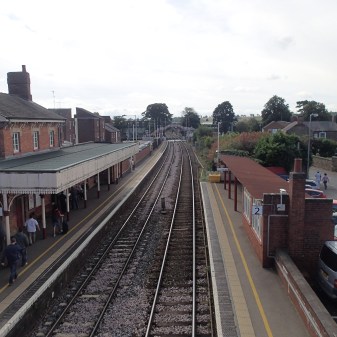
Oakham Station
The picture shows the station from the footbridge. In the distance you can just see the infamous level crossing, that is a pain to people living in the town. The signal box there was used as a model for the Airfix kit.
After an excellent lunch at the Finches near Oakham, I arrived a few minutes late at Derby and thought I’d buy my return ticket before the match.
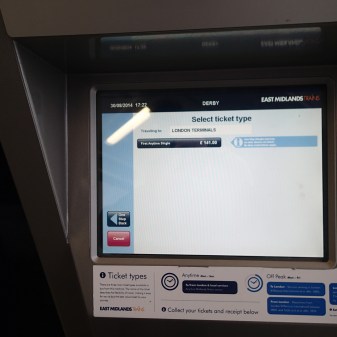
£141 – You Must Be Joking!
This was the only ticket offered by East Midlands Trains. A First Anytime Single at £141.
For Ipswich fans, the match was overshadowed by the news that David McGoldrick is leaving for Leicester. If he had played, the result might have been different as a couple of chances missed in the second half, were possibly the sort, he wouldn’t have missed.
But if Mick McCarthy has got the reported eight million for McGoldrick, then turning round the player’s career and getting half a season out of him for Town, has been good business for all concerned. Let’s hope Mick can resurrect Conor Sammon‘s career in the same way.
The match was enlivened by the debut of Ted Bishop, who after a quiet first half, started to create trouble for Derby in the second half. In dealing with him in one instance, Derby gave away the free kick that led to Ipswich’s equaliser. One shot from distance and another he had when he came on as a substitute at Crawley, show that he might have some serious talent in the future as a scorer from midfield, in the manner of Matt Holland. In some ways, the shot today, was reminiscent of some from Ipswich’s legend Ted Phillips, who I saw score several goals in the early 1960s.
When Bishop tired, he was replaced by Alex Henshall, who showed he could torment the Derby defence.
So two youngsters with a combined age of 38, showed the Ipswich fans, that this season might not be in the dire mould of some of recent memory.
I eventually got home with a ticket that cost £42.90, which was just forty pence more than their on-line price and £2.70 more than the sum of my two tickets to get to Derby. But why don’t East Midlands Trains make their ticket machines easier to use. The trouble was that I tried to buy a ticket via EMTrains, rather than Any Permitted Route on the machine. But as East Midland Trains was the operator I needed for London, surely my choice was logical.
Incidentally, on the train to London, I sat with a Derby fan, who said that for Tuesday night matches he reluctantly had to drive, as there is no late London-bound train after the match.
I don’t find East Midlands Trains good value and avoid them, if I possibly can.
Disappearing Balances
One of my old school friends came round last night for a drink and a chat. At one point, I used my letter balance to weigh something.
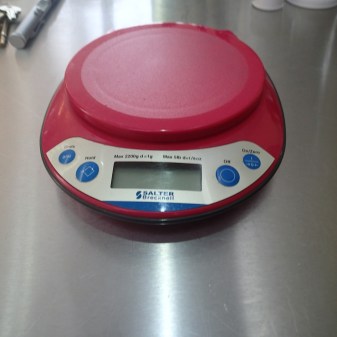
My All-Purpose Balance
They said, that at the University, where he works, they have given up on expensive weighing machines and now use cheap letter balances, as the students nick them, to weigh out their drugs.
Such is University life these days!
Forward Thinking In Liverpool
As a Londoner, I have always been fascinated with the City’s transport system. I have watched it develop and grow for over sixty years, from the days of trams and trolley buses through the classic Routemaster buses and the birth of the Victoria Line to the present day. London always seemed to have some sort of plan, even if sometimes some of them like the Bakerloo Line extension to Camberwell don’t get implemented and some like bendy buses were a mistake. In some ways one of the best parts of London’s transport system, that has grown over these years has been its coherent and understandable non-electronic information system, which is second to none in the world.
When I first went to Liverpool in the 1960s, the local train system was old and decaying and although the buses were generally younger than most of London’s, the only way to find how to get to different parts of the city, was find out your bus route before you started. It was the same in London in those days, but now generally turn up at any bus stop, train or Underground station in the capital and want to go a particular tube station and you can easily find the route.
Liverpool, Manchester, Birmingham and most of our large cities, still have public transport systems that are fairly incomprehensible to a visitor, who perhaps just wants to get to the hospital to see their Auntie Gladys.
I have never seen something as basic as a decent pedestrian or bus route map at a bus stop outside of the capital.
Could London’s obvious superiority in this area and others in particular, be down to London having an overall transport body, whose origins go back almost a hundred years? Part of Transport for London’s genes say that you must make the best of what you’ve got and that all design must be top class, even if you can’t afford the best architects and designers.
Most conurbations outside London don’t have overall transport bodies with such a heritage. They also often seem to allow the train and bus companies to go off in their own directions, rather than one that is best for everyone.
As an example, ask any visitor to London, how many bus companies there are. They will probably say one. Which is not true as there are several, who each run a number of routes to the same rigid standards laid down by Transport for London. How many areas outside London have a joined-up transport system?
Merseyside is slightly different, in that many of the local rail routes are run under the name of Merseyrail, in much the same way as the London Overground. It is system that seems to serve the city and its visitors well.
I was pleased to see on Global Rail News, that Liverpool is developing a thirty year rail plan. Here’s the first part.
The Liverpool City Region has worked with Network Rail to draw up a 30-year plan to improve passenger and freight rail links.
The Long Term Rail Strategy outlines 12 high-priority rail projects for the city and surrounding area designed to improve both suburban and intercity rail services.
Are other cities so forward thinking? I shall get hold of their plan and explore it.
Another Talking Statue
I took this picture of the war memorial on platform one at Paddington station.
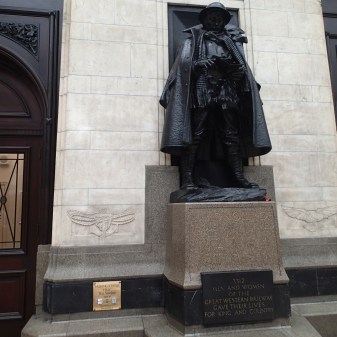
Another Talking Statue
A voice track has now been added.
It’s All About Votes!
The phone-in on Radio 5 this morning was about child abuse and the Rotherham scandal in particular.
It was generally informative, but it livened up at the end, when a Muslim of Pakistani orgin from Rotherham denied the facts of the court case, where several men of Pakistani origin were found guilty and jailed.
Then a member of the Labour Party in Rotherham described meetings of the local party, where members tried to ask questions about the scandal, only to be shouted down.He then finished by saying how certain Asian councillors deliver several thousand votes and make sure Labour win.
Politicians of all parties have courted minorities and interest groups, as long as elections have been contested. But in this case, a group’s baggage has been discounted in favour of votes and power.
This must not be allowed to happen.
Do We Really Need A New London Airport?
The Guardian is running a report this morning, about the resignation of the Mayor of Berlin. This is the first paragraph.
Klaus Wowereit, the openly gay mayor who turned Berlin into a capital of cool, announces intention amid delays to new airport
If you read the Wikipedia entry about the new Berlin-Brandenburg airport, you’ll see a large number of problems.
It looks like to me, that Berlin has bitten off more than it can chew with this airport.
So would it be the same if London decided to build an airport in the Thames Estuary? Or anywhere else for that matter?
I think that we’re in some ways trying to make a decision about new airport capacity in the South-East, before all the things we’re doing now have had time to settle down.
The aviation industry obviously wants more airport capacity, as it will make the aerospace, airline and airport companies larger. And Directors, Senior Managers and Shareholders would like that, as it would enrich them. Just as British Airways has merged with Iberia, will other mergers happen, that will effect our decision on airport capacity. The shape of the airline industry will be driven by the desire to get bigger and also American companies wanting to be more tax efficient.
The airlines too, will be bringing in lots of new aircraft. If we take the example of replacing say an A330/A340 with an A380, this will probably increase the passengers going through an airport for the same number of aircraft movements. Even small airliners like the Airbus A320 and Boeing 737 are squeezing in a few more passengers every couple of years or so.
So in the future we may need several more terminals. But perhaps only one extra runway! If that!
We also don’t know what the air passenger market will be. If I read the travel pages of serious newspapers, you find that the self loading cargo is restless and complains about everything from drop-off and parking charges to security delays. Even Ryanair is introducing a Business Class. Things are changing and in some ways, I think I’m typical of the new breed of passenger. I go to and from the airport by train, I only carry hand baggage and if it is available, I can afford to travel Business Class. Incidentally, I’ve had five or six outward flights from the UK this year and only one inward.
In some ways the most interesting flight I had was to Iceland, for my holiday. Many of the travellers I met, were going between North America and Europe and were having a holiday and flight break on the island. I never liked long flights and would often go to Houston or California, by changing planes at Boston.
So I think we’re going to see passengers demanding flexibility in how they book flights and they’ll adjust their schedules to make the most of the awful experience of sitting in an aluminium tube for several hours.
With the growth of low cost airlines, have we in the UK changed our pattern of holidays and swapped long haul holidays for several short-haul ones.
I believe that every flight that can be avoided should be. After flights this year, I think my days of travelling steerage are over.
All the vested commercial interests also ignore the herds of wildebeest and zebra in the room. Trains in the UK will shape our airports policy more than anybody predicts.
Manchester is now the UK’s third busiest airport. With the Northern Hub rail developments and the expansion of the Metrolink tram, the airport is getting much better connectivity. Already, electrification in the area, has allowed new electric trains to connect the airport directly to Glasgow and Edinburgh.
Heathrow gets Crossrail and Gatwick gets an updated Thameslink in 2018/2019, which coincidentally is the date when the Northern Hub developments will be substantially complete.
If you look at the top ten airports by passengers, only Glasgow and Bristol don’t have a rail link, although Glasgow may be getting one. But then Glasgow’s trains need a good sorting out, as I discussed here.
I think by the end of this decade, that a much higher percentage of passengers will go to their departure airport by public transport, mainly because of more frequent and passenger friendly tram and rail links. Although the way airports see motorists as cash cows will help.
And then there’s the elephant in the room of the Channel Tunnel Rail Link. By now, London should have been linked to at least Amsterdam and Cologne, in addition to the current destinations. I wonder sometimes if there is lack of political will in the various governments to get more services through the tunnel. Or is our policy determined more by the British government discouraging immigrants than providing a proper rail service?
All of these factors must be allowed to settle before we decide if we need any more airports or runways in the South East.
 The Anonymous Widower