Starting To Program Again!
I have had, this idea for a mobile phone app and as before my stroke, I was a more than capable hack programmer, I think I might program it myself.
I notice there are systems that allow the creation of apps, that work on all platforms, so feel that this would be the way to go, as if it’s one thing I hate it’s having anything to do with Apples and their alien money-grabbing ideas.
I don’t even like the fruit!
Any help would be appreciated!
The New And Updated Platforms 13 to 16 At Manchester Piccadilly
I have been looking to see if I can find anything more about what is happening to update platforms 13/14 and create new platforms 15/16 at Manchester Piccadilly station.
I found this image on the Network Rail web site.
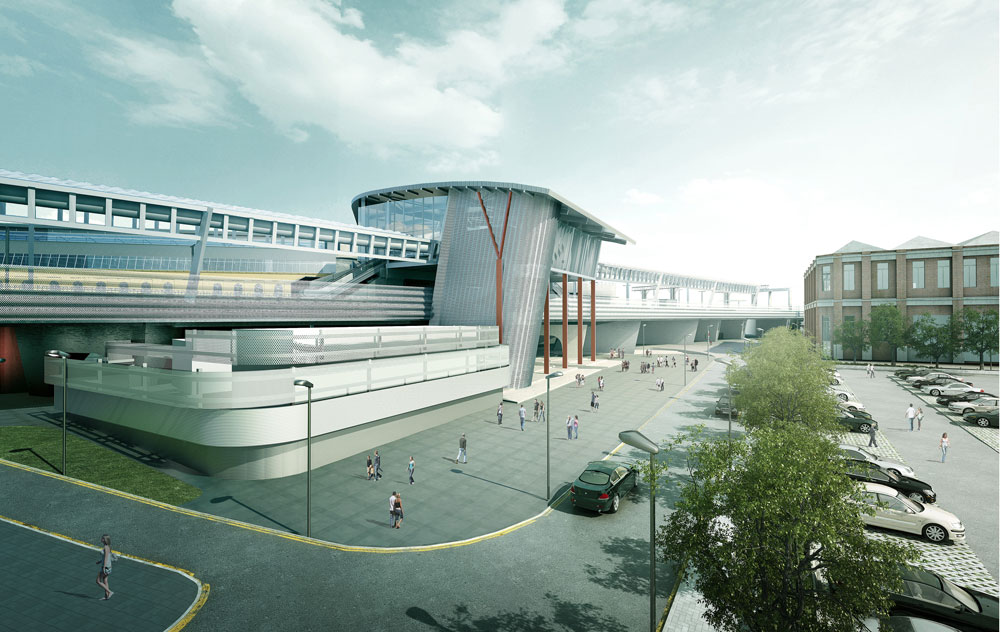
Proposed Platforms 13-16 At Manchester Piccadilly Station
I think it shows the way that Network Rail are thinking.
- A second entrance to the station.
- Does the entrance lead underneath all of the platforms?
- Lots of escalators.
- A proper gateway station for Manchester, opening on to an open space.
- Is that a public space like a restaurant on top of the tower?
The picture does show that there are possibilities to create a very good building to serve platforms 13 to 16.
Masts Are Sprouting On The Goblin
I took these pictures of the new electrification masts going up on the Gospel Oak to Barking Line (GOBlin)



The piles seem to be very strong, but the masts are a touch more dainty, than those on the Great Western Main Line.
Abbey Wood To Romford In Forty Minutes
I didn’t believe this figure when I calculated it yesterday, so I’m laying it out properly.
Crossrail have said that the two Eastern branches of the line;Abbey Wood and Shenfield will both run a dozen trains an hour.
- Whitechapel to Abbey Wood would take 15 minutes
- Whitechapel to Canary Wharf would take 3 minutes
- Whitechapel to Romford would take 24 minutes
- Whitechapel to Shenfield would take 38 minutes
- Whitechapel to Stratford would take 5 minutes
These times are from Crossrail’s journey time calculator.
But obviously, when changing trains at Whitechapel to go from say Abbey Wood to Romford, you’d have to wait for the next train going the other way.
So as there are twelve trains an hour in the peak, that would mean a wait of up to five minutes.
Or would it?
All the trains on Crossrail will be tightly controlled to keep to an exact schedule, so that twenty-four trains an hour can go through the core tunnel between Whitechapel and Paddington. Think Victoria Line with full-size trains carrying fifteen hundred people a train.
So if it was timed that trains from Abbey Wood turned up at Whitechapel at 0, 5, 10, 15 etc. minutes past the hour and trains left Whitechapel for Shenfield at say 1, 6, 11, 16 etc. you’d have a minute to walk a few metres across the platform to await the arrival of your onward train.
Trains from Shenfield could arrive at Whitechapel at 2, 7, 12, 17 etc. with trains leaving for Abbey Wood at 3, 8, 13, 18 etc.
Obviously, the flow of trains to and from the West would have to be at precise frequency of twenty-four trains per hour or one train every two and a half minutes.
I think trains could be timed to the second!
These train times of mine are just speculation, but I can’t see why the interchange at Whitechapel needs to take more than a minute.
So adding up the times to Abbey Wood and Romford from Whitechapel with a minute for the change gives 15+24+1 = 40.
Stratford to Canary Wharf would take 3+5+1 = 9, which is the same time as on the Jubilee Line.
The East of London doesn’t know the revolution that will be happening to their lives.
Whitechapel station will truly be the Jewel In The East and one of the most important transport interchanges in the UK, let alone London.
A Railway Station With A View
Tattenham Corner station is the nearest station to Epsom Downs racecourse and is just a short walk from a view point from where I took these pictures.




The station is in Zone 6, which is in Freedom Pass territory, so it is an easy place to go for a walk.
Bermondsey Dive-Under – 10th April 2016
The Bermondsey Dive-Under is coming on and it’s looking to be a very substantial construction.


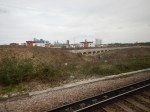
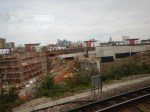



If you want to see it, take a train from New Cross Gate station to London Bridge station and it’ll be on the right of the train, just after you pass SELCHP.
The map from carto.metro.free.fr shows the lines in the area.
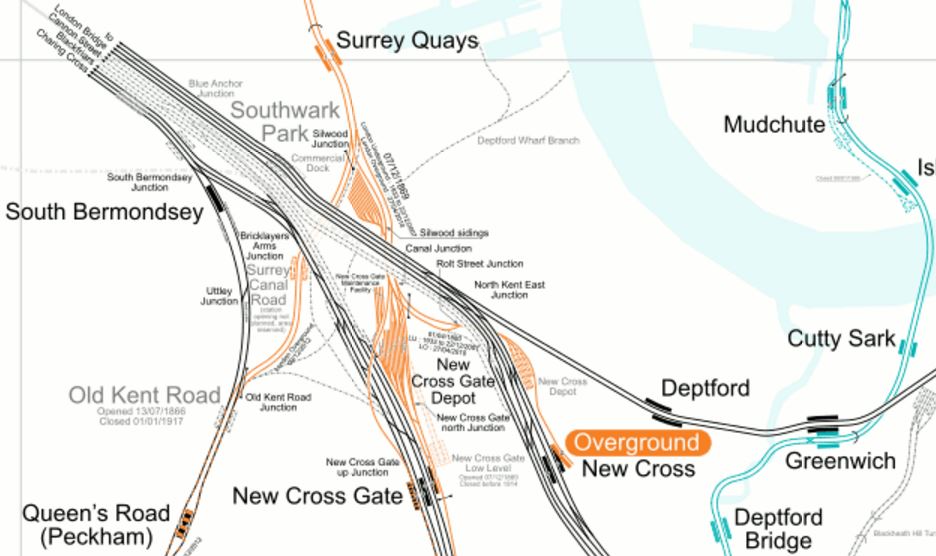
The BermondseyDive-Under
Note the dive-under is all the dotted lines between South Bermondsey and Southwark Park stations.
Reversal Stations
In Crossrail In East Docklands, I said this about Whitechapel station.
Whitechapel station will be Crossrail’s Jewel In The East and the most important interchange for the line in East London.
- It links both eastern branches of Crossrail to the Metropolitan and District Lines.
- It provides an interchange to London’s important but sometimes forgotten East London Line.
- An extended Whitechapel station would provide much better access to the East of the City of London.
But perhaps more importantly, Whitechapel is the reversal station for passengers travelling between one Eastern branch of Crossrail and the other.
A reader has asked me what I mean by a reversal station.
Look at this map from carto.metro.free.fr, which shows the lines around and through Whitechapel.
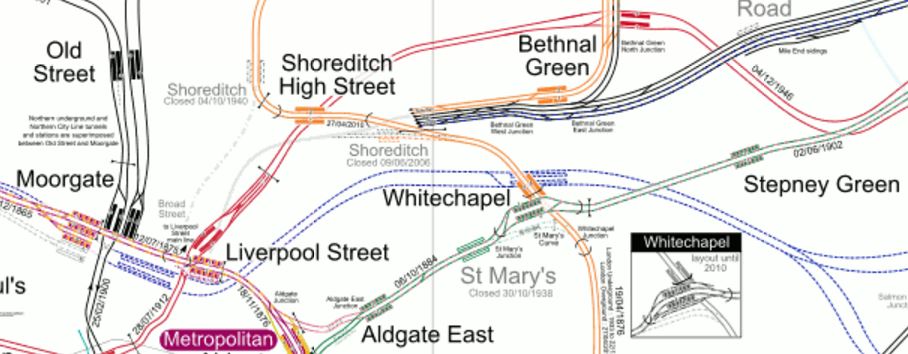
Lines Through Whitechapel
The Crossrail tracks, which are shown in blue, come from the West and go through the two platforms at both Liverpool Street/Moorgate and Whitechapel, before dividing into the two branches to Abbey Wood and Shenfield, a mile or so South of Stepney Green.
Note.
- Liverpool Street and Moorgate will share a massive doubled-ended Crossrail station with an island platform, that connects to all the lines at the two stations it connects.
- Whitechapel has a massive underground station with another island platform, where all Eastbound trains use the North side of the platform and the Westbound trains use the South.
I call Whitechapel a reversal station, as it means that any passenger arriving from the East wanting to go West on the other branch, just walks across the platform and gets an appropriate train.
As a dozen trains an hour will be using each branch, that means the maximum wait will be five minutes, but if say the trains were timed to pair up at Whitechapel, so that an Eastbound Shenfield train was always in the station with or just after a Westbound train Abbey Wood and vice-versa, the interchange time would be determined by how long it took passengers to walk across.
The interchange is totally step-free for transferring passengers and can be paired with a very wide platform to make the interchange easy for everyone.
It is a simple but absolutely brilliant concept!
The designer of the station obviously liked it so much, he did it again at Whitechapel.
Arrive at Whitechapel on an Eastbound Metropolitan or District Line train and if you need to go back West on the other line, you just walk across for the train you want. These trains don’t pair up, but then the signalling wasn’t designed to be this sophisticated in the middle of the last century.
This interchange on the Sub Surface Lines has only started recently and I wonder how often it is used by passengers.
Are there any other stations, where this passenger reversal is or could be used?
Hayes And Harlington
A similar technique could have been used at Hayes and Harlington station to link the two Western branches of Crossrail, which have the following services.
- Four trains per hour serve the Heathrow Branch.
- Two trains per hour serve both Reading and Maidenhead.
But using a similar layout to Whitechapel with a spacious island platform and scheduling the trains appropriately, might effectively give Reading four services an hour to Heathrow, which would involve nothing more than a step-free interchange at Hayes and Harlington.
It would certainly have been more affordable than tunneling into Heathrow from the West.
This map from carto.metro.free.fr shows the lines through Hayes and Harlington and the Junction for Heathrow.
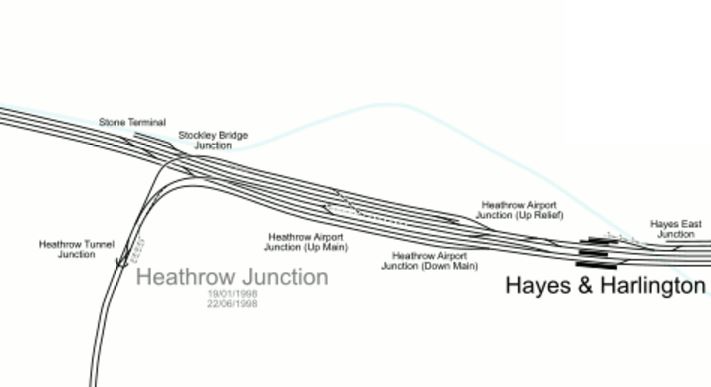
Lines Through Hayes And Harlington And Heathrow Junction
It’s probably too late now to adjust all the tracks and platforms at Hayes and Harlington station and the Stocley Viaduct, but I do believe that something could be setup at the station to improve access to Heathrow from the West until the full tunnelled link is built.
I believe that good design here, could have enabled a much more affordable Western Link for Heathrow, without any need to tunnel into the Airport.
An ideal solution would incorporate.
- Two tracks into Heathrow.
- Step-free and preferably step-across interchange at Hayes and Harlington station for passengers from Reading.
- Connection to Great Western Railway’s local trains in the Thames Valley.
- Contactless ticketing using bank cards between London, Heathrow and London.
- All Crossrail trains from London to serve all terminals.
Point five must be possible, as I’m sure the tunnels under Heathrow have a larger capacity than is being used.
But Heathrow are holding Crossrail, London and Londoners to ransom!
But then we hold all the cards, as no Mayor and few Londoners, would ever support the expansion of Heathrow!
This Google Map shows the current Hayes and Harlington station.

Hayes And Harlington Station
This description of platform use is from Wikipedia.
The station has five platforms, four being through platforms and one being a terminus bay platform. Platforms 1-2 are used only during engineering works; platforms 3 & 4 are for stopping services to and from Heathrow Airport, Reading and Oxford; platform 5 is a bay terminus platform, which is sometimes used during peak times, amended services and during engineering works. Platform 5 is capable of holding an eight-car train; platforms 2, 3 and 4 can hold seven-car trains and platform 1 can hold a five-car trains. All lines at Hayes & Harlington are electrified. On platform 5 there is an alternative entrance leading to High Point Hayes, the entrance has Oyster Pay & Go readers, platforms 3 & 4 are connected by a bridge towards the end of the platforms.
Stations are numbered from the South.
What would need to be done is create an island platform between the two relief lines that will be used by Crossrail.
This would mean that a passenger between Heathrow and Reading, would just walk across the platform and wait for their train. As at Whitechapel, the first train would arrive a few minutes before the second left. It would be easy to arrange with Crossrail’s modern signalling and train control.
Under Crossrail in the Wikipedia entry for the station, these modifications are listed.
- New station building
- 4 new lifts to provide step-free access
- Platforms 1-4 extended
- New 200m bay platform 5 constructed (replacing existing bay)
- New platform canopies to platform 4 and 5
- Track work to widen the island platform 2/3 and to provide access to the new bay platform
Does point six mean that Platform 2 is Crossrail for Reading and Heathrow and Platform 3 is Crossrail for London?
I hope so, as that would give a step-across interchange between Reading and Heathrow.
But there is no mention of the layout of the two fast lines, which are currently served by platforms 1 and 2.
In Hayes And Harlington Station – 28th March 2016, there are several pictures of the station and the lines don’t appear to have been slewed to the South to enable the Crossrail Lines to be either side of an enlarged island platform 2/3.
It was probably just too difficult.
Old Oak Common
There are proposals to add a branch of Crossrail that would go up the West Coast Main Line to perhaps Milton Keynes. The logical place for Crossrail to join the West Coast Mail Line (WCML) is near Old Oak Common station.
I believe this could be another reversal station like Whitechapel, where the Western and WCML branches split to the West of the station.
This map shows some of the proposed track and station layout at Old Oak Common.
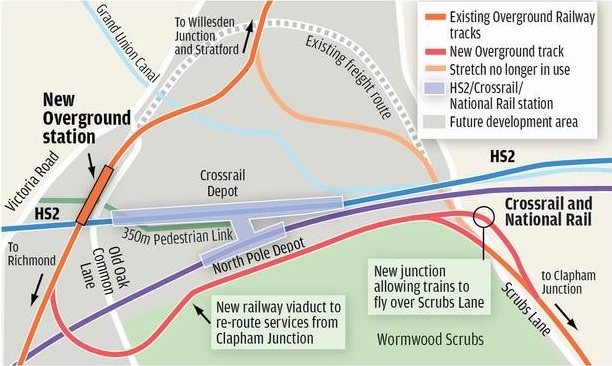
Rail Lines At Old Oak Common
The WCML is off the North of this map.
Get this connection right and there would be step-across access between the WCML to Milton Keynes and all stations to Heathrow on Crossrail.
Willesden Junction On The North And West London Lines
The North London and West London Lines divide to the west of Willesden Junction station.
Passengers between say Richmond and Imperial Wharf stations can use Willesden Junction station as a step-across to reverse direction. The timetable gives five or six minutes for the change, which is acceptable, but not as quick as I believe Whitechapel will be.
St. Pancras Thameslink
When the Thameslink Programme is completed, the Thameslink platforms at St. Pancras International will become a reversal station for passengers wanting to change between the Great Northern and Midland Main Line branches.
But it will not be a simple walk across a platform, but a hike over a footbridge, albeit one with step-free access.
The only Central London station on Thameslink, which will be an island platform will be London Bridge, where platforms 4 and 5 will serve Thameslink.
East Croydon
In an ideal world all Northbound Thameslink services at East Croydon station would call at the same island platform and all Southbound services would call at the opposite face of the island. I think that sixteen trains per hour will use the various Thameslink routes through East Croydon. On a dedicated platform, that is only one train every four minutes and the East London Line handles that with ease!
I think that the number of Thameslink trains through East Croydon is not very ambitious, in contrast to the number through the core of twenty-four trains per hour, which is ambitious, but not unduly so!
But I can’t find any information as to whether this will happen.
Where will passengers wanting to travel between Caterham and Tattenham Corner stations change trains?
It does strike me, that the care applied to the design of Crossrail, is lacking in the Thameslink Programme.
They obviously used ordinary envelopes, rather than special engineering ones!
Just compare the mess that is East Croydon station to the much larger, more complicated and impressive Reading station.
If Croydon is serious about being important, it needs a gateway station like Ealing Broadway, Huddersfield, Leeds, Liverpool, Manchester Victoria, Northampton, Nottingham, Stratford or Reading, rather than an overcrowded badly-designed stop on the Brighton Main Line, that just makes visitors say, they’ll never return.
East Croydon also needs a proper connection to the East London Line. The current terminus of West Croydon is one of the worst designed pieces of railway infrastructure in the world. It’s equivalent to putting a main station for Liverpool in Birkenhead or one for Newcastle in Sunderland.
West Croydon station should be shut as soon as possible and East London Line services transferred to East Croydon.
Manchester Piccadilly
Whilst I’m in attack-dog mode, the two worst platforms in the country are platforms 13 and 14 at Manchester Piccadilly station.
- These platforms were designed to get passengers as fit as possible, by locating them some distance from the main station facilities.
- They are too small and always crowded.
The plans to remedy the overcrowding, include building two new platforms further out at great expense.
This may solve the problem, but I’d like to see answers to these questions first.
- How many trains per hour stop at each platform? A platform like this should be able to handle sixteen trains per hour both ways, as does Canada Water on the Overground.
- How many passengers use this island platform to reverse direction?
- How many passengers get off one train here and get on another in a few minutes? I’ve done that myself on those platforms, a few times.
- How would platform utilisation change with two and three-car trains changed for larger ones?
- Could a reorganisation of services and the Ordsall Curve, increase seats on various routes, but reduce the number of trains through these platforms?
- What difference would contactless ticketing using bank cards make to passenger throughput?
- Is it necessary that every train stopping at Piccadilly always seems to stop at Oxford Road?
As an aside here, I could rightly claim that I’ve written more successful resource scheduling programs, than anybody else ever has!
I know it was designed in the 1960s, but I believe that by applying some modern data analysis and desjgn, that platforms 13 and 14, with more space, escalators and lifts everywhere, better facilities and perhaps a direct entry to the Metrolink station underneath, could go a long way to handling more traffic.
Green Steel
This article on the BBC is entitled Tata Steel: Would-be UK buyer Liberty’s jobs hope.
Sanjeev Gupta, the head of the Liberty Group, is reported as saying this.
We would look to transition from blast furnaces to arc furnaces, from imported raw material to domestically available scrap, from making carbon steel to making what we call green steel – melting and recycling scrap using renewable energy.
As I heard the quote on the radio, I can verify that it is more or less correct.
I don’t know, whether what Mr. Gupta said can be achieved, but it strikes me that it is a feasible idea.
The High Speed Metro Train
According to the Wikipedia entry for High-Speed Rail, the European Union Directive 96/48/EC, Annex 1 defines high-speed rail in terms of
- Infrastructure: track built specially for high-speed travel or specially upgraded for high-speed travel
- Minimum Speed Limit: Minimum speed of 250 km/h (155 mph) on lines specially built for high speed and of order 200 km/h (124 mph) on existing lines which have been specially upgraded. This must apply to at least one section of the line. Rolling stock must have a minimum speed of at least 200 km/h (124 mph) to be considered high speed.
- Operating conditions: Rolling stock must be designed alongside its infrastructure for complete compatibility, safety and quality of service.
In the UK, we have several types of High Speed Train, which are capable of 200 kph on upgraded lines like the East Coast Main Line, with perhaps the most famous being the legendary InterCity 125.
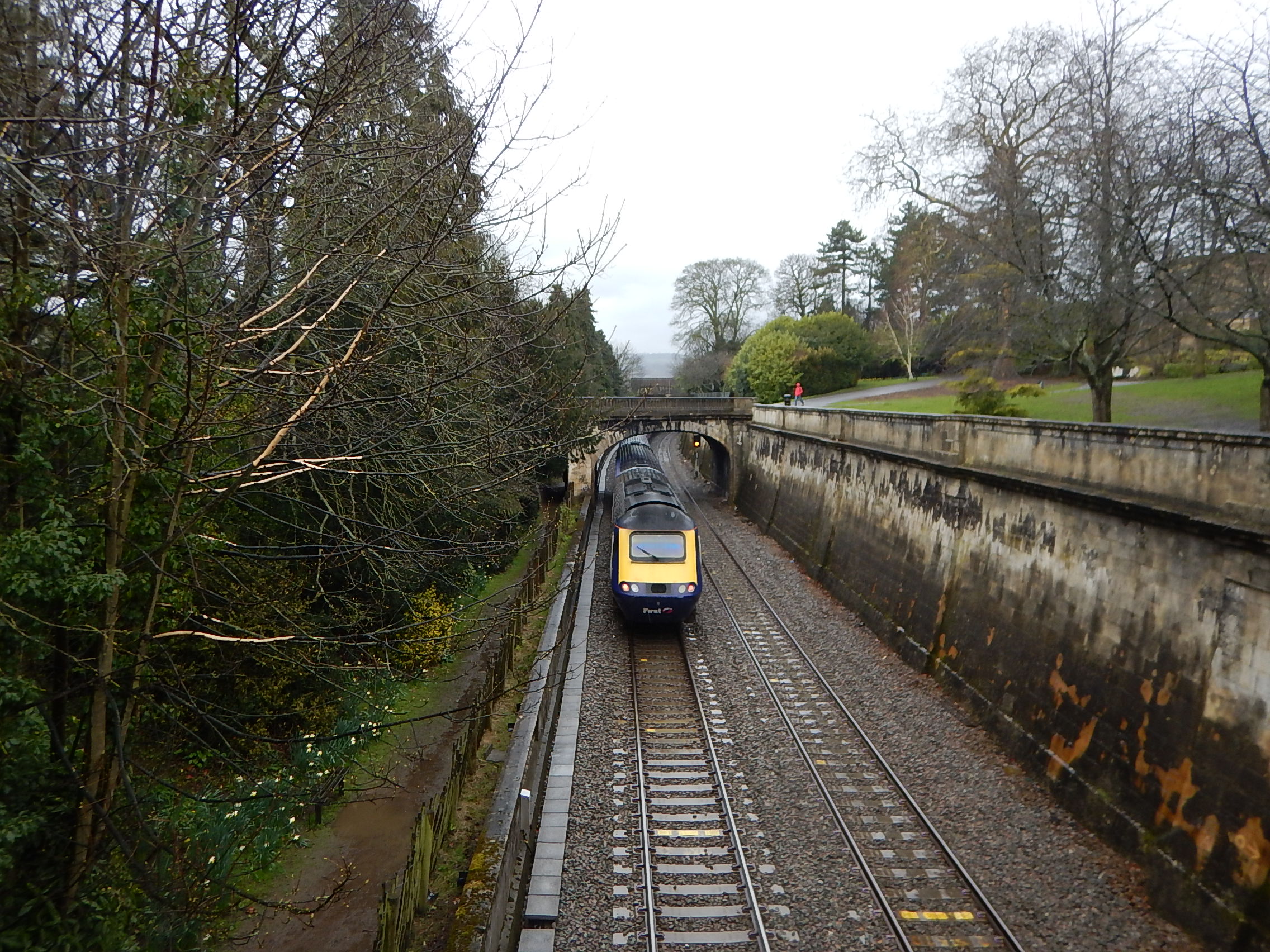
An InterCity 125 Passes Through Sydney Gardens
If there were classic trains, like there are classic cars, then Terry Miller‘s development would be a classic.
Not only does it hold world records for being the fastest diesel-powered train, but some features of the design, like the wonderfully smooth-riding Mark 3 coaches have been used to create many other trains, which range from the traditional locomotive-hauled rakes of Chiltern Railways and Abellio Greater Anglia, and the Class 442 trains, which hold the speed record for third-rail electric trains, down to hundreds of multiple units like the Class 455 trains, one of which survived the Oxshott Rail Incident.
So it would appear that one common design of train, can adapt to various different applications.
But then Miller and his team got the basic structure and design right! I once read a story about how a few years ago, structural engineers at Salford University applied modern finite-analysis techniques to a Mark 3 coach designed without computers in the 1970s. They were amazed at how good it was. When you read what happened at Oxshott, the quality of the structure is not surprising.
On 5 November 2010, at approximately 3:30pm, a cement mixer lorry fell off a bridge crossing over the railway line close to Oxshott railway station, and landed on carriages of a passing train. No-one was killed. Witnesses stated that the rear of the lorry crashed through the parapet of the bridge and dragged the whole vehicle over the side of the bridge. The eight-carriage train, operated by South West Trains, was working the 1505 Guildford to London Waterloo. The train was formed of two Class 455 electric multiple units. The lorry, loaded with concrete and weighing 24 tonnes, landed on the sixth carriage, severely crushing the end of the roof. Further damage was sustained to the fifth and sixth, seventh and eighth carriages, with the latter being derailed at its trailing bogie, although the train remained upright. British Transport Police reported that six people on board the train sustained minor injuries whilst the driver of the lorry had sustained more serious injuries. This was later revised to two serious and five minor injuries. The Class 455 electric multiple unit involved has since been fully repaired using a rebuilt carriage from a Class 210 diesel multiple unit and returned to service in July 2013
Will we ever see a train, as good and versatile as a Mark 3, where the same design of vehicle is is as happy at 200 kph from St. Pancras to Sheffield as it is trundling its way from Liverpool Street to Chingford?
I would have thought, it would have been unlikely, that anybody could come up with a one-size-fits-all design, but after reading Ian Walmsley’s article in the April 2015 Edition of Modern Railways, about Bombardier’s new Aventra train for Crossrail, I’m not so sure
Ian writes enthusiastically about Bombardier’s new train, where under Potential he starts with this sentence.
As a platform, the design will be offered in various guises for future contracts up to 125 mph.
He then goes on to say this about a possible future order for Aventras.
But the interesting one to me is East Midlands Trains electrics. As a 125 mph unit it could cope well with Corby commuters and the ‘Master Cutler’ crowd – It’s all about the interior.
Ian is talking about a train, that is equally at home, running at over a hundred miles per hour on InterCity routes, or trundling through suburbs bringing commuters to work.
This is a genuine bi-mode train.
- InterCity – Up to 200 kph on fast lines.
- Metro – Appropriate speed with great efficiency on commuter or metro routes.
Consider the various features and benefits.
An Identical Fleet
The advantages of an identical fleet that can work all lines and services for an operator must be immense!
Ryanair, Easyjet and all those budget airlines with homogeneous fleets can’t be wrong!
A Universal High-Class Interior
Bombardier’s Class 387/1 trains are almost there, with most seats having a table. Just like Chiltern’s Mark 3s or the original InterCity 125s.
You might not get the passenger density, but you get punters rolling up.
Features on what I call the High Speed Metro would include.
- 2+2 seating.
- Most seats with tables.
- Seats aligned to windows.
- Wi-fi
- Electronic Seat Reservations
- Full step-free access and compliance with all disabled regulations.
- No ghastly pink interiors!
All except electronic seat reservations, would be in both InterCity and Metro configurations.
Ability To Have An IPEMU Capability
I believe that if you have one train, that can act in both InterCity and Metro configurations, that you need the extra features that an IPEMU or on-board energy storage capability would bring on some or all of the fleet.
On-board energy storage would be similar to buying a car with a higher performance, but with a more more efficient and less polluting engine.
- IPEMUs would help break the need of having to design a train for a specific route.
- IPEMUs would have the ability to add branches to a company’s InterCity network. Think Liverpool Street to Lowestoft!
- Regenerative braking becomes available for all electrified routes and improves efficiency. Think Merseyrail and other intensive Metros!
- Discontinuous electrification would be possible. Think Ipswich to Cambridge!
- New branches without electrification would be possible. Think Barking Riverside!
- No electrification, where it gets habitually nicked.
- Heritage, difficult or areas with stroppy natives could be left without electrification. Think Bath, Dawlish or Severn Tunnel!
- Less wiring in depots.
- Unwired level crossings and stations. Think health and safety!
- Trains would use less electricity.
- Trains have a get-to-the-next-station capability and essential power for charging passengers’ phones and devices, when electrification fails.
Obviously, the amount of on-board energy storage on the trains would be provided appropriately.
Automated Pantograph Up And Down on IPEMUs
If IPEMUs were working routes, where the electrification was discontinuous, the trains would need an automated system to raise and lower the pantograph accordingly.
This would also be done at line speed.
As we landed men on the moon in the 1960s, surely we can land a pantograph on an overhead wire in the 2010s.
Dual Voltage Capability
As required by the routes, this will sometimes be fitted.
An Interesting Statistic
In this article in Rail Magazine about the Great Eastern Main Line, it says that better signalling, faster trains and track improvements would increase the number of train between Liverpool Street and Chelmsford from the current twenty-four trains per hour to thirty-two!
Compare that with the frequency of nine trains per hour through High Wycombe on the Chiltern Main Line.
Both are double track main lines, but the Great Eastern Main Line is electrified.
How much of the capacity difference, is down to the faster stopping and starting of electric trains?
Note that the work-horses of both lines are 160 kph trains.
Pick-Up-and-Dash And Dash-And-Drop-Off Services
Because the High Speed Metro is equally at home running a local service as on a high speed line, it could work in ways impossible for a normal train.
Suppose the first service from Lowestoft to Ipswich in the morning was run by an IPEMU working in Metro mode, using the on-board energy storage, to run the route as efficiently as possible. Once at Ipswich on the Great Eastern Main Line, with all the passengers on the branch for the capital, it would dash for London in InterCity mode. Going back in the evening, the process would reverse and passengers would be dropped off on the branch.
The train could even overnight in Lowestoft, whilst plugged into a charging system.
This may not be a practical idea for other reasons, but a train with a unique schizophrenic character will get used in innovative ways.
East Midlands Trains
We can assume that East Midlands Trains could be one of the first customers, as Ian Walmsley mentioned them specifically.
- They have both 200 kph InterCity and slower commuter routes.
- They have heritage issues in the Derwent Valley.
- The Midland Main Line is being electrified.
- I believe that electrification could be discontinuous to both save money and accelerate installation.
- I have a feeling that an IPEMU could serve Corby from where the wires run out at Bedford, with just a few extra miles of wires.
- IPEMUs could work branches without electrification to Luton and East Midland Airports.
- Some branch line services in the East of the franchise could be run by IPEMUs.
- There is scope for extending services past Corby, Derby, Nottingham and Sheffield using IPEMUs.
- Long-distance cross-country services like Norwich-Liverpool might be within the range of an IPEMU in a few years.
It will be interesting to see what decision the company makes.
Abellio Greater Anglia
Abellio Greater Anglia were involved in the IPEMU trials, so it is likely, that they will have plans for trains with an IPEMUs.
- They have some long routes, where a proportion is not electrified. Think Liverpool Street to Lowestoft!
- The ageing London-Ipswich-Norwich trains must be replaced. IPEMUs could reach Yarmouth going via Cambridge.
- They have some routes with discontinuous electrification. Think Ipswich to Cambridge!
- They have several branch lines, that could be served by IPEMUs. Think Marks Tey to Sudbury!
- Speed is always important and the track is being upgraded. Think Norwich in Ninety!
It will make a change if East Anglia gets some new trains, rather than somebody else’s scrapyard specials!
A new Aventra IPEMU running to Felixstowe would probably be the first new train on the branch since the 1950s.
Virgin Trains, Grand Central, Hull Trains Etc.
I’m putting these operators together, as all could use Aventras on services to the North.
- Nearly all services would be run at high speeds of up to 200 kph.
- Some or all would have an IPEMU-capability to serve places away from the electrified network. Think Blackpool, Huddersfield and Lincoln!
- Pick-up-and-dash and other innovative services would be possible. Think Sunderland to London!
One of the great advantages of these trains, would be that as the electrification network in the North expanded, more and more places could be reached from London and the South by electric trains without a change.
Chiltern Trains
In Could A Chiltern Metro Be Created? and A Trip To Aylesbury Vale Parkway, I showed how the High Speed Metro train could provide electric train services on all or most of Chiltern‘s services.
Electrification could be discontinuous.
- Marylebone to Neasden. Or perhaps West Ruislip and Harrow-on-the-Hill!
- A section in the middle perhaps between Banbury and Leamington Spa.
- The Snow Hill Lines into Birmingham.
- Shared sections with the East West Rail Link.
The gaps would be bridged by using the trains on-board energy storage.
High Speed Metro trains would give Chiltern other advantages.
- High Speed Metro trains and especially the IPEMUs are expansionist and high class. They suit Chiltern’s character.
- Chiltern could end up as almost a one electric train class railway.
- Chiltern would meet their objective of London to Birmingham in ninety minutes.
- The train’s performance would enable innovative timetabling to make maximum use of the limited platforms and paths on the Chiltern Main Line.
I would be very surprised if Chiltern didn’t go the High Speed Metro route.
Conclusion
I think Bombardier are going to sell quite a few Aventras.
Would a train operator like to see another company using new 200 kph metro trains, say from London to Norwich or Leicester, whilst they run 140 kph trains with a dated interior to say Bournemouth, Warwick or Hastings?
Bombardier have created the train equivalent of a high-performance saloon car, beloved of those that commute long distances by car.
 The Anonymous Widower