Pioz is the Most Indebted Village in Spain
Pioz in Guadalajara has just 3,000 inhabitants, but the village has run up debts of €16,000,000 and at the current repayment rate will take over 7,000 years to pay the debts back. It all stems from a previous administration that built an elaborate water purification plant.
And then there was the €150,000,000 airport at Castellon near Valencia, which never attracted a single aircraft.
No wonder Spain and Spanish banks are in trouble!
The Headmistress Lays Down the Rules
The headmistress or is it the Chief Warder, has put on her sternest East German face to lay down the law to the naughty Greeks, who have said they won’t take her medicine.
I’m afraid I think they will have to otherwise the financial police of New York, London, Frankfurt and the Far East, will make it so expensive for them to get the money they need to spend on expensive cars and the other imports they need.
The state of the Greek parties are outlined here. Just look at the face on the Chief Warder’s picture.
As if the Chief Watrder hasn’t got enough on her plate with the Greeks, and the French decide to play by their own rules. I suppose they have to, as reportedly, it’s the French banks, who are up to their necks in Greek debt.
Could the London Overground Call at Brixton?
The London Overground extension of the East London Line to Clapham Junction station goes on a viaduct across a lot of South London and before flying right over the top of Brixton tube station to reach its destination by way of Clapham High Street and Wandsworth Road stations. This picture show the two bridges that cross Brixton Road to the north of the tube station.

The Two Rail Bridges Over Brixton Road
The high bridge in the foreground will carry the London Overground, whereas the one just visible behind takes the main line trains to and from Victoria. The picture was actually taken from the entrance tro the tube station and you can see how difficult it would be to get passengers between the two levels.
Turn the corner into Atlantic Road and you see how difficult the problem is.
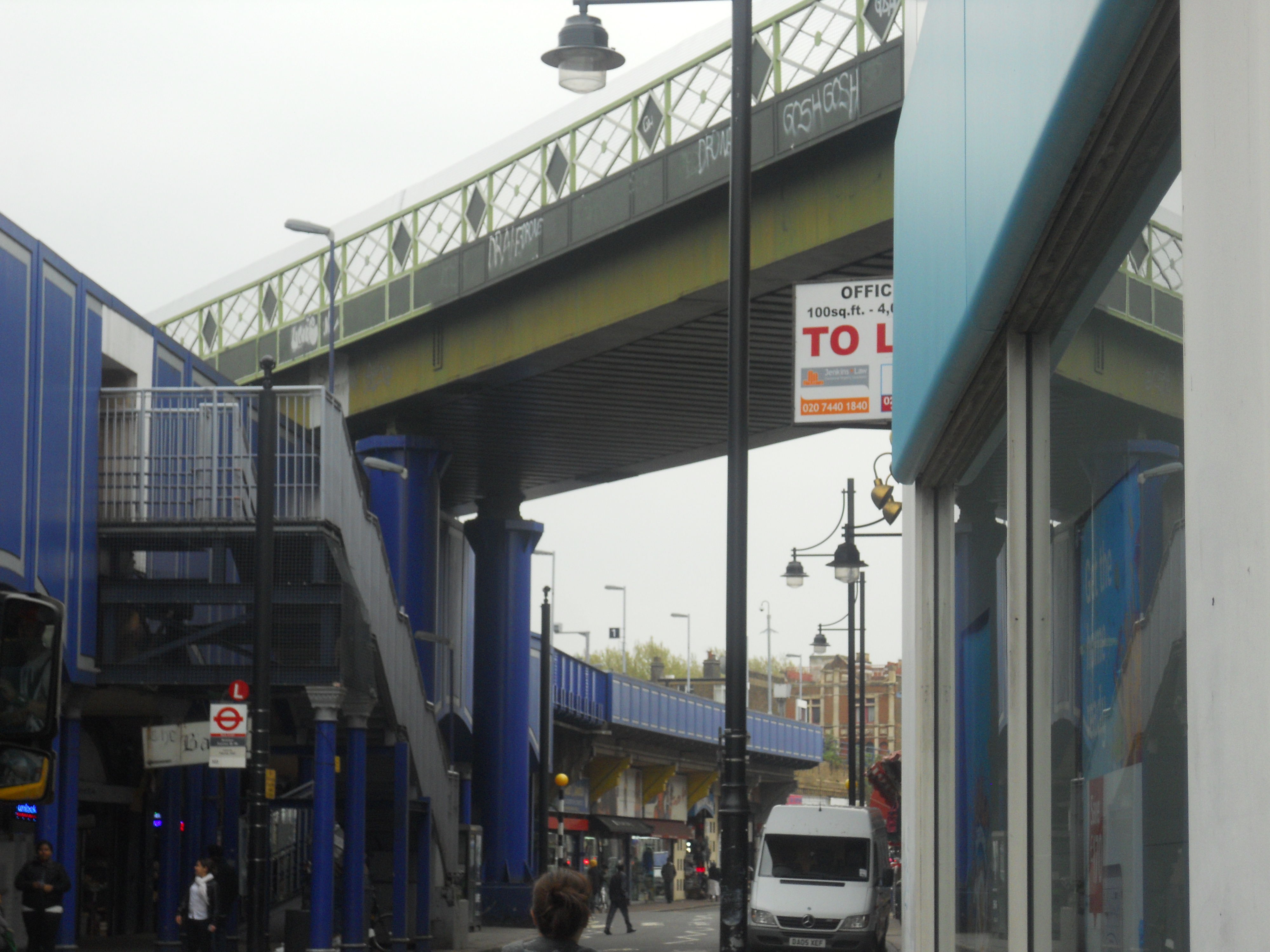
The Overground Flies Over Brixton Station
The track that will take the Overground extension, now flies over Brixton railway station. It is almost as if, the designer of the rail lines in the area, went out of his way to make connecting them difficult, To further complicate matters, there used to be an East Brixton railway station on the line that the Overground will use. This was closed in 1976 and demolished soon afterwards.
If the East Brixton station was to be rebuilt, it does give some interesting connection options, albeit with a bit of a walk.
I tend to think that the only solution would be to spend millions to create a proper interchange station, that connects all of the three lines; Victoria, East London and main line together. But in the present financial climate that is impossible.
One point is that today, after seeing Brixton, I took a 35 bus to Clapham Junction station. It is obvious, that one of the UK’s busiest stations needs a proper connection to the Underground network. It is possible the Northern Line extension will eventually deliver this. At present the best you can do is to take a train to either Waterloo or Vauxhall stations and get the Underground from there.
It’s Not Just Customers That Hate Banks
I found this article entitled Why Investors hate banks. It is a fascinating read, with the main point being that if you invest in utility shares over the past year, your return will be six times that of investing in banks.
Spanish Football is Built on Debt
I know there’s a lot of debt in British football and some clubs such as Portsmouth and Rangers seem to have succumbed to the problems. But this is nothing compared to the tax debts of the leading Spanish clubs, as detailed in this report from AFP.
I thought UEFA had a series of fair-play rules, that British clubs adhere to. It would appear that Spanish practices are different. Here’s just one phrase from the report.
But the latest figure to hit the headlines in Spain is the 752 million euros that Spain’s elite clubs owe to the tax man at a time when more than five million are unemployed and the government is asking citizens for more sacrifices.
Even Rangers don’t owe a tenth of that to the taxman.
Rules for Zopa – May 2012
I did write a set of rules for Zopa investors or lenders some time ago, but my thoughts have changed since then.
Joining Up
The first set of rules are concerned with joining up.
1. Don’t join up to Zopa without reading all you can find out about the system and how it works. There is a forum on the site, where you can ask questions to borrowers and lenders. Search the Internet for any references to Zopa. That is easy as the word, Zopa, doesn’t occur much outside of reference to the company.
2. When you are certain you want to join, always get invited by a member. That way, if you invest more than £2,000, they will get a bonus of upwards of £50, which traditionally,they will share with you on say a meal!
Getting Started
The next set of rules are concerned with getting started with lending money.
1. Choose a sum of money that you would like to experiment with. Obviously choose a sum that if you really muck it up, you can afford to lose. I would suggest a sum below £500 initially so you can get a feel for the system. I did make a mistake in that I started too high and got a couple of bad contracts because in my impatience to get the money lent out, I set the parameters wrong.
2. Choose the markets you want to lend into. I started with A* and A, and later I added the B market to them. I ignored the C and Y markets as I thought they were too risky. Do all your lending in one offer, as this will mean, that if say there is a shortage of punters in the A market, but plenty in A*, the money will get lent out.
3. When you have chosen the markets adjust the interest rates you want to charge in these markets. I have found that the best thing to do is to set the rate, one notch( or 0.1%) below the level where you are told it is “Too High”. Note that the lower you set the rate the faster you will lend out the money, but this lower rate also brings in more dodgy borrowers.
4. Set the maximum amount you want to lend to individual borrowers to something like £50. Setting it higher will mean you lend out the money quicker, but it will increase your risk. Looking at it simply, if you lend out £1,000 in 10 lots of £100, if one goes bad, you will lose £100, but if you lend it in 20 lots of £50 and one goes bad, you only lose £50. It’s not quite as simple as that, but it does show you the pitfalls of lending in too big chunks.
As money gets lent out, you will see how changing the rate and maximum amount you lend will change the speed with which money is lent out.
Daily Maintenance
I look at my account and do the following every day.
1. Withdraw any money I need from accumulated interest and early repayments, if required.
2. The balance of this money is then reinvested.
3. The interest rates I charge are set to my desired level of one notch below the “Too High” level.
4. I also put all of my important values in an Excel spreadsheet.
Obviously not everybody has time to look at their accounts every day, but make sure you do it regularly. There is nothing worse to login and find that you have a lot of money sitting there doing nothing. You might as well have it in ten pound notes under the bed!
A Long Term Strategy
Most borrowers set their repayment day to either the first of the month or somewhere close to the end, which probably reflects when people get paid. I have lent out 3130 loans of which 38.4 % were on the first of the month and 8.2 % on the next most numerous day, which is the 28th.
I have now developed a long term strategy, where on or about the first of the month, I withdraw enough to pay my monthly bills to my current account. If say, at the mid-point of the month, I have more in my current account than I need, the excess is returned to Zopa.
Peer-to-Peer Lending; An Assessment of Returns
This article from This Is Money makes an attempt to analyse the returns from peer-to-peer or social lending, as it is increasingly being called.
RBS, Donald Trump and the Dreaded Wind Farms
The more I read about Donald Trump and the wind farms, I just think how funny it would be if either the golf course or the wind farms had been all or part funded by the Royal Bank of UK Taxpayers.
After all something Sir Fred did is going to jump up and bite us, so when it does, it might be something with a good laugh in it.
The Weather Hasn’t Helped the Recession
I can only look at the London weather, but I don’t think that the first three months of the year have been very good. How has this effected the recession, especially, as figures show the construction industry hasn’t performed well?
I predict that the figures for the next quarter will be much better, if the weather pulls its socks up.
 The Anonymous Widower