Coeliac Journey Through Covid-19 – Worried About Covid-19
Worried About Covid-19
I think like many others, I was worried about the pandemic when it started.
These are a few of my thoughts and actions.
Attitude To The Internet
I have been an avid reader of the Internet since it started.
But as someone, who has worked with serious researchers off and on for fifty years, I like to think that I know fake news or untrustworthy research when I see it.
I am also in the lucky position, that if I have an advanced question about say DNA, I generally know someone I can ask, with my connections at universities.
I’ve also been used by my cardiologist friend, as an example patient in a couple of his lectures.
Being Coeliac
I was quite worried about whether being coeliac would count against me in the pandemic.
Coeliac UK were not much help and their advice seemed to be along the line of Keep Calm and Carry On!
The Ultra-Orthodox Jewish Community On Stamford Hill
It must have been in 2019, when I was asked by my GP, if I had been vaccinated against measles.
I said no, but I did have a bad case at about twenty-five, which I recounted in A Surprising Question From A Doctor.
He said fine and then added that there’s a measles epidemic in the North of the borough.
Apparently, the ultra-Orthodox Jews have a low level of vaccination and a lot of children.
This worried me, as will they bother to get the vaccine for Covid-19.
They should listen to the eminently sensible Chief Rabbi.
So in the end I just kept calm and carried on!
Coeliac Journey Through Covid-19 – Retirement
Retirement
After my stroke, I was not allowed to drive because of an eyesight problem.
As my late wife and myself had decided we would move back to London on our retirement, I decided to carry-out our plan by myself.
I sold my large house in Suffolk and moved to a smaller one in Dalston in East London.
This is an area, where my many and varied ancestors had strong roots.
My father was born close by and was a direct descendant of a Jewish tailor, who around 1800, was kicked out of Konigsberg in East Prussia, which is now Kaliningrad in Russia, for no other reason than he was male, eighteen and Jewish. I suspect my coeliac disease comes from this Jewish ancestor. No female born into the family has ever successfully given birth and my granddaughter was born with a congenital hernia of the diaphragm, which was successfully repaired by surgery, when she was a few hours old. She now suffers from endometriosis.
My mother’s family were a mix of Huguenots and Devon yeomanry and although she was born a few miles away, her mother was born just round the corner.
My father called himself a London Mongrel and I use the term about myself, as my genes are probably more mixed than his.
Since around the turn of the century, I have been a blogger and around 2008, I started my blog called the Anonymous Widower. The topics, I cover are very varied and have made me quite a few friends.
I am a strong advocate of using blogging to improve peoples’ lives.
Coeliac Journey Through Covid-19 – Medical Research
Medical Research
I first got involved as a lab-rat in medical research, when I had my second endoscopy to check for coeliac disease at Addenbrooke’s Hospital in 1997. Rebecca Fitzgerald took a sample of fluid from my gut for her Barrett’s oesophagus research.
After my wife died, I asked my contact in Alumni Relations at Liverpool University, if they did widowhood research.
They are one of the few universities that do and I did several interviews for PhD students in the unit, which is in the Psychology Department. It was very much a positive experience and certainly helped with my grieving.
In some ways the most enjoyable piece of research I have been involved in, was at the University of East London, where they were using computers to measure the balance of those recovering from strokes.
My GP also suggested that I get involved in drug tests at Queen Mary University. The tests were abandoned as the drug didn’t have any good or bad effects, but now I’m one of the William Harvey Centre’s lab-rats.
I also help to sponsor pancreatic cancer research at Liverpool University in memory of my son.
In There’s More To Liverpool Than Football And The Beatles!, I detail some research, that I sponsored in a small way.
I may be tempted to do the fund-raising trip again.
I always advise people to get involved in medical or psychological research, as I have found it such a beneficial experience.
One thing that is needed, is an on-line database of all research projects that are looking for volunteers.
Remember, that much medical and psychological research is about as dangerous as meeting someone in a GP’s surgery for a chat or perhaps in a cafe and having a coffee.
Coeliac Journey Through Covid-19 – A Few Bad Years
A Few Bad Years
In 2007, my wife died of what her consultant at Papworth said was one of the worst cancers he’d ever seen. It was a squamous cell carcinoma of the heart.
Her’s was the only occurrence in the UK that year and someone told me, there were four in the United States.
Our youngest son; George, then died of pancreatic cancer in 2009.
When I had been diagnosed as a coeliac in 1997, my wife and I had told our sons to get themselves tested, as is now advised on the NHS web site.
But George was a sound engineer in the music business, who lived the unhealthy rock-and-roll lifestyle.
A year later, I had a serious stroke in Hong Kong.
I had had a warning a year or so before and Addenbrooke’s recommended I go on Warfarin, but my GP in Suffolk, talked me out of it.
Now twelve years later, my GP and myself manage my Warfarin, where I do the testing of my INR on my own meter from Roche.
But then I am a Graduate Control Engineer!
A couple of doctors have said I have made a remarkable recovery, and I’ll go along with that as the only thing I can’t do, that I could before the stroke is drive, as the stroke damaged my eyesight.
On the other hand, the latest therapy for stroke in the United States is B12 injections and I haven’t missed one of my three-monthly injections since 1997.
If anybody is doing serious research into B12 and stroke recovery, then I would be happy to be a lab-rat.
Coeliac Journey Through Covid-19 – Coeliac Diagnosis
Coeliac Diagnosis
My health was very variable as a child.
I would often have months off school and my health only really improved, when my parents bought a second home in Felixstowe, where we spent most of our holidays.
Perhaps it was the sea air, as going to Liverpool University didn’t seem to adversely affect my health.
I had been having gut problems for years and then in Autumn 1997, I didn’t see my GP, but a very elderly locum, who as I had recently had my fiftieth birthday, gave me a present of my first blood test.
It turned out that I was very low on B12 and a course of B12 injections was arranged.
As the injections didn’t raise my levels, an appointment was made to see a consultant at Addenbrooke’s Hospital in Cambridge.
It was a Monday, when I went to the appointment and after a quick chat and no examination, the consultant said that they would take some blood. Which they did!
Within forty-eight hours a letter arrived on my door-mat saying that I was probably coeliac and it would be confirmed by endoscopy.
Two endoscopies without sedative or anaesthetic were performed and I was confirmed as coeliac.
The first was performed by Dr. Richard Hardwick and the second by Dr. Rebecca Fitzgerald.
My gut health has been better since, I’ve been on a gluten-free diet, backed up by three-monthly B12 injections.
A few years later, I was talking to a gastroenterologist in Cambridge and he told me that he thought he had more coeliac patients than any other in England.
The manager of Carluccio’s in the city, also told me that they sold a very high percentage of gluten-free food.
Were Cambridge testing a genetic test for coeliac disease or was it just a Whack-A-Coeliac policy?
They certainly had everything geared up for high-speed diagnosis. They even did the endoscopies without a sedative, so they didn’t need any recovery beds.
Coeliac Journey Through Covid-19 – Introduction
Introduction
I am coeliac and I had an interesting journey through the Covid-19 pandemic.
My experiences will be laid out in this narrative, as I believe they might be of use to someone.
I was born in 1947 and after a good education at Minchenden Grammar School in North London, I read Electrical Engineering and Electronics at Liverpool University, where in addition to getting a B. Eng degree, I met and married my late wife; Celia. We had three boys in the early seventies.
My working life was mainly spent in the solving of mathematical problems and writing software to perform complex calculations mainly in the fields of data analysis, project management, statistics and the solving of simultaneous differential equations.
The Artemis software, that I wrote in the 1970s, controlled the building of the Channel Tunnel, was the software of choice in the development of the North Sea oil and gas fields and was even used by NASA to plan the missions of the Space Shuttles and their refurbishment after each flight.
My business partners and myself sold the company to the American aerospace company; Lockheed in the 1980s.
Since then, I have been involved in various ventures.
The most successful was to back two inventors, who had developed an aerosol valve that used nitrogen as the propellant.
We sold that on to Johnson & Johnson, but the experience led to the development of the Respimat Inhaler for Boehringer Ingelheim.
Coeliac Journey Through Covid-19
I am writing this presentation for a meeting, in the next few days, so there will be several pages with similar titles to this.
Are Boots Marching In The Wrong Direction?
My family has used Boots at the Angel since about 1900.
But have they ever been so disorganised?
Yesterday, I went to pick up some Warfarin, which I have taking for a dozen years.
It must be one of the most common and cheapest drugs they dispense.
I needed both 1 mg and 3 mg tablets.
But they didn’t have any 1 mg tablets.
The pharmacist explained that Boots didn’t have any.
Surely, this is a bit like Sainsbury’s running out of baked beans?
Coping With My Cough
Over the last few weeks, I’ve developed a terrible hacking cough.
I used to get these as a child and regularly had months off school.
I can remember that our GP; Dr. Egerton White was worried and visited me regularly.
But I can’t remember having one since and certainly, I never had one in the forty years I lived with C.
About ten days ago, I noticed that a Marks and Spencer chilli con carne seem to calm my coughing down.
So I consulted Doctor Google and found several pages like this page on Rochester Regional Health, which is entitled Spicy Foods and Your Health.
Under a heading of Spicy Foods Help with Cold Symptoms: FACT, this is said.
Spicy foods contain capsaicin, the bioactive ingredient in chili peppers. Capsaicin breaks up mucus, which can help effectively relieve coughing and a sore throat. However, capsaicin can increase the production of mucus, causing a more prevalent runny nose.
My nose is running, but not excessively so. But I am generating a lot of mucus, just as my father always did.
His remedy was a mixture of strong mints and catarrh tablets.
I have started eating my Leon breakfast, that I eat most days with a pot of their chilli sauce.
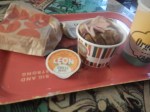
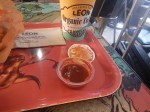
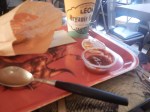
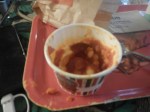
It does seem to calm my cough throughout most of the day.
The Cough Goes On!
The cough that started last week has still not left me and it’s like the ones I used to get as a child, that went on for months and months. At least twice, I had six months and more off school. Sadly, those sections of my medical records got lost after University, so we can’t find out what the good doctor Egerton White thought!
 The Anonymous Widower