Smoking In Restaurants In Poland
The weather in Poland was so good that I ate outside in a couple of places.
But unlike the UK, where people tend not to smoke where food is served, you sometimes get smokers in the areas outside restaurants.
My Short Term Memory
Over the last four years since my stroke and the move to London, I’ve often thought that my short term memory is going.
Sometimes, I’ll go out and leave the windows open for example.
But this morning, I realised this has been happening since C became very ill on her final journey.
In other words, do we for short term purposes rely partly on our partner’s memory.
At least it doesn’t seem to be getting any worse!
Interaction Between Warfarin And Terbinafine
A few weeks ago I was prescribed a course of oral Terbinafine to clear up a fungal infection. It seemed to work well, except that there is still some of the tinea in my toe-nails.
But over the time, I was taking the drug, I have felt that my INR was constantly wanting to slip downwards towards and below two.
Luckily I test my INR daily, and use a simple control algorithm to calculate my Warfarin dose. Normally, it is 4 mg, but if it goes below 2.3, I increase it to 5 mg, and if it goes above 2.8, I reduce it to 3 mg. So the algorithm got me taking a lot of 5 mg doses as opposed to the usual4 mg.
Only since I finished the course of Terbinafine has the INR stabilised around 2.5, which is my target value.
I didn’t at first see any link until everything settled after the course finished. But I decided today to type “Warfarin Terbinafine interaction” into Google. I found this paper from the BMJ entitled Drug points: Serious interaction between warfarin and oral terbinafine.
I think this minor incident shows the value of regular INR testing! Because I was testing daily, as the INR started to drop, my algorithm told me to increase the dose to 5 mg. In fact my average dose has gone up from 4 to 4.5 mg. in the period that I was taking the Terbinafine.
So there was no harm done at all!
My Letter In The Times Yesterday
I had a letter in The Times yesterday about BBC Radio, under the headline of Let’s Hear It
Amid the debates about the BBC’s licence fee some are questioning the value of the BBC’s radio stations …
Sir, Four years ago I was in hospital in Hong Kong after a serious stroke. Luckily, I had a laptop with me and I was able to listen to BBC radio
online.
BBC radio aided my recovery and certainly allowed me to keep my sanity. Those who would like to see the abolition of BBC radio should try six weeks in a hospital where the television and most of the staff are all in a foreign tongue.
I might add, that I now think that most patients in hospital should be allowed a computer or smart phone to fix their mind. Subject of course to it not conflicting with their treatment.
How To Remove A Fish Bone
I was reading Melanie Reid’s column in The Times yesterday, which was all about waiting for an operation, when I remembered an incident with a fish bone.
C had breast cancer a few years before she died and a couple of days before she was due to have her operation, we went to have a fish supper in a restaurant in Cambridge.
Unfortunately, I got a bone stuck across my throat and we ended up in Addenbrooke’s Hospital. They repeatedly tried to remove the bone, but after a couple of hours, it was decided that it would be best if I came back in the morning and they gave me a general anaesthetic to get it out.
So I duly arrived in the morning and I was admitted to a ward to wait. They said it wouldn’t be long.
But I waited and waited and the staff nurse was getting fed up with having one of her beds blocked by a fish bone. Apparently, there had been a whole series of serious emergencies and they’d run out of operating theatres.
Eventually about four in the afternoon, the staff nurse got so fed up, she forcibly recruited a very junior doctor, to remove the bone, in the way that Dr. Finlay would have used. That is by means of pure medical dexterity.
The first two attempts were complete failures, mainly because I wasn’t calm enough. So partly in jest, I suggested they got a pretty nurse to hold my hand. So they volunteered this Spanish nurse to hold my hand.
It worked and a couple of minutes later the bone had been removed from my throat and the staff nurse got her bed back.
If there is a moral to this story, it is that so much of the old skills we use for all sorts of actions in all professions are being lost and not handed down through the generations.
Kiera Knightley’s Waist
There has been a lot of talk in the paper’s lately about Keira Knightley and her waist. There’s an article here in the Telegraph.
In the Times today, they say it is twenty-three inches and that between 1951 and today, womens’ waists have risen on average from 27½ to 34 inches.
My waist at 30 inches, is only an inch or so bigger than when I left University and C’s waist was never much more than twenty-four. Although, I suspect that when we got married it was naturally about twenty-two.
If the claims that Kiera’s waist was natural in the photos is true, I can believe it, as some of us are naturally very slim. I do wonder if some of those tiny Victorian corseted waists, were on women, who perhaps naturally were in their low twenties and were just enhancing, what their genes had given them!
My only problem with being this slim, is that I do sometimes find it difficult to buy clothes. On the other hand, I don’t think that there are any health problems about being built like the Aldgate Sphinx.
Margate Made Me Feel Better
What do Margate, Biarritz, Felixstowe, Liverpool and Schveningen have in common?
They’ve all made me feel better at various times in my life and it doesn’t take much to realise that they’re all by the sea and can be a bit breezy.
Yesterday, after Margate, I felt a lot better and after getting my shopping at Eastfield on the way home, I took the Overground to Canonbury and walked home, which is something I rarely do from there.
I also slept very well, But as usual, I was awake before five and listening to the radio.
Russia’s Biggest Problem
A few years ago, I read a book called PeopleQuake, which talked about how some countries like Russia have a birthrate that is not enough to sustain the population. Apparently, in Russia, the women didn’t want to have children, as the men might not be there to be a good father.
This article illustrates the problem with Russian men and their drinking and other bad habits. Here’s the first paragraph.
The high number of early deaths in Russia is mainly due to people drinking too much alcohol, particularly vodka, research suggests.
PeopleQuake reckoned that putting the drunk; Boris Yeltsin in charge, was the real problem, as he reversed all of the previous reforms, that were aimed at cutting down on cheap vodka.
The BBC article says this.
In 1985, the then Soviet leader Mikhail Gorbachev drastically cut vodka production and did not allow it to be sold before lunch-time.
Researchers say alcohol consumption fell by around a quarter when the restrictions came in, and so did overall death rates. Then, when communism collapsed, people started drinking more again and the death rates also rose.
So what is Putin doing about improving Russian society? Spending billions on the Sochi games and clamping down on those, who don’t fit the Russian stereotype!
You could also argue, that he doesn’t have a good grasp of foreign policy!
My INR For January 2014
As January is now finished, I can show a graph of my daily INR tests for January 2014.
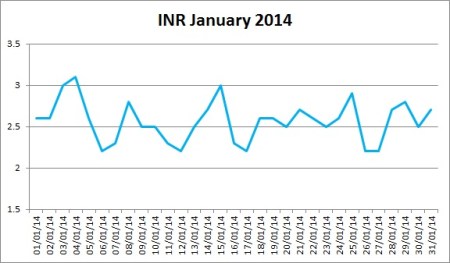
My INR For January 2014
The average INR for the month was 2.6 with a standard deviation of 0.2. This is well within the range of 2 to 3 and just above the target of 2.5.
I’m using a simple algorithm of 4 mg. normally, with 3 mg. if the INR is above or equal to 2.8 and 5 mg, if it is below or equal to 2.2.
It would be interesting to see if the results with the switch limits set to 2.1 and 2.9, or if a little bit of integral control were to be introduced. As with all control systems, getting everything stable always needs a bit of fine tuning.
Does This Mean I Won’t Get Dementia And Depression?
I have just read an article in The Times describing a diet for your brain.
They also publish the neurologist’s eating rules as down to Dr. David Perlmutter, in a book called Grain Brain.
So what does the diet advocate? A lot of things that I stick to fairly well, like certain fruits, vegetables and oily fish, with possibly a glass of red wine a day. But above all it says avoid gluten!
So far so good!
But then he’s an American from Florida!
 The Anonymous Widower