Is Drug Packaging Distinctive Enough?
I take quiet a few medicinal drugs. Every day, I test my INR and then put the drugs for the next twenty-four hours in an old black 35 mm. film canister, which fits neatly into the bag I generally carry or a pocket of my coat.
When I go away for a few days, I put the required drugs plus a few for luck, in a white film container, which I then transfer to the black one every morning.
Look at these two pictures of two strips of drugs.
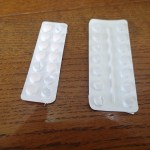
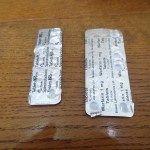
One is Spirolactone and the other is 1 mg. Warfarin. When I went to Glasgow because I was in a hurry, I took two Warfarin instead of two Spirolactone. It didn’t matter in this case, but for others similar mistakes could be more serious. A contributory factor in this mistake, was that Boots have started to give me a differently packaged brand of the Warfarin.
The top side of the drug packaging should be distinctive. I think too, that the old brand of Warfarin had the writing on the back in the same colour as the drug. i.e. brown in this case. The new one is just an anonymous black.
Centralised Stroke Care Is Good For You
I had what some doctors have described as a serious stroke, although I think it might not have been that severe, although it did leave me with damaged eyesight.
I had the stroke in Hong Kong and within about an hour, I was in hospital receiving the special clot busting drug.
But if I’d had that stroke in London, I would have probably had that drug in the ambulance and I would have been in hospital within thirty minutes.
In common with Manchester, London has centralised stroke care in what are called hyperacute stroke units or HASUs. And according to research published in the BMJ, they work well and save lives and money for the NHS. Read all about the system in the Guardian. The article finishes like this.
So what’s stopping this system from being rolled out in other metropolitan areas? It’s a question that Morris’s collaborators are seeking to answer, by studying the potential barriers and facilitators of country-wide stroke unit reconfiguration. Morris himself wants to look at the cost-effectiveness of the exercise: does the improvement in care and reduction in hospital (and hospice) stays make the reconfiguration worthwhile?
There are a few hundred people alive today who would undoubtedly answer “yes”.
My life may not have been saved by a HASU, but I did have similar care.
Admittedly, not every hospital could have a HASU, but most metropolitan areas could and should.
If you take where I used to live near Cambridge, and you draw a thirty-minute ambulance ride area around Addenbrookes hospital, you would enclose about 300,000 people. So it is not just the large metropolitan areas that would benefit.
Everyone possible, should be within range of a HASU.
Lose Weight Whilst You Sleep In A Cooler Bedroom
It sounds too good to be true, but read this article from the New York Times.
Is This The Future Of Patient Monitoring?
As anybody who has spent time in hospital connected to a traditional heart, blood pressure, pulse and temperature monitor will know, it is not an easy process. Leads fall off, moving around is difficult and you are often in need of staff. I’ve only spent time recently in good hospitals, where they were enough staff to check on me regularly and that includes two NHS hospitals. But in one NHS hospital, I had a private room and a quick visual check as the nurse passed by wouldn’t have been possible.
In some ways the current system is like driving a car without a fuel gauge and every few miles, you have to get out to dip the tank to see if you’ve enough fuel to carry on.
But then enter the engineers!
I have just watched this story on BBC Breakfast Here’s the first three paragraphs.
The NHS is starting to test a sticking-plaster-sized patient-monitoring patch.
Placed on the chest, it wirelessly transmits data on heart rate, breathing and body-temperature while the patient is free to move around.
Independent experts say the system, developed in Britain, could ease pressure on wards and has the potential to monitor patients in their own home.
I think we all have to remember, that this is the first device. No-one would be able to predict how far this technology will go. And how a healthcare system like the will be able to use it in the future!
On the other hand, there is also this statement in the story.
But the Royal College of Nursing says there is no substitute for having enough staff.
In some ways that shows what a good system it must be, as the Luddites and Nimbys always try to stop good developments.
Read more about the company; Sensium Healthcare, behind the development here.
As it’s got one or more ultra-low power chips in there somewhere, is this another application of technology from ARM?
Wasting My Licence Fee
The BBC has just broadcast an interview with some Islamic nutcase.
Why is the BBC wasting my licence fee, giving fantasists like this time on the airwaves?
He might even be able to find out if jihadists go to heaven in a few days or weeks!
INR Results Of A Coeliac Using Warfarin And Taking Terbinafine
This graph shows my INR a period between the 20th of May and the 25th of June.

I should say that I have a degree in Control Engineering from Liverpool University.
My aim here is to keep my INR between two and three, with a target value of 2.5.
Since starting to self test, I normally take around 4 mg. a day of Warfarin, but I have found that five is a better dose for when I’m taking Terbinafine, which has been prescribed by my GP for a fungal infection. The drug is well-known to affect the action of the Warfarin.
So now I take 5 mg. unless the INR is 2.8 or more. In which case I reduce the dose from five to four. On the other hand, if the level is 2.2 or below, I increase it to six.
The average INR value for the period shown was 2.6 with a standard variation of 0.2.
The peak at the beginning of June may have been caused by a B12 injection or hot weather. Both of which seem to raise my INR.
You will notice that the INR went up around the beginning of June. I can’t be sure, as I don’t have the dates, but this may have been caused by having a B12 injection.
One Of The Most Depressing Days Of The Year
I hate June the twentieth, as it was my late son’s birthday. He would have been forty-four today, if he hadn’t died of pancreatic cancer four years ago. I never hate my late wife’s birthday in the same way, but that could be eased as another son virtually shares it.
So why did England’s kamikaze defending have to ensure their exit from the World Cup last night?
The media will be full of this depression today.
To make matters worse, BBC Breakfast is talking to a lady, who lost her husband and daughter in a speed-boat accident.
I’ll have to find something stimulating to do.
If my son were still here, we’d at least be arguing the whys and wherefores!
My only comfort is life could be worse. I did try to organise a luxury trip to the World Cup some months ago, but failed.
I would feel a lot worse, if I was waking up in Brazil.
Skin Cancer Trial Results Exciting
That is the headline on this story on the BBC web site. Here’s the first few paragraphs.
The results of two international trials against advanced skin cancer have been hailed as “exciting and striking”.
Both treatments, for advanced melanoma, are designed to enable the immune system to recognise and target tumours.
The last statement is key. After all one of ourposes of your immune system is to fight infections and any other dangerous things it finds in your body.
Research has shown that coeliacs on a gluten free diet, have a reduced cancer rate compared to the general population.
So should everybody avoid obesity, too much drink, smoking and gluten, if they want to reduce their cancer risk?
I don’t have the data, so I won’t make a prediction. But the man, who helped to identify the link between smoking and lung cancer, Richard Doll, was a coeliac and was obviously on a gluten-free diet.
He lived until he was 92.
He obviously looked at the data and probably massaged his immune system.
The Other Side Of Healthcare
According to reports like this, the new boss of the NHS is going to create more smaller community hospitals. Here’s the first few paragraphs
Smaller community hospitals should play a bigger role especially in the care of older patients, the new head of the NHS in England has said.
In an interview in the Daily Telegraph, Simon Stevens signalled a marked change in policy by calling for a shift away from big centralised hospitals.
The health service chief executive said there needed to be new models of care built around smaller local hospitals.
I think there is something, which is just as important, that he doesn’t seem to mention.
That is that all hospitals should be easy to access from most of their catchment area.
When I lived in Suffolk, the only way to get to the excellent local hospital at Addenbrooke’s in Cambridge, was either by a private car or taxi. It certainly couldn’t be done by public transport.
Where I live now, I only have to walk round the corner about fifty metres and every ten or fifteen minutes, there is a 30 bus direct to University College Hospital. The other local hospitals; Royal London, Barts and Homerton are also easy by public transport. I could even get the 30 bus to Harley Street for a private consultation.
But not everybody is so lucky and many hospitals are downright difficult or even impossible to access by public transport. Two hospitals in Suffolk; Ipswich and Bury \St. Edmunds come to mind.
Fixing this problem, will not only help patients, but make it easier for visitors without their own private transport to get to the hospitals.
Hopefully good public transport to hospitals, may also ease parking problems for staff and visitors and hopefully cut down the number of patients who miss their appointments.
A Summary Of My Health
Doctors have always been puzzled about my health. In my early years, Dr. Egerton White struggled to find, what was wrong with the sickly child I was.
I used to miss one school term in three and it was probably the Spring Term, but as I’m relying on memory I could be wrong. I was always suffering from rhinitis, sore throats and often coughed for England. At one time, I was diagnosed with scarlet fever, but as I was the only case in London and no-one caught it from me I do wonder if it was a misdiagnosis.
Dr. White, at one point thought I had an egg allergy, but in the end I got the usual treatment of children in those days, they took my tonsils out.
Sadly, none of my medical records of those days exist, as they got lost somewhere between London, Felixstowe, where my parents had retired and Liverpool University.
But as my current doctor and I have agreed, whatever has bugged me over the years didn’t kill me as a child, so hopefully it is unlikely to kill me now!
Spending time at Felixstowe on the windy East Coast seemed to improve my health, but I still had lots of small problems like athlete’s foot, terrible dandruff, joint and foot pains and an overactive gut. I should also say that I suffering pain from my left arm, where the humerus had been broken by the school bully.
My mother’s health incidentally was generally good, but my father suffered from terrible rhinitis and catarrh, which wasn’t helped by his smoking of a pipe. His father had been similarly effected and found that the best way of coping was smoking and drink. Consequently, he died in his forties.
Moving to Liverpool for four years for university and work, seemed to dull my troubles and I can’t remember any new problems until a few years later, when I was living in a flat in London, when I started to get pains in my knee joints. One doctor recommended an operation, but luckily I decided to pass.
Things seem to get better in the mid-1970s, when my wife and I moved into an eleventh floor flat in the Barbican.
Generally, for the next thirty years or so, my health was pretty good, although my arm, where it had been broken, could be painful in hot weather. We had moved to Suffolk and generally spent a lot of time outdoors.
Then in the early years of this century, I was diagnosed as a coeliac by Addenbrookes and went gluten-free. My health changed for the better, with most of the joint pains and gut problems disappearing. But I still seemed to suffer from the odd bad Spring, although it got better, when my wife and I could afford to take luxurious winter holidays.
Then my life fell in, in that my wife of forty years died of a squamous cell carcinoma of the heart in 2007, followed by our youngest son, who died of pancreatic cancer in 2010.
My health got worse on the death of my wife, with hay-fever like symptoms at times.
I then had a serious stroke in Hong Kong, whilst on holiday. Luckily, they gave me the superduper clot-busting drug, and my brain is no worse than it ever was!
As I lay there for about three months with the sun streaming through the window, some of my old symptoms returned. Rhinitis was pouring down my throat, like it hadn’t since the 1960s and my left humerus was giving me some of the worst pain ever.
Since then, I’ve sold up in Suffolk and moved to Hackney, so that I have access to public transport.
The rhinitis is often present, usually in the Spring, and my body feels very much as it did, when I was at school. I’ve also started to get conjunctivitis in my eyes
In one instance, I collapsed and was taken to hospital. They were puzzled, but did report that I had something like water on the lung. A couple of days of oxygen and I was able to come home.
This Spring, my small problems have been getting worse, with constant wind, itchy skin and especially eye-brows. Then I was found to have a fungal infection in my toes for which Terbinafine was prescribed.
This reacts with my Warfarin, but as I test my INR daily on a meter, I’m able to keep it under control. I should be able to, as I have a Degree in Control Engineering.
One thing that seems to help cope with the muck pouring into my mouth and throat is fresh lemonade, as it scrapes the muck into my stomach. The odd glass of weak Scotch has a similar effect. At times though it all goes away and white wine tastes like white wine, rather than vinegar.

