Will Walthamstow Central Station On The Victoria Line Be Expanded?
This post is prompted by this article on London Reconnections, which looks at Transport for London’s World Class Capacity Upgrades for the Victoria, Jubilee and Northern Lines.
After the upgrade of the crossing at Walthamstow last summer, the Victoria Line now has a capacity of 33 trains per hour and most trains run all the way between Walthamstow Central and Brixton stations.
Sometime this year the limit will be further increased to 36 tph, which will be a very high limit considering the design of the line.
The London Reconnections article says this about future upgrades.
With the Victoria line pushing towards what must be the theoretical limit for a line with that amount of rolling stock and – more importantly – two-platform termini, there are no plans to further improve the service. Indeed the challenge of procuring more trains and finding the depot space for them would probably discourage any such plans on its own. This does not mean that the line will be forgotten, as both Oxford Circus and Walthamstow Central are on TfL’s top ten hit list of stations in need of a major capacity upgrade. Simply that the days of pushing more trains through the same stations more quickly have passed. In the case of Walthamstow Central it is highly likely that the next step will be making the station double-ended, with an entrance near or in the shopping centre.
Certainly with just two escalators, Walthamstow Central station can be busy with both working. At the moment it is on my list of stations to avoid, as one of the escalators is being replaced.
Is the idea of creating a double-ended station at Walthamstow Central worth pursuing?
Look at this map from carto.metro.free.fr, which shows the lines at the station.
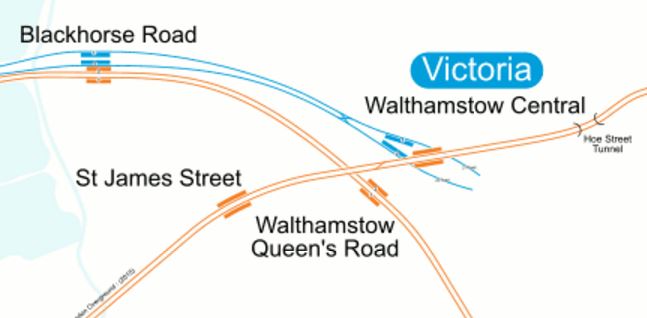
Walthamstow Central Lines
So it would appear that the Victoria Line platforms could be somewhere under the bus station and the shopping centre.
It certainly isn’t an impossible dream to create a second entrance to the Victoria Line platforms.
Walthamstow Central station was one of London Transport’s economy stations. Wikipedia says this.
The underground station, like many stations on the Victoria line, was never completely finished. White ceiling panels were never fixed to the ceilings above the platforms; instead the steel tunnel segments were painted black and used to support the fixtures and fittings. This has had a detrimental effect on the lighting levels. There is a concrete stairway between the two escalators instead of a third escalator; this caused a hugely disruptive station closure for several weeks in 2004 when both escalators went out of service.
It would be hoped that any upgrade of the station finishes the 1960s era construction.
But surely creating a double-ended station is the way to go.
- It would take the pressure off the passageways in the existing station.
- The existing station is not step-free and there is no deep lift.
- If the second entrance had two escalators and lifts, it would give a lot of redundancy in platform access.
- There is plenty of space in the shopping centre for a new entrance.
Passengers interchanging with the Chgingford Brancxh Line and those interchanging with buses or going shopping, could possibly be persuaded by good design to use appropriate and different entrances.
Conclusion
It’s feasible.
But the biggest advantage is surely that by planning carefully, the second entrance can be built around the current station, without disrupting passenger entrance and exit.
Related Posts
Improving The Chingford Branch Line
Could Electrification Be Removed From The Chingford Branch Line?
Could Reversing Sidings Be Used On The Chingford Branch Line?
Could The Hall Farm Curve Be Built Without Electrification?
Crossrail 2 And The Chingford Branch Line
New Stations On The Chingford Branch Line
What Will The Northern Line Extension TBMs Be Called?
This article in Global Rail News is entitled Northern Line TBMs Complete.
So all that is needed now is to find two suitable female names for the machines.
As the extension goes to Battersea, surely they should be given the names of famous dogs.
How about?
- Beauty – The world’s first rescue dog – Awarded the Dickin Medal in 1945.
- Judy – A pointer, who helped keep morale high in a Japanese prisoner-of-war camp – Awarded the Dickin Medal in 1946.
- Sasha – A labrador, who died with her handler in Afghanistan – Awarded the Dickin Medal in 2014.
- Susan – The queen’s first corgi.
There must be quite a few others.
Reinventing Victorian Engineering
Just because something has been used for centuries, it doesn’t mean that modern engineers, technologists and designers can’t come up with something better.
Take the humble points or to the Americans, railroad switch, which are seen all over the world’s railways and tram systems.
According to Wikipedia, points were patented by Charles Fox in 1832.
So as the two-hundredth anniversary of the invention approaches, you’d think that points had reached their ultimate form.
But you could be wrong!
This article in Global Rail News is entitled Full-size prototype for innovative track switch and describes work at Loughborough University to create something better.
It would appear that the design could be more affordable to build and maintain, safer and much faster to operate.
I also feel, it could simplify trackwork and save a lot of space in places like terminal stations and depots, where there are a mass of points, so that trains can access the correct platform or siding.
You can read the full details on the Loughborough University web site. There’s also a video.
I also feel, it could simplify trackwork and save a lot of space in places like terminal stations and depots, where there are a mass of points, so that trains can access the correct platform or siding.
Driver Only Operation Of Trains
There was a wonderful demonstration of the benefit of DOO or Driver Only Operation, when I got my train at Horwich Parkway station.
The four car Class 150 train pulled in and stopped and about thirty or forty souls stood by the train doors in the rain, for perhaps two minutes, whilst the conductor, whose duty it is to release the doors, got to a point to press the appropriate button. He was probably delayed as the train was crowded.
Surely, the driver, could have pressed an appropriate button, when he had ascertained the train was safely halted.
As it was, passengers got wet before they boarded a dry train and moaned about it all.
It’s so crazy that when the Class 319 trains were cascaded from Thameslink, where they work under DOO rules, extra buttons were fitted for the conductors.
DOO operation doesn’t have to mean a crew of one, as on some of the services I rode, the conductor was also issuing tickets.
I do wonder if in some ways it’s traditional. In the 1960s in London on buses, everyone could push the button to tell the driver to stop at a particular stop. When I arrived in Liverpool, I did this on a Liverpool bus and was told off in no uncertain terms by the conductor, that it was his job.
Welcome to the weird, wonderful and wet world of Northern Rail.
If this article from Rail Technology, entitled Liverpool council joins campaign opposing driver-only operation, is anything to go by this daft method of working is going to continue.
Staff shouldn’t be on trains with little to do but on platforms and in stations helped passengers. Transport for London’s policy is laid out in Help From Staff on their web site. This is said about assistance in rail stations.
On the Tube, TfL Rail and Overground, station staff will also accompany you to the train and help you on board and, if needed, can arrange for you to be met at your destination. Anyone can use this service, but it is particularly used by blind and visually impaired passengers and people using boarding ramps onto trains.
If you would like to use this service, ask a member of staff when you arrive at the station.
It seems to work very well and should be UK law and mandated on all station operators.
Manchester’s Nineteenth Century Ticketing
On Wednesday from my hotel by the Reebok Stadium at Horwich Parkway I had to get three tickets to get to Manchester Piccadilly station.
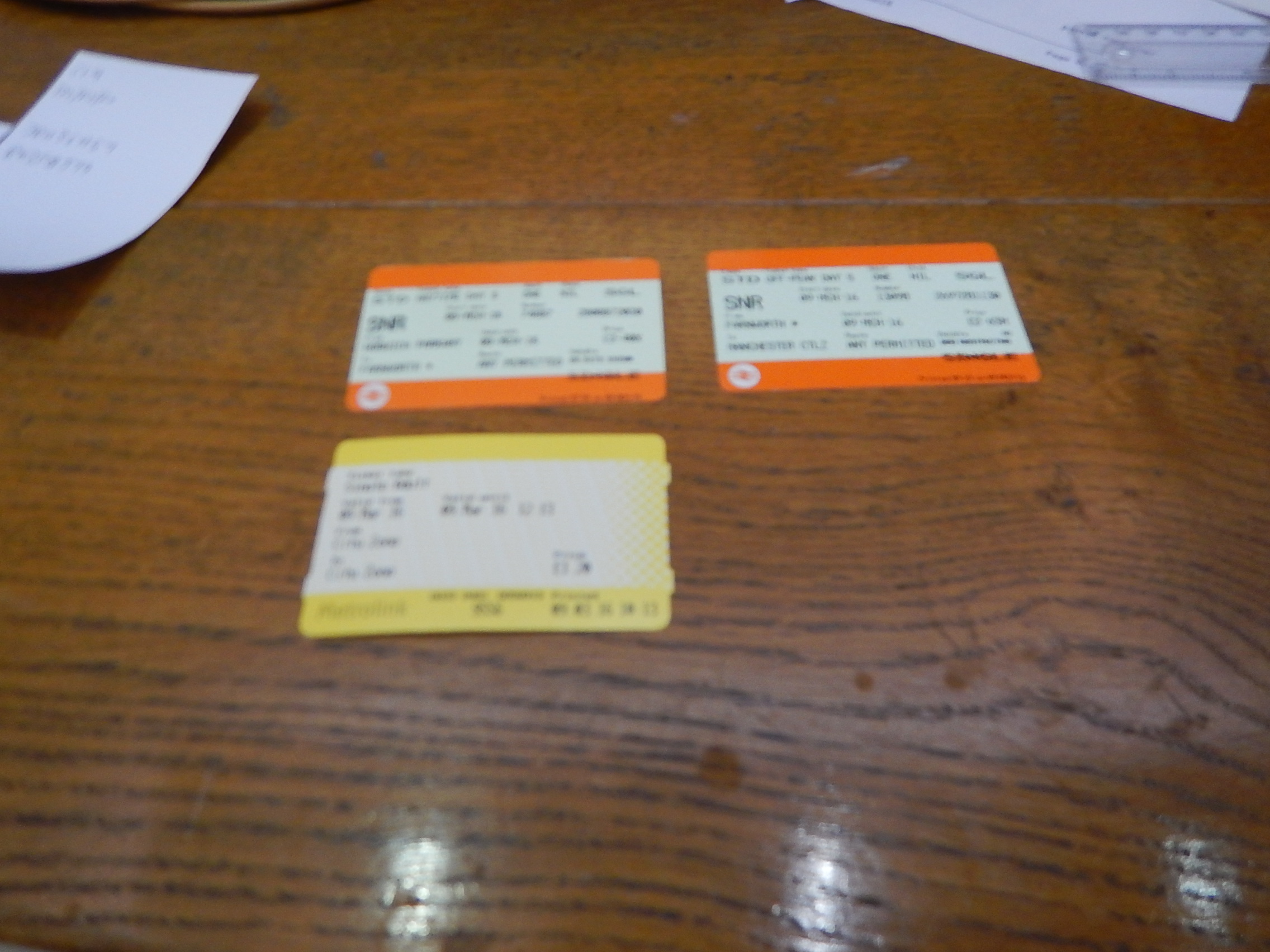
Three Tickets To Ride
The first took me from Horwich Parkway to Farnworth with a change at Bolton.
The second then took me from Farnworth to Manchester Victoria
The third was the tram ticket across the city.
As there were not even any ticket machines at Horwich Parkway and Farnworth, I had to use the Ticket Office.
It’s all so very nineteen-century!
At Farnworth, I got talking to a couple of fellow passengers, who were local and probably over ten years older than I am.
One had just visited his granddaughter in Bromley and said he’d been impressed with using his bank card as a ticket in London.
Mancunians seem to understand London’s simple ticketing concept, so why haven’t the transport authorities embraced contactless ticketing?
It might encourage a few more visitors and commercial activity, if all the great cities of the North allowed contactless ticketing with bank cards.
It will happen, if only because American Express, AndroidPay, ApplePay, Mastercard and Visa will insist it does for their own commercial interests.
Freight Through Nuneaton
Nuneaton is where freight trains between Felixstowe and the North West and the West of Scotland, join and leave the West Coast Main Line (WCML).
This Google Map shows the rail lines through Nuneaton station.

Freight Through Nuneaton
Note how the WCML runs diagonally North-West to South-East, though Nuneaton station.
Freight trains from Felixstowe arrive and turn North alongside the WCML before crossing the WCML on a flyover.
Trains can either go straight on to Birmingham and the West Midlands or turn North using the 2012-built single-track Nuneaton North Chord to proceed up the WCML.
This Google Map shows the flyover and the Nuneaton North Chord.

Nuneaton Flyover And North Chord
Trains from the West Midlands to Felixstowe take the flyover in the other direction, but trains from the WCML proceed through Nuneaton station and then turn off to Felixstowe.
This Google Map shows the WCML to the South of Nuneaton station, with the line to Coventry turning off to the West and the line to Felixstowe turning off to the East.

Lines South Of Nuneaton Station
As I came through the area today from North to South, I took these pictures.



I didn’t take any south of the station, as I was sitting on the wrong side to show the line going East.
The Nuneaton North Chord was a one-mile chord and cost £25.6million, which in terms of railway projects isn’t a lot of money.
But it is one of a pattern of short railway lines that have been built or planned in recent years to unlock the potential of the UK’s railways.
- Bicester Chord was opened in 2015 as part of a £130million project to extend Chiltern services to Oxford.
- Hitchin Flyover was opened in 2013 at a cost of £47million.
- Ipswich Chord was opened in 2014 at a cost of £59million.
- North Doncaster Chord was opened in 2014 vat a cost of £45million.
- Tinsley Chord is being built to enable tram-trains to run between Sheffield and Rotherham at a cost of £2million.
- Todmorden Chord was opened in 2015 at a cost of £9million.
But iit is not all plain sailing, as the saga to create the Ordsall Chord in Manchester shows. Plans show it should be finished in December 2016 at a cost of £95million, but a determined local protester has stuck the development in the Courts with the local Councils, Network Rail, the train companies and the Government on the other side.
I do wonder how many of these short railway lines and chords can and should be built.
Could Virgin Run A Double Shuttle?
Coming back from Manchester today, I didn’t book a ticket, but then I never do when returning to London.
Suppose I’m going to a football match or a meting at a place like Huddersfield, which is a single change at Manchester Piccadilly or Liverpool Lime treet station.
Going North, I’ll choose a train that gives me about an extra hour to get me to the stadium in time for the match. This means that if the trains are running to time, I will have time to buy a gluten-free lunch at Carluccio’s in Piccadilly station or Liverpool before doing the second leg to the destination.
I might book a First Class Advance, but usually on a Saturday, I’ll book an Off Peak ticket in Standard Class and pay the Upgrade on the train.
Coming home, I’ll always use an Off Peak ticket, as from many places, you can never guarantee to be able to get to the station to catch a booked train. Especially, if it’s a wekend and there are Rail Replacement Buses.
I use similar booking tactics to places like Birmingham, Cardiff, Leeds, Liverpool, Sheffield and York.
It is a tactic that works well and I’ve never needed to buy a new ticket to get home, because I’ve missed a booked train.
Today got me thinking, as I came home from Manchester.
Would it be more profitable, if Virgin ran the service between London and Manchester as a turn-up-and-go Shuttle?
- Passengers would be able to book the trains in the normal manner.
- It would also be possible to turn up at Euston or Manchester and just by touching in and touching out with contactless technology at your destination to get on the train.
- Perhaps it could all be done on a simple terminal where you choose your class and destination, paying for the ticket with contactless technology using ApplePay, AndroidPay or a bank card.
- At Manchester Piccadilly, I had plenty of time today, so taking ten minutes to buy a ticket wasn’t a problem.
- Surely, the quicker you can buy a ticket, the more passengers will travel.
- Three trains an hour would run in both directions always starting from the same platforms.
It could get very interesting, if it was made into a double shuttle, with Euston to Liverpool services.
I suspect there’s a pattern, that perhaps has six trains an hour to Crewe, with some trains going to Manchester and others to Liverpool.
What Will Oxford Think Of This
Over the last couple of years, certain interest groups in Oxford have not been very pleased with the plans of Network Rail, Chiltern Rail and Great Western Railway to give the city an improved rail connection.
I wrote about this opposition in Network Rail’s Problem In Oxford.
So I was surprised to see this article on the BBC web site, which is entitled Oxford station design competition winners revealed. This is said.
Three competition ideas have been picked to help secure funding for a £125m revamp of Oxford railway station.
Six architects submitted designs to a contest launched in December by the city and county councils.
A proposal featuring a rooftop restaurant by firm AHR was chosen by a panel of judges and scored 70% in a public vote.
This is an image from the article of the winning design.
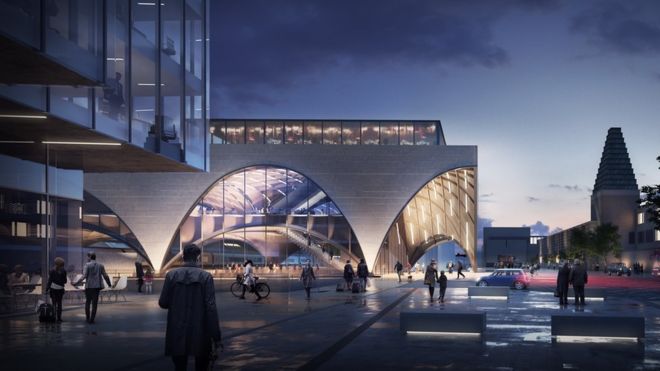
New Oxford Station Design
I agree with the panel and the general public.
But is it too good to be wasted on Oxford?
And We Thought Bendy Buses Were Long
Londoners didn’t get on well with articulated or bendy buses and a major complaint about the Mercedes-Benz Citaro was their length of eighteen metres which blocked junctions and turns for other road users and crossings for pedestrians.
A friend told me the only reason they were bought was the length and the three entrances, allowed people to get on without paying.
Our two bendy routes here in Dalston; the 38 and 73 have been replaced by New Routemasters and I think it is true to say, that three entrances don’t encourage fare-dodging, but they do speed up loading and unloading.
So it was with a bit of trepidation I read this article in Global Rail News, which is entitled Approval For World’s Longest Tram. This is said.
BKK has received approval to operate the first of its new 56-metre Urbos 3 trams in Budapest – thought to be the longest trams in the world.
It is a version of CAF‘s Urbos 3, that are used in Birmingham and Edinburgh. Those trams are just 33 and 42.8 metres long respectively.
They are over three times the length of London’s hated bendy buses.
An Hour In Farnworth
You might ask, why I spent an hour in Farnworth.
I wanted to take pictures of the Farnworth station and the tunnels nearby and as there is only one train an hour in both directions, that seem to arrive almost together, it meant I had to wait an hour in the rain.
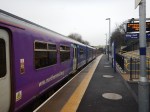


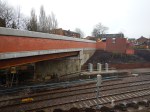
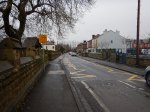
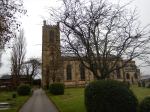
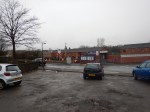
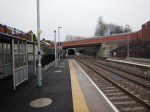
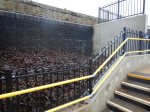
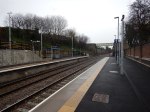

This Google Map shows the station and the town.
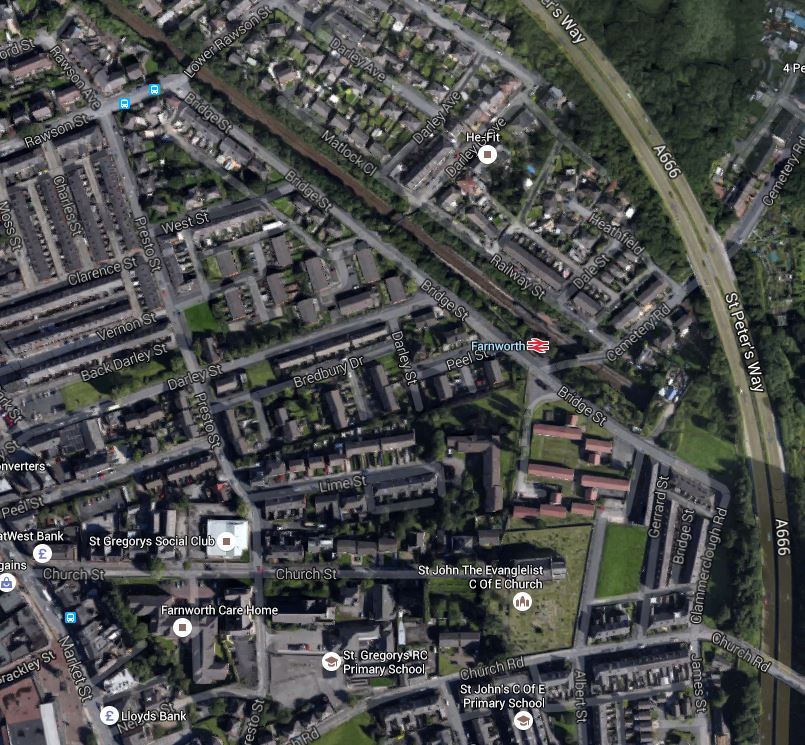
Around Farnworth Station
Note the A666 goes over the top of the tunnels. An omen?
Note the following about the station and the area.
- The station has a sturdy reconstructed bridge at each end, which could surely be used to support the overhead electrification.
- I was surprised that there was no obvious place to put the gantries to support the wires between the bridges.
- There was no ticket machine and I had to buy one from a person, which meant a walk up to the office.
- One train an hour isn’t enough, but hopefully this will change with electrification.
- There are no facilities near the station and I had to walk up the hill to Farnworth to get a cup of tea.
- Two locals were very adamant that no new trains will be added, as all money is spent on Metrolink.
The station very much reminded me of Crouch Hill station on the Gospel Oak to Barking Line.
- Access is from a road at one end.
- They are between bridges.
- How the stations will be electrified is not obvious.
It will be interesting to see how these stations are electrified.
 The Anonymous Widower