Improving London’s Transport In Small Ways
I feel there are two ways of getting more out of London’s crowded transport system.
The first is the obvious ones of capital projects, which at the top end is Thameslink, Crossrail and Crossrail 2, and at the bottom end it is projects of the order of small numbers of millions, which might include.
- Remodelling major junctions like Archway, Elephant and Castle, Highbury Corner and Old Street.
- Reorganising bus routes around train and Underground stations, with more shelters and better information.
- New and rebuilt stations like Crystal Palace, Deptford and Lea Bridge
- Inclined lifts like that installed at Greenford.
- Step-free access at stations like Clapham Junction, Gospel Oak, Honor Oak Park, New Cross and South Tottenham.
I’m sure that new technology epitomised by the inclined lift at Greenford, will increasingly be seen.
But with any complex system, there is always improvements to be made in small ways.
The recent extension of contactless cards to Gatwick Airport, could be the sort of improvement, that increases ridership on the trains to the airport and is very much a win for the airport, the train companies and passengers alike.
We need more small improvements to London’s transport system to squeeze more capacity and improved efficiency out of the network.
1, London’s Airports And Other Places Should Have Contactless Ticketing
Heathrow, Luton and Southend Airports will join City and Gatwick in coming within London’s contactless ticketing network.
But why stop at just airports?
I feel that within a few years, the following will be within London’s contactless ticketing area.
- Chafford Hundred for the shopping at Lakeside.
- Ebbsfleet International for trains to Europe.
- Greenhithe for the shopping at Bluewater.
- Thorpe Park and other places for the fun!
- Windsor and other places for the tourists!
The benefits to residents, tourists, business and train companies won’t be small.
I suspect that as the contactless ticketing network grows, attractions and towns outside the area, will be enthusiastic to join and might even bribe Transport for London.
2. Buses Should Trial Entry Through All Doors
The bus journey I do most commonly is to get a 38 or 56 bus between my house and the Angel, where I tend to do my food shopping.
The 38 route uses New Routemasters with three doors, all of which can be used for entrance and exit, whereas on the 56 route, standard two door buses are used, where you enter through the front door and exit through the one in the middle.
There is no question that the Routemasters get through a typical stop quicker, as drivers and passengers use their brains to get on and off the bus as fast as possible. However, on the standard buses, threading a push-chair into the middle of the bus can be difficult and time consuming.
I think that an experiment should be trialled, where in perhaps areas, where there are a lot of Routemasters, passengers can board the standard buses from the middle door and touch-in on a convenient reader.
Obviously, it would be open to fraud, which is why an experiment would have to be performed first. But from several years of watching passengers on New Routemasters, I don’t think losses would be substantial. Many a time, I’ve seen passengers collectively stare at another passenger, who didn’t touch in! It’s East London peer pressure at work!
Remember too, that the doom-mongers of the left, felt cashless buses and contactless payments would be a disaster and discriminate against the poor. Try finding an incident, where someone was severely inconvenienced by London’s contactless ticketing system!
3. All Stations Should Indicate The Train Direction
On some stations this is obvious, or can be worked out, as on heavy rail routes, trains drive on the left.
But on many Underground stations, it is not obvious from which direction your train will arrive.
Often regular passengers will know that when going to a specific station, they will need to be in a particular carriage. If I am coming North to Angel on the Northern Line, I want to be in the first or second car, as this saves the effort of walking down the platform.
A simple arrow above the sdverts say, would orient you on the platform.
Hopefully, it would distribute passengers in a better manner along the platform.
4. Some Rail |And Underground Maps Could Be Larger
The standard maps are fine, but over the years, I’ve seen some really large transport maps around the world.
There’s no doubt in my mind that with maps, big is beautiful and the bigger the better.
In many stations there is a large tiled wall, for which no-one has really found a sensible use. Often you’ll come down an escalator into the bowels of an Underground station and face such a wall.
So why not put a really large map there?
It would be out of the way too and if passengers just wanted to stand in front of it and look, no-one would bother.
5. More First Train Indicators At Terminal Stations
Some terminal stations have more than one platform from which stations start their return journeys.
At Walthamstow Central on the Victoria Line, where there are two platforms, an indicator tells you, from which platform the first train will leave.
But at other stations like Stratford on the Overground, it is difficult to ascertain which will be the first train to travel west.
All terminal platforms should be fitted with First Train Indicators.
6. Better On Board Bus Information
London’s buses have a simple display, which gives a selection of the following information.
- The route and the destination.
- The name of the next stop
- Any customer information like delays, strikes or closures.
- The time.
I know the size of the display is limited, but it is poorly arranged and could be much better.
It should also show the five-number code of the next stop, so that passengers changing there could check out their next bus.
7. All Stations Should Have TfL-Standard Rail/Tube, Bus Spider And Walking Maps
When you arrive at a Transport for London (TfL) managed station, you find the following maps prominently displayed.
- The Rail and Tube version of the iconic Underground map.
- A bus spider map for all the routes serving the area.
- A comprehensive walking map.
At most TfL stations, there is increasingly a Legible London lith.
But this is not the case at some stations in London, that are managed directly by railway companies.
All stations should be made to adhere to London’s standards.
8. Below Ground Information Needs To Be Improved
Crossrail will bring some truly labyrinthine stations to London, to add to those difficult to navigate ones like Bank, Green Park, Kings Cross St. Pancras and Waterloo.
Transport for London needs to provide more bus and walking maps on the platforms and in the passageways, so that passengers can find their way to the entrance they need to continue their journey.
9. Rail And Tube Map On All London-Bound Platforms
The need for this was illustrated at Coventry station, where two tourists were asking the Virgin station-man, how to get to Ewell West from Euston. He told me, he had asked for a London Rail and Tube Map for the station, as this would have answered a large proportion of the questions he was asked.
The map could also have full details on how to use London’s contactless ticketing, which should reduce the queues at London terminals.
The only station outside London, I’ve seen such a map is Cardiff Central.
If it’s good enough for Wales, then the map should be displayed in Amsterdam, Brussels, Cologne, Lille, Marseilles and Paris.
Obviously, with information in the correct languages!
10. There Needs To Be More And Better Ticket Machines
Increasingly, I use the Internet less and less to buy tickets for travel out from London, unless it’s a longer journey and I want to reserve a seat.
I get the best Internet price from the latest ticket machines at Dalston Junction station, where I can buy the following tickets.
- Singles and returns, for today or a date in the near future between any two stations in the UK.
- Extension tickets from the Zone 6 boundary to certain stations close to London.
I get the best Internet price, without having to sign-up to be bombarded with spam by the train or ticket company.
The Zone 6 extension tickets are often a big money saver. Recently a return to Woking cost me just £5.15 with my Senior Railcard. The Standard Class Return Ticket costs £14.10, so the saving almost paid for my lunch in Woking.
These ticket machines need to be in a lot more places and not just on the Overground.
11. Ban Diesel Trains As Much As Possible From London
Despite lots of electrification on the lines into and through London, their are still quite a few noisy and smelly diesel trains to be found in London. They fall into the following categories.
- Long-distance trains like those to the West Country, Wales and Scotland.
- Freight trains on through routes, like the North London and Gospel Oak to Barking Lines.
- Commuter services using diesel multiple units.
- Engineering trains haled by diesel locomotives.
I believe that many of these can be replaced by trains hauled by quieter and greener electric traction.
Many residents of London, especially those who live on the feight routes of North London, would back this small improvement.
Conclusion
I have detailed ten small ideas, that might be used to improve London’s transport network.
I think that only the provision of more and better ticket machines will cost serious amounts of money, but from what I see as I travel around London, I suspect it’s already being done.
If I was the London Mayor, I would ask Londoners and regular travellers for simple ideas to improve the network.
Some would be bonkers, some would be so-so, but I believe that some would be brilliant.
I also believe that those good ideas, that were worthwhile implementing, should result in a reward to the proposer.
After all, London’s transport network belongs to London and Londoners, so why shouldn’t they have a say in its design?
London’s New Stations
This is a list of the new stations that are being built or are proposed for the London area.
- Battersea Power Station – Being built for Northern Line Extension – Opening by 2020
- Brent Cross Thameslink – Outline planning permission
- Canary Wharf – Being built for Crossrail – Opening in 2018
- Cassiobridge – Being built for Croxley Rail Link – Opening in 2020
- Lea Bridge – Being built – Opening in 2016
- Maiden Lane – Proposed for North London Line
- New Bermondsey – Being built for East London Line
- Nine Elms – Being built for Northern Line Extension – Opening by 2020
- Old Oak Common – Being planned for Crossrail and HS2 – Opening in 2026
- Primrose Hill – Proposed for North London Line
- Silvertown – Proposed for Crossrail
- Watford Vicarage Road – Being built for Croxley Rail Link – Opening in 2020
- West Hampstead Interchange – Proposed
- Woolwich – Being built for Crossrail – Opening in 2018
There are of course other proposals in the dreams of London’s many local authorities.
Could The Golden Mile In Houslow Get A Station?
A couple of words in Modern Railways led me to this article on the Hounslow Council web site, which is entitled Restoring Great West Rd to former golden glory. This is said.
He said: “We need a big improvement to the public transport links to realise our vision. We want to see a brand new station near Sky’s HQ by using an under-used freight line and create a new station – the Golden Mile’s very own station – and link it to Southall which will be on Crossrail.”
This Goggle Map shows the area.
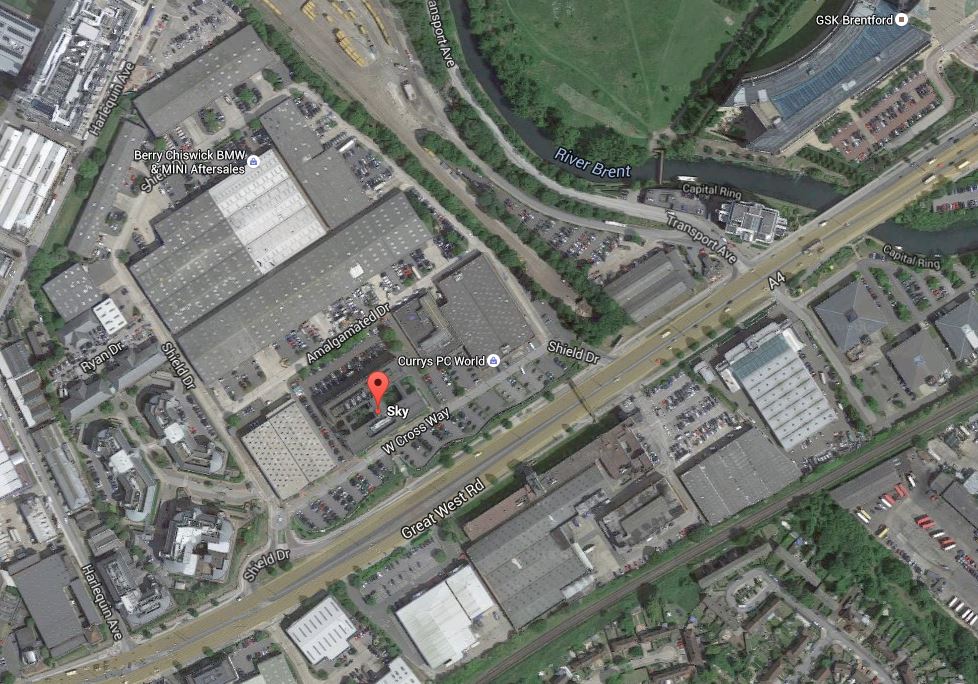
Sky HQ And Possible Golden Mile Station
Note the following.
- Sky’s HQ is indicated by a red arrow.
- The rail line behind the Sky HQ is the Brentford Branch Line.
- The main road is the A4.
- The other rail line running parallel to and south of the A4 is the Hounslow Loop Line.
There are certainly possibilities to create a station here.
At the other end the Brentford Branch Line used to terminate at Southall station.
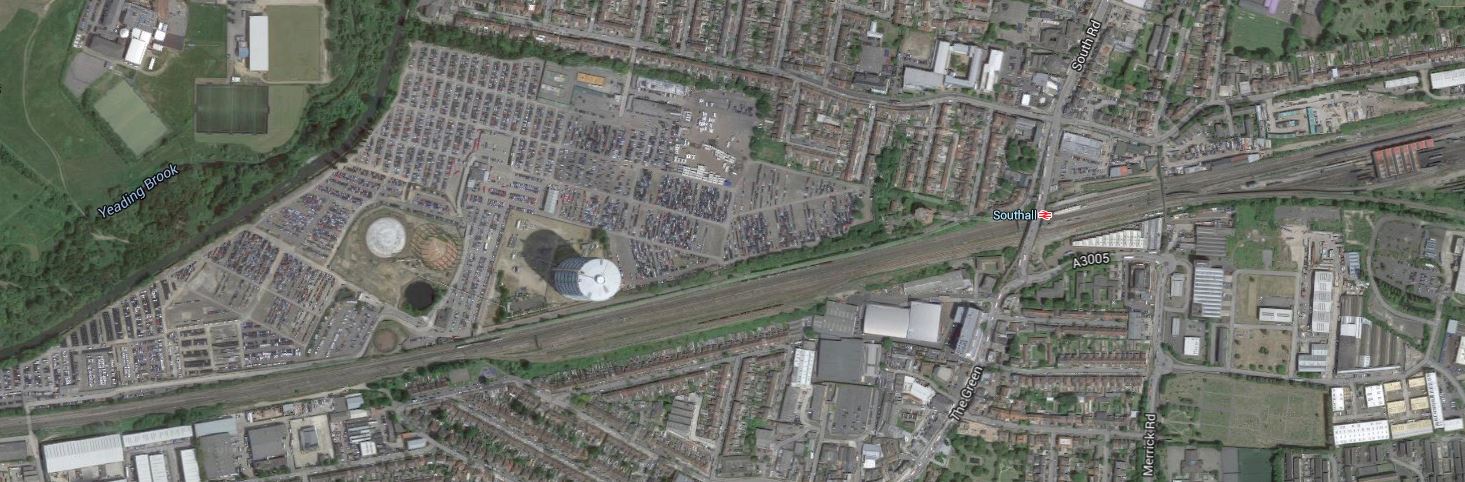
Around Southall Station
Note.
- The Brentford Branch Line curves into the Great Western Main Line to the East of Southall station.
- Trains on the branch could terminate in a bay platform in Southall station.
I have deliberately taken the Google Map over a wide area, so that I bring in the Southall Gas Works site, which is currently used for long term valet parking at Heathrow.
The site is to be developed and I just wonder, if the businesses and houses could be served by an extension of services on the Brentford Branch.
Perhaps a tram could run from the Gas Works site, through Southall station and then down to the Golden Mile.
- I have suggested a tram, as this would mean that extra stops would be more affordable.
- If it needed to cross the Great Western Main Line, a single-track bridge for trams would be more affordable.
- Trams could also go walkabout at either end of the core section.
- If the line was just used as a shuttle between Southall and the Golden Mile, to get sufficient capacity with trains might be an expensive solution.
- Perhaps a tram could sneak down to Syon Park and the River Thames.
I think that there are possibilities for a well-designed solution in the area to connect the Golden Mile to Southall station for Crossrail.
Railways In North East Poland
Look at this Google Map of the Polish town of Goldap, where we stopped for supplies on our holiday.

Goldap
Just to the North of the main road, it appears that there is the recognisable scar of a multiple-track railway.
Our Polish guide confirmed that Goldap had a large station with several platforms, and that it is still there.
Until the end of the Second World War, this area was East Prussia and was part of Germany. The railways were connected to the Prussian Eastern Railway, which connected Berlin to the major East Prussian city of Koningsberg. The Prussian Eastern Railway still exists as far as Braniewo on the Polish side of the Border, but there doesn’t appear to be a rail connection onward to Kaliningrad as Koningsberg is now called. This Google Map shows the area from Braniewo in Poland to Mamonova in Russia.
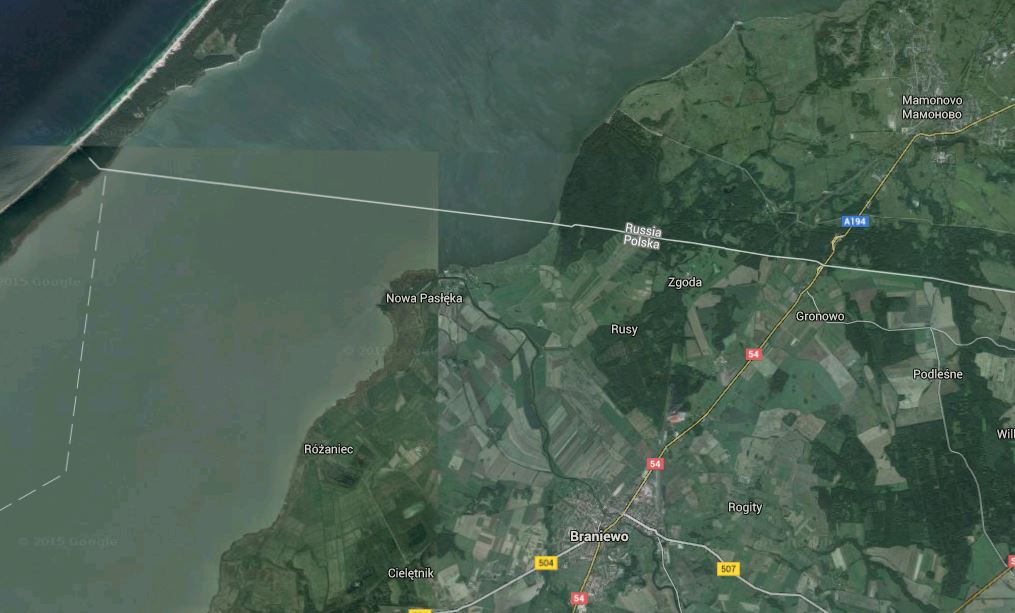
Braniewo To Mamonova
The white line across the map is the border.
You can pick out the old railway from Braniewo to Mamonova.
If we lived in a sane and reasonable world, which I’m afraid that President Putin doesn’t, it would appear that some form of direct rail connection could be created, which would connect Russia and the Baltic States to Poland.
There is the problem of gauge as like Spain, Ireland and India, Russian railways don’t use the same gauge as everybody else. At one time the platforms in Kaliningrad-Passazhirsky station, were arranged so that those facing Poland were standard gauge and the others were Russian gauge.
As a train enthusiast, wouldn’t it be nice to travel from Berlin to Kaliningrad by luxury train, spend some hours in the city, before taking a train on to St. Petersburg.
It would sadly appear that Putin doesn’t have the commercial nous to run the Russian equivalent of a whelk stall.
It is a long term ambition of the European Union to connect the Baltic States and Finland to the rest of the European Union by rail, they have funded the creation of Rail Baltica. This map shows the route.
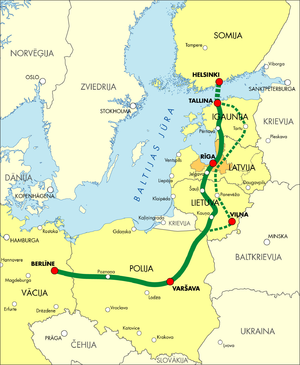
Rail Baltica
The objectives are broadly as follows.
- Build a 200 kph double-track standard gauge railway all the way.
- By-pass Russia and Belarus.
- Put a lot of the extensive freight traffic in the area on the railway rather than the roads.
The overall aim is to finish by 2025, although rumours persist that the section from Warsaw to Kaunas in Lithuania could open this year.
An interesting take on the project is given by this article on the Latvia Public Broadcasting web site, which is entitled Rail Baltica hits buffers at Polish border. This is said.
Even though Poland has allotted €16 billion to modernizing its railroads by 2023, not a single zloty has been earmarked to be spent on developing the connection to Rail Baltica at the Polish side of the border with Lithuania. Without this 200-kilometer section, the planned high-speed European gauge rail from Tallinn through Rīga through Kaunas won’t be connected with the rest of Europe, reported LSM’s Russian-language site on Friday.
It does appear that the section between Bialystok and Trakiszki isn’t up to scratch.
There is an interesting take on Rail Baltica in this article on a blog, which is entitled Rail Baltica Project Directed against Russia’s Security, Pavlovsky Says. This is said.
The Rail Baltica project, eventually intended to link Berlin with Helsinki via Poland and the three Baltic countries is “extremely doubtful from an economic point of view” but has obvious security implications for the region and Russia’s interests there, according to Moscow commentator Igor Pavlovsky.
The project, which will allow trains to pass from one end of the line to the other without changing from Western to Russian gage track, may never carry as many passengers or as much freight as its boosters claim, he writes on Regnum.ru; but it can carry troops and materiel from the West to the border of Russia.
Ever since I first heard of Rail Baltica, I’ve been rather surprised on the silence from Putin and his merry thugs!
Aberdeen Gets A City Deal
Yesterday as reported in this article on the BBC, Aberdeen got a City Deal.
Acording to the BBC, the funding will be used as follows.
- An initial £200m to improve journey times and increase capacity on key rail links between Aberdeen and the central belt, upgrading the rail line in the Montrose basin
- £24m for the trunk roads programme to support improvements to the key A90/A937 south junction at Laurencekirk
- £10m for extension of digital infrastructure in the Aberdeen and Aberdeenshire area above and beyond the commitment through the City Deal
- £20m in infrastructure funding to unlock housing sites that are of strategic importance to the local authorities as well as five-year certainty on £130m of affordable housing grant.
It all seems good to me, given the problems of the oil industry.
I gained a unique perspective to the North of Scotland, when I travelled from Edinburgh to Inverness, a few years ago. I wrote about the trip in Edinburgh to Invernesss In The Cab Of An HST.
InterCity 125s may be iconic transport, but Scotland’s two Northern cities and the surrounding areas need many more quality services to Edinburgh and Glasgow.
The rail part of the City Deal talks about dualling the railway line from Aberdeen to the South.
I would go further. Consider.
The Aberdeen to Edinburgh Line is a 100 mph railway.
The Aberdeen to Glasgow Line branches off at Dundee and goes to Glasgow via Perth and Stirling.
Important communities are served all along the railways.
Services are every hour, but some are slow, as there are a lot of stops.
In my view Scotland North of the Tay, is ideal IPEMU country. I would run services between Edinburgh and Glasgow and Aberdeen using 125 mph electric trains with an IPEMU capability. These would shorten journey times, not just because of their speed, but because electric trains, stop at stations and then accelerate away in a reduced time.
Obviously, there would need to be some electrification.
- Across Aberdeen, Aberdeen Crossrail could be built between Dyce and Stonehaven, so that Aberdeen could have an electrified cross-city service.
- Around Dundee and Perth. This would come with the aspiration of connecting these two cities to the much-delayed Edinburgh to Glasgow electrification with electric trains. These trains could have an IPEMU capability.
It would give the Eastern side of the North of Scotland the railway links it needs.
To provide electric services to Inverness would be trickier, but as support for IPEMUs gets even more innovative, I suspect that Perth and Aberdeen to Inverness could be bridged.
I think IPEMUs are one area, where engineers will be able to marry all sorts of disparate technology together to give improvements, others would think impossible or even downright silly.
The main northern routes and their approximate distances are.
- Dundee to Aberdeen – 70 miles
- Aberdeen to Inverness – 100 miles
- Perth to Inverness – 110 miles
The only route that could be served by an IPEMU at the present time is Dundee to Aberdeen. But this would mean that creating an electric service from Glasgow and Edinburgh to Aberdeen is not the major engineering project that many believe it to be.
It would need.
- Creation of an electrified Aberdeen Crossrail from Dyce to Inverurie.
- Electrification from Stirling to Dundee via Perth.
- The purchase of some suitable trains with an IPEMU capability.
Get the railways to the North of Perth and Dundee right and the benefits to the North of Scotland could be immense.
- An improved rail service would increase tourism, with all the benefits that brings.
- Aberdeen Airport would get a proper rail service.
- Edinburgh to Aberdeen by train is now well over two hours. Steam trains in the 1895 Race To The North did it in only an hour longer.
- 125 mph trains with an IPEMU capability could break the two-hour barrier.
- Ferries for the Orkneys and Shetlands leave from a port near to Aberdeen station. so those islands could benefit.
I also believe that if the lines are improved in the North, then connectivity in the South of Scotland should also be improved.
- Glasgow Crossrail would improve rail links through Glasgow.
- Some form of Glasgow Airport Rail Link should be provided.
- The Borders Railway should be extended to Carlisle.
- The Glasgow and South Western Railway should be electrified to provide an alternative to the West Coast Main Line.
Scotland needs to get its railway improvement plans into shape.
Class 387 Trains On Track
February 2016’s Modern Railways has some news on the building by Bombardier of Class 387 trains. Three orders are in the pipeline.
- 27 trains for Gatwick Express
- 8 trains for Great Western Railway
- 20 trains for Porterbrook
All are of four cars.
Modern Railways says this.
The 20×4-car units for Porterbrook (for an as-yet unnamed operator) will be built first, followed by the 8×4-car units for Great Western Railway.
I feel that we’ll be seeing Porterbrook’s twenty trains on the UK rail network before the end of 2016 or soon afterwards. You have to admire their business acumen in spotting the need.
The article also goes on to say that Bombardier has created a new facility dedicated to the Class 345 trains, that will be for Crossrail. So their production will not effect production of other trains.
Does this also mean that Bombardier could use the existing production facilities to create more Class 387 trains or build the Class 710 trains for the London Overground?
If it’s the first then there are several operators, who would like a new 110 mph electric multiple unit. If it were a 125 mph train, there would be more takers.
If it’s the second, then I’d be pleased to be riding new Aventras on the Gospel Oak to Barking Line and up and down the Lea Valley Lines.
I think that it is true to say, that judging by the mess, that is the Great Western Electrification, that Great Western Railway will have a few spare Class 387 trains, if any operator had an electrified railway.
I would also love to ask Porterbrook and/or Bombardier how many of the leasing company’s twenty trains will be delivered with an IPEMU capability.
As I’ve said many time before, a 125 mph four-car IPEMU would be some train and would transform rail services in East Anglia, Across the Pennines, on the Midland Main Line and perhaps many other places.
All is starting to be revealed!
How Not To Handle An Environmental Issue In A Large Project
On my holiday in Poland, I met someone, who lives on the route of HS2.
They told me that a million tons of tunnel spoil will be dumped on farmland in the Chilterns.
I was rather surprised to say the least, as having followed major projects for the best part of forty years, I know that project managers, engineers, architects and construction companies, don’t want hassle from what are collectively termed Nimbys, so they do their utmost to design projects, so that disruption and damage to the environment is minimised.
Crossrail had its problems early on, as Mayfair didn’t want the rsailway or the disruption of ten years of construction. So they devised a strategy based on openness and archaeology, which sold the project to Londoners, as something more than a railway. They have also been very helpful in giving access to the general public in events like Open House.
So I typed “HS2 tunnel spoil” into Google and found this article in the Bucks Free Press, which is entitled HS2 tunnel spoil to be dumped in Chilterns AONB. This is an extract from the article.
The announcement was made by HS2 Ltd’s Country South Area Manager Neil Cowie at a community forum in Little Kingshill on Tuesday.
He said it would be placed within a ‘sizeable area’ within two or three miles of the planned tunnel portal at Mantles Wood near Amersham – but he added HS2 Ltd did not want the location to be made public yet.
Mr Cowie said: “Rather than taking it longer distance along highways, we’ve taken some additional land alongside the route which we will landscape.
“When it’s finished it will be properly landscaped and will look very nice.”
I’m no diplomat, but it does seem a rather poor statement, which probably came out of a forum, where things were not up to scratch.
I’ve been to several Transport for London foums about projects like Camden Town station, Crossrail 2 and Hackney station and at each one, there has been an architect, engineer or project planner, who understands in detail what is proposed.
A later statement in the article says this.
In a later statement, HS2 Ltd said: “We will not being be depositing spoil/excavated materials from tunnelling in the AONB – it will be excavated materials from the cuttings going through the AONB. All tunnelling excavated materials from that part of the line will be taken out via the Colne Valley construction site.”
When dealing with any sensitive project from a children’s playground upwards, you must get your facts right! Once errors are in the local culture, they can only be eradicated with great difficulty and tremendous expense.
With respect to HS2, my project management and engineering instincts lead me to the conclusion, that HS2 will probably come up with an innovative and non-disruptive way to remove the tunnel spoil from the area.
If they don’t, then they don’t deserve to be building the line.
Central Masts At West Ham Station
West Ham station has been upgraded over the last couple of decades. Wikipedia says this.
In 1999 platforms were re-established on the line from Fenchurch Street, now operated by c2c.
So it would appear, that the following pictures showing the overhead electrification, which dates from around 1999.
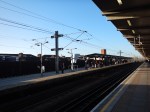
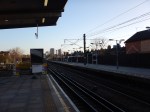
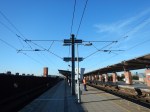
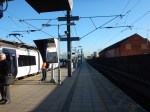
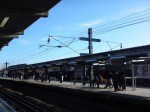
Almost uniquely for the UK rail network, the masts are in the mid-point of the two lines, with the wires cantilevered on either side.
Flimsy they are not! They have certainly been designed to survive a direct impact from a runaway Class 66 locomotive pulling several hundred tonnes of imported Chinese steel.
But as I said, the central masts probably date from 1999, so I suspect if similar structures were to be used in the electrification of the Gospel Oak to Barking Line, they would be designed to look better and probably be stronger and lighter too! I used to know a lot about using structural steel, and remember an expert telling me, that lighter structures are sometimes actually stronger.
Look at this picture from Upper Holloway station.
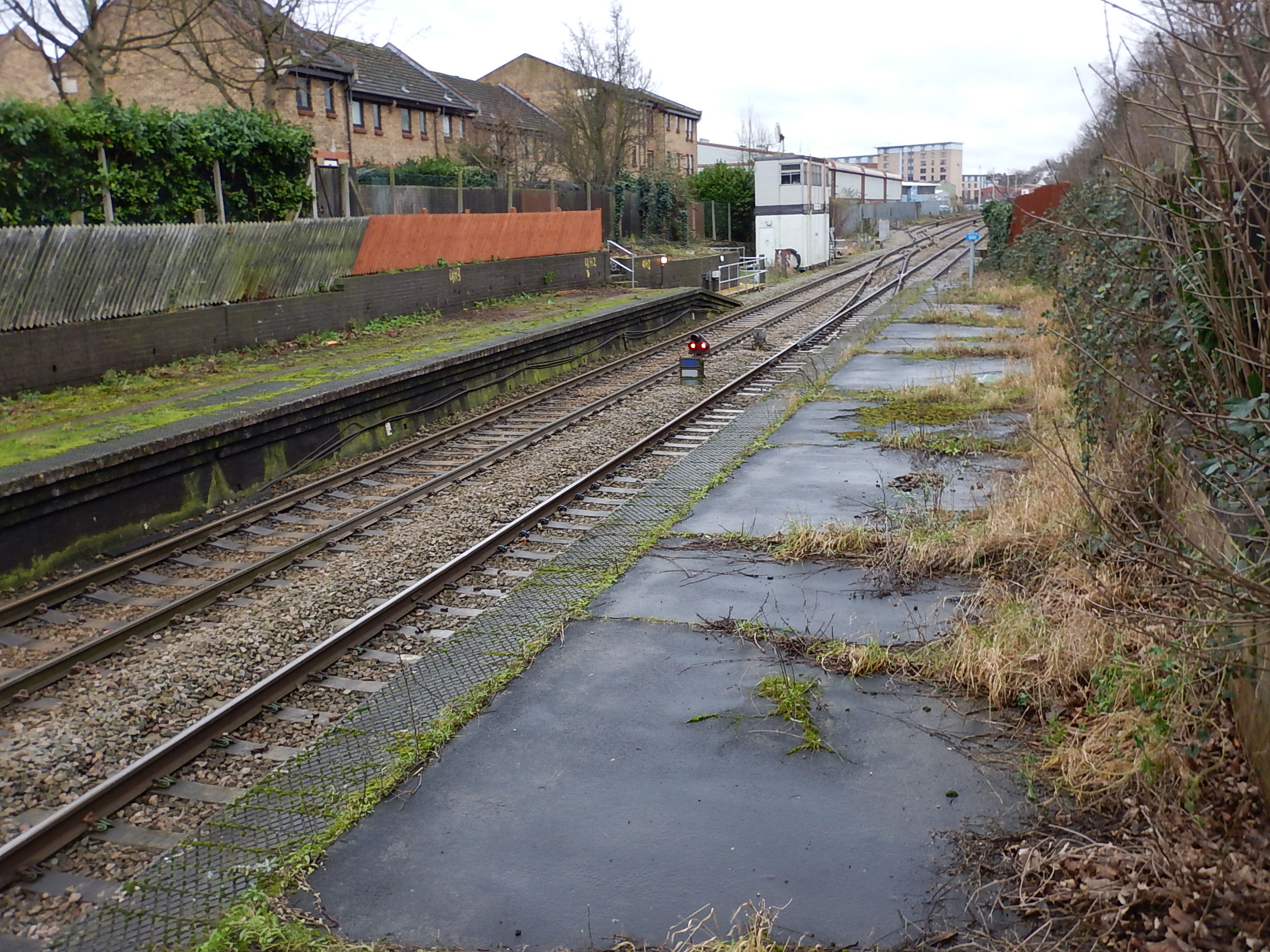
Looking West At Upper Holloway Station
It would appear that Murphys have piled around the crossing by the signal box to put a traditional portal frame across the railway to support the overhead wires. Some fifty metres behind me is a bridge that is being rebuilt over the railway.
So could the wires be installed through the station, by supporting them on the frame by the signal box, the bridge and several central masts, designed to fit between the tracks in the station area.
After seeing what was done in 1999 at West Ham station, I believe that an expert structural engineer could design a central mast to support electrification in the challenging conditions of Upper Holloway station and all the other difficult locations on the Gospel Oak to Barking Line.
There are advantages to this method.
- All of the platforms are untouched by electrification works.
- The number of piles to be driven at the side of the railway is reduced. This type of piling has caused problems in the past.
- Piles are positioned in the firm track-bed between the rails.
- Some piles will be positioned on viaducts. I suspect, that as the viaducts of the line seem sound, this would not be a very difficult problem.
- All work can probably be done by using a crane on the railway.
It does seem to me, that central masts could make the electrification easier.
There’s A New Green Hill In East London
I took this sequence of pictures from a c2c train as it crossed Mile End Park on its way between Fenchurch Street and West Ham stations.


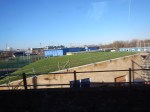
The hill covers the ventilation and access shaft in the Park for Crossrail.
This architect’s impression shows how the completed shaft will look.

Mile End Park Vent Shaft
Note the railway, from where I took the pictures in the background.
It’s certainly a less intrusive design, than the monstrosities used for the Channel Tunnel Rail Link, with architecture from the Napoleonic Wars.
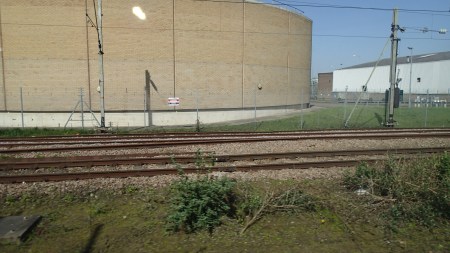
A Typical Channel Tunnel Vent Shaft
There are five of these across East London. Crossrail makes do with less than that!
I certainly feel that all those people worried about a Crossrail 2 ventilation shaft in their area, should go and have a look in Mile End Park.
 The Anonymous Widower