Is More Tram Fun On The Way In Edinburgh?
This article on the BBC web site is entitled Edinburgh trams: Plans to extend the line to Newhaven.
This is said.
Edinburgh’s tram network should be extended to Newhaven, a report to councillors has recommended.
It is estimated the three mile extension would cost £144.7m to build. The line currently stops at York Place in the city centre.
Edinburgh city council is looking into extending the tram network to Newhaven, Ocean Terminal or the foot of Leith Walk.
Councillors will vote next week.
As there are elections in Scotland in May, this could restart the saga of the building of the current Edinburgh trams, which kept Glaswegians and Sassenachs so amused.
I doubt they’ll start the extension of the tram system before the end of this decade!
Crossrail 2’s Roadshow At Dalston
Today was a Roadshow Day for Crossrail 2 at Dalston.


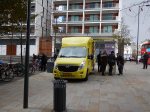

You do get a chance for a chat, but most of the information presented is on their web site.
Boxing Day Trains On Merseyside
The title of this post is the title of an article in Rail Magazine.
Running trains on Boxing Day for one of the busiest shopping and sporting days of the year, is a logical thing to do.
But where are my trains to Ipswich on that day?
Two Ticketing Stories
This story on Rail News is entitled Metrolink offers Get me there app and this story on Rail News is entitled Contactless payment to Gatwick Airport.
The stories illustrate the difference in philosophy between Manchester and London.
I don’t use financial apps, as they are a security risk to my bank and credit card details, so in Manchester I’ll still have to buy a ticket, as they haven’t embraced the modern technology of contactless cards.
Also why can’t I buy a Plus Tram ticket when I book a Virgin for Manchester?
For Gatwick now, I won’t have to buy a ticket, as I’ll use a contactless card between East Croydon and Gatwick.
North Yorkshire Proposes Rail Expansion
It surprised me when I read that North Yorkshire was the largest county in England. But thinking about it, there can’t be many others of a similar size.
This document on the coumty’s web site is entitled North Yorkshire County Council Local Transport Plan 2016 – 2045 and it lays out, what it says on the fitrst page.
It has these two sections about rail.
Rail Line Re-openings
The County Council supports, in principle, proposals for rail reopening in the County, on identified routes such as Skipton to Colne and Harrogate to Ripon / Northallerton.
In the past many of the line re-openings were considered to be “local schemes” and therefore required local funding. The Council will only actively support opportunities for line re-openings where these are demonstrated as of National or pan North of England importance. National or pan North strategic importance will be assessed on the basis of the contribution to network resilience, improved strategic connectivity, the delivery of greater capacity or improved rail freight opportunities.
In all cases North Yorkshire County Council will only work with railway industry and local stakeholders where there is common agreement to develop a proposal.
Future of Rail
On the East Coast Main Line, over £240m is being spent by Network Rail on infrastructure, increasing capacity, reducing journey times and improving reliability. With investment in new InterCity Express trains and the franchise holder’s commitment to further investment, including a new timetable with 6 direct services between Harrogate and London, the route is set to be transformed by 2020.
The re-franchising for both the Northern and TransPennine services has produced invitations to tender that are transformational. In North Yorkshire this will result in many routes having increased frequencies, additional Sunday services, new or modernised trains and better customer focus. With greater local input into the management and development of the franchises through Rail North it is felt that we can achieve the rail services that are needed for the North.
High Speed connectivity with proposals for HS2 network linking London –Midlands– Sheffield-Leeds–York and the North East in the early 2030s and the work of Transport for the North on HS3, providing fast frequent and reliable links between Northern Cities provides opportunities now for the Council to develop its plans for good connectivity for North Yorkshire to and within these networks.
Private investment such as the Potash Mine near Whitby (improvements planned for the rail service on the Esk Valley) along with other planned housing and economic growth in North Yorkshire all combine to facilitate growth in rail.
The County Council remains committed to ensuring North Yorkshire benefits from the growth and investment in our railways and will continue to influence decisions to achieve the best outcome for the County
The Council is recommending re-opening these two lines.
Skipton to Colne
Skipton station is a station at the western end of the electrified lines to and through Leeds. There are several plans for the future, involving direct trains to London and more frequent services to and from Leeds. There is also an aspiration of the Embsay and Bolton Abbey Railway to extend into Skipton.
Colne station is at the eastern end of the partly single-track East Lancashire Line, with services all the way to Blackpool South station via Burnley, Blackburn and Preston.
The two stations used to be connected until 1970, when it was closed, despite not being recommended for such by Beeching.
An organisation called Skipton-East Lancashire Rail Action Partnership is pressing for the line to be reopened. This map shows the rail lines in the area.
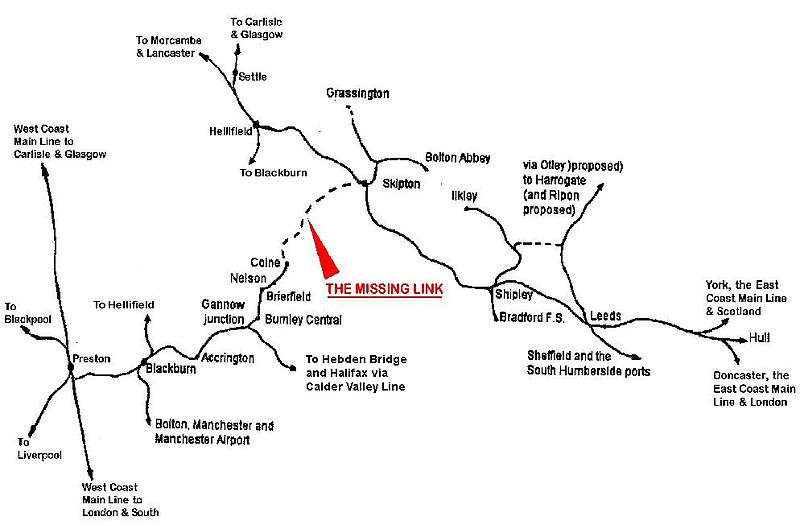
Skipton To Colne
Reopening this just under twelve miles length of track could bring a lot of benefits.
Most of the trackbed hasn’t been built on, but look at this Google Map of Colne station.
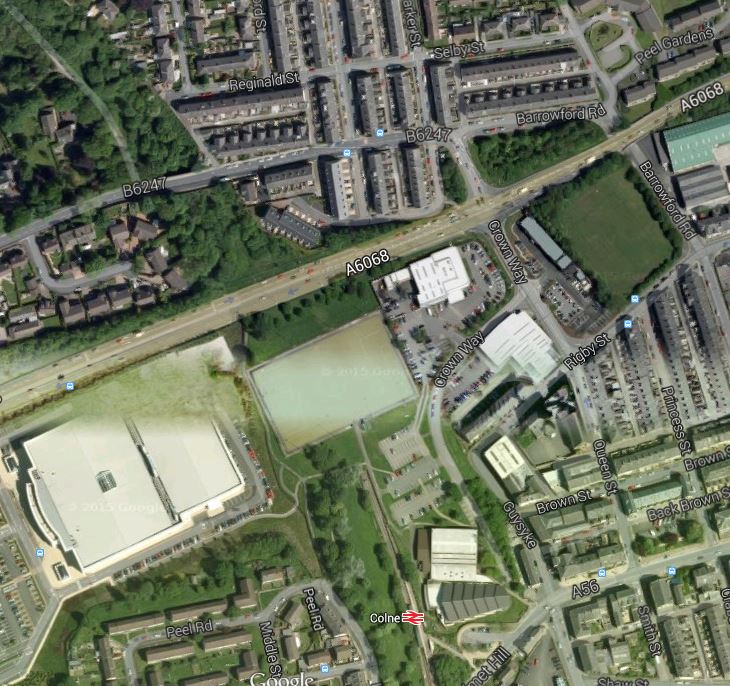
Colne Station
Note how the dual-carriageway, A6068 and a football pitch have been built, where any link from Colne would probably go.
So there would be a need for an expensive bridge. But as the line to Colne is only single-track, I suspect that the bridge could get away with one track, providing there was a passing loop at Colne station.
Having seen tram-trains in Germany, I know what the Germans would do and that is run tram-trains from the Blackpool tramway across Lancashire as trains and then over a tramway to Skipton. The advantage would be simpler infrastructure and lower costs.
But we have our own solution in the shape of the IPEMU, which could charge its batteries at Skipton and Preston and use bateries on any unelectrified line in between. The advantage would be no wires and possibly only a single track across the Pennines.
But if it is decided to create a link between Skipton and Colne, the railway technology developments of the last few years, could make the link more affordable.
Harrogate to Northallerton
Harrogate station has local services on the Harrogate Line to Leeds and York and some long-distance services to London and the South. The lines through the station are not electrified.
Northallerton station is on the East Coast Main Line
The plans would reopen the section north of Harrogate of the Leeds and Northallerton Railway. This would reconnect the cathedral city of Ripon to the rail network.
Under the Wikipedia entry for the former Ripon station, this is said.
Today much of the route of the line through the city is now a relief road and although the former station still stands, it is now surrounded by a new housing development. The issue remains a significant one in local politics and there are movements wanting to restore the line. Reports suggest the reopening of a line between Ripon and Harrogate railway station would be economically viable, costing £40 million and could initially attract 1,200 passengers a day, rising to 2,700. Campaigners call on MPs to restore Ripon railway link.
On the face of it, it might appear a good plan, but there are still questions to be answered.
- Ripon would need a new route and probably a parkway station.
- Leeds to Northallerton is under sixty miles and is electrified at both ends, so a passenger service could be run by IPEMUs.
- Would the line be double-track and electrified?
- Would the line be capable of being used as a diversion route for the East Coast Main Line?
- Would freight trains be encouraged to use the line to relieve pressure on the busy East Coast Main Line?
I’ll repeat what the report says about the East Coast Main Line..
On the East Coast Main Line, over £240m is being spent by Network Rail on infrastructure, increasing capacity, reducing journey times and improving reliability. With investment in new InterCity Express trains and the franchise holder’s commitment to further investment, including a new timetable with 6 direct services between Harrogate and London, the route is set to be transformed by 2020.
It is probably true to say, that what happens on the East Coast Main Line is going to determine, whether the Harrogate to Northallerton Line gets reopened.
This article in the Northern Echo is entitled £230m plan to reinstate key North railway line receives major boost details a lot more about the project and the Council’s enthusiasm.
Improved Connectivity
This is always an aim of Councils and reports like that commissioned by North Yorkshire County Council. These come to mind.
Esk Valley Line
The only specific mentioned is that York Potash might be funding improvements to the Esk Valley Line.
In An Alternative Approach To Provide A Local Metro Network, I put forward the concept of using IPEMU trains with minimal electrification to dvelop a Tees Valley Metro.
I believe with some small amount of electrification at Middlesbrough, the Tees Valley would get its Metro and Whitby an improved service of new electric trains.
Leeds to Sunderland
Reopening an electrified Harrogate to Northallerton line, with additional electrification from Leeds to York on the Harrogate Line and Northallerton to Middlesborough on the Northallerton to Eaglescliffe Line, would open up the possibility of extending services between London and Leeds to Harrogate, Ripon, Northallerton, Middlesbrough and Sunderland without using the East Coast Main Line north of Doncaster.
Again with minimal electrification, the service could be run by 110 mph IPEMUs.
Sorting Northallerton
Northallerton station is in a nest of level crossings. Removing these is probably high up Network Rail’s list of must-do projects, but it strokes me that in the future, if all plans for the East Coast Main Line, the Northallerton to Harrogate Line and the various electrification schemes in the area come to pass, then Northallerton station and the tracks leading away from it, need a very strong sorting out.
Conclusion
To me, the most important thing about this report from North Yorkshire is that the council is looking seriously at transport options for the future.
How Long Will We Wait For A Tram At Birmingham New Street Station?
The Midland Metro extension to Birmingham City Centre and New Street station was supposed to be completed by March 2015.
It is still not connected at Birmingham Snow Hill station to allow access across the city to Birmingham New Street station.
It had been previously announced that trams would reach New Street station, this year, so I was surprised to red this article on Global Rail News entitled Birmingham New Street tram extension delayed until 2016. The article says this.
Trams won’t reach Birmingham New Street until the New Year after Centro announced that work would be scaled back to support traders ahead of the Christmas period.
It’s probably the most valid reason, I’ve heard for a delay, but it does strike me that if the trams had reached New Street in March, they would have brought more visitors to Birmingham City Centre for Christmas.
If I was the Mayor of Birmingham, I’d be kicking a few backsides.
Ipswich Town’s Away Support
At Rotherham on Saturday, where I saw Ipswich win 5-2, the away end was pretty full.
It’s always the same, even if the match is a long way away!
Ipswich does seem to have a large diaspora, but a surprising number travelled up from Suffolk.
Compared to some of the pathetic away crowds we see at Portman Road, Ipswich Town’s away support always surprises me. I think the team appreciate it too!
An Advantage Of IPEMU Trains
My correspondent from the Corbedian Republic Of North Islington, has visited family in Newcastle over the weekend.
But things coming home didn’t go to plan and I received this text.
Our train dropped it’s pantograph.
Driver can’t put it back and train has been declared a failure. I quote. Now waiting to be rescued from Doncaster.
Later I received another text.
Train guard and driver not in touch. Could turn long and silly!
It all got me thinking!
As the train dropped a pantograph it was probably an InterCity 225 and not a diesel InterCity 125, which are built to Carry On Regardless. When I travel North from Kings Cross, I’ll look to see if the train is going to Aberdeen or Inverness, which means it will be a 125, with a reliable lump of a massive diesel engine front and back!
Incidentally, I found this extract in the Wikipedia entry for the Class 91 locomotive that pulls the InterCity 225.
In November 2012, unit 91114 had a second pantograph added as a pilot project operated jointly by Eversholt Rail Group, East Coast, ESG, Wabtec Rail and Brecknell-Willis. The new design uses the same mounting positions as a conventional pantograph but pairs two pantograph arms in an opposing configuration. If there is an ADD (Automatic Dropping Device) activation or the pantograph becomes detached, the train can keep going, so the system provides redundancy in the event of a pantograph/OLE failure.
So it could be that Class 91s regularly drop pantographs like whores drop their drawers!
As far as I can find out, only one locomotive has been fitted with the new pantograph.
But in future, I have a feeling that this type of problem could give a big advantage to an IPEMU train, which has on-board energy storage.
As it rolls along, it will be charging the battery, so if the pantograph fails, it will have a full battery and should be able to run for perhaps another fifty miles or so to a convenient station.
Having two independent systems, is not a bad way of improving reliability.
Crossrail 2 Consultation – Angel Station
This Crossrail document is entitled Angel Station.
The current Angel station is not a run-of-the-mill station with long escalators, an unusual platform layout and a situation in the ground-floor of an office block!
But as it was only built in the 1990s, I suspect the design is such to aid the construction of the Crossrail 2 station.
This is TfL’s proposal for the Crossrail 2 station at Angel.
-
2×250 metre long platforms.
-
Station platform tunnels around 30 metres below ground level to the top of tunnel
-
An increase in capacity within the existing Northern line ticket hall to accommodate a Crossrail 2 ticket hall on Islington High Street
-
An enlarged station entrance and a new second entrance onto Torrens Street
-
An underground connection between Crossrail 2 and Northern line services
-
A facility for reversing Crossrail 2 trains
The last item is possibly surprising, as although they need reversing facilities, I didn’t think it would be Angel.
This map from the document shows the layout of the station and the work-sites.

Crossrail 2 – Angel Station
The four work-sites are as follows.
- Site A – The site of the Royal Bank of Scotland building would be used for station tunnelling works and construction of the station entrance, station box and station shaft.
- Site B – Includes Iceland and other properties to the north of White Lion Street. This site would be used for construction of the station shaft. Impacts on Chapel market would be avoided.
- Site C – At the southern part of Torrens Street, the location of the old entrance to Angel station would be used as access to support the construction of the underground connection between Crossrail 2 and the Northern line.
- Site D – The Public Carriage Office site, which is owned by Transport for London, could be used for construction of a facility for reversing Crossrail 2 trains at Angel. This is subject to further investigation.
I have walked round the Angel and the various sites taking pictures in the order A, C, D and B.




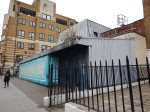


All of this leaves me with these observations, thoughts and conclusions.
- All sites except D are bordered by roads carrying large amounts of traffic.
- The chaotic Junction At The End of White Lion Street needs easing before rebuilding Angel station.
- It is quite surprising how far the Northern Line platforms are from the entrance to the station. Sadly, this history will probably mean that there will be no simple interchange between the two lines as is promised at Balham.
- I would split the Northern Line into two lines before building Crossrail 2, as this might take pressure off Angel station during building of Crossrail 2.
- I think it is also a pity, that there is no entrance to the station shown on the Chapel Market side of the road.
On the plus side, I can’t see the design of the station causing too many problems in both design and construction.
A 2020 Update
It is now over five years since I wrote this post, so these are some new thoughts.
The Reversing Facility
The TfL document says that the facility will be for reversing trains at Angel station.
- As the site is to the West of Angel station, it would reverse trains from the East.
- Usually reversing sidings are between the two tracks and would be long enough to take a full-length train.
- The facility would be underground and it could be built in the traditional way as the new Bank tunnel was recently.
- The effect on buildings, would probably be the same as the main Crossrail 2 tunnels.
Operation of the reversing siding would be as follows.
- Trains would pull into the Westbound platform at the Angel.
- After all passengers had got out, the train would move forward into the siding.
- The driver would then change ends.
- When the line was clear move into the Eastbound platform.
It should be noted that Crossrail doesn’t have a reversing facility under London, and I think it would have been useful in enabling the route to open in sections.
Is This Another Line For A Great Western Railway IPEMU?
Nothing much has happened since I wrote Rumours Of Battery Powered Trains, which said that a report had appeared in Modern Railways saying that Great Western Railway was looking at Class 387 IPEMUs.
But I did find this article on the Get Reading web site entitled Green Park Station may open without any trains stopping there.
Apparently, the problem is that diesel multiple units can’t accelerate fast enough to keep to the schedule with the stop at Reading Green Park station, but electric ones can.
As it appears the wires won’t go up in time for the station’s opening of 2018, then the trains won’t be electric.
Unless of course an IPEMU could stick to the schedule. It would certainly have a lot of power in the battery, as Reading to Basingstoke must be less than twenty miles and it’s electrified at both ends.
The line is a classic for use of IPEMU technology.
 The Anonymous Widower