‘I Get To Work On The Most Scenic Railway Line In The World’
The title of this post, is the same as that of this article on the BBC. It is a quote from someone in the BBC article.
This is the sub-heading.
Have you heard the one about the railway line that was threatened with closure, so lots of people started using it and it was saved?
These three opening paragraphs add some detail to the story.
Welcome to the Settle to Carlisle line, the quirky steel road through some of Britain’s most magnificent countryside.
The line starts in Leeds and passes through Shipley and Skipton, but it is the section between North Yorkshire and Cumbria that is world-famous for its views.
Heading north from Settle, the peak of Pen-y-Ghent soon looms large, with Whernside and Ingleborough following a few miles later.
The saving of the line in the 1980s, is one of those classic British tales of a fight against bureaucracy, which like all these tales involved a dog, who gets a heroic mention in the BBC article.
In the next few sections, I will detail how improvements to the rail infrastructure between Bradford, Carlisle, Lancaster, Leeds have gradually developed the rail infrastructure, so that the Settle and Carlisle Line can play an increasing part in improving the economic outlook for a large area of England.
Is The Settle And Carlisle Line In Good Condition?
Google AI gives this answer to the question in the title of this section.
Yes, the Settle-Carlisle line is in good, operational condition and is considered a vital, well-maintained part of the National Rail network.
Despite a history of threatened closures and past structural issues, major investments have secured its future, and it currently carries over 1.2 million passengers a year.
Here is the current status of the line as of early 2026:
Infrastructure Condition: Following significant repairs, including a major £2.1 million project on the Ribblehead Viaduct completed in 2021 and extensive work at Eden Brows (2017), the line’s 14 tunnels and 22 viaducts are in good condition.
Active Usage: It is regularly used by Northern passenger services and is a designated diversionary route for mainline express trains when the West Coast Main Line is closed.
Operational Status: The line is fully operational, featuring regular commuter services, tourist trains, and steam heritage charter trains.
Safety & Upgrades: While it is a historic line, the infrastructure is deemed safe.
Occasional, isolated issues (like the 2022 freight derailment near Carlisle) have been managed with swift repairs.As of early 2026, the line is heavily used, with special passenger services and 150th-anniversary celebrations planned.
It’s probably in better condition, than many houses in the UK.
What Is The Operating Speed Of The Settle And Carlisle Line?
Google AI gives this answer to the question in the title of this section.
The Settle and Carlisle Line generally operates at a maximum speed of 60 mph/97 km/h.
While historically faster, this 60 mph limit is standard for modern passenger and freight services on the route.
Usage Examples and ContextPassenger Services: Northern Rail and various chartered services, including the scenic “Staycation Express” HST 125, operate along the route.
Freight: The line is used for heavy freight, including oil, timber, and cement trains.
Diversions: The line is frequently used as a, albeit slower, alternative route (approx. 2.5 hours for Leeds-Carlisle) during major West Coast Main Line (WCML) closures.
Scenic Tourism: The line is renowned as one of England’s most scenic, carrying over a million travelers annually, with notable sights like the Ribblehead Viaduct.
The Settle And Carlisle Line Is Well Connected To The Rail Network At The Northern End
This OpenRailwayMap shows how the line connects to the West Coast Main Line and the Tyne Valley Line, to the South of Carlisle.
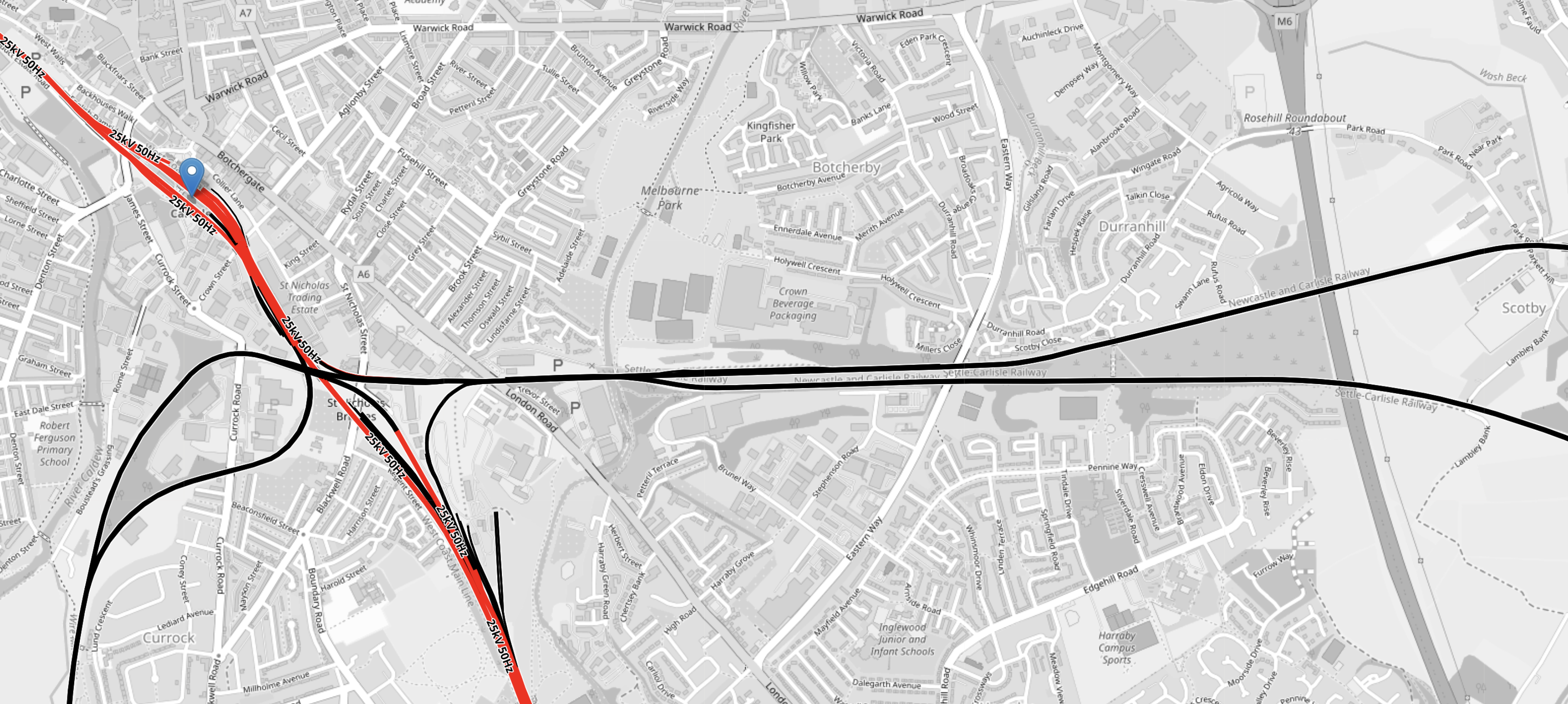
Note.
- Electrified lines are shown in red and lines shown in black are not electrified.
- The electrified West Coast Main Line runs diagonally across the South-West corner of the map.
- The blue arrow on this line, indicates Carlisle station.
- The Northernmost of the two black cross lines is the Tyne Valley Line between Carlisle and Newcastle.
- The Southernmost of the two black cross lines is the Settle And Carlisle Line, which goes South to Settle, Bradford Forster Square, Leeds and Settle stations.
- The line going South-West joins the Cumbrian Coast Line, which joins the West Coast Main Line at Carnforth.
It does appear that the junction South of Carlisle is very comprehensive and allows very flexible routing.
The Settle And Carlisle Line Is Well Connected To The Rail Network At The Southern End
This OpenRailwayMap shows how the line connects to the West Coast Main Line and the Tyne Valley Line, to the North of Skipton.
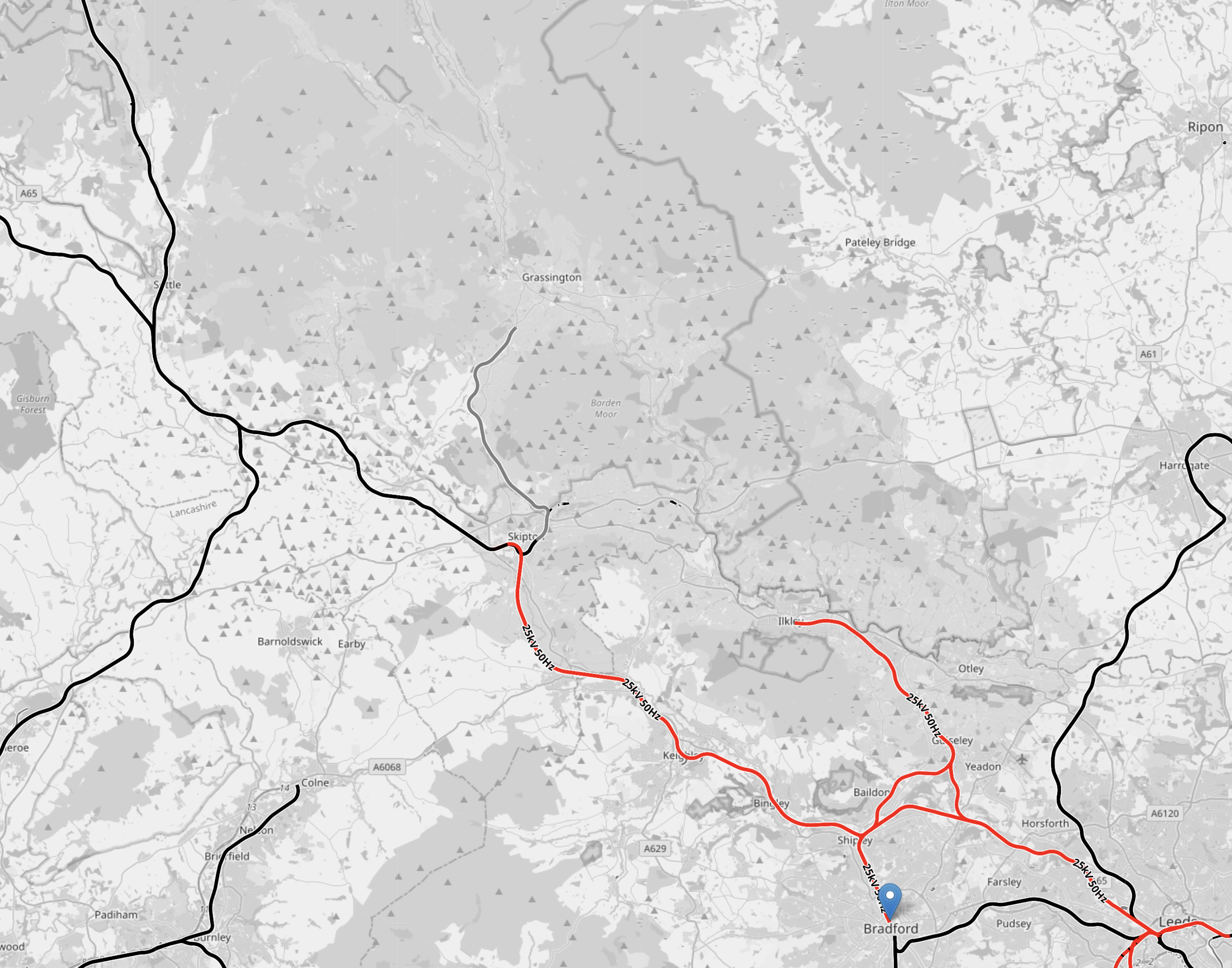
Note.
- Electrified lines are shown in red and lines shown in black are not electrified.
- The blue arrow on this line, indicates Bradford Forster Square station.
- The fully-electrified Leeds station is in the South-East corner of the map. You can just pick out the ee of the name.
- The electrified Leeds-Bradford Line connects Bradford Forster Square and Leeds station via Shipley station and its triangular junction.
- The electrification continues in a North-Westerly direction as far as Skipton, where the red track stops.
- Electric intercity trains can run from London to Leeds, Bradford Forster Square and Skipton.
- Self-powered intercity trains can also run from London to Harrogate, which is on the line without electrification, that runs North from Leeds.
- Leeds receives a London service of two trains per hour (tph).
- Bradford Forster Square station receives a London service of one train per two hours (tp2h) via Leeds.
- Harrogate station receives a London service of 1 tp2h via Leeds.
- Skipton station receives a London service of one train per day (tpd) via Leeds.
The Leeds-Bradford area gets a frequent service to London and the South.
This OpenRailwayMap shows how the Settle and Carlisle Line connects to the electrification at Skipton.
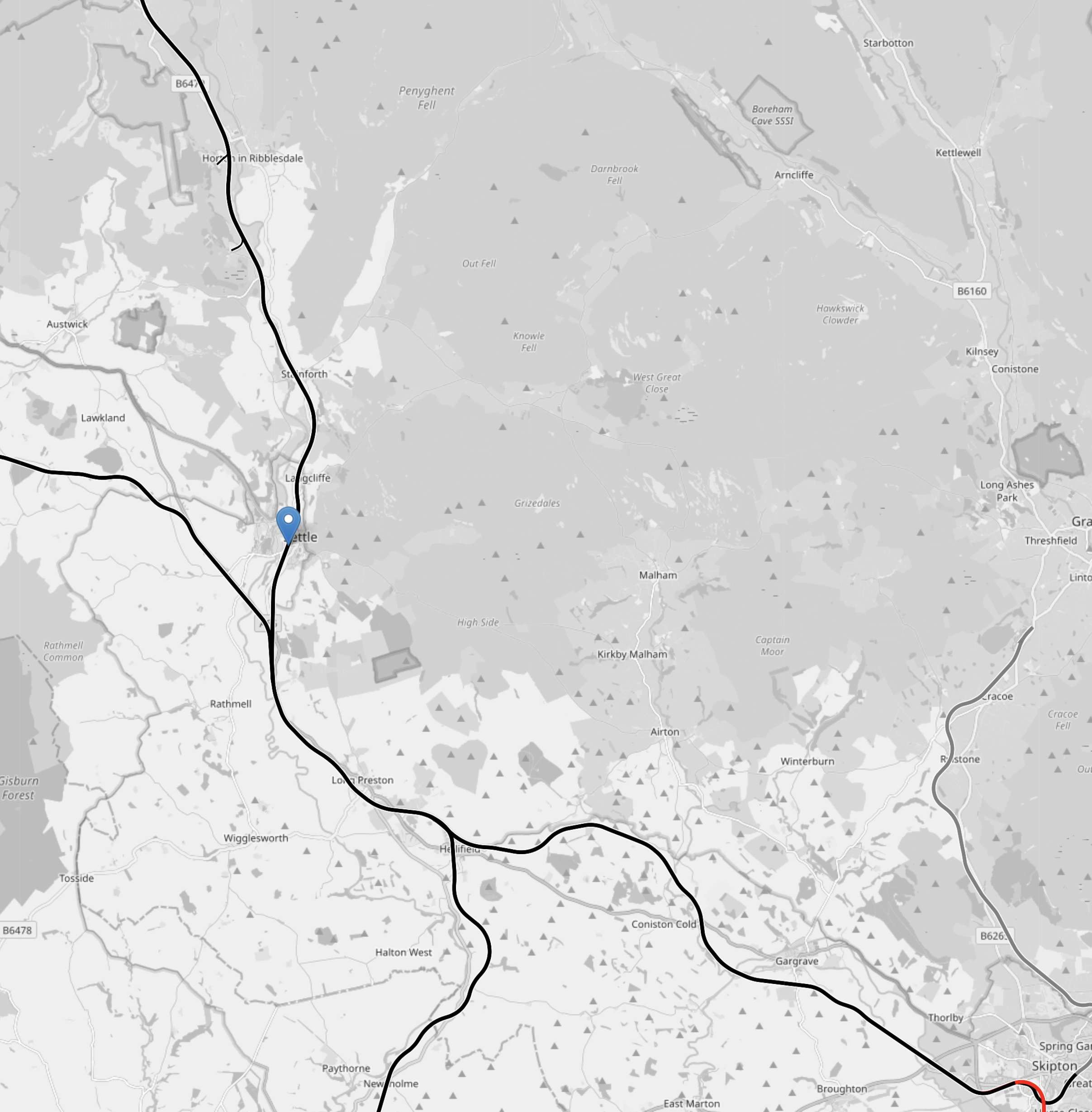
Note.
- Electrified lines are shown in red and lines shown in black are not electrified.
- The only electrified lines on the map are at Skipton station in the South-East corner of the map.
- The blue arrow on this line, indicates Settle station.
- Skipton and Settle stations are 15.2 miles apart.
- Settle and Carlisle are 71.5 miles apart.
To bridge the gap in the electrification between Carlisle and Skipton, trains will need to be able to run 86.7 miles on their own power.
Bridging The Carlisle And Skipton Gap
But once the train gets to Carlisle or Skipton, the train will have the luxury of 25 KVAC overhead electrification to both power the train and charge any batteries.
In my opinion, there are three intercity trains coming into service, that could handle an 86.7 mile gap in electrification.
- East Midland Railways’s Class 810 train, which is a diesel bi-mode with lots of power, which is described in this Wikipedia entry.
- LNER’s Class 802 trains, which currently is a diesel bi-mode, that Hitachi could convert into a Hitachi Intercity Battery Train, which is described on this Hitachi web site.
- LNER’s Class 897 trains, which is a diesel tri-mode, that CAF are building in Spain and Wales, which is described in this Wikipedia entry.
In How Far Will A Hitachi Intercity Battery Train Travel Without Using The Electrification?, I answer the question for both Hitachi and CAF trains.
Surprisingly, I got the answer of a range of 120 miles for both the Hitachi and CAF trains. But could it be that Network Rail and the train companies wanted a range of 120 miles to electrify the UK rail network and so a 120 mile battery range was in the specification.
My estimate of 120 miles for Hitachi’s trains, was also confirmed by the company.
Bridging The Gaps
Some other distances, where gaps must be bridged include.
- Sheffield and South Wigston – 69.4 miles
- Holyhead and Chester – 84.4 miles
- Exeter and Basingstoke – 124,3 miles
- Fishguard Harbour and Cardiff Central – 119.1 miles
- Aberystwyth and Shrewsbury – 81.5 miles
- Bristol Temple Meads and Newbury – 70.8 miles
- Inverness and Aberdeen – 108.3 miles
- Carlisle and Glasgow Central via Dumfries – 115.9 miles
- Hereford to Didcot Junction – 96.9 miles
120 miles could be a good fit.
Could it be that that distance was the range of a steam locomotive on a full load of water?
The Updating Of Bradford Forster Square Station
This is now a four-platform station, with two platforms able to take a pair of 5-car Hitachi or the new CAF 10-car Class 397 trains.
In Bradford Forster Square Station – 20th May 2025, I describe and show pictures of the updated station.
Bradford Forster Square station now gets seven trains per day to and from London King’s Cross via Leeds.
This article on the BBC, which is entitled New Platform’s Opening Gives Bradford More Trains has this sub-heading.
A new £35m platform at Bradford’s Forster Square Station has opened – boosting rail services in the city
£35million seems a lot of money to spend to just increase the number of services between King’s Cross and Bradford, even though 2025 was the year that Bradford was UK City of Culture, but there may be valid reasons to create a new route between London and Scotland, using the Settle and Carlisle Line.
- The Settle and Carlisle Line is one of the UK’s most famous scenic routes with 20 viaducts, 14 tunnels and countless beautiful vistas along its 72 mile track.
- You put the Mona Lisa on display, not in a store.
- LNER now has battery-electric bi-mode trains, with CAF tri-mode trains due to enter service in 2028, that can both handle the 86.7 mile gap in the electrification in silence.
- The CAF trains have extra diesel power, about which CAF is not disclosing much. This to me, suggests some innovative use.
- There appear to be no flights between Leeds/Bradford Airport and Scotland.
- There appear to be no direct trains between Glasgow and West Yorkshire.
- A direct train between Glasgow and Leeds and Bradford Forster Square would add additional connectivity between Scotland and Yorkshire.
- With the cancellation of High Speed Two, we need more train paths between London and Scotland.
- Decarbonisation of aviation is difficult, but replacing fossil-fueled planes with zero-carbon trains is easier.
- A single Class 897 train can carry 569 seated passengers, which is about 3.5 times the capacity of a single Airbus A320.
- The proposed Leeds Metro would bring passengers to the new service.
- Leeds and Bradford could see an upturn in tourism.
I also think the line will not be lightly used due to its iconic status.
How Would A Leeds/Bradford And Scotland Service Call At Bradford Forster Square Station?
- Bradford Forster Square station now gets seven trains per day to and from London King’s Cross via Stevenage, Newark Northgate, Doncaster, Wakefield Westgate, Leeds and Shipley.
- There is one fewer train on Sunday.
- There is a triangular junction at Shipley station, which connects the three electrified lines to Leeds, Bradford Forster Square and Skipton.
This OpenRailwayMap shows Shipley station and the triangular junction.
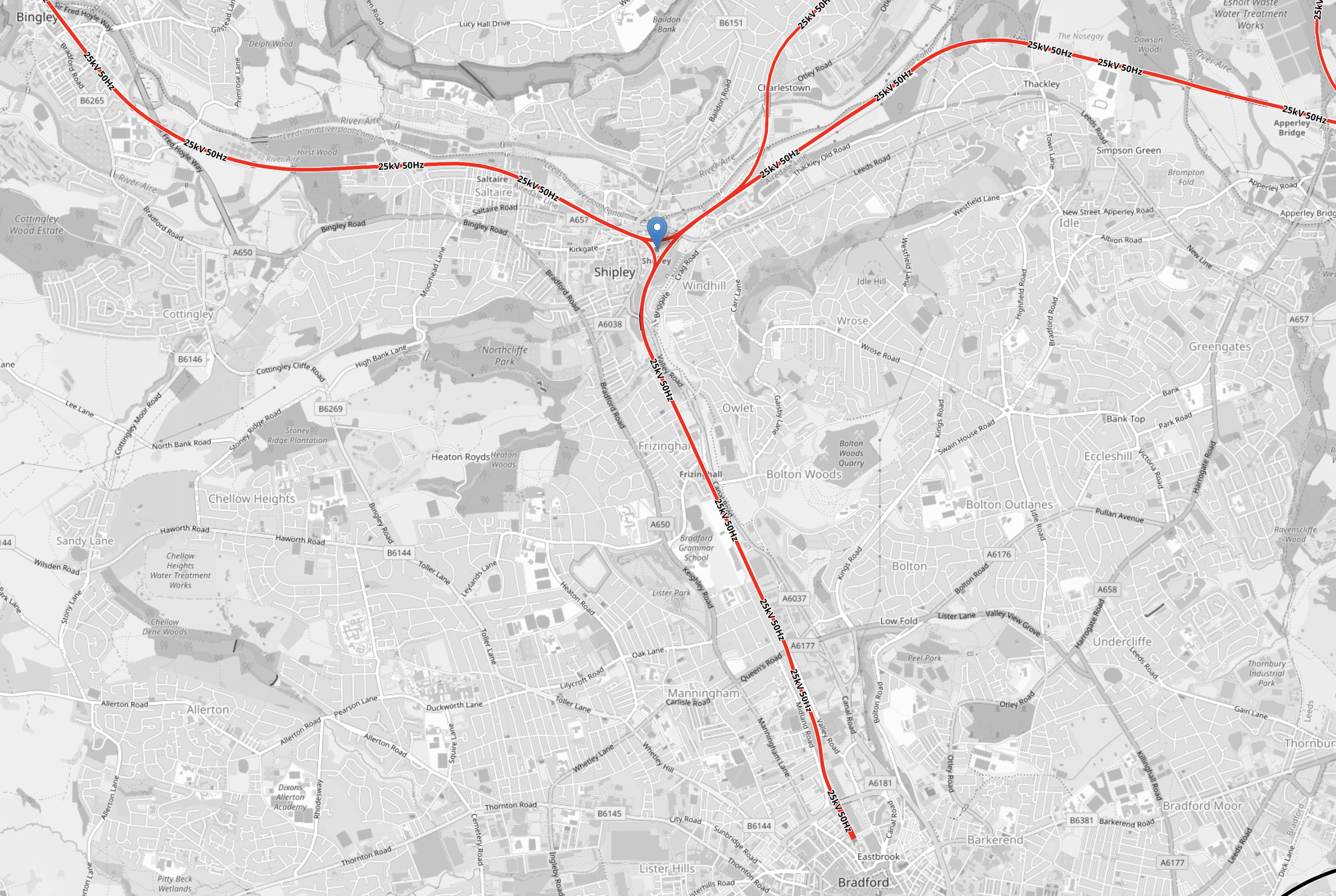
Note.
- All rail lines are electrified and shown in red.
- The blue arrow on this line, indicates Shipley station.
- Shipley station appears to be in the middle of the junction.
- The line going East connects to Leeds station.
- The line going South connects to Bradford Forster Square station, which is at the end of the line.
- The line going West connects to Skipton station and the Settle and Carlisle Line.
Trains returning to London would reverse out of Bradford Forster Square station and take the Eastern route through Shipley and Leeds back to London.
- An appropriate number of trains for Carlisle and Scotland, could surely just reverse out of the station and take the Western route through Skipton station and go on to the Settle and Carlisle Line.
- The trains would call at Wakefield Westgate, Leeds, Shipley, Bradford Forster Square and Skipton stations in the Leeds/Bradford conurbation.
- Other stations could be added to the route if required.
- The trains would effectively reverse direction in their call at Bradford Forster Square station.
- Going North the trains might check their battery levels in Bradford Forster Square station and use a fast-charger if necessary.
- Going South, there would be no need for charging, as the route South from Bradford Forster Square station, is already fully-electrified.
- Would the operator, use this longer stop to replace the crew with a fresh one?
It could be a simple and efficient way to run a London and Scotland service via the Settle and Carlisle Line.
What About Hull, Sheffield And York?
I’m asking this question, as Yorkshire is a large county and this article has only mentioned a few places, where people live and might need to go to London or Scotland.
In February, I wrote Northern Launches New Yorkshire Flyer Fast Service Between Leeds And Sheffield.
I’m fairly sure that Hull, York and other cities and large towns in Yorkshire already have a good regional service to Bradford Forster Square or Leeds station, which will give a good connection to the new service.
Could Dumfries Be Served By Using The Glasgow South Western Line?
This OpenRailwayMap shows the Southern part of the Glasgow South Western Line.
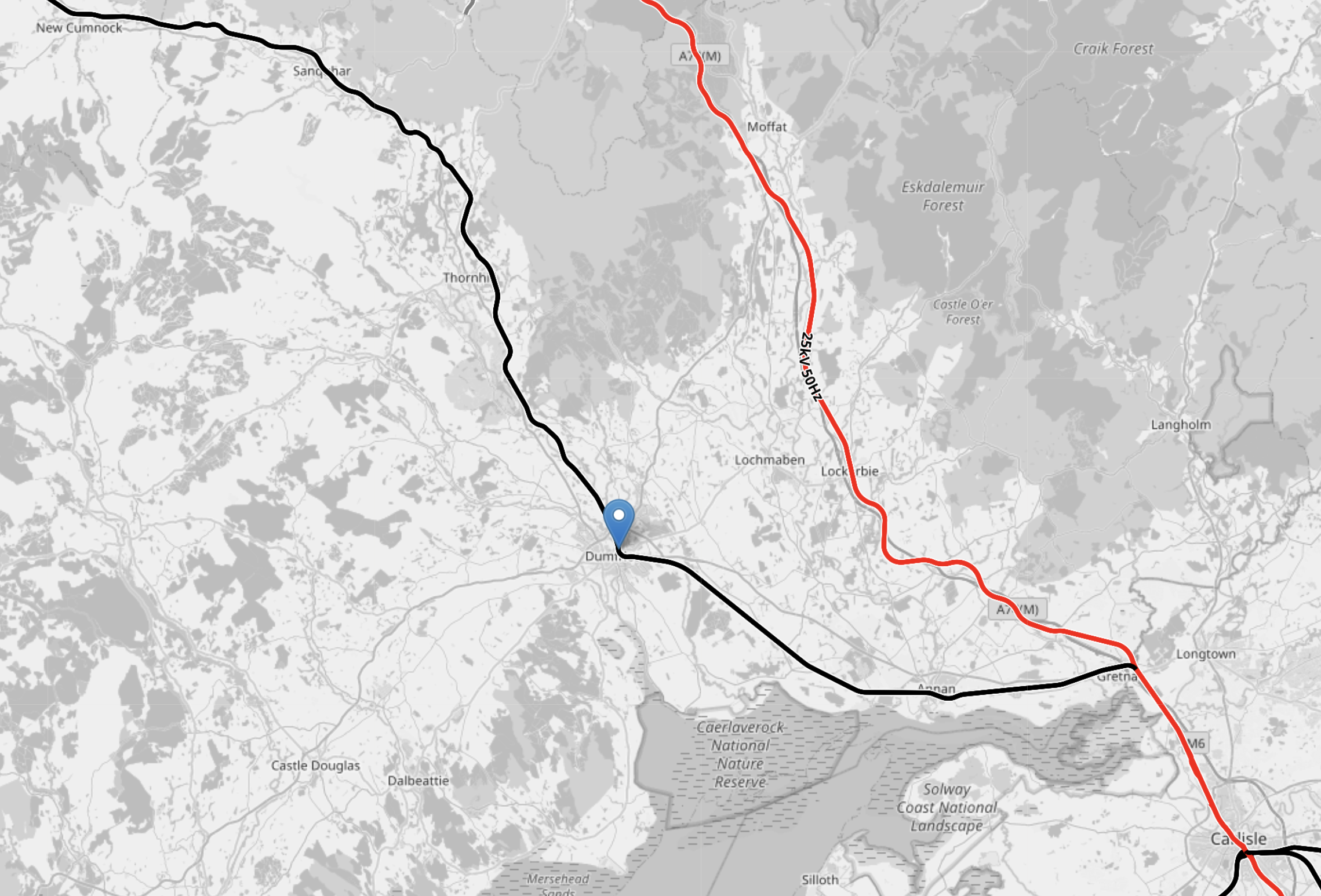
Note.
- Electrified lines are shown in red and lines shown in black are not electrified.
- The blue arrow on the black track, indicates Dumfries station on the Glasgow South Western Line.
- The red track is the West Coast Main Line.
- Carlisle is in the South-East corner of the map.
- Carlisle and Glasgow Central via Dumfries is 115.9 miles
- The Thames-Clyde Express, ran on this route until 1974.
- According to the Wikipedia entry for the Thames-Clyde Express, the train called at Dumfries and Kilmarnock stations.
From this brief look it appears that the new service could include Dumfries and should be able to serve the town on battery power.
Is More Capacity Needed On The West Coast Main Line Between Carlisle And Glasgow?
I asked Google AI, this question, to see if there is capacity.
This was the answer I received.
Yes, increased capacity and infrastructure enhancements are required on the West Coast Main Line (WCML) between Carlisle and Glasgow, as the line is currently full and unable to meet modern, growing passenger and freight demands.
Upgrades are necessary to tackle aging infrastructure, bottlenecks, and the need for more frequent services.
Key Aspects of the Need for Capacity:Full Capacity: The WCML is essentially full, with little space left for growth, despite 75 million passengers using it annually.
Freight and Passenger Growth: Passenger numbers are expected to double by 2050, and the line is a crucial artery for Anglo-Scottish freight.
Infrastructure Age: The northern section is undergoing its largest upgrade in half a century to address reliability issues.
Performance Bottlenecks: Specific locations, such as those north of Carlisle, require signaling and track improvements to prevent delays.
Proposed Upgrades: Current initiatives include a £400m investment until March 2029 for upgrades, including signalling and track renewals, though these are largely to boost reliability rather than provide a massive increase in capacity.
It looks to me, that a bit of a redesign and some use of battery trains on the Glasgow South Western Line, might squeeze a few more trains into the route.
North Yorkshire Proposes Rail Expansion
It surprised me when I read that North Yorkshire was the largest county in England. But thinking about it, there can’t be many others of a similar size.
This document on the coumty’s web site is entitled North Yorkshire County Council Local Transport Plan 2016 – 2045 and it lays out, what it says on the fitrst page.
It has these two sections about rail.
Rail Line Re-openings
The County Council supports, in principle, proposals for rail reopening in the County, on identified routes such as Skipton to Colne and Harrogate to Ripon / Northallerton.
In the past many of the line re-openings were considered to be “local schemes” and therefore required local funding. The Council will only actively support opportunities for line re-openings where these are demonstrated as of National or pan North of England importance. National or pan North strategic importance will be assessed on the basis of the contribution to network resilience, improved strategic connectivity, the delivery of greater capacity or improved rail freight opportunities.
In all cases North Yorkshire County Council will only work with railway industry and local stakeholders where there is common agreement to develop a proposal.
Future of Rail
On the East Coast Main Line, over £240m is being spent by Network Rail on infrastructure, increasing capacity, reducing journey times and improving reliability. With investment in new InterCity Express trains and the franchise holder’s commitment to further investment, including a new timetable with 6 direct services between Harrogate and London, the route is set to be transformed by 2020.
The re-franchising for both the Northern and TransPennine services has produced invitations to tender that are transformational. In North Yorkshire this will result in many routes having increased frequencies, additional Sunday services, new or modernised trains and better customer focus. With greater local input into the management and development of the franchises through Rail North it is felt that we can achieve the rail services that are needed for the North.
High Speed connectivity with proposals for HS2 network linking London –Midlands– Sheffield-Leeds–York and the North East in the early 2030s and the work of Transport for the North on HS3, providing fast frequent and reliable links between Northern Cities provides opportunities now for the Council to develop its plans for good connectivity for North Yorkshire to and within these networks.
Private investment such as the Potash Mine near Whitby (improvements planned for the rail service on the Esk Valley) along with other planned housing and economic growth in North Yorkshire all combine to facilitate growth in rail.
The County Council remains committed to ensuring North Yorkshire benefits from the growth and investment in our railways and will continue to influence decisions to achieve the best outcome for the County
The Council is recommending re-opening these two lines.
Skipton to Colne
Skipton station is a station at the western end of the electrified lines to and through Leeds. There are several plans for the future, involving direct trains to London and more frequent services to and from Leeds. There is also an aspiration of the Embsay and Bolton Abbey Railway to extend into Skipton.
Colne station is at the eastern end of the partly single-track East Lancashire Line, with services all the way to Blackpool South station via Burnley, Blackburn and Preston.
The two stations used to be connected until 1970, when it was closed, despite not being recommended for such by Beeching.
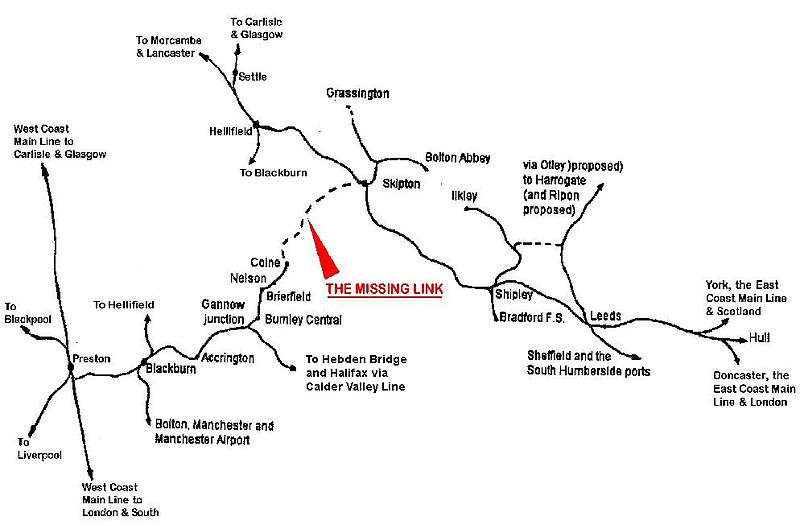
An organisation called Skipton-East Lancashire Rail Action Partnership is pressing for the line to be reopened. This map shows the rail lines in the area.
Skipton To Colne
Reopening this just under twelve miles length of track could bring a lot of benefits.
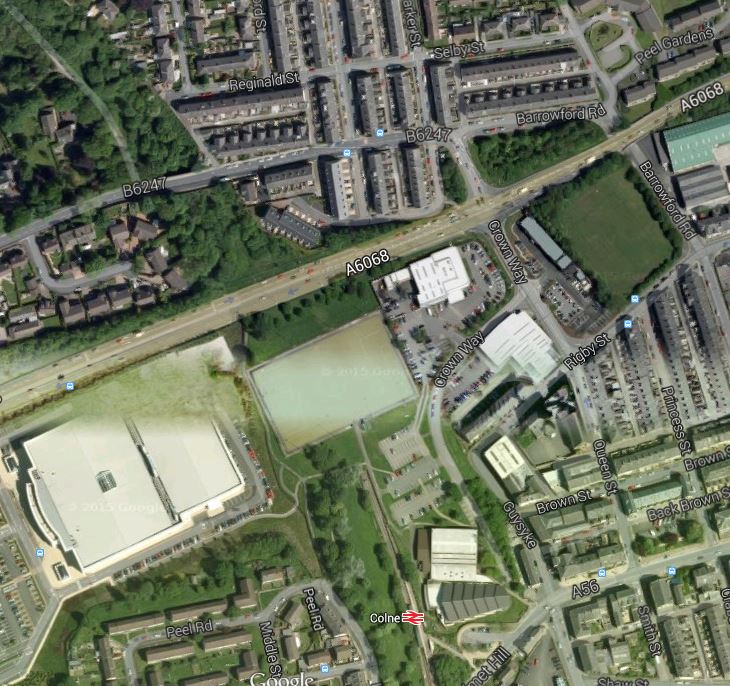
Most of the trackbed hasn’t been built on, but look at this Google Map of Colne station.
Colne Station
Note how the dual-carriageway, A6068 and a football pitch have been built, where any link from Colne would probably go.
So there would be a need for an expensive bridge. But as the line to Colne is only single-track, I suspect that the bridge could get away with one track, providing there was a passing loop at Colne station.
Having seen tram-trains in Germany, I know what the Germans would do and that is run tram-trains from the Blackpool tramway across Lancashire as trains and then over a tramway to Skipton. The advantage would be simpler infrastructure and lower costs.
But we have our own solution in the shape of the IPEMU, which could charge its batteries at Skipton and Preston and use bateries on any unelectrified line in between. The advantage would be no wires and possibly only a single track across the Pennines.
But if it is decided to create a link between Skipton and Colne, the railway technology developments of the last few years, could make the link more affordable.
Harrogate to Northallerton
Harrogate station has local services on the Harrogate Line to Leeds and York and some long-distance services to London and the South. The lines through the station are not electrified.
Northallerton station is on the East Coast Main Line
The plans would reopen the section north of Harrogate of the Leeds and Northallerton Railway. This would reconnect the cathedral city of Ripon to the rail network.
Under the Wikipedia entry for the former Ripon station, this is said.
Today much of the route of the line through the city is now a relief road and although the former station still stands, it is now surrounded by a new housing development. The issue remains a significant one in local politics and there are movements wanting to restore the line. Reports suggest the reopening of a line between Ripon and Harrogate railway station would be economically viable, costing £40 million and could initially attract 1,200 passengers a day, rising to 2,700. Campaigners call on MPs to restore Ripon railway link.
On the face of it, it might appear a good plan, but there are still questions to be answered.
- Ripon would need a new route and probably a parkway station.
- Leeds to Northallerton is under sixty miles and is electrified at both ends, so a passenger service could be run by IPEMUs.
- Would the line be double-track and electrified?
- Would the line be capable of being used as a diversion route for the East Coast Main Line?
- Would freight trains be encouraged to use the line to relieve pressure on the busy East Coast Main Line?
I’ll repeat what the report says about the East Coast Main Line..
On the East Coast Main Line, over £240m is being spent by Network Rail on infrastructure, increasing capacity, reducing journey times and improving reliability. With investment in new InterCity Express trains and the franchise holder’s commitment to further investment, including a new timetable with 6 direct services between Harrogate and London, the route is set to be transformed by 2020.
It is probably true to say, that what happens on the East Coast Main Line is going to determine, whether the Harrogate to Northallerton Line gets reopened.
This article in the Northern Echo is entitled £230m plan to reinstate key North railway line receives major boost details a lot more about the project and the Council’s enthusiasm.
Improved Connectivity
This is always an aim of Councils and reports like that commissioned by North Yorkshire County Council. These come to mind.
Esk Valley Line
The only specific mentioned is that York Potash might be funding improvements to the Esk Valley Line.
In An Alternative Approach To Provide A Local Metro Network, I put forward the concept of using IPEMU trains with minimal electrification to dvelop a Tees Valley Metro.
I believe with some small amount of electrification at Middlesbrough, the Tees Valley would get its Metro and Whitby an improved service of new electric trains.
Leeds to Sunderland
Reopening an electrified Harrogate to Northallerton line, with additional electrification from Leeds to York on the Harrogate Line and Northallerton to Middlesborough on the Northallerton to Eaglescliffe Line, would open up the possibility of extending services between London and Leeds to Harrogate, Ripon, Northallerton, Middlesbrough and Sunderland without using the East Coast Main Line north of Doncaster.
Again with minimal electrification, the service could be run by 110 mph IPEMUs.
Sorting Northallerton
Northallerton station is in a nest of level crossings. Removing these is probably high up Network Rail’s list of must-do projects, but it strokes me that in the future, if all plans for the East Coast Main Line, the Northallerton to Harrogate Line and the various electrification schemes in the area come to pass, then Northallerton station and the tracks leading away from it, need a very strong sorting out.
Conclusion
To me, the most important thing about this report from North Yorkshire is that the council is looking seriously at transport options for the future.
 The Anonymous Widower