Will Brent Cross Thameslink Station Get The Go-Ahead?
This was said in this article in the Standard last night.
At the same time, the Chancellor is promising a £97 million downpayment for a new station at Brent Cross, a major redevelopment area highlighted in his National Infrastructure Plan with last December’s Autumn Statement. It could help start construction of 7,500 homes. Another £7 million will go to the Croydon growth zone, aiming to create 4,000 homes. A further £1 million will fund the new London Land Commission to help create a “Domesday Book” of surplus public-sector land and brownfield sites for redevelopment.
London desperately needs more housing and building it around the Shopping Centre and a new Brent Cross Thameslink station at Brent Cross, astride the North Circular Road on surplus railway land must be a good idea.
This is a Google Earth image of the area.
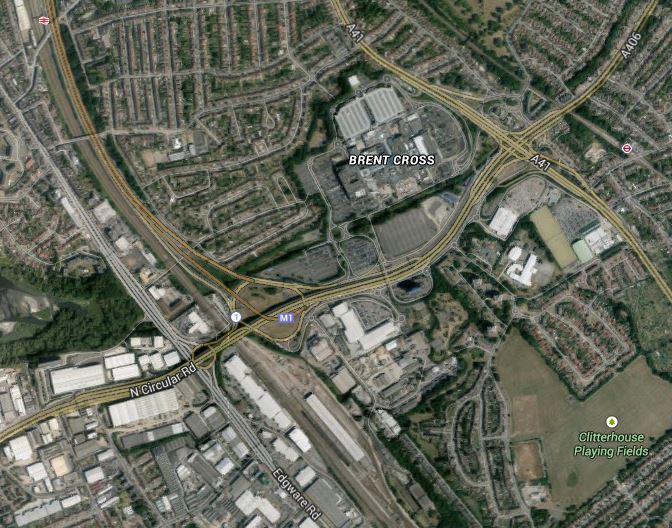
Brent Cross
The Midland Main Line on which the station will be built runs north-south at the western edge of the image, with Hendon station just visible at the top beside the M1.
The Shopping Centre is clearly marked and the A41 passes beside it towards the east.
The whole area is dominated by the roads and flyovers of the M1, A5, A41 and North Circular Road, which are choked with traffic. As the developers of the new Brent Cross Cricklewood development are spending £4.5 billion over the next twenty years and have stated they are improving the roads and other transport links in the area, together with creating four new parks, could we see all of these roads either buried in tunnels or more likely roofed over so that all traffic is put out of sight and mind?
According to the development web site, one of first things being done is this.
Renew and revive Clitterhouse Playing Fields and Claremont Park creating two beautiful community parks, as well as starting to create Brent Riverside Park.
Let’s hope this defines how they mean to carry on. Clitterhouse Playing Fields are at the south-east corner of the Google image.
The developers and their architects could have great fun with this development.
Looking at the position of the station, one place to put it could be where the Midland Main Line crosses the North Circular Road in an echo of how Blackfriars station was recently rebuilt over the Thames.
I can see in my mind, a shining glass palace with a roof garden above the roads with an enormous red rail sign, saying “I’m Brent Cross Thameslink, Ride Me!”
It would be the signature for the whole development.
The new station would also be a major interchange where passengers to and from the East Midlands and South Yorkshire changed between the new electric trains on the Midland Main Line and London’s rail system.
Rail Freight Contributes £1.6billion To UK Economy In 2013
This is said in a report on Rail Magazine, based on details from the Rail Delivery Group.
The report also says that £30 billion of goods were moved by rail and that the amount of shipping containers moved has increased by 30% since 2006.
How much extra motorway space has been created by all this rail freight?
They Still Haven’t Unwrapped It!
The first fifth coach in the Class 378 Overground trains still has the wrapping on.
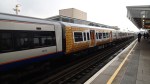
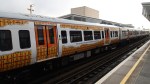

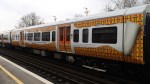
It’s now nearly four months since it was delivered, so perhaps it’s time the wrapping was taken off.
A Rat Run Is Going To Be Cut
The Ardleigh Road junction off Southgate Road, near to me is a dangerous place for pedestrians. Cars, trucks, vans and cyclists like to peel off Southgate Road and see how fast they can turn down Ardleigh Road.

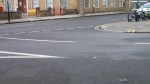

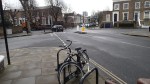

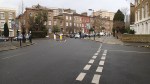


I took these pictures this morning, as I walked across De Beauvoir Town to my doctor’s surgery. Later on, two visitors to my house, who know the area well, told me that they are always very careful near that junction.
But the other end of Ardleigh Road, where it meets Culford and Engelfield Roads near the Scolt Head pub, is going to become a dead end for vehicles because Cycle Superhighway Route 1 goes up Culford Road, which will go straight across Engelfield Road towards the City.
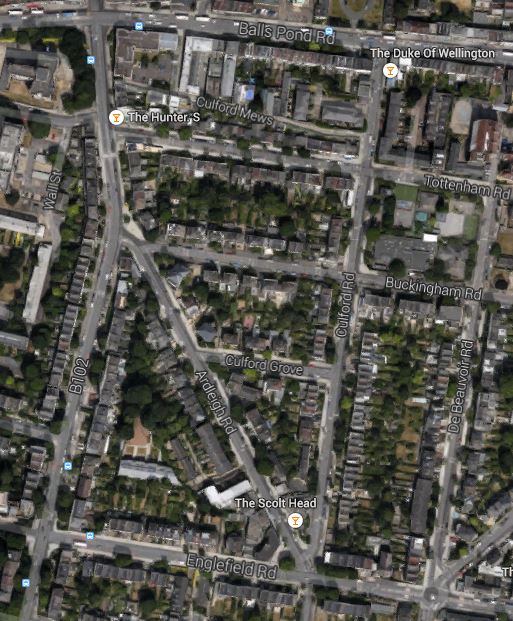
This Google Earth image shows the area.
Ardleigh Road
On the map note how the Scolt Head sits between Ardleigh Road and Culford Road. Culford Road is going to be straightened and will take the cycling route on a north-south axis through De Beauvoir Town crossing the Balls Pond Road by the Duke of Wellington pub.
You can clearly see from the map how tempting it is to drive fast off Southgate Road into Ardleigh Road just south of the Hunter S pub. Someone told me, that the wide junction of Southgate and Ardleigh Roads was to allow trams and trolley buses to turn. This photostream on Flickr shows, trams, trolley-buses and buses in the area. The first picture in the photostream was taken on the western side of Southgate Road opposite the Hunter S looking towards the Balls Pond Road.
There are going to be a lot of very angry rats. And at least one very happy pedestrian!
Where Now For Rail In The Border Country?
In this post I use the term Border Country to describe the Scottish Borders and the area of England that adjoins the actual border. The two sides of the border have a long association with fighting on the one hand and co-operation on the other.
But whatever happens on one side has a direct effect on the other. It has been thus, ever since England and Scotland first became nations.
So you understand what area I’m talking about let’s define the Border country as any part of Scotland South of a line drawn south of the Greater Edinburgh and Glasgow areas and in England anything North of say a line from Middlesbrough to Penrith. Apart from the main north-south, East Coast Main Line and West Coast Main Line, there are not many major railways, except for.
!. The Waverley Line, from Edinburgh to Carlisle, the Northern part of which is being rebuilt at the Borders Railway.
2. Carlisle to Newcastle, which has recently been prioritised for electrification and is very much a scenic line.
3. Settle to Carlisle is another down for electrification, which is also an important diversion for freight from the West Coast Main Line.
4. Cumbrian Coast Line that encircles the Lake District is another line on the electrification list.
5. The various lines linking Newcastle, Sunderland, Middlesbrough, Saltburn, Whitby and Darlington are a set of lines that will be electrified to create the Tees Valley Metro.
Most of them are scenic lines, with lots of Listed structures, good walking country and excellent food and drink.
So what factors will effect how the railway network develops in the Border country?
1. The Success Of The Borders Railway
I can’t see the new Borders Railway between Edinburgh and Tweedbank, being anything other than a big success. Virtually, every new train or tram line built in the UK and the wider world in the last few years except for the Dutch High Speed Line; HSL-Zuid has been a rip-roaring success.
My only worry about the Borders Railway is that they have decided to open on September 6, which was the day chosen by HSL-Zuid.
This success will lead to demands to extend the railway all the way to Carlisle. Some politicians have stated this is an aim. This extract is from Wikipedia.
In April 2014, Alex Salmond said the Scottish government would consider reopening the entire length of the Waverley Line to Carlisle; he said, “the success of the 30-mile stretch to just south of Galashiels would ‘calibrate’ a feasibility study into rebuilding the remaining 70 miles”
It could also lead to pressure for the reopening of other lines in the Border country.
2.Increase In Anglo-Scottish Traffic
Last week,according to this report in Modern Railways, First Group have applied to run a one-class rail service between London and Edinburgh to compete with the budget airlines.
If more services are sanctioned it will put pressure on both the East and West Coast Main Lines and it is unlikely that HS2 will be built within a few years. More likely this will only happen in a few decades!
And it won’t just be passenger trains, as when the economy gets better on both sides of the border, freight trains will increase too!
The only hope to increase capacity in the short term is to get passenger services on the two current main lines running at 140 mph, selectively add another track and hope by the use of ERTMS you can create a enough paths for the extra trains.
Somewhere there is an ambition to run trains between the English and Scottish capitals in four hours. When this happens, I suspect it will further increase the number of Anglo-Scottish passengers.
At a pinch, I suppose you could move freight trains to an uprated and fully-rebuilt Waverley Line, which could reach the English Midlands, via the Settle and Carlisle Line, to further eke out capacity, but it just goes to show how much HS2 will be needed all the way to Scotland.
3. Electrification In The North Of England
If this goes as far as the report of the North of England Electrification Task Force suggest, this could increase the number of lines in the Border country that get electrified. According to the Borders Railway web site, the new railway is being created so that electrification could be added reasonably easily.
You would hope that as they do more electrification, the engineers will get better at putting up the wires and keeping costs down. They may also come up with less obtrusive ways of electrification.
4. Improvements In Central Scotland
It seems that the railways between Edinburgh and Glasgow are very much like the railways between Liverpool and Manchester. There are several routes and they should have been electrified forty years ago.
In Glasgow too, you have the problem that trains can’t run between the West Coast Main Line and Perth, Aberdeen and Inverness. Passengers have to take a bus, taxi or walk across the city centre.
Hopefully, with the completion of the Edinburgh Glasgow Improvement Programme and the final implementation of Glasgow Crossrail, things will get better in a few years.
One outcome will be that more tourists will treat Glasgow and Edinburgh as one destination and will perhaps stay longer and explore the area more. So properly marketed they will take trips down into the Border country.
5. Track And Station Innovation
When I traced the Borders Railway on Friday and then when I looked up some of the visualisations of the track and stations, I was surprised how different some are to your typical station. Most on the Borders Railway are simple bi-directional stations on a single line, just like James Cook station in Middlesbrough.
As Network Rail and their appointed architects and engineers improve the design, this will mean that more lines can be reopened for an affordable cost.
I suspect too, that the designs will be used to create new stations in new developments all over the UK.
One good thing about the Borders Railway, is that there are no level crossings, with all of their adverse safety implications.
6. Train Innovation
Over the last few weeks, I’ve ridden battery-powered trains in Essex and tram-trains in Germany and France. So could innovation in train design mean that designers come up with a train that offers serious advantages over today’s trains for running on both heavy rail lines and perhaps on-street? And could it use a battery so that it doesn’t need to have fully-electrified lines?
I’m not sure yet, but something less capital intensive than today’s trains will be developed for use off the main electrified network.
Perhaps the ultimate train would be a variant of a Class 379 train or Class 399 tram/train, that could run on any voltage, but had a battery capability giving a range of perhaps sixty miles. Such a train could probably be used on the line between Carlisle and Newcastle with ease, as because both ends are electrified, it could charge the batteries fully at both ends.
The battery option would give all the speed and comfort of an electric train on rural lines, but without the cost and hassle of putting up electric wires.
7. ERTMS
A lot of the lines in the Border country are fairly simple, so ERTMS may make life even simpler as there will be no signals at the track-side to maintain in remote locations. In fact the Cambrian Line in Wales, which is very much a remote line has been working under ERTMS since 2010. This article from ERTMSOnline says that after a couple of teething problems things are going well now.
I don’t know whether the Borders Railway will run under ERTMS, but from what I’ve read, it would be more efficient if it did.
Certainly if you were opening a new line in a few years, ERTMS would be used and there would be no line-side signals.
8. Leisure Opportunities
If the Border country has lots of decent railway lines connecting small towns to major stations on main lines, it can’t help but encourage more people to explore the area.
The Borders Railway may well be opened with a steam train, although the design of Tweedbank station has not been designed with a run-around loop, so the engine can change ends.
Abellio ScotRail, who are the new franchise operator for Scotland are reported under their Wikipedia entry like this.
The franchise agreement requires the introduction of ‘Great Scottish Scenic Railway’ trains on the West Highland, Far North, Kyle, Borders Railway and Glasgow South Western lines. Steam special services will also be promoted by Scotrail.
As Abellio ScotRail are also committed to running shorter InterCity 125s between the major cities in Scotland, could we see a regular service to the Borders using one of these iconic trains?
When the Borders Railway is extended to Carlisle, as it surely will be, I suspect that these trains would take the Settle and Carlisle route all the way to Leeds.
If the trains were given a Chiltern-style spacious refurbishment, the finest and fastest diesel train, the world has ever seen, will have found a mission for a long and happy retirement.
Conclusion
All of these technical developments will mean that in a decade or so, the Border country will be criss-crossed by railways, where modern electric trains and a few heritage trains will speed passengers comfortably about their business.
It can’t but help to secure a prosperous future for the area.
The Creation Of The Tees Valley Metro
James Cook station is the first project that could be thought of as part of the proposal to create a Tees Valley Metro, which is described in Wikipedia like this.
The Tees Valley Metro is a project to upgrade the Tees Valley Line and sections of the Esk Valley Line and Durham Coast Line to provide a faster and more frequent service. In the initial phases the services will be heavy rail mostly along existing alignments. The later phase may introduce tram-trains to allow street running.
Tram-trains could be ideal for the line and perhaps if they ran past the Riverside stadium could be used to provide a stop there.
The proposed layout of the metro is powerful in that it links the East Coast Main Line at Darlington and the possibly soon-to-be-electrified Middlesbrough station to a number of both local heavy rail lines and a couple of heritage ones, opening up the area for all sorts of business, leisure and employment opportunities.
If Newton Aycliffe becomes a major train building centre as Hitachi hope, then surely that area could become an important destination on the Tees Valley Metro.
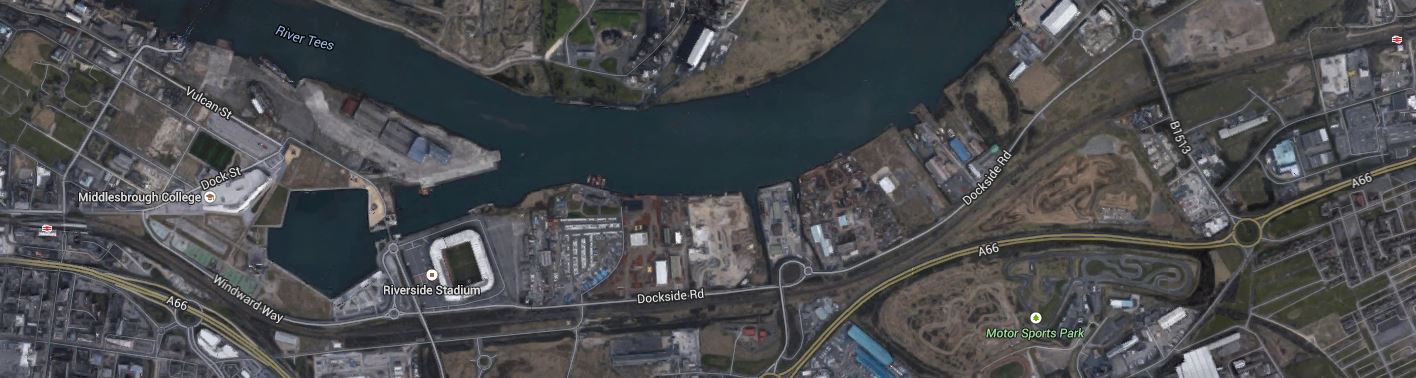
This Google Earth image shows the Tees Valley Line through Middlesbrough.
Middlesbrough
Note Middlesbrough station at the west (left) and South Bank station at the east, at the top of the image.
The current Tees Valley Line threads its way between the two stations, on the north side of the main A66 road, passing close to the Riverside stadium.
The Esk Valley Line to James Cook, Nunthorpe and Whitby branches off from this line between Middlesbrough station and the stadium and goes off in a generally south-easterly direction alongside the A172 road.
A Dreadful, But Totally Avoidable Train Journey
As a coeliac who avoids gluten and also because I’ve had a stroke and am on Warfarin, I have to be very careful about my diet. For this reason I plan my pit-stops well when I travel by train. If I do change trains, I usually arrange this at a station like Birmingham New Street, Cambridge or Leeds, where I know there is a good M & S Simply Food or a selection of restaurants that I trust.
The last couple of days, I have been in Scotland and on the way back I saw Ipswich Town play at Middlesbrough.
As Middlesbrough is a particularly difficult town for suitable food, I decided to come south as soon as possible after the lunchtime match. I did get lunch of sorts from the M & S in the town.

Quiche And Lemonade On A Bitterly Cold Day
It was bitterly cold and I ate it in the gardens in from of the Crown Court. But hey, two of my family’s bloodlines are Jewish and Huguenot and I reckon at times, they’d have found my simple lunch a veritable feast.
A couple of weeks before, I’d tried to book a First Class ticket from Middlesbrough to Kings Cross, but found the prices rather stratospheric, so in the end I bought a reasonably priced First Class ticket from Middlesbrough to Peterborough changing at York, from where I could get a Great Northern train into London.
I had assumed that the difficult availability of tickets was because of the England-Scotland match at Twickenham and at no time did the on-line booking process on East Coast inform me of the real reason for a ticket shortage.
It was only, when I caught the Virgin Trains East Coast train at York, did the staff inform me of the reason. The East Coast Main Line was subject to engineering work and we’d be using a diversion.
Unlike some other companies, East Coast’s gluten-free offering is non-existent, so I was getting hungrier by the hour, as we were shown the delights of the GNGE in the dark.
As the train was going on to Kings Cross and there were plenty of empty seats, I asked the conductor if I could buy a ticket to complete the journey on the train, rather than decamping at Peterborough to purchase a ticket for another train.
Astronomic prices were mentioned, which bore no relation to the twenty pounds or so, my phone said I would need to spend on-line for a Standard Class ticket. So I got off and bought a ticket in the Booking Office for around ten pounds for Great Northern. Incidentally, the Off-Park Single with a Railcard for East Coast is £14.75. So where did a price of three times that come from?
I finally arrived in London six hours after I left Middlesbrough. To cap it all, the only gluten-free food left in M & S at Kings Cross was one packet of sandwiches.
I could say the sandwiches were stale to add colour to this tale! But they were excellent!
If the works on the line had been flagged up when I tried to book the ticket, I would have only used East Coast as a last resort. After all, I could have gone via Sheffield or Manchester, where I can at least get something to eat. The Booking Office clerk at Peterborough had told me that they have to tell personal callers that there are problems! So why not on the web?
The conductor on the train, said it was all my fault, as I should have gone to Kings Cross, to read all the information about engineering works. Doesn’t that remove one of the advantages of booking on-line?
If you say you want to collect a ticket from a station that is not the starting point of your journey, the train purchase web sites ask you if this is what you want to do. Surely, a warning if there are works or likely delays on your route could be similarly indicated.
The real losers in this tale are Virgin Trains East Coast, as they had an empty seat between Peterborough and Kings Cross, for which I would probably have paid a reasonable amount. Next time I go to York or Doncaster where there is an alternative, I will also probably use it.
James Cook Station – The Reinvention Of The Halt
Simple stations or halts, were once very common on UK railways. These pictures show James Cook station in Middlesbrough, which is a new small station, that opened in May 2014.
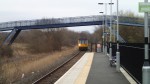
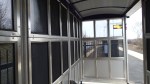
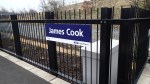

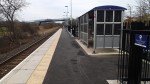

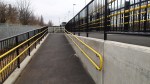
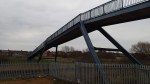


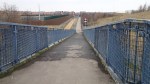

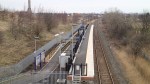


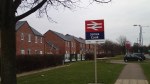
As the trains stopping at the station have conductors to sell tickets, there is no ticket machine, but there is a smart shelter, a help point, a destination board, a step-free bridge and ramps to the single platform.
James Cook station is the first construction in the possible creation of a Tees Valley Metro, which may see other new stations created or old ones reopened.
Surely, some of the ideas used in the design of the single platform James Cook station could be used at several places on the Tees Valley Metro and the wider UK rail network.
Incidentally, is there another station named solely after a person?
The Updating Of Newcastle Station
Newcastle station is one of the most important stations on the East Coast Main Line. I took these pictures of the station redevelopment as I passed through.

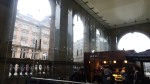

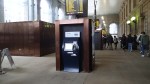

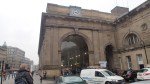

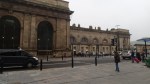

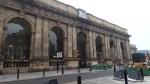
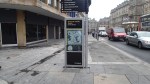
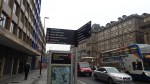
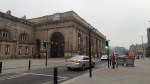
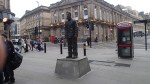

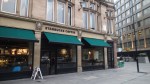


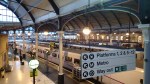

My memories of the station usually involve how blustery it can be. The glazing of the front of the station, may not be as dramatic as that at Strasbourg, but it did seem to make the station entrance a lot more civilised. The position of the ticket machines and information screens under the portico, is an idea that could have been borrowed from the French station, with which it shares a lot of operational characteristics, like fast trains to the capital, an extensive regional network and a below-ground metro or tram.
Newcastle has now joined Kings Cross and Liverpool Lime Street, where you can walk straight outside the station and be in a partly-pedestrianised area, where you can get your bearings of the city, that might be unknown to you. As the pictures show work is still continuing in this area.
Newcastle is one of six operational stations in the UK, that is a Grade One Listed Building. The others are Bristol Temple Meads, Huddersfield, Kings Cross, Paddington and St. Pancras. I can see Manchester Victoria joining this elite group, when it is completed.
Tracing The New Borders Railway
A friend and I traced the new Borders Railway from it’s terminus at Tweedbank, back into Edinburgh.

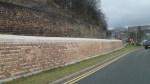
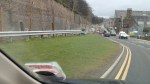
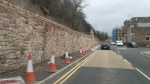


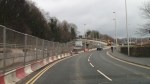






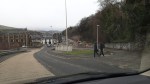

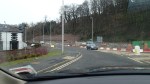


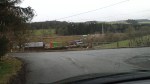
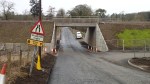
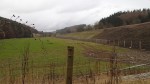









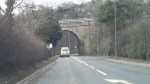
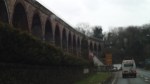
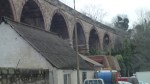
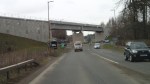
It certainly looks like the opening date won’t be far off the planned one of September 6th, 2015.
To my untrained eye, it looks like they’ve done a superb design and engineering job to squeeze the new railway through some of the places it serves like Galashiels. Especially, as the railway is being built ready for electrification and with a loading gauge that could take the largest freight. On the Borders Railway web site, they say they have no plans to carry freight at present, but in the future an important project may create a freight need, so it is wise not to rule it out.
In all the pictures you will not see any level crossings. The Borders Railway has been built without them, as they are too much of a safety risk.
 The Anonymous Widower