The End Of The Line For Crossrail 2?
Southgate is famed in transport and architectural circles for its wonderful Underground station. So you would think, that New Southgate station would be even better and certainly newer.
But you’d be mistaken as these pictures show.

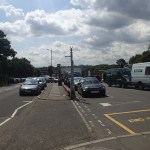


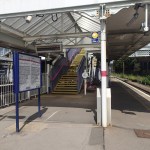
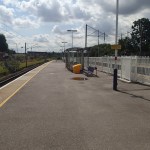


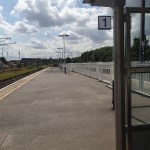
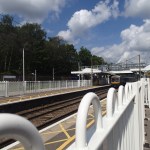

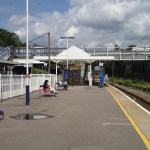


This is the station though, which is now being proposed as one of the northern terminals of Crossrail 2.
I suspect the station will probably be rebuilt, even if Crossrail 2 doesn’t use it as a terminus, as it must be one of the worst examples of corrugated iron stations in the country.
I can’t say I can remember ever catching a train from New Southgate Station, until today, when I returned to Central London. I also don’t think I’ve ever taken a train to the station either, although I’ve been on trains through the station countless times.
It does appear that there is space for another platform either side of the current station, which must be the minimum if the station is to be a terminus for Crossrail 2.
Travelling back in to London after taking the pictures, I can understand, the proposed change of terminus to the station from Alexandra Palace. There’s just so much more space to put a depot if one is needed. New Southgate would also allow a future development of Crossrail 2, to use the Hertford Loop as another branch.
Looking at the map, as New Southgate station is close to the North Circular Road and is generally surrounded by industrial estates, although there is some housing, there would be scope to probably create a really good transport interchange with a large bus station and perhaps even a tram line along the North Circular Road from Brent Cross to Enfield or Southgate. If nothing else, all of the work should result in the notorious bottleneck on the road being eased.
Artwork At Bowes Park Station
Bowes Park station is one in my old haunts around Southgate and Wood Green.
I found a story that there had been some artwork put up at the station, so as I’ve never been to the station, I went to look.
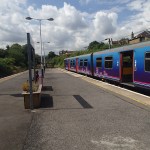

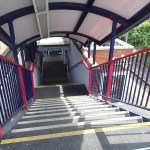
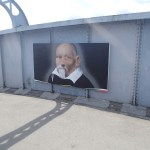
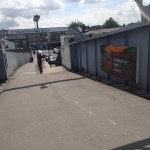

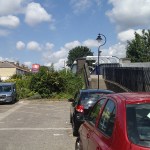

I wasn’t that impressed with the artwork. But we do need some stations to be brightened up.
The station itself is of a rather unusual layout, but is clean and tidy, although the disabled entrance is possibly one of the worst in London. However, adding a lift, wouldn’t necessitate a major rebuild.
In fact, the station is one of those, where a clever architect could turn a bad station into an extremely good one, as it has spacious platforms and walk up access from both sides to the footbridge across the station and the tracks.
According to the latest news, the line which currently uses Class 313 trains, is going to be provided with new trains in the next few years.
A good disabled-friendly station coupled with the new trains and good cycle parking might almost make make the station improvements self financing, through more traffic.
Later when I returned to London from my visit to New Southgate, nearly all the passengers who got off the train at Highbury and Islington, crossed onto the Victoria line for trains to Central London. So would an upgraded Bowes Park station take customers away from Bounds Green tube station, which will probably never have lifts?
Will The Updated GNGE Affect Lincolnshire?
I ask this question because my Crossrail Google Alert picked up this article from Geoff Ford in the Grimsby Telegraph. He starts by saying this.
Have you noticed that most major transport projects are concentrated in the South, the West Midlands and the North West? And then berates the Chancellor for leaving Lincolnshire off the list of those getting big transport projects!
He has a point
If I have a bone to pick with Geoff, then it is that he doesn’t talk about The Great Northern and Great Eastern Joint Railway (GNGE) , that I talked about in this post. But then I hadn’t heard that such a large project with a value of £330million was taking place in Lincolnshire, until a couple of weeks ago.
The project is certainly an unexpected place to bury that sum of cash.
But the project will be completed before the end of the year and will hopefully stop most of the freight trains on the East Coast Main Line from imposing lower speed limits on passenger trains on the line.
People in Lincolnshire, should be asking the question of “What will the GNGE do for us?”
I’ll start with a negative, as all those freight trains will create noise and also increase congestion at some of the level crossings on the route. Lincoln will still be a problem and there are probably a few old British Rail employees, who cautioned against the closing of Lincoln St. Mark’s station and the associated by-pass line in 1985. But hopefully some clever engineers have got an affordable scheme that will help get the endless camels through the eye of Lincoln.
If I was a Logistics Manager for a company that was importing loads of stuff from China, that was destined for my company’s shops in Scotland and the North and I needed a distribution centre, then Lincolnshire is now on the list of acceptable places to build it. Especially, if the site is close to the GNGE and a decent road to the M62. But that is rather hypothetical, until the first company takes the decision and I think I know a lot more about project management, than I do about logistics.
Some things that the upgraded GNGE will offer is faster journey times for both passenger and freight, through higher speed limits, fewer level crossings and much improved signalling. So will these improvements allow more passenger trains up and down the various parts of the line from Peterborough to Doncaster, via Spalding, Sleaford, and Lincoln?
Currently, on the southern part of the line from Peterborough to Lincoln, there seems to be about one train every hour or so, which takes about ninety minutes to do the trip.
Perhaps more interestingly, is that it takes two hours from Lincoln to London if you change at Newark and thirty minutes longer if you change at Peterborough. So if nothing else is done, with judicious timetabling, the upgraded GNGE might even give extra two hour train journeys to London from Lincoln via Peterborough. It might even open up the market for an easier route for a direct train to London from Lincoln, which has been promised for years.
In one area though there may be an improvement. Wikipedia says this about Sunday services between Peterborough and Lincoln.
The line has a regular weekday daytime service but is closed between Sleaford & Spalding in the evenings (due to the high staffing costs associated with the large number of manned level crossings on this section) and has no Sunday service.
So as there will be fewer level crossings, will the line see an evening and a Sunday service?
Going between Lincoln and Doncaster seems more difficult, but hopefully after the line is finished, journeys will all take the quickest time achieved now.
Those that work out the timetables are going to have a complicated problem on their hands.
What Do We Do With Four-Four-Two?
I’m not referring to the formation used in football, but the Class 442 trains used on the Gatwick Express from Victoria.
At nearly twenty years old they are still comfortable trains in which to travel and I’ve used them a couple of times to get to or from Gatwick Airport and Brighton from London. As far as I’m concerned, they are not my preferred way to get to the airport, as they leave from Victoria, which is not as easy to get to as London Bridge from Dalston.
But there is nothing wrong with the Class 442 as trains, especially as they are based on the legendary Mark 3 coach and they hold the speed record of 174 kph for third rail electric trains.
The fact that they are third-rail only electric trains, is one of their two main problems. The other is that they weren’t designed as airport trains and are fairly unsuited for loading and unloading heavy cases.
It should be noted, that all of the third-rail electrics trains, built in the last few years are either dual voltage trains or they have a pantograph well, so they can be easily modified, so they can work with 25kV overhead electric lines.
The renewed franchise holder for Gatwick Express is reported as going to acquire a new specialist fleet of trains for the service, which will be delivered in 2016.
So we have the problem of a set of twenty-four five coach trains, with no service for which they are suitable.
They are fast trains, which means that only the suitable lines on which they could run are from Victoria to Brighton and Waterloo to Portsmouth, Southampton, Bournemouth and Weymouth. But they are unsuitable for the Victoria service, and they are not needed on the Hampshire services.
They are probably too old and too difficult to convert to overhead electric. It would seem to me with my engineering hat on, that to convert trains from third rail to overhead, unless that was in mind in the original design, is not a job with a small budget.
So conversion is probably a complete no-no!
So does the scrapyard beckon?
I would think so, but then a new coach costs around £1.5million and there are 120 coaches.
On the other hand, rail engineers have been living off scraps from the government for so long, that they are not short of innovative and oddball ideas. As an example read this article about how the previous Gatwick Express trains, the Class 460, were split up and used to lengthen the Class 458.
There are only two places where the Class 442 could appear to find a home.
The first is the two Coastway lines; East and West, which run from Ashford in the East to Portsmouth and Southampton in the West, via Hastings and Brighton. It would release other trains for use elsewhere, but I doubt it would need many of the twenty-four trains.even if the frequency was increased significantly.
The only other place where they could be used is on an electrified West of England Main Line to Salisbury and Exeter. I found this letter from South West Trains on the Network Rail web site. It states a whole list of advantages of electrying fom Basingstoke to Exeter.
So could the Class 442 find a home here on a third-rail electrified railway to Exeter?
It would probably go against policy to electrify such a long line in the archaic and incompatible third-rail system, but the upgrading does come with a set of fast affordable second hand trains in good condition, with an increasing reputation for reliability.
Another factor is whether Network Rail build a new route to Plymouth, as is outlined here on the BBC. If they do, I would suspect they would electrify it with overhead wires, so to have third rail to Exeter from Basingstoke, wouldn’t be that sensible.
So I still think that the Class 442 will go to the scrapyard.
But I wouldn’t mind being shown to be wrong and that the trains find a good home on somewhere like the West of England Main Line or the Coastways.
Crossrail Is Even Now Having A Big Effect On London
Two stories I found today, show the sort of effect Crossrail is going to have on London.
This article from Ealing Today describes how Hanwell is going to get four trains per hour during peak hours of the day. Currently, it would appear it’s less than that. The report says this.
Dr Onkar Sahota, Labour Assembly Member for Ealing & Hillingdon said: “Whether it has been the re-opening of the South entrance to the station or the step-free access to platform level, the good news for Hanwell keeps coming.”
“I am pleased that after so much pressure from across the community, Crossrail have relented and will attempt to deliver four trains during peak hours.”
“I will continue to press the Mayor and Crossrail to ensure that we have a minimum of four trains per hour at all times, and will be watching closely to ensure that Crossrail come good on their pledge to deliver the long awaited Sunday service.”
There is also this report from Easier Property, which discusses how if your near a Crossrail station properties are doing better. It says this.
According to Hamptons International , transactions for properties within a mile of a Crossrail station grew by 21% in 2013, compared with the London average of 13%, and New Festival Quarter from Bellway Homes certainly echoes this London-wide trend.
And it is still four or five years before the new railway opens.
Is Electrification The Key To More Diesel Trains?
My two trips on Saturday to Norfolk and Tuesday to Wiltshire, show that sometimes off the main lines, the backbone of the trains are elderly Class 150, Class 153, Class 156 and others, which are totally overcrowded and inadequate for the task. Up North and even more far flung places, it’s even more grim with quite a few dreadful Pacers, which were built as a stopgap in the 1980s with a twenty year lifetime and don’t match the latest disability regulations.
So something drastic needs to be done.
On Tuesday, the crowded Class 150, I used between Salisbury and Westbury, was totally inadequate for the task of running a long distance service between Cardiff and Portsmouth. It was like expected four people with luggage to make the journey between the two cities in an Issigonis-designed Mini. I suppose you wouldn’t do it, unless you were hard up and wanted to get to Glastonbury.
The Class 153 train, that I used between Westbury and Swindon are probably adequate with a bit of refurbishment on branch lines like Ipswich to Felixstowe, but being only a single coach, if traffic continues to grow, they will be totally packed for much of the day.
The Class 156 trains, I used in Norfolk had been updated with new disabled toilets and are probably ideal for the East Anglian branch lines, until traffic means that three carriages are needed.
The Class 153 and 156 trains can probably soldier on reliably for some years after refurbishment, but I doubt there is much future for the Class 150, unless a clever engineer/designer comes up with a solution, that converts them into something completely different. They could certainly be msade good enough to replace the single coach Class 153s on routes like Ipswich to Felixstowe.
When I travel to somewhere like Blackpool, Barnsley or to Sheffield via Doncaster, I sometimes end up on a Pacer, as I did here. The title of the post, which is In Style to Sheffield And Then This, sums up Pacers in my mind.
As a lot of visitors will encounter Pacers, as I did as the last leg of a journey to the area, the managers of such as Virgin, East Coast and the other long distance companies, must despair that their passengers have their journey ruined by the connecting train. How many say go from London to Scunthorpe once by train and never do it again because of the inadequate Pacers?
But hope for the end of these dreadful trains is at hand if Modern Railways is to be believed, with an article with a headline of Pacer Replacement Likely. It is all down to the replacement Northern Rail franchise, which I suspect is unviable financially and possibly illegal with a third of the fleet being inadequate and unable to meet the disability regulations.
London Overground has shown how you replace trains. Until quite recently, the North London Line was served by Class 313 trains built in the 1970s. Al;though even older than Pacers, some are still running on the network after refurbishment, and to travel in one is an experience that is almost twice as good as travelling in a Pacer. But even some of these are destined for the scrapyard in the next few years according to Modern Railways.
London Overground replaced its Class 313s with new Class 378 trains. These were designed to be three coach trains and have been lengthened to four and are now going to five, by just plugging extra coaches in the middle. I’ve no idea what the limit is for trains of this family, but Greater Anglia regularly couple their closely-related Class 379 trains together to make longer trains.
But these trains are electric, although they do have a diesel cousin, the Class 172, which comes in both two and three coach versions. So it would appear that they can be lengthened in a similar fashion to the Class 378 on the Overground.
In a sane and sensible world with money everywhere, you’d have Class 172 or something with a similar nature coming out of the factories to replace the Pacers and Class 150s.
As the Class 172 trains are British-built in Derby by Bombardier, there is surely a strong case to keep the production lines busy there and use them as replacements across the network. As London Overground and other operators have shown, these trains work well and having a type that is widespread must help with Maintenance and staff training.
Wikipedia’s entry for the Class 172, says this about new orders for the type.
As part of its franchise agreement, London Midland has an option to purchase an additional 26 Class 172 vehicles which could potentially allow further cascade of its existing rolling stock.
In 2008, First Great Western applied to the Department for Transport to re-equip its Cardiff to Portsmouth via Bristol services with 11 new four-car DMUs which would potentially allow the existing Class 158 Express Sprinter trains to be transferred to other services. According to the West of England Partnership, these were likely to be “similar to Class 170s”, suggesting that they might be Class 172 Turbostars.
The Government announced in December 2008 that Bombardier, with its Turbostar design, was one of the pre-qualified bidders (along with CSR of China, CAF of Spain and Rotem of South Korea) for the first 200 DMU vehicles of its planned 1300 new carriages. These new trains were intended for use on suburban and inter-urban services operated by First Great Western, First TransPennine Express and Northern Rail. However, with the announcement of the electrification schemes in the North West and on the Great Western Main Line, the DMU order was cancelled, with the needs of the train operating companies planned to be met by transfers of existing stock.
But why do we need to get the new trains built outside of the UK?
The piece talks about the transfer of stock, as lines are electrified. In fact, eight virtually-new Class 172s will become surplus, when the Gospel Oak to Barking line is electrified. According to this article in the Barking and Dagenham Post, this will happen by 2017.
But as my trip to Westbury showed, some of the worst problems are on longer services like Portsmouth to Cardiff, which probably have to be run using diesel trains. But as the extract shows, First Great Western is pressing to get new and better trains on that route.
From personal experience in the last few years, there are a host of services, where more and longer diesel services are required.
One collection of routes, I have talked about for years is the lines from Ipswich and Norwich to Peterborough and on to Birmingham, Nottingham and Liverpool.
Some of the lines within East Anglia , like Cambridge to Norwich and Ipswich, and Ipswich to Lowestoft, could also benefit from more trains. But hopefully,as I pointed out here, electrification is the key and that would release trains to improve the secindary routes and branch lines.
Sheffied to Leeds, Hull and Manchester, are three lines where the trains are a discouragement to travel. Eventually, these three lines will get electrified, but in the meantime. some longer and more modern trains would be very welcome.
Obviously we could just build more trains, but trains are expensive at about £1.5million a coach, if all of the other things are taken into account.
However, we do have electric trains that are being replaced by new trains.
First Capital Connect has a lot of electric trains that will not be needed when the new Class 700 trains replace them. As there is going to be 60, eight-car and 55, twelve-car trains, there will be a lot of Class 319 and Class 377 sets to be moved on.
The Cl;ass 377 are virtually new, whereas the Class 319 are from the late 1980s. I’ve travelled on the Class 377 trains regularly and as multiple units go, there are many worse examples on the UK’s railways.
According to Wikipedia, these are the plans for the Class 319, once they are replaced, by the Class 700.
As part of its announcement of the electrification of both the Great Western Main Line and the Liverpool to Manchester (via Newton Le Willows) route, the Government has announced that when new Class 700 Thameslink rolling stock arrives from 2015-2018, Class 319s will be refurbished, fitted with air-conditioning, and transferred to the following two routes:
Suburban services between Oxford, Newbury, Reading and London
Manchester Airport to Liverpool Lime Street and Manchester Victoria to Liverpool Lime Street servicesOn 2 April 2014 it was announced that the first 14 units would be transferred to Allerton Depot in time to enter service between Manchester and Liverpool from the December 2014 timetable change.
So as electrification progresses, these trains will release much-needed diesel trains.
The other big schemes like the Great Western Main Line and Midland Main Line electrification, and Crossrail will also see lots of new trains and push out older electric and diesel sets for other uses.
Probably one of the biggest problem or opportunity is what to do with all the High Speed Diesel Trains. I suspect some will worm their way into all sorts of strange places, where the designer and his team, never dreamt they could ever be used.
No-one makes predictions where these trains are concerned, as they are held in such tremendous affection by staff and passengers alike. Their replacement on the Great Western and East Coast Main Lines, the Class 800 and 801 have a very hard act to follow!
We appear to be going round in virtuous circles. So I think the answer to the question I posed is yes!
What Will Be The Effects Of Cashless Buses?
When London’s buses go cashless on the sixth of July, London and the passengers on its buses, will submit themselves to a big experiment.
But as I said in this post, nearly all of the staff and passengers seem to be strongly in favour.
The average London bus driver isn’t stupid, as what employer would allow an imbecile to have control of any £200,000 machine. The biggest problem they have with cash, other than the security one, is the inevitable delay, when passengers go searching for small change. London buses are timed to the minute and drivers seem not to like to miss their schedule.
I haven’t found any actual data on what passengers think about going cashless, but I have seen or heard no complaints in the media. I have heard the odd moan though, when a bus is delayed by passengers searching for small change. Although, that seems to have happened less since it was announced buses were going cashless and contactless bank cards could be used.
There will obviously be some troubles on the sixth, but I suspect TfL will put a lot of extra staff on the buses to smooth things through.
Remember though that according to Wikipdeia, London’s buses are used by six million riders a day and that every touch-in is registered on TfL’s ticketing system. That will generate an enormous amount of data.
When it has all settled down, just by examining before and after data will give conclusions, that will help with the planning of London’s transport system.
Will going cashless speed the buses?
Will the buses be carrying more or less passengers?
Will we be seeing a new group of passengers using a bus for the first time?
Would visitors to London, use their bank card or an Oyster?
Will we see a long term decline in the use of Oyster on buses?
I will not speculate, but let the data do the talking!
But the biggest effects will be felt, if the scheme works well and increases the revenue and profitability of London’s buses.
How many cities seeing how the London system works, would decide to go to a similar system? Many bus systems like Manchester, Liverpool, Edinburgh and Glasgow are not very comprehensible to a visitor without a guide, but London’s simple touch-in once with your bank card system, is probably understandable to everybody familiar with a contactless bank card.
I would also see London using the same system on the Underground, Overground and railways within London.
As Oyster now works on train journeys around London and many stations like Cambridge, Watford and Brighton are gated, would we see pressure to allow the Oyster/bankcard ticketing on journeys around the broader South East of England. Yesterday, when I went to Salisbury, I paid £24.60 for my walk-up Off Peak ticket, which was the same price as if I’d bought it earlier in the day on-line. It would have been so much more convenient to have touched-in at Waterloo and touched-out at Salisbury with a contactless bank card. Especially, as I just missed the previous train to Salisbury, so with a contactless bank card ticket, I’d have got there thirty minutes earlier.
So will we see the creeping of Oyster/bank card ticketing out from London? One problem is Railcards, but I’m sure one could be associated with a particular bank card.
Would it increase the resolve of TfL to introduce cashless ticketing all over the Underground, Overground and trains in the London area?
London’s new ticketing regime is going to provide a lot of answers to questions, some of which haven’t even been thought up yet. It is also going to ask a lot of politicians to bury some of their views. A lot of money will have been proven to have been wasted on systems that can never accept contactless bank cards.
Scaremongering Over Cashless Buses
I travel on London buses regularly and probably every other trip, I hear a message broadcast on the bus saying that from the 6th of July, London buses will go cashless.
Yesterday, when the message was played, I started talking to the young lady sitting next to me. We both agreed that we rarely see anybody pay cash on the 38s or 56s we regularly used, although we did think we’d been held up by a passenger scrambling for small chsnge. Transport for London (TfL) say the number paying by cash, has dropped below one percent for those, who use cash on the buses.
Speaking to one of tail-gunners on a 38 last week, she said that staff were looking forward to the cashless buses, as it should further cut the dangers of dealing with the public.
So it would appear from my small survey, that passengers and bus staff are in favour of buses going cashless. I certainly haven’t heard anybody sounding off on the Dalston omnibus about it being a bad idea.
However, there was this story in the Standard last night, which claimed up to two thousand passengers could be stranded every day in London, due to lost Oyster cards. Here’s the first couple of paragraphs.
But notice it is the Green Party complaining.
If this means that 770,000 people are given a free ticket every year at the cash price of a ticket of £2.40, this would cost TfL just under £2,000,000. Compare that with the savings of £24million from going cashless stated in this article on the BBC. The remaining savings would buy a lot of buses or fund other improvements.
You can just hear the rattle in the various canteens in bus garages, as they prepare the teacups for the inevitable storms.
A Trip Around Wiltshire
I went from Waterloo to Salisbury and then onto the to the TransWilts to Swindon before coming home on a High Speed Diesel Train.
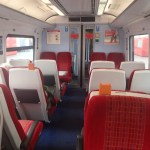
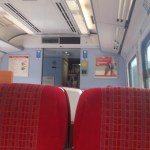
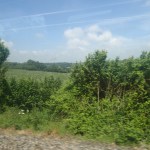
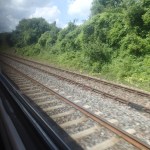
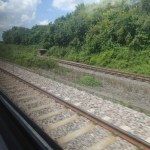
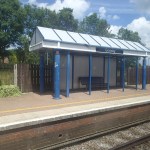
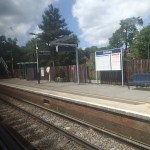

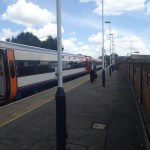
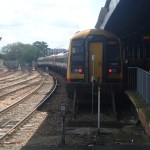
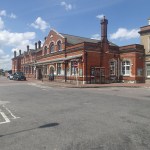
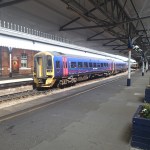
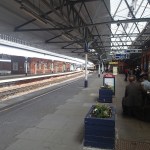
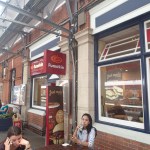

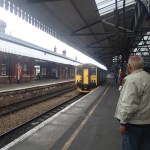
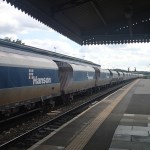
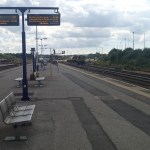
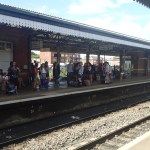
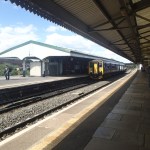
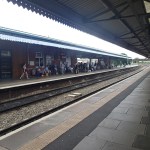
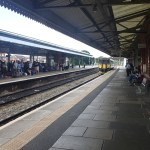
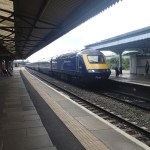
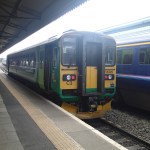
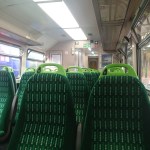
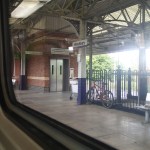
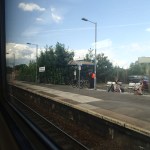


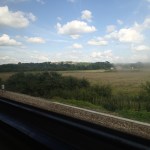
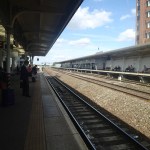
The train rides were enjoyable, through the countryside bathed in sun.
They did show some of the best and worst that trains in the UK have to offer.
The trip down to Salisbury was in a spotless Class 159, which probably because of the late morning time was rather empty. It was a diesel train, as no-one ever got round to extending the electrification on from Basingstoke.
I found Salisbury difficult, as the maps and signage were terrible. I couldn’t even find anyone, who knew where the street I needed was located.
Salisbury station was rather nice, even if the Pumpkin buffet was its usual self, with no bottles with proper caps and no change. There used to be jokes about British Rail catering and Pumpkin don’t seem to have improved over the years.
I found Salisbury difficult, as the maps and signage were terrible. I couldn’t even find anyone, who knew where the zstreet I needed was located.
On from Salisbury to Westbury it was in a very crowded Class 150. This seemed to be mainly due to Glastonbury travellers many of whom were carrying lots of luggage.
Westbury station was busy with lots of freight trains passing through and full trains taking travellers to Castle Cary for Glastonbury.
The station also had a non-Pumpkin buffet, where I bought a nice coffee and a banana with a curve as delicious as the fruit. We need more independent rail caterers like this. It is mentioned in this list from the Gusrdian.
On fom Westbury to Swindon it was a single coach Class 153, which was again spotless, but it had a hideous mainly green interior.
But after a couple of stops, it brought me to Swindon for a very crowded High Speed Train to London.
It had been a mixed day, with the undoubted low point of Salisbury, the station’s buffet and the train I took from there to Westbury.
It could have been a lot worse, as the driver at Westbury had trouble releasing the brake on the Class 153. I didn’t hear any signs of a large wrench being used as a hammer, so he must have persuaded the train to release her brake by kindness or some other acceptable method. Or it could be that the cheery conductor, used her undoubted good humour.
At least the day was sandwiched by two rides in diesel trains at high speed.
The Transwilts Community Rail Partnership, appear to be making a good fist of creating a frequent rail link across Wiltshire. I’ll go again in a couple of years, to see if they have found a cure for their nauseas train. But I won’t go anywhere near the area at the time of Glastonbury.
A Telling Statistic
Justin Webb in this article in The Times says the following.
This year under 70 per cent of American 19-year-olds have driving licences, down from 87 per cent two decades ago.
I have heard young people in London, say they are not going to learn to drive, as they have no need. So as [ublic transport and cycling gets better, are we all falling out of love with our cars.
In a thought provoking article he goes on to say this.
Does the hunger for live events in the internet age — concerts, exhibitions, demonstrations — encourage people to meet and talk again?
Certainly here in East London, there are two groups of four seats on the new Routemasters on route 38, where people do seem to congregate to have a chat. If they don’t chat, everybody also interreacts in a very polite way.
So has a good design, made life in the world’s greatest city better and less fraught?
 The Anonymous Widower