More And Better Wi-Fi For Trains
There are reports like this one from the BBC, which say that a Network Rail fine is going to be used to improve wi-fi on trains.
I believe that Chiltern Railways have got wi-fi right, with free access on their Mainline trains to Birmingham. Virgin appear to be going the same way too.
So lets hope that in a few years all trains have free wi-fi in all classes!
I must admit that if GreaterAnglia had free wi-fi in all carriages, then I wouldn’t bother to book First Class when I go to football at Ipswich, which would save me money.
I would think that it could be a good marketing tool for train companies, as it might be the service that will tempt people out of their cars and onto the trains.
And if trains can be wi-fi enabled how about more buses. I had hoped that London’s new Routemasters would be enabled, but they are not.
London Buses Go Cashless
Today was the first no-cash day on London’s buses and I took five trips. I didn’t see anybody board and offer cash.
Perhaps tomorrow, with the Tour coming and people returning to work will throw up some problems.
But after chatting with passengers and an off-duty driver, I think there won’t be much trouble.
The only people who seem to be against the move are the Green Party. Why? Perhaps they are jealous as they didn’t think of it or feel all buses should be free!
Is George Osborne A Closet Trainspotter?
We all know that sometimes George Osborne travels by trains, due to the story about tickets.
But does the Chancellor’s interest in trains and all things rail go deeper?
The reason I say this, is that since he has been Chancellor, the UK rail network has seen unprecedented investment.
If you read an account of his early life and education on Wikipedia, there is no clue there. But then if you live a substantial part of your early life in London, it must implant at least some thoughts in your mind, that public transport is good and necessary. It certainly did with me and I can think of a couple of my friends, who have also been seduced by the philosophy of London Transport and its successor, Transport for London.
But look at the rail projects, that have been given approval or firmly backed since he became Chancellor.
I won’t count HS2, as if you believe the Labour Party, that would be starting if they were now governing the country. I think the only thing that will derail HS2, is another 2008-style crash of the banking system.
London’s two major cross-London lines; Thameslink and Crossrail, could have been cut back in scope, but Crossrail if anything has got slightly bigger. This in part, is due to the way that the project is managed and partly financed. I hope some of the lessons learned on this project, are applied to projects like HS2 in the future.
Perhaps the most important project that has started to grow since 2010 is the Northern Hub. And grow it is! More lines seem to be marked for electrification and stations for rebuilding, every few months or so. He even seems to be taking the lead on creating HS3 across the Pennines. You could argue that as a Northern MP, he’s only looking after his consituents’ interests or has his eyes firmly on the 2015 General Election.
But whatever you say, Manchester and Leeds will have a fast electrified connection by 2018, because Osborne has provided the funding for the electrification on all the main lines from Blackpool, Preston and Liverpool in the east to Manchester and on to Leeds in the East. I wouldn’t bet against that by 2020, Network Rail’s engineers have stretched the electrification to Hull.
I would also argue that he has backed the full modernisation of the Great Western Main Line. Given the economic situation, cutting back the electrification to Bristol could have been a prudent decision, as it would have cut out the difficult Severn Tunnel electrification.
But this project has survived intact. Would a less rail-friendly Chancellor have insisted on cutting the project back?
The long-awaited electrification of the Midland Main Line was announced in 2012.
It could be argued that if you were electrifying the Great Western Main Line, then the Inter City 125s, released from that line could have been used to improve services on the Midland Main Line.
Many politicians would have used that argument in the past. Probably both Harold Wilson and Margaret Thatcher would have done that, as they are reported to have not thought much of trains.
Under the current government, some other substantial but low-profile projects have been proposed and funded, and in some cases even started.
The Electric Spine is an £800million project to connect Southampton to the Midlands and the North by an all-electric railway up the spine of England. The line will be mainly for freight and when completed will take lots of trucks off the roads.
Linked to the Electric Spine is the first part of the East West Rail Link, that will eventually go between Ipswich to Oxford, via Cambridge, Bedford and Milton Keynes.
I’ve talked about the upgrade of the GNGE before and this mainly-freight line will take a lot of freight off the East Coast Main Line to improve the passenger trains between London,Newcastle, Leeds and Edinburgh. As we’ve managed without it for years, will we be missing it, if it wasn’t upgraded.
In the last few days, there has been announcements concerning the Cornish Main Line and the Glasgow Airport Rail Link.
But George Osborne has also been lucky in that more and more passengers want to use the railways, and engineers have come up with better and more affordable ways of increasing capacity and providing better trains and stations.
As an example of the latter, the actual trains are a major cost of any new project with a typical coach sometimes costing £1.5million. We have a shortage of diesel trains on the one hand, and on the other there are some old electric trains that are being replaced by shiny new ones. But we are lucky in that a lot of these older trains were well-built in the 1970s and 1980s, often from body shells based on the legendary Mark 3 coaches, so they can be refurbished to be virtually as-new trains. We are also very good at taking these old trains and making them comfortable, as anybody who has ridden an Inter City 125 will testify.
So what projects do I think we’ll see announced before the General \election in 2015?
I suspect, it will be a lot more of the same, spread around the UK.
Over the last few years, one of the things we’ve seen is a host of smaller projects, that remove bottlenecks, like the Hitchin Flyover, the Bacon Factory Curve and the Todmorden Curve, to name just three of several. I suspect various rail companies have been pushing for some of these schemes for many years and now that they have been completed, they will have all the costs, engineering and statistics to show where else, flyovers and curves could be built to improve the railway.
There will also be quite a few extensions to electrification, as when you are doing this, often you can feed the new wires from the current infrastructure, so you don’t need expensive new systems to connect them to the UK’s electricity grid.
And what about some new stations, as often they are a very good way of increasing capacity without building new rail lines or adding new trains. Retailers have long recognised that smart new stores attract footfall and I suspect it’s the same for railways.
It was interesting to note that the announcements about Glasgow talked about improving the buses. If we integrated buses and trains properly with good maps and information on how to use buses, with special attention for visitors, everyone would benefit.
So what specific projects might be announced.
I will start with East Anglia, an area I know well.
In East Anglia, the freight routes out of Felixstowe are busy, so I wouldn’t be surprised to see the line from Felixstowe to Peterborough being electrified, especially if when it was opened up to take the large freight containers, they made enough space for the electric wires. There might also be some selective reopening of lines across the Fens, so that freight trains can reach the GNGE without going through Peterborough.
But the flagship project will be Norwich in Ninety. It has a good ring to it, won’t be that expensive, as it could probably be achieved using the existing trains, with perhaps new motive power and a Chiltern Railways-style refurbishment. Being cynical, it would probably ensure more votes, than any other similar-sized project.
Without doubt in Kent, the Marshlink Line will be electrified, as it would enable fast trains to London from Hastings, Bexhill and Eastbourne, and also open up all sorts of possibilities along the South Coast.
As you move along the coast, there might be odd pieces of electrification infill and tidy-up, but probably nothing major, except perhaps the Oxted Line to Uckfield
Further west, I would electrify Basingstoke to Exeter, if for no other reason, than to release the Class 159 for service elsewhere.
Will there be a plan to reinstate the continuation of this line to Plymouth, after the troubles of last winter at Dawlish? I would have thought, that if it was in government thinking, at least a study would have been announced. But then you wouldn’t show your hand too early.
Reading the magazines and web sites, it would appear that there could be extensions to electrification, around big cities like Birmingham, Liverpool, Manchester and Leeds. I’ve left out Csrdiff, as many of the Valley Lines there are being electrified, as was announced in 2012. Liverpool, which I know well could be a big beneficiary, as there is a lot of scope for electrifying through to Preston to avoid the change of train, I performed at Ormskirk on this trip.
One thing that will happen is that George Osborne will sign the death warrants for a lot of the Class 142, Class 143 and Class 144 Pacers. Several of these are on lines, which will be electrified, so they will be replaced by younger and hopefully refurbished Class 315 and Class 319 electric trains. Some of the Pacers will be refurbished or cannibalised for spares, but as all fall foul of the disability regulations, many will be scrapped. The difference will be made up with an order for some new Class 172 or similar from Bombardier, which could be the last diesel multiple unit order placed by railways in the UK. That could be a good political point to use against the Green Lobby.
It has been announced that the new franchise for Thameslink called Govia Thameslink Railway, will also be buying new trains for the Gatwick Express and the Great Northern suburban routes. The plans are detailed here.
There are also those projects that for years successive governments have placed in the box marked, Leave For The Next Government. In that category, I would place the Digswell Viaduct, the problem of getting freight trains from the London Gateway through or around the capital to the Midlands and the North, the rebuilding of Euston station, whether HS2 is built or not, and what to do with the remaining level crossings. Plans need to be put in place for all of these and many other projects that governments have ducked for decades.
If I was George Osborne though, I’d have one big worry.
Whoever wins the election in 2015, will be the biggest beneficiary of all this planned spending, as many projects like Crossrail, Thameslink and the Great Western Main Line, will be fully implemented just before the 2020 General election.
On the other hand perhaps, Noel Coward had it right, when he told Mrs. Worthington to not put her daughter on the stage. Now, she should send her to a good University to do engineering, so she could help the UK rail industry spend its money wisely.
The Things You Find When You Look Through Old Photos
I’ve just bought myself a cloud and I’m putting all the family pictures on DVD up there, so that my son and certain old friends can see them.
I found this photo of a sign on the outskirts of Leicester or Derby.
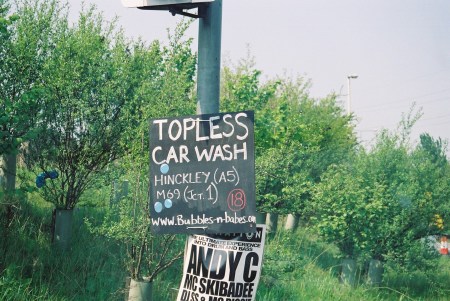
The Things You Find When You Look Through Old Photos
I wonder what happened to Bubbles and Babes?
Did the bottom fall out of the market?
The picture was taken around 2006 or so!
Glasgow Gets Money For Infrastructure
After the announcement yesterday about investment in the rail route to Penzance, a story broke later yesterday about a large amount of money for infrastructure and City Deal status for Glasgow. Read about it here on the BBC. One major piece of infrastructure included is the Glasgow Airport Rail Link.
So what is a City Deal?
Under the section on Wikipedia for Local Enterprise Partnership, there is a small section on City Deals and several large cities like Liverpool, Leeds, Manchester and Sheffield have got them. Only Manchester seems to have a meaningful entry in Wikipedia.
Type “City Deal UK” into Google and you get all sorts of irrelevant rubbish like transfer deals involving football clubs with City in the name and Groupon.
It stikes me that whoever thought of the name City Deal dropped an enormous clanger.
I did eventually find a government web site, well down the page in Google.
the obvious URL; citydeal.co.uk, is owned by Groupon.
Never trust a politician to get the details and small print right.
Good News For Cornwall
Cornwall is not where you would go, if you want to drive there in an hour and it is unlikely you’ll ever be able to get an electric high speed train to the county. I drove back once at a very busy time in my Lotus and reported it here. It took six hours to Cambridge if I cut out the delay due to accidents. Why bother?
But today, it is reported on the BBC, that the government has announced a £146million package of measures to upgrade the rail system in Cornwall, by resignalling the Cornish Main Line from Totnes to Penzance and refurbishing the sleeper trains.
I’ve only taken the train as far as Plymouth a couple of times, but on one memorable trip, the train was several minutes late at Totnes and the driver had recovered most of the time by Plymouth, by showing how an Inter City 125 can perform, if it is needed.
The BBC article doesn’t say if Network Rail are going to raise the speed limits on the line, but surely when the signalling upgrade is complete, the current journey time of five and a half hours could be reduced and the frequency increased to half-hourly, even if they still run the same amazing trains designed in the 1960s. But I travel in these trains and Mark 3 coaches regularly and you rarely hear a complaint about the trains, as they ride so well on their air bag suspension. Read about the construction of the coaches here. It is true to say that they don’t build coaches like that any more.
As it currently takes two hours from Plymouth to Penzance and a couple of years ago, First Great Western did Plymouth to London in under three hours, it would seem to be a possibility, that when the updating is complete, we could see trains from Paddington to Penzance taking under five hours. The tourism business in Cornwall will be licking its lips in anticipation of a service like this.
So will we still be seeing these trains going at full speed to Cornwall in twenty or even thirty years time? With these trains you never say never, as clever engineers always find some way to prolong their lives for another few years.
Crossrail To Start Construction At Maidenhead
I think we’ll be seeing lots of little articles like this one from the Maidenhead Advertiser in the next few months. This is the guts of the report.
The first visible phase of building work to prepare Maidenhead Station for the arrival of Crossrail is set to begin.
Network Rail contractors are due to arrive at the site in Braywick Road on Saturday and will be a permanent fixture throughout the summer.
Changes to the station including lengthened platforms to make room for 10-car Crossrail trains, a new lift, enhanced station information facilities, security systems and CCTV equipment.
The article goes on to say that 10,000 people will be working on Crossrail on 40 sites before the line opens in 2019.
It is a very large project.
Think Quarts Into Pint Pots
London Underground’s Victoria line, may have been a technological triumph for 1968, when it opened as an automatic train line, where the driver doesn’t really drive the train. Although, he or she is the person in charge. Incidentally, when the line opened in 1968 a lot of the electronic control systems used valves rather than transistors. I can remember reading about the line in a copy of Simulation magazine when I worked at ICI around 1970. It was truly cutting-edge world-beating technology in its time.
But you can’t say much for some of the stations, which were built on the cheap and are very much sub-standard compared to the extensions to the Piccadilly Line built in the 1930s.
But now the trains are running at a maximum rate of 34 trains an hour for much of the day, as is reported in this article on Global Rail News. Here’s the first three paragraphs.
London Underground’s Victoria line is now operating 34 trains an hour – ‘the most frequent train service in the UK’.
Peak-time services have been incrementally increasing since the Victoria line upgrade was completed in 2012 from 28 trains an hour to 30, 33 and finally 34.
Passengers now only have to wait two minutes between trains and there are also more trains running the full length of the line from Brixton up to Walthamstow Central.
So in two years capacity has increased by over twenty per cent, mainly by good design and engineering.
I wonder what the engineers, who built the line in 1968, would think of their baby now!
You have to also wonder if by applying the principles used on the Victoria line. could be applied to other lines in the Underground. Upgrades on lines like the Piccadilly have been delayed, but I do think, we’ll see some more squeezed out of the current system.
There are of course things that are being done and as a regular Underground user you tend to feel that the system may be more crowded, but you seem to get fewer delays. Perhaps reliability of trains, power systems and escalators is getting better.
It will also be interesting to see what happens next Monday, when buses go cashless. It might be anywhere between a disaster and a triumph.
At the disaster end of the scale, it will load more passengers onto the Underground.
But if it is a triumph and speeds up the buses, as I think it could, will passengers who can, swap from the cramped and dark Underground to a lighter and more spaceous bus, if it only takes a couple of minutes longer. Living in Hackney with no Underground, I change my route according to which bus arives first. Since the 38 has been run by New Routemasters, it has been effectively cashless, with passengers using the closest and most convenient door and only the few who need to pay using the busier front door by the driver. Certainly, if I want to get to the Angel quickly, I’ll choose a 38, as against a 56, which goes the same way, but is often overtaken, by a succession of New Routemasters.
If cashless buses work well, this will surely hasten the removal of ticket offices on the Underground, with contactless bank cards, supplementing Oyster and Freedom Passes. What differences, will this make to the ridership on the Underground?
The only thing that is certain, is that more quarts will continue to be poured into pint pots all over London’s transport system.
A Taxi With A Phone Charger
I got a taxi home today, as I had a heavy parcel to carry and was surprised to see it was fitted with a mobile phone charger.
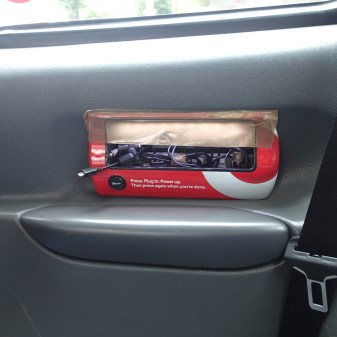
A Taxi With A Phone Charger
I didn’t need it, but I like the idea. It’s all described here. Apparently, Voafone, who’ve set it up, has a system, where the taxi fare can be charged to your mobile phone bill.
It’s ideas like this that will be the best defence against Uber, when coupled with the black cab driver’s knowledge.
The latter was illustrated recently in Edinburgh, where although it was a black cab, the driver didn’t have the knowledge that I expect from a driver.
I remember once, C and I were going to a house, in a tucked away square in South London. The driver dropped us in the next street and said there was a litle passage into the square. There was and it was just by our destination by chance.
You don’t get that sort of knowledge from a computer system!
Station Names On Bridges
Network Rail seems to be getting the blue paint out and slapping it on bridges.


As the pictures show, they’re also indicating the station name. Obviously Caldeonian Road and Barnsbury will need a much longer bridge, but The Cally will do.
I’ll add more as I see them.
 The Anonymous Widower