The Overground Advantage
I think that the London Overground has a tremendous advantage over other rail lines that are being developed. Look at this picture of the new extended platform on Willesden Junction station.
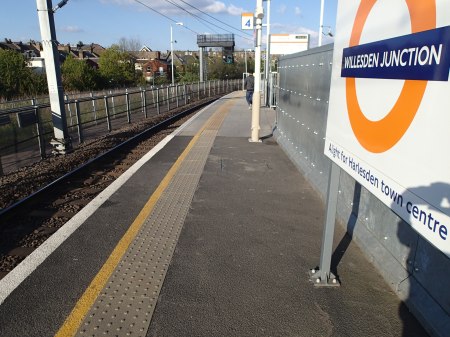
An Extended Platform At Willesden Junction
The platform has been extended for the new five car trains which will start to run later this year. It would appear it has been a simple job, as there was nothing in the way of the extra platform.
Most of the developments in progress on the Overground, like the lengthening of platforms and the addition of shelters and small shops for coffee etc., seem to not require too much work, as most of the stations seem to have been built fairly well, with longer platforms, than are currently used. So some of the lost space is just being regained.
But also remember that many of these stations had been neglected for decades before they were incorporated into the Overground.
So they have the great advantage that any money spent shows a tremendous improvement.
It’s a bit like buying a wreck of a house, which looks so much better after you’ve cleaned out the previous owner’s junk and painted the front door.
So perhaps other lines in London and the wider UK could benefit from the sort of procedures that are being applied to the London Overground. In truth, I’ve come across quite a few stations across the UK, like Middlesbrough, Huyton, Bexhill, Wigan and Hartlepool, that have been made much more attractive for passengers without breaking the bank.
After all, if you have clean stations with good facilities and the trains have comfortable seats and they are clean and on time, you will probably go some way to increasing the number of passengers.
My worry about this lengthening of London Overground trains from four to five cars, together with longer and better stations, is going to be far too successful, in getting others to use the route.
At least though, the Class 378 trains can probably be lengthened again to six-car trains, by the simple process of sticking another carriage in the middle.
A Gluten-Free High Street In Watford
I went to see Ipswich play at Watford yesterday and ate lunch in Carluccio’s in the High Street there. Their restaurant is actually in a sandwich between Nando’s and Jimmy’s World Grill, both of which seem to cater for gluten and other allergies.
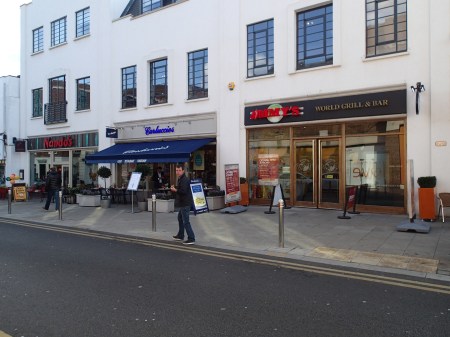
A Carluccio’s Sandwich
There is also a Pizza Express on the other side of the road.
For the first time, I used the Overground to get to Watford, by travelling to Watford High Street station. This station is due to be rebuilt in the next few years as part of the Croxley Link project. As the Watford Junction station and the tracks through it are also being remodelled, it looks like Watford is getting a full transport makeover.
Après Bob, Le Déluge
It would seem that the successors to Bob Crow at RMT are out to inflict more pain on Londoners, than Bob Crow ever did, with five days of strikes in the next few weeks, as reported here on the BBC.
But Londoners will in the main survive and get on with their business, just as they did when Adolf gave the city, quite a few years of much more dangerous strikes.
As someone, who uses the Underground and Overground a lot, I pass by ticket offices quite a bit. Many are crowded with long queues at the ticket machines. Only a few stations seem to have long queues at the actual ticket offices themselves.
So to cure the problems of the queues at the ticket machines, Transport for London will introduce more and better machines at stations.
The ability to be able to use a contactless bank card as a ticket as well as Oyster, which is already happening and is supposedly working well on buses, will also contribute to a reduction of those needing the ticket offices.
If the machines and contactless cards do cut all the queues, then we could have have the situation of fully-manned ticket offices, where staff see hardly any customers at all.
Surely, the RMT should be stopping the installation of more ticket machines and the using of contactless bank cards as tickets, if they wanted to stop the closure of ticket offices.
Where else will this worrying new militancy turn up?
Snippets From 1862
I’ve just bought a reprint of Bradshaw’s Illustrated Hand Book to London, which was originally published in 1862.
It was bought in Waterstone’s in Islington, as a present for a friend’s birthday, but I spent most of my lunch in Carluccio’s round the corner reading it. It is full of interesting information and some very surprising differences and facts.
1. Nelson’s Column is known as The Nelson Column.
2. The Houses of Parliament is known as the New Houses of Parliament, as it has just been built.
3. The Crystal Palace gets a lot of pages.
4. There is a lot of description of places anyone familiar with London would recognise.
5. Under rules for railway travellers, it says that passengers are forbidden to smoke on trains or in stations. But obviously, it was acceptable for the engines to do this!
6.They also have a table of money of all nations. As Germany wasn’t yet united, they have separate rates for Hamburg, Prussia and the German States. The Swiss rate is given against one of their coins, which was a thirty-two franc.
More details on the book are given here.
Not Long Now For The New Pudding Mill Lane Station
The Wharf is reporting that the Stratford top Bow Church section of the DLR will be closed over the weekend.
The DLR has is not running between Stratford and Bow Church from Friday 18 April until Friday 25 April due to Crossrail works at Pudding Mill Lane.
The completion next week will see the opening of the new Puddling Mill Lane station, 100metres from the original.
So it looks like it won’t be long before access to the Olympic Park, the Greenway and the ViewTube is a lot easier.
Should Scottish Islands Be Given More Independence?
The BBC this morning is running a report about more independence from Scotland and the rest of the UK.
Scottish Secretary Alistair Carmichael has promised to deliver greater powers for the Northern and Western Isles.
The Orkney and Shetland MP said government from Edinburgh had been “just as bad and just as dangerous” for the islands “as it is from London.”
He hopes to deliver “genuine and long lasting reform,” and said an agreement should be in place by midsummer.
Why not?
It could be argued that a greater degree of independence hasn’t done the Isle of Man and the Channel Islands any harm!
But if we look at giving this independence to any area of the UK, giving them control of their strengths and natural resources and such things as infrastructure, education and planning could only be positive.
I probably know most about infrastructure and especially railways than anything else and if we look at Scotland and London, where transport policy has been partially devolved, we’ll see a lot more rail projects than say in the North East or South West, so I’ll look at one example.
If East Anglia had control of its transport, they would have probably dualled the A47, A11 and A140 by now and would be seriously thinking about improving the London to Norwich and the Peterborough to Ipswich rail lines. The latter is probably needed to be electrified, to enable Felixstowe to compete with the London Gateway.
This type of local control could only be good for an area.
But as I said in this article on Mayors, central government doesn’t like to give up power.
The Bacon Factory Curve Opens
The BBC are reporting that the Bacon Factory Curve or the Ipswich Chord to give it its official name, is now open. Here’s the summary.
A new £59m railway giving the Port of Felixstowe a direct link to the Midlands is opening to freight.
Until now freight trains have had to travel in to Ipswich and then out again, adding a hour to journeys.
Hopefully, this small piece of track will improve timekeeping of trains that pass through or by the junction.
As I first posted about this curve in February 2013, construction has been pretty fast.
Have the government and Network Rail decided that lots of small projects can improve the efficiency of the railway significantly?
The Lack Of Left-Luggage Facilities
On the 26th of April, Ipswich are playing in Burnley, and I shall be going.
Unfortunately, the match is on Sky and starts at 12:15, which means taking the 08:30 train to Preston out of Euston, where I change for Burnley.
It is not a difficult journey and I’ve done it before.
However, this time, I think it might be a good idea to go on holiday the next week and there is an ideal flight out of Liverpool to Gdansk on the Saturday evening.
So as it is easy to get to Liverpool Airport from Burnley, via Preston, it would be ideal.
But what do I do with my case for the holiday?
Preston is a major train interchange, but in common with most mid-sized stations in the UK, it doesn’t have any left luggage facilities.
So if I do decide to go on holiday that week, I’ll have to come home to get my case and use a more expensive flight, than the good value one out of Liverpool.
It strikes me that there is an opportunity for someone to create a nationwide system to handle left luggage.
Was This What Really Annoyed The Board At The Co-op?
Prufrock in The Sunday Times looks into the trouble at the Co-op and has this interesting paragraph.
Apparently, certain senior members of the Co-op movement first decided Sutherland had to be stopped after he cut a long-standing entitlement to first class travel for the 20 board members, whose number includes a farmer, a university lecturer and a nurse. Free travel is a perk that disappeared years ago from all but the most lavish plc boards.
So I conclude that to really live well as a socialist, it has to be at the expense of others.
 The Anonymous Widower