Lunch With A Swing In Spitalfields
Sometimes on a day when the weather is good, I go for lunch in Leon’s in Spitalfields.
Today there was a free bonus cabaret with every meal! And the brave could dance! Which I’ve never been able to do!





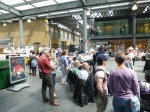


The girls are twins and go by the name of Twin Swing. They probably fall into the “Twice the fun, but double the trouble” category. All my experience with children growing up leads me to the opinion that boys are more difficult, but I’ve met a couple of sets of very naughty girl twins. Boy twins on the other hand seem to behave well, except perhaps for Ronnie and Reggie.
They are appearing at the Waldorf Hotel on the 19th of July as entertainment for the Traditional Afternoon Tea. It’s all reported here in this article in the East Grinstead Courier. The report contains this immortal line.
Lingfield twins Jessica and Emily Evans, both 24
It would be rather unusual for twins to have different ages.
Is A Mobile Phone A Dog And Bone With Legs?
My father, who was not really a real Cockney, as you couldn’t quite hear Bow Bells from where he was born, was a regular user of rhyming slang.
I was writing a message to someone and suggested we text each other.
I then realised that I’d never heard rhyming slang for mobile phone, which led me to the title of this post.
This page supports the use of Obi Wan Kenobi.
Where Are The 33cL Water Bottles?
In the UK, I generally carry a small bottle of water. Usually, it’s a 33cL Evian or if I’ve been on a train a 33cL Harrogate.



As the pictures show, these bottles are smaller than the 50cL ones that you have to use on the Continent. On my recent trip, I never managed to find a smaller bottle.
I prefer the smaller bottles, as there is less to carry. And they fit my jacket pocket!
I would have thought that there might be an economic advantage for both consumers and retailers in the smaller bottle. Not knowing the costs of production, I can’t do a full calculation.
Amber Rudd Puts Onshore Wind Out Of Its Misery
I don’t like onshore wind farms so I was pleased to see this announcement by Amber Rudd on the BBC, which is titled Earlier end to subsidies for new UK onshore wind farms.
Onshore wind blights the countryside and you have to use a lot of subsidy to make a development viable.
But, I mainly don’t like the concept of wind power, because it is too mechanical, as opposed to solar, where you put up a panel and its control system and you get electricity.
Solar’s other big advantage is just emerging and that is the ability to link it to an intelligent battery such as the Tesla Powerwall to provide an independent power system for a building or something remote that needs good clean energy.
In a few years time, I predict that all new houses will have solar panels on the roof and the next generation of storage battery in the garage. Coupled with increases in insulation quality, I also think, we’ll see the likes of Barratt advertising houses with no external gas and only a stand-by electricity connection, for use on the dullest days.
The big energy companies won’t like it! But surely this is the sign of a good idea?
My energy usage isn’t high, but when the solar/battery powerplant drops in price sufficiently, I’ll fit one!
Surely Taking Your Children To Syria Is Child Abuse?
I’m no lawyer, but I did live with one of East Anglia’s finest children’s barristers for forty years and for at least twenty of those years, C was at the top of her profession.
So to my trained-by-association legal mind, if you take your children to a war zone, like Syria, you’re putting your children in danger and that in my view and probably would in C’s mind, be akin to child abuse and should get the mother, father or guardian into Court.
As well as the case of the three Bradford sisters on their way to Syria and possible oblivion, we also have the case of the attack on the pregnant woman in Peckham.
In the second case someone has been charged and will appear in Court today.
As the Authorities knew something was up with the Bradford sisters, why was nothing done to sort the problem earlier, when they went to Manchester Airport the first time?
When I went out on Eurostar on my way to Kassel, there was a lady about fifty, who was travelling with a young girl of about four. The lady got a minute or so’s questioning from Immigration at St.Pancras. Which was quite right, as C was often in Court trying to get children produced that had been sneaked out of the Jurisdiction. I seem to have read that immigration rules have been tightened to make taking children out of the country, against one parent’s wishes more difficult.
Perhaps, if they were tightened again, it might stop a repeat of the case of the Bradford sisters and their nine children.
An Unusual Sculpture Outside Osnabruck Station
It’s rather unusual, as they turn.




Perhaps I should have made a video.
Philistines Like Islamic State Are Nothing New
We are all worried about what Islamic State will do to important world heritage, as is reported on the BBC in this article about Palmyra.
In Leipzig I came across a modern church that was not to my liking with a model of an old Gothic church in front.




So I got thinking, that perhaps the church was something like a cathedral or important church that had been destroyed in the Second World War.
But it isn’t!
The model church is the Paulinerkirche and it stood on the site. Wikipedia sums up what happened to the church as follows.
The church survived the war practically unscathed but was dynamited in 1968 during the communist regime of East Germany. After the reunification of Germany, it was decided to build a new university church on the site in the shape of the former church. A new building, the Paulinum (formally: “Aula und Universitätskirche St. Pauli”, i.e. “Assembly Hall and University Church St. Paul”), was built on the site beginning in 2007.
Enough said!
The Nikolaikirche
The Nikolaikirche in Leipzig is introduced in Wikipedia like this.
The St. Nicholas Church (in German: Nikolaikirche) has long been one of the most famous in Leipzig, and rose to national fame in 1989 with the Monday Demonstrations when it became the centre of peaceful revolt against communist rule.
As I was close I had to visit.




It seemed shut, so unfortunately, I had to pass on a visit to such an iconic place in the fall of another evil dictatorship. In Peaceful Demonstrations in the church’s Wikipedia entry this is said.
Cabaret artist Bernd-Lutz Lange said about the events which started in the St. Nicholas Church:
There was no head of the revolution. The head was the Nikolaikirche and the body the centre of the city. There was only one leadership: Monday, 5 pm, St. Nicholas Church
But then my father always said that St. Paul’s stood defiantly against the Nazis in the Blitz.
The Bombing Of Dresden
I could not leave Dresden without commenting on the Bombing of Dresden by the Allies in World War II.
Some feel it was a war crime and many say it was justified. This is the first paragraph in the Wikipedia section describing the background to the bombing.
Early in 1945, after the German offensive known as the Battle of the Bulge had been exhausted — including the disastrous attack by the Luftwaffe on New Year’s Day involving elements of eleven combat wings of the Luftwaffe’s day fighter force — and after the Red Army had launched their Silesian Offensives into pre-war German territory, theGerman army was retreating on all fronts, but still resisting strongly. On 8 February 1945, the Red Army crossed the Oder River, with positions just 70 km from Berlin. As theEastern and Western Fronts were getting closer, the Western Allies started to consider how they might aid the Soviets with the use of the strategic bomber force. They planned to bomb Berlin and several other eastern cities in conjunction with the Soviet advance—to cause confusion among German troops and refugees, and hamper German reinforcement from the west.
It is a sensible argument, but I feel that decisions earlier in the War meant that to cause the required confusion, they had no alternative.
Churchill and others were also worried about what the Russians would do with the territory they captured. And he was right, as their colonisation and subjugation of Eastern Europe happened and it was something of which no-one can be proud.
In some ways it’s a pity that the German leaders in 1944, didn’t know how close we were to perfecting the atom bomb. But if they had,would the likes of Hitler ever surrendered? I doubt it! When you’re dealing with the really mad, all logic goes out of the window.
So could there have been an alternative to the bombing of Dresden and Leipzig?
What my father had been involved with in the war, I know not! But he was a passionate believer in the abilities of the de Havilland Mosquito. My father was well-connected in some way to John Grimston, who later became the 6th Earl of Veralem. In the 1950s and 1960s, Grimston’s company, Enfield Rolling Mills, was my father’s biggest customer. I know he was well-connected because when I needed a vacation job, my father rang the Earl and called in a favour, which got me three months extremely useful work in the Electronics Laboratory. My father did move in some unusual circles before and during the war. At one time, he was even working at the League of Nations in Geneva.
I have just read the section in Wikipedia about the Inception of the Mosquito. To say it was a struggle to get de Havilland’s wooden design accepted and then built would be an understatement. My father and others have said that there was scepticism in the Air Ministry about sending out crews to bomb Germany in a bomber with no defensive armament, which was built out of ply and balsa wood and stuck together with glue.
You have to remember that together the RAF and the USAAF lost hundreds of thousands of crew bombing Germany with four-engine heavy bombers. So was it the right policy?
One of my late friends, was a Mosquito pilot, who flew the aircraft in the RAF in the late 1940s. Several times we discussed the bombing of Germany in the 1970s. He had flown many types of aircraft, but in his view nothing compared with the amazing Mossie. The only flying problem, was an engine failure on take-off, which as a pilot with several hundred hours on a Cessna 340A, I know is a serious problem on any piston-engined twin. Luckily it never happened to either of us!
It is useful to compare the performance of a Mosquito to a B-17 Flying Fortress.
The following words are taken from the Bomber section in Wikipedia for the Mosquito.
In April 1943 it was decided to convert a B Mk IV to carry a 4,000 lb (1,812 kg), thin-cased high explosive bomb (nicknamed “Cookie”). The conversion, including modified bomb bay suspension arrangements, bulged bomb bay doors and fairings, was relatively straightforward, and 54 B.IVs were subsequently modified and distributed to squadrons of RAF Bomber Command’s Light Night Striking Force. 27 B Mk IVs were later converted for special operations with the Highball anti-shipping weapon, and were used by 618 Squadron, formed in April 1943 specifically to use this weapon. A B Mk IV, DK290 was initially used as a trials aircraft for the bomb, followed byDZ471,530 and 533.[108] The B Mk IV had a maximum speed of 380 mph (610 km/h), a cruising speed of 265 mph (426 km/h), ceiling of 34,000 ft (10,000 m), a range of 2,040 nmi (3,780 km), and a climb rate of 2,500 ft per minute (762 m)
And the Flying Fortress had a maximum speed of 287 mph, a cruise speed of 182 mph and a range of 1,738 miles with a 6,000 bomb load. In addition it needed a crew of ten, as against the Mosquito’s crew of just two.
I have seen statistics that Mosquito bombers could sometimes do two trips to Germany in one night with different crews and that they had the highest safe return rate of any Allied bombers.
So why did we not use Mosquitos to bomb Germany?
The statistics and according to my friend, the crews, were in favour, it’s just that those that made the decisions weren’t!
If we had been using a substantial number of Mosquitos, then a totally different strategy would have evolved, as the Allied Air Forces wouldn’t have lost so many experienced crew and the number of bombing raids would have increased and would have been of a much higher accuracy.
A serious mathematical analysis may or may not have been done since the war, but if it has been, it could have given surprising results.
This strategy could have meant that the destruction of Dresden and Leipzig might not have happened. If nothing else Mosquitos could almost have reached the German lines on the Eastern Front to support the Russians, from bases in South Eastern England.
As an aside here, after having visited Dresden, I have seen how the historic centre is all along the River Elbe, with the railway, which surely was an important target to disrupt traffic and cause confusion behind German lines, slightly further away from the river. As any pilot, who has flown at night by the light of the moon as I have, will tell you, rivers stand out like nothing else and it would have been very easy to find the historic centre of the city to drop bombs.
So I feel strongly, that the crude, misplaced philosophy of four-engined heavy bombers contributed to the destruction of Dresden. There were raids for which these bombers were ideal, like the destruction of dams, U-boat pens and V-missile sites, but carpet-bombing cities was not one of them!
To sum up, I have also heard arguments from former Mosquito pilots like my friend, and others, that properly used Mosquitos could have shortened the war by several months.
An Inscription In The Pavement
I came across this inscription in the pavement dated to the 8th October 1989 by the Dresden Hauptbahnhof.

An Inscription In The Pavement
I can’t find anything about it directly on the web, but it is probably connected to this section in Wikipedia’s entry for the Monday Demonstrations In East Germany, which says this.
A major turning point was the events in the West German Embassy of Prague, where thousands of East Germans had fled in September, living there in conditions reminiscent of the Third World. Hans-Dietrich Genscher had negotiated an agreement that allowed them to travel to the West, in trains that had to pass first through the GDR. Genscher’s speech from the balcony was interrupted by a very emotional reaction to his announcement. When the trains passed Dresden’s central station in early October, police forces had to stop people from trying to jump on the trains.
I should have taken more pictures.
 The Anonymous Widower