The Tories Will Aim To Cut Inheritance Tax
According to this article on the BBC, a future Tory government would end Inheritance Tax on family homes up to a million pounds.
I have form in opinions in this area and had a letter published in the Financial Times in 2006 about this tax, after an article in the paper on March 31st 2006 advocated the killing off of the tax. This is the first two paragraphs of the letter.
I have been against inheritance tax for years, not because I would benefit from its abolition or because I am getting to that age, when I should start to do something about it (“Inheritance tax should be killed off”, March 31). It is just that as a control engineer by training, I think it does untold secondary damage.
Consider: how many bright minds are employed on both sides of the inheritance tax war in avoiding and collecting the tax? Abolish it and they would have to do a proper wealth-creating job.
I still believe that the Inheritance Tax should be abolished, if not totally, but substantially! I don’t have current figures but in 2006, it only raised half as much as Air Passenger Duty in that year. I’m not alone on thinking this way as this article from the Telegraph in 2013 shows. This paragraph is from the article.
Yet the tax raises just £2.9bn a year, a mere 0.18pc of GDP, a tiny sum given all of the collateral damage caused and one which could easily be recouped by accelerating the Government’s savings programme.
David Cameron’s proposals are welcome, but pretty timid and will only have a limited positive effect on the economy compared to what full abolition will have.
The tax revenue would have to be replaced and as a BBC survey showed in 2006, that people would prefer a couple of pence on Income Tax. These days other and better options exist. The problems with abolishing Inheritance Tax are all political rather than economic, as if the Tories went for full abolition, the Labour Party would have a field day, saying they were looking after their friends.
They’ll probably do that with David Cameron’s announcement, even though probably nearly half of the beneficiaries of the tax reduction will be Labour voters.
The Future Of Pay As You Go (PAYG) Energy
Before I bought this house, it had been tenanted and because of the letters I’ve received since, I reckon that quite a few tenants skipped owing money to energy suppliers. Because of this, the house had a PAYG gas meter that used a key. I never used it for more than aa day or so, as the energy company I chose, replaced it with a normal one.
Using PAYG must be a nightmare for a family with problems, either monetary or organisational. So when I saw OVO Energy had brought in a PAYG system that worked on-line, I started following reports of the system.
Today I’ve picked up this comprehensive article from the Yorkshire Post. This is the first couple of paragraphs.
Thousands of Yorkshire customers who have been paying over the odds for their gas and electricity may be in for some relief – so long as they have a computer, email address and bank account.
British company Ovo Energy has just launched the UK’s first full-service, smart, pay-as-you-go (PAYG) energy platform, Smart PAYG+, which offers the cheapest pre-payment tariff in the country.
Eventually, this is how people with a computer, e-mail address and bank account will pay for PAYG energy.
OVO’s Smart PAYG+ system seems to be a very good design and will have applications outside of where the current key meters are used. OVO says this.
If you’re a prepayment energy customer, or even if you’re not, why not switch to OVO Smart PAYG energy? It takes away the hassle of paying for your gas and electricity. OVO gives you a choice of two ways to Pay As You Go.
I think that this technology will be used in some surprising places. I doubt I’ll be changing, but my energy use is rather erratic and sometimes I’m deep in credit with my energy supplier, who is OVO. PAYG would allow me to have a minimum credit at all times.
Confusion Over The Weather
This morning, the BBC ought to get its messages on the weather consistent.
Their headline is that there will be high pollution levels in the South East, which they illustrate with pictures of London.
But the weather babe on BBC London hasn’t mentioned the pollution, despite her forecast covering a lot of the South East.
And then the two presenters have just said it’s going to be a lovely day out there today.
It’s all confusing and I’ll ignore the lot of it and use my Mark One eyeballs.
How To Redesign An Everyday Object
Electricity pylons in the UK are generally made to a design that dates from the 1920s. So National Grid, who are responsible decided to have a design competition in partnership with RIBA.
According to this story on the BBC, National Grid are putting up a test line of the winner to teach engineers how to put them up.
They certainly look to be an improvement, but after nearly a hundred years, you’d expect that!
National Grid has also put up a blog.
I like the new pylons and hope to photograph them soon!
Wytch Farm And Horse Hill
I couldn’t resist looking at the Google Earth images of the two sites.
This is Wytch Farm
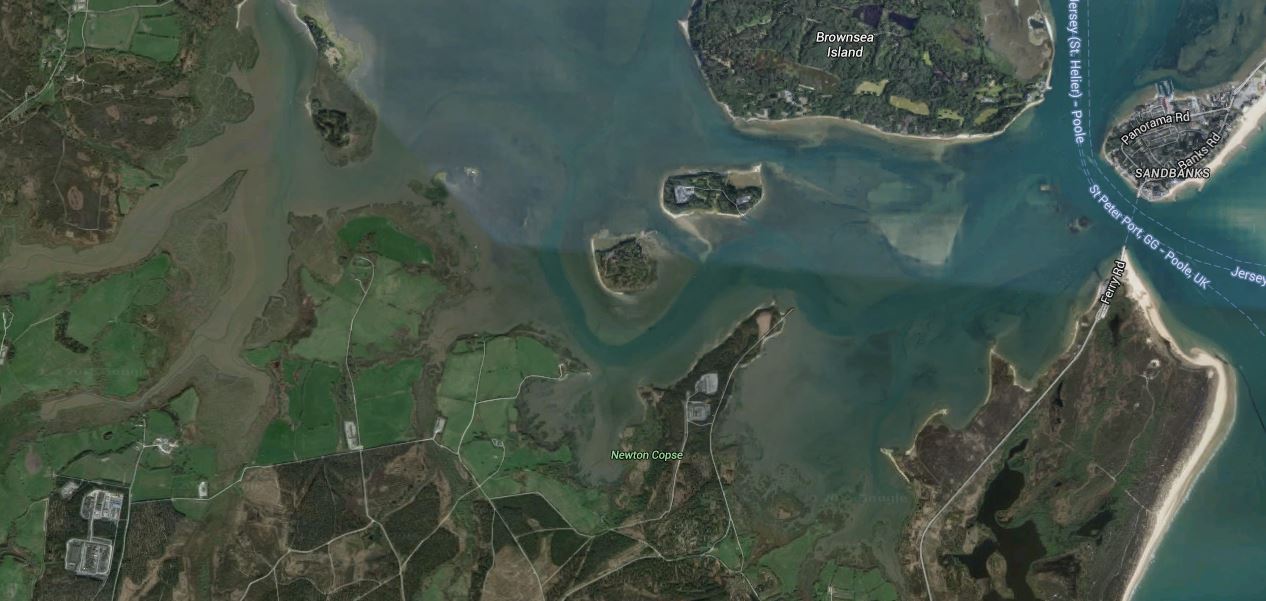
Wytch Farm
The processing plant for the field is the two squares in the bottom-left or south-west corner of the map and the wells fan out for upwards of 10 km. The field even goes under the upmarket area of Sandbanks, so if anybody would complain, the residents from there would.
And this is the area of Horse Hill
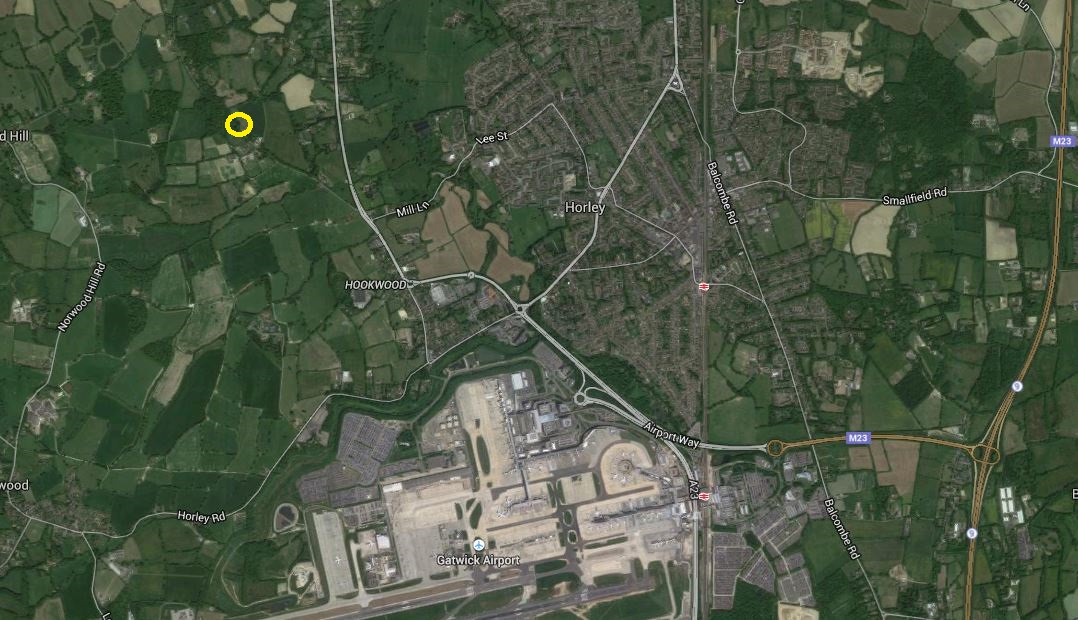
Horse Hill
It is marked by the yellow circle. Note the sprawl of Gatwick at the bottom.
Both sites are surrounded by a lot of green field and woods, so I feel that a similar camouflage job could be done in Surrey to that done in Dorset.
Although as Wytch Farm is now forty years old, I suspect we’ll do a better job today of hiding it. It might be that directional drilling is used from a site near the railway through Gatwick, so that the processing plant could be well hidden and oil could be removed by train.
The Oil Find That Will Settle The Result Of The Election
I’ve believed for some time, that which ever party wins the election in a few weeks time should win the next election in 2020.
This belief is based on the fact, that so many large rail and other transport projects are due for completion in the later years of this decade.
The report on the BBC of the large oil find at Horse Hill in Surrey, is one of many that describe the find as of national significance. This is said in the BBC’s report.
“We think we’ve found a very significant discovery here, probably the largest [onshore in the UK] in the last 30 years, and we think it has national significance,” Stephen Sanderson, UKOG’s chief executive told the BBC.
Many will worry that developing an oil field in rural Surrey could be an environmental disaster.
A friend of mine had a lot to do with the development of the last major onshore oilfield in the UK at Wytch Farm, which is the largest onshore oil-field in Western Europe. The new field could be bigger, but all reports get their millions and billions mixed up.
Wytch Farm is not your average oilfield, as it is in the heart of rural Dorset by Corfe Castle. Wikipedia says this about the environment of the field.
Most of the field is protected by various conservation laws, including the Jurassic Coast world heritage site, Purbeck Heritage Coast and a number of sites of special scientific interest, areas of outstanding natural beauty and nature reserves (including Studland and Brownsea Island), so the gathering centre and most of the well sites are small and well screened by trees. Directional drilling has also contributed to reducing the impact on the local environment, with extended reach drilling from the Goathorn Peninsula attaining distances in excess of 10 km.
But the field would appear to have been an impeccable neighbour, more conspicuous by its absence in the media.
So I think the UK has good form in the development of oilfields in sensitive areas and there is no reason to expect that the development of Horse Hill will be any more disruptive than that at Wytch Farm.
The field’s biggest effect will be on the UK economy, if as reports are saying, production will start in a few years time, it will be producing revenues and cutting imports by the next election in 2020.
Circumstances have left the incoming government with a very large dowry.
They will have to be really stupid to lose in 2020. But then that’s normal for politicians.
The Slow Demolition Job At Highbury And Islington Station
I went past Highbury and Islington station yesterday and they’re still demolishing the old Post Office.




Has any other demolition job taken so long? Original gossip in the newsagents and at the station, said it would take a week. I first posted that work had started on the first of February.
I can only thing that the building is built with lots of asbestos.
An Historical Side-Effect Of The London Gateway
This story from the Southend Echo, tells about the excavation of HMS London. They say this.
A PHOTOGRAPHIC exhibition detailing the excavation of a shipwreck off Southend pier has opened to the public.
HMS London was first rediscovered in 2005 during works to build the London Gateway superport.
Mary Rose it is not, but HMS London would appear that it is starting to give up its secrets.
I shall certainly go to the exhibition of photos at the Beecroft Gallery in the town.
Two ‘eads Are Better Than One!
This is an old phrase, but it certainly doesn’t apply to the two Eds trying to think up Labour Party tax policies.
In this article on the BBC, about the taxing of ‘non-doms’, this is said.
Ed Miliband said the non-dom rules were “indefensible” and axing them would raise “hundreds of millions” in tax.
But shadow chancellor Ed Balls was forced to deny contradicting himself after saying in January that scrapping the rule “would cost Britain money”.
How many people will now take everything they say with an awfully large pinch of salt?
I think it illustrates the first law of politics, which is don’t go into it, if you can’t remember everything you’ve done and said, since you first drew breath.
Shopping In IKEA Without A Car
I don’t drive, but when it comes to shopping in IKEA, I can get to the three London stores at Croydon, Edmonton and Neasden by public transport.
Edmonton, to where I get a 341 bus, is probably the easiest and if say I bought something that was too big to carry, the store will put me in a mini-cab.
Croydon is actually the farthest, but I use it at times, as it is so easy to get to using the tram from West Croydon. So if I’m going South of the river for some reason, and I need to check something, I’ll pop in to that store.
As my house and the built-in garage front the street and there is usually plenty of parking outside, I usually shop at IKEA by going to a store and ascertaining what I need and then ordering on-line. It doesn’t always work out as it should.
Due to finger trouble I ordered the wrong freezer for my kitchen. And as I only discovered too late to send it back, if you want an IKEA DJUPFRYSA, I’ll be putting one on eBay soon!
I need to check on a few things at the moment.
On my trip to Huddersfield on Monday, I wondered, if there was an IKEA in Sheffield that I could have visited to answer my queries. But there isn’t.
So it got me thinking, as to how many IKEA stores in the UK, are as easy to get to by public transport, as the three in London.
Only four seem to be easy to get to from the local station or tram stop.
Here’s Manchester, shown on a Google Earth image.
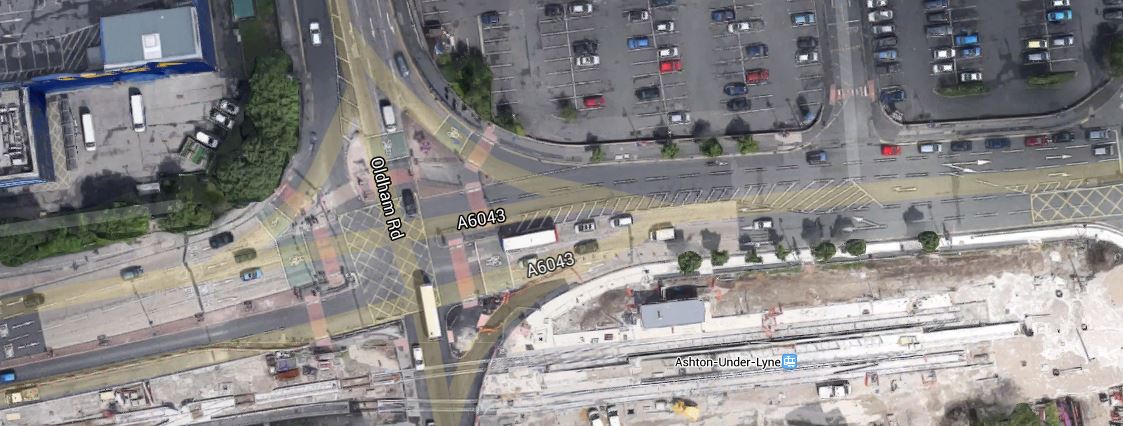
IKEA Manchester
This store would have been ideal, as there is a direct train service from Ashton-Under-Lyne station, which is near the store to Huddersfield. Except that there were no trains to Manchester on Monday and anyway I’d already bought my ticket via Sheffield.
As to the other stores on the UK mainland, they are Cardiff, Coventry and Southampton, all of which are in easy walking distance of a train station. But they wouldn’t have been much use on Monday!
So I’m off to Croydon today!
 The Anonymous Widower