Strasbourg Station
Strasbourg station is unusual in that they’re put a glass canopy on a magnificent nineteen-century station.


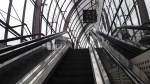
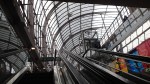

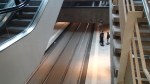
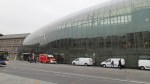

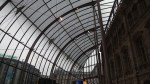

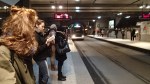

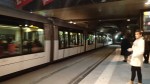

I liked it. The design also allows the Strasbourg trams to be in a tunnel under the front of the station and be accessed by lifts and escalators.
As the building of these glass or plastic canopies and roofs is getting easier and cheaper, due to the work of structural engineers, I think we’ll see a lot more Strasbourg-style stations.
Lunch On A Clothes Line
I had a nice gluten-free salad for lunch at a restaurant called La Corde a Linge



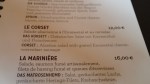
The salad was called le corset, as a lot of the dishes were named after clothes as the restaurant had once been a laundry.
They knew their gluten-free and also sold a decent cider.
It was also delicious and good value.
Petite France
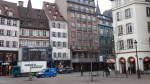
Petite France is an area of Strasbourg, that is a UNESCO World Heritage Site.

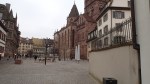
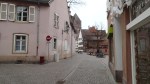
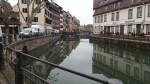

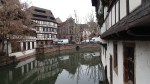
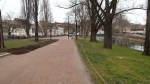



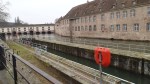
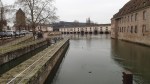
I walked around for an hour and had lunch there.
Exploring Strasbourg
I didn’t have much time in Strasbourg before I needed to catch the TGV Est, so I used the excellent tram system to explore the city.
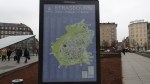


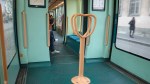


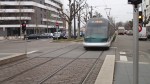

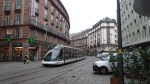






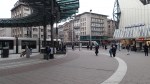
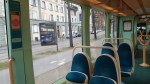


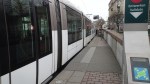
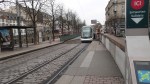
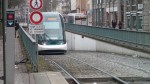
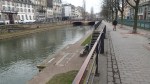


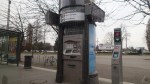
The trams are all low floor, which as a Londoner, you appreciate, as all the buses are going that way. The New Rputemasters are totally flat and no-one should have to accept anything less.
Strasbourg’s successful introduction of trams has been credited with helping to start the tram-revolution in France. Like Nottingham, which was an instant success in the UK, both networks are 100% low-floor. This doesn’t apply tro all UK tram networks.
As a Londoner, you appreciate this, as all the London’s buses are going that way. The New Routemasters are totally flat and no-one should have to accept anything less.
From Mulhouse To Strasbourg
After exploring Mulhouse, I took an early evening train onto Strasbourg. Theation journey was done without any trouble, but as there was no information system on the train and station names were not too visible, I was worried about being taken to Nancy.
But a fellow passenger put me right.
Surely, in these days, it should be a European law that all trains have good information systems and that station names are clearly illuminated.
At Strasbourg the station wasn’t a problem, although in common with most European stations, the lighting levels, weren’t at the levels you get in the UK.
After a little bit of searching, I found that the tram to my hotel was in a tunnel under the station and with assistance from a helpful local, I was able to purchase a ticket and go the two stops needed.
Often the pasengers’ experience of a train, tram or metro journey can be improved significantly with clear signs and good lighting.
A Quick Exploration In Mulhouse
On the way from Basel to Strasbourg, I stopped off at Mulhouse to have a look at the city and ride its tram-trains.
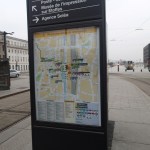

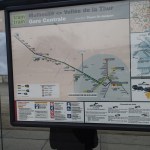
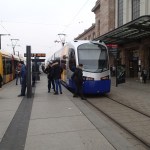
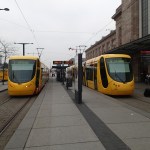
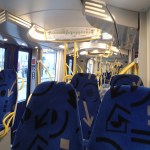

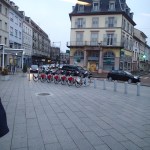
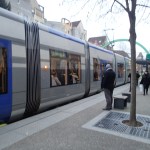

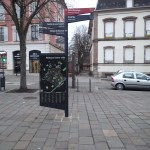
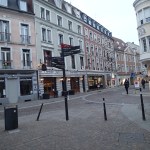
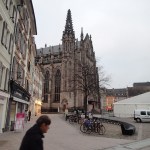
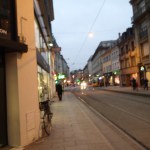
The line is a good bit short of its planned length and rather infrequent at the moment, but compared to the two German systems in Karlsruhe and Kassel, it is a step up in design quality.
I should also say, I was impressed with both Mulhouse and its trams and tram-trains.
There was a lot of information maps everywhere and this was an order of magnitude better than anything I’d seen in Germany.
The Germans could do a lot worse than hop over the border with a camera and pinch the designs used in Mulhouse.
I particularly liked the red finger on the finger post, which always pointed to the historic city centre. So simple, I wonder why I’ve not seen it before!
If you look at the proposal for the extension of the Sheffield Supertram to Rotherham using a tram-train, it has similarities to the system in Mulhouse.
The Siemens S70/Avanto tram-trains used in Mulhouse are dual voltage capable of running on 750 V DC or 25kV AC. The Class 399 Sheffield tram-trains which are being made by Vossloh are said to have a similar capability. You could argue that being able to run on both these voltages is akin to the dual-voltage Class 378 which run on both voltages. The Class 378 halts for the changeover at places like Acton, but surely modern electric systems can be designed that handle the changeover between voltages automatically.
Uncertainty In Basel
The train arrived in Basel on time, but due to a misunderstanding with the public address, I got out at the German station rather than the Swiss one.
So I lost about half-an-hour on my way to Mulhouse. I then had to go to virtually a separate station to get my French train.
Surely for reasons of efficiency, the three stations should be more integrated.
From Karlsruhe To Basel
I left Karlsruhe for Basel and one of the tram-trains had even turned up in the station.
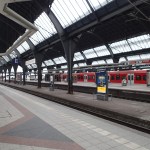

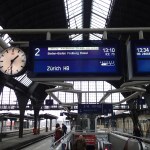
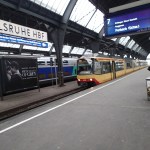
Again it was another of those journeys which would have been better in the sun.
There is though the chance of having a stop in Baden-Baden to break up the journey.
Exploring Karlsruhe And Its Trams And Tram/Trains
As the main reason I went to Karlsruhe was to see their tram/trains, properly called the Karlsruhe Stadtbahn, in action, I’m combining all the posts in the city in one.
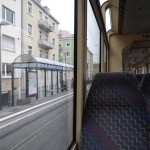
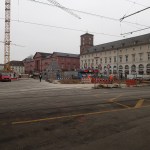
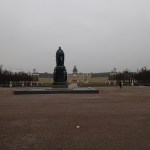
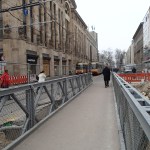
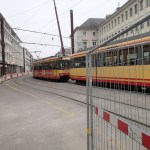
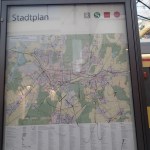
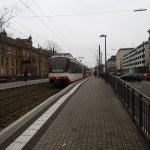
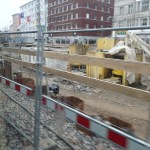
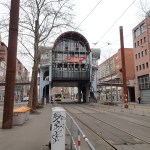
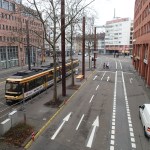
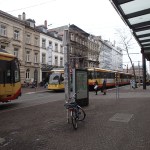
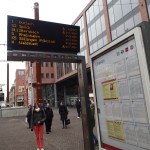
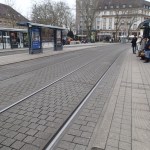
It’s also probably a good idea to combine the pictures, as the main street of the city is being dug up to create a new tunnel for the tram/trains across the city. So you can’t really see any of the city’s attractions.
Notice that Karlsruhe’s tram/trains can be quite large and I think I saw some of four or possibly five coaches. Their network is also over two hundred and fifty kilometres, so small it is not! By comparison the Sheffield Supertram is just thirty kilometres, but Sheffield has a population twice that of Karlsruhe. These figures show how undeveloped our tram systems are compared to those in Germany.
It will certainly be worth returning to Karlsruhe, when the tunnel is complete and the network is expanded.
The operation of Karlsruhe’s tram-trains are often described as the Karlsruhe model. Kassel is described as working to this and so is the Tyne and Wear Metro, although that is not a tram-train, but it does share tracks with heavy rail.
Karldruhe also uses Vossloh Citylink tram-trains, which are similar to the Class 399 ordered for Sheffield for operation as tram-trains to Rotherham.
Rules For Using German Trains
Deutche Bahn is not the most difficult railway system to use, but from the German part of my trip, it is worthwhile following a few rules.
1. Learn to use the ticket machines
The standard DB ticket machines work well, and as well as issuing tickets are a good way of finding the train to do a later or next day journey.
2. Don’t expect the same frequency you get in the UK
I’ve just looked up Kassel to Frankfurt and compared to say Norwich to London, which is a similar journey, there are perhaps half the trains.
Because of this always make sure you plan the train you are going to use for the next leg of the journey before say you explore something you’ve come to see.
Turn up and go often means a two-hour wait for even the simplest journey.
As an example, at Darmstadt I checked and found the next-but-one direct train to Karlsruhe left in three hours, which was good for my break and explore in the city. So I bought the ticket there and then.
There were other trains, but they meant going back to Frankfurt to get an ICE. These tickets were more expensive.
3. Use the regional trains
As I did between Kassel and Frankfurt, don’t ignore the regional trains, as often they are cheaper and usually pretty comfortable, and often with a panoramic view from a top deck. They may be a bit slower, but often they are less crowded.
4. Take as little luggage as you can
Often German trains are not the level access we see so often in the UK, like on the Overground, so cut your luggage to a minimum, unless you want to lug cases up and down steps.
5. Be prepared for lots of steps
Some stations have lifts and escalators, but most just have steps and some are exceedingly long.
6.Plan your route in detail before you leave
7. Investigate the Bahn cards
If you do a lot of travel on German trains, a Bahn card may be a good idea.
8. Don’t expect to see helpful staff
You do occasionally, but usually you’re left to your own devices and the excellent ticket machines. And if things go really wrong, like they did for me last year at Osnabruck, you won’t get a hotel.
9. A warning about on-line ticketing
When you buy on-line there is no problem and I think it can sometimes be cheaper than a machine. But as in some UK machines for shorter journeys the machines now give a best price, if you discount a specific advanced purchase.
I bought my ticket for Brussels to Kassel on-line before I left and as Deutsche Bahn don’t accept Amex, which is my usual travel card, on-line, I used another credit card.
The ticket inspector needed to see this, as of course I didn’t have an identity card. I don’t think passports are acceptable, as your identity card must be entered in the on-line purchase.
These sort of rules, are perhaps a good reason to use the ticket machines for all shorter journeys.
Conclusion
Work out your methods and at least plan your route before you leave. But don’t bother to buy lads of individual tickets, as German trains do seem to drop me in it, more than say Virgin, East Midlands or First Great Western.
 The Anonymous Widower