The Importance Of Libraries For Research
I went to a fund-raising event for Book Aid at the British Library on Monday evening.
The main purpose was to raise funds for the library in Mosul, which has been wrecked by IS.
The event made me think, about the number of times in the 1960s and 1970s, I used libraries for research.
- My undergraduate thesis was about analogue computing and I used information about how Lord Kelvin and his elder brother; James, were developing and using mechanical analogue computers in the late 1800s, that I had found in the Liverpool University library.
- A few years later, whilst working for ICI, I found that by properly searching Chemical Abstracts in their library, I could find the solution to difficult problems. Nowadays, you’d use the Internet!
- When I developed Artemis, I needed methods to improve the performance of the software. Some I developed myself, but one particular algoithm used for linking datasets together was found in a paper, written in the 1960s in IBM’s library. In those days, getting the maximum performance from not very powerful computers was more difficult and the algorithm was important.
- These days, with everything on the Internet I use libraries less. Although, I regularly visit Hackney’s Records Office near to where I live, to browse old images, reference books and maps.
Do we all underestimate the part books, play in our lives?
World’s Top Wealth Fund Puts Billions Into Britain
The title of this post is the same as that of a news story on the front page of today’s copy of The Times.
There is a subtitle to the article.
UK will be stronger after Brexit, Norwegians say.
Some points from the article.
- Norway’s wealth fund is worth £740billion.
- The fund owns £62billion of UK investments.
- Britain is the third largest market for their investments.
- The fund works to a thirty-year-plus investment strategy.
- The fund is co-owner of Regent Street.
- The fund is a top five investor in companies.
I feel a smidgen of pride, that Artemis, which was the project management software, that I wrote; in the late 1970s, had played small part in the creation of Norway’s wealth from oil and gas.
The Structure Of Artemis
Some claim, that Artemis was the first relational database. I don’t! Although, I must admit, it would be nice to have invented something.
When the system was being designed, we realised that we needed to use a small computer that could fit into a desk. This would differentiate us from the competition, which was inevitably based on large mainframe computers like the IBM 360.
We all had experience of dial-up time-sharing computing using a teletype, but we knew of the limitations of dial-up lines and wanted a project management system, that could fit into a small office, possibly on-site or at a remote location.
In my mind, I had an image of a computer system like the IBM 1130, I’d used a few years earlier at Liverpool University.
This had a processor, a keyboard, some rudimentary data storage and a printer in a desk-sized unit.
I can remember drawing up a list of three possible computers, that could be used.
- Digital Equipment Corporation (DEC) – PDP-11.
- Data General(DG) – Nova ~(?)
- Hewlett-Packard (HP) – 2100
I think, we thought that the DEC would be favourite.
- It was the market leader in small computers.
- Our chairman, had spent a lot of money buying PDP-10 computers for his company; Time-Sharing Ltd.
- I had a lot of experience, with their Fortran compiler on the PDP-10 and it was very good.
But, they just didn’t want to know and felt our plan was an impossible dream!
DG tried hard, but to get the computing power, I estimated we would need, their offering would be expensive.
Luckily HP were more interested.
I remember the day, that their two salesmen, gave the Chairman and myself a presentation, by his swimming pool on a very hot summer’s day in possibly 1977 or 1978.
HP gave me a lot of help and I was able to use a machine at their premises in Wokingham to thoroughly test out the 21MX computer and its Fortran compiler.
We ended up using a computer with a specification like this.
- A 21MX processor.
- 64 Kb of memory
- A five megabyte hard disc, with a 5 megabyte removable disc.
- A VDU and a printer.
It all fitted into a custom-built desk, about the same size as a typical office desk.
I’d now got a computer and ~I could start to design Artemis.
All complicated software systems need access to some form of tables or arrays.
If you have ever used a spreadsheet program like Microsoft Excel seriously, you’ll know that you can create a series of worksheets in a workbook.
But this was the 1970s and the first spreadsheet program; VisiCalc didn’t launch until 1979.
For Artemis, I needed arrays to hold the following during processing.
- The activities
- The events
- The calendar details
- The resource details
And I didn’t think small, so the maximum-sized project was going to be 16000 activities.
For a time, it looked as if, I would have to write a sophisticated database structure to access the data on the limited five megabyte hard discs.
But HP had just released a program possibly called DSMP, that could handle up to 16 tables of up to 16,000 records.
So I used this program to handle the data that I needed.
Activities
In a PERT network, activities are entered for each task in a project.
I used two tables for this. The main one held the activities themselves and a secondary one held details of the resources needed for the activity.
Both tables had a 16,000 limit.
Calendars
Artemis had a comprehensive calendar structure and these were stored in another table.
Each activity was linked to the appropriate calendar record.
Resources Available
Another table was used to list the resources available to a project.
Working Tables
One working table contained all the event names used by the activities.
Linking Them All Together
I used a variety of techniques to link these tables together.
In some cases, I used simple pointers, which used the record number, but in other cases, I wrote very sophisticated and fast software to generate the links on the fly. Incidentally, the algorithm was based on research I found in IBM’s library on the South Bank, that dated from the 1950s.
I had taken HP’s DSMP program and effectively created a relational structure, that created links as it needed them.
Building On The Original Structure
In my view, I made the right decisions technically, as it enabled the scope of Artemis to be expanded.
The Multi-User Version
This was designed in an alcohol-fuelled session with Nobby (Richard Nobbs), in either Suffolk or Amsterdam and basically involved Nobby creating a version of DSMP for HP’s multi-user operating system.
Linked Datasets
I was able to use the structure to create other tables in the projects.
Again the linking was on the fly and it greatly increased the applications of Artemis.
So Was Artemis A Relational Database?
It is true to say, that from the earliest days in the late 1970s, I used relational techniques deep in the program to link all of the data together.
Working on such a small computer, I had no choice!
Deep Insights Into Crossrail
London Reconnections is a web site, that often gives deep insights into rail projects in the London area.
Recently, they have published two articles about Crossrail.
I have read every word of both articles and feel that, the Project Management on Crossrail has been severely lacking.
If I go back to the days of Artemis, Project Managers were always using our innovative graphics to communicate all of the details of project costs and status to managers and stakeholders.
I can remember in one case, we were the bringers of terrible news about costs to a major company. One of our project managers had distilled a very large project to a series of graphics on a single sheet of A3 paper, so senior management couldn’t avoid our message.
Today, the company would probably shoot the messenger, but we went on to sell the company over a dozen systems.
I know nothing of modern Project Management systems, but surely they are more capable than Artemis, which was largely written by myself and others in the 1980s.
Is This The Most Important Door In My Life?
In some ways this is the most important door in my life.
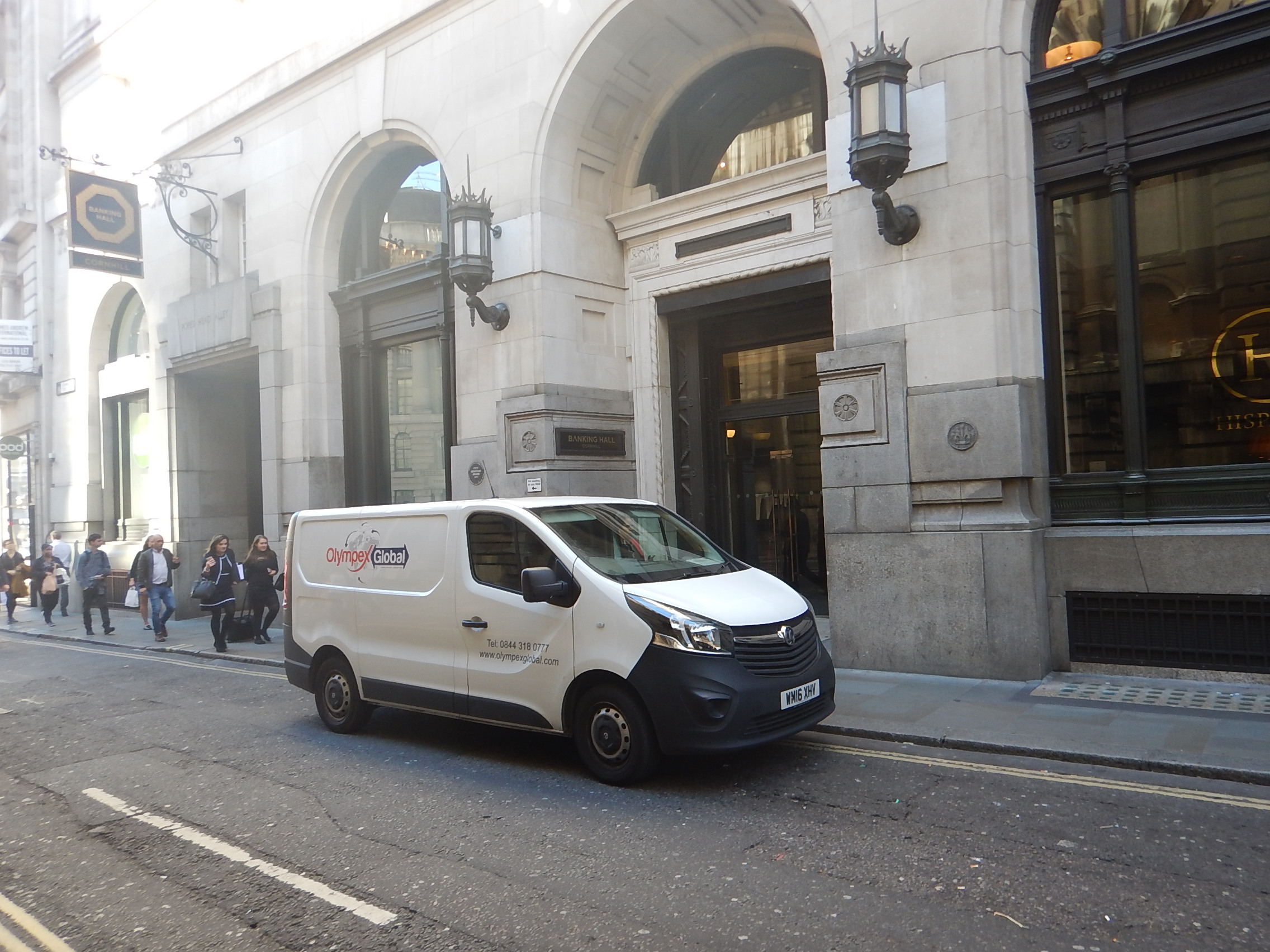
It used to lead through into the superb banking hall of Lloyds Bank.
In the early 1970s, I was doing some programming for the bank as a consultant to a company called Time Sharing Ltd.
The purpose of the software was to take the banks costs and expenses and calculate how much each of the various actions cost the Bank, by branch,area and region.
I was working for one of the Managers; Mike Spicer, who worked under the Chief Management Accountant; C. R. C. Wesson, who I later knew as Bob.
I’d never met Bob and as Mike was away, Bob phoned me up one morning and asked me to run the software, as they’d just uploaded a new batch of data.
I duly did this from home, and checked that it had run successfully after cycling to Time Sharing at Great Portland Street. They then asked, if I could take the results to the Bank on my way home to the Barbican.
I was worried that I was not dressed for visiting the Head Office of one of the UK’s big banks. I was painting our flat and wearing a pair of ice blue jeans and a short-sleeved shirt. . Luckily, I had a carrier on my bike, for the couple of inches of fan-folded green-striped print-out.
I had been told to ring the bell by the side of the door in the photograph and despite the banking hall being closed, I would be let in.
I arrived safely about six and rang the bell.
Perhaps a minute or two later, the ornate and extremely heavy door slid aside and a footman appeared, immaculately dressed in the Lloyds uniform of green tail-coat and top hat. He said. “You must be Mr. Miller!”
When I affirmed, he ushered me through and I offered him the printout. He then said, that Mr. Wesson would like to see me. I protested about my clothes, but he firmly showed me to the lift and pressed the appropriate floor. He added that Mr. Wesson would meet me at the lift.
It was the start of a very firm friendship.
Together we developed the software and produced loads of copious tables and graphs.
I learned a tremendous amount from dealing with the only innovative accountant I have ever met.
A lot of his philosophy found its way into Artemis.
One thing he told is that bankers when given a table of figures, always add them up to make sure there are no mistakes.
So I developed a technique in the Lloyds Bank software, where if money was allocated between various rows in a table, the total was always correct. If you round each row, this isn’t always the case.
I used this technique in the aggregation of resources and costs in Artemis.
Sadly, Bob died of I think cancer, a few years later!
I owe him a great debt!
Pick Your Own Hours With (Really) Flexible Working
The title of this post is the same as that of an article in today’s copy of The Times.
This is the first two paragraphs
More than 2,000 staff at PWC offices in Britain will be allowed to choose their own working hours under a scheme introduced by the accounting network.
PWC’s “flexible talent” initiative will allow people to apply for jobs, stating their skills and availability. It will then match the recruits to relevant projects on which they can work shorter weeks or work for only a few months a year
I think it’s a brilliant idea.
Although, in some ways, it’s a pity, that I’ve retired from programming.
Programming a computer system that could handle this problem, would have been right up my street.
Will PWC make me an offer I can’t refuse?
I doubt it, as they probably believe there are no capable programmers over thirty. And certainly not over seventy.
But then I’ve written four programs to allocate resources.
- A Space Allocation Program for ICI in the early 1970s
- PERT7 for Time Sharing Ltd.
- The original Artemis.
- Artemis for the PC.
All share the same basic algorithm that I first used for the Space Allocation Program.
But I’m certain, that everybody, who has programmed a resource allocation program, uses their own version.
Protecting Your Company, Organisation Or Workgroup From Viruses, Ransomware And Other Malware
I am not a computer malware expert and since 1970, I have generally worked alone, with one or more computers , not connected by a network.
But after all the problems of the last few weeks with ransomware, I feel that one of my experiences of a few years ago, should be put into this blog.
A Daisy Demonstration
The Research Department of a major corporation were interested in using my software; Daisy to analyse data being collected in their local offices.
So I was summoned to their offices to the South West of London, so that they could have a proper demonstration.
I found something extremely sensible that I’d not seen before.
The Department had the usual corporate network, as you would expect, with logins, malware protection, but for my demonstration I used another computer.
The Lonely PC
We moved to a lonely PC sitting on a desk in the corner. It had the following characteristics.
- Adequate power.
- A recent version of Windows.
- Direct connection to the Internet through a landline.
- No connection to the main network.
- A directly connected printer.
- A selection of browsers.
- Microsoft Office, but no e-mail program.
The only thing, that the computer lacked was a large screen.
Uses Of The Isolated Computer
The isolated computer was used for the following.
- Demonstrations
- Checking out ideas and web sites in suspect locations.
- Testing software.
I think that after the recent ransomware attacks, emergency Internet access could probably be added to the list of uses.
Rules For Using The Computer
The Department had setup a series of rules for the use of the computer.
- The computer could be booked by anybody in the Department.
- Comprehensive data transfer rules using physical devices had been setup.
- No software could be installed on computers on the main network, without full testing on the isolated computer.
- The computer was regularly checked for any viruses or malware.
- If any nasties were found on this computer, it was immediately restored to a pristine state.
Incidentally, whether it was for my benefit or not, it was one of the cleanest corporate computers, I’ve used for a demonstration.
Benefits
I was told that since the computer had been installed, malware problems on the network had decreased.
But how much was this down to a constantly improving and rigorously updated malware-protection system for the Department’s main network?
An Ideal System
A lot would depend on the type of company and their needs.
The system I used needed a big screen, as often a demonstration needs to be seen by several people.
I also think, that with a large screen, it could be a valuable tool in Corporate Communications.
Some might think, that this type of computer, which bypasses the corporate network, could be used by those with access for nefarious purposes.
Years ago, my software; Artemis was used to do the Project Management on Chevaline. The Ministry of Defence was worried that the Russians might use some unknown technology to read the electromagnetic radiation from the cathode-ray tube of the VDU. So I suggested they put the desk-sized computer in a shielded internal room. But what about the door, they said! I suggested that they get Chubb to put one of their best locks on the door.
A few weeks later, when a software problem struck, I went home with a complete copy of the project on a disc.
I had encoded the data using a personally-designed method that I still believe is unbreakable. But that is another story! Especially, as I’ve never signed the Official Secrets Act!
As this tale illustrates, there are ways to enforce security and holes will always appear.
Lionel Stapley
It is with great sadness, that I must report the death of Lionel Stapley, who was a colleague at Metier Management Systems and a friend since we first met in the 1970s.
 The Anonymous Widower