Bank Holiday Effects On Zopa
My repayments from Zopa over the last week or so have been rather erratic, with a lot of payments failing from otherwise good borrowers, quite a few loans being cancelled and other non-normal occurrences. I also didn’t have any repayments for several days, probably because the banking system was virtually shut down. I don’t think there is anything to worry about as the system seems to be levelling out to normal behaviour. Today for instance, I had the highest daily level of repayments ever.
The Future Worldwide Public Transport Ticketing is Almost Here
I read last month, that Transport for London would be aiming to introduce ticketing using contactless bank cards before the Olympics next year. They would work instead of or alongside the Oyster card.
So after some of the comments with regard to public transport in the Aston Martin post, I thought I’d look up the progress.
I myself have a Freedom Pass, so you might ask why I would need to pay in other way. I usually keep it in the back pocket of my trousers, so I have forgotten it a couple of times, when I’ve changed in the middle of the day. I also keep an emergency Oyster card in my wallet, in case I lose the Freedom Pass or I meet someone from outside London, who doesn’t have an Oyster.
So how is it all progressing? Read about it here.
This is an extract.
Hany Fam, President of MasterCard UK & Ireland, said: ‘We’ve been working closely with TfL since 2006 to make this shared vision a reality and recently announced a deal for the exclusive branding of TfL’s Oyster card wallet for 2011.
‘MasterCard was the first to introduce contactless bankcard payments on UK public transport in 2009 and we’re delighted that from 2012 consumers with a PayPass card issued anywhere in the world can use it to access London’s transport system.
‘We believe that London’s leadership will pave the way for adoption of contactless payments in other major cities across the world.’
What is this worldwide universal ticketing, going to do for worldwide tourism?
So perhaps the banks, helped by lots of clever engineers and computer programmers are going to do something worthwhile for a change.
You might ask what’s in it for them?
These contactless transactions are much cheaper to process than one with a pin. I suspect too that as your bank card will be able to buy your travel, your paper and your lunch, you’ll only carry one card much of the time and hence theft and the associated fraud will be a lot less.
Should It Still Be Called The Royal Bank of Scotland?
We walked past this building on the waterside at Bristol.
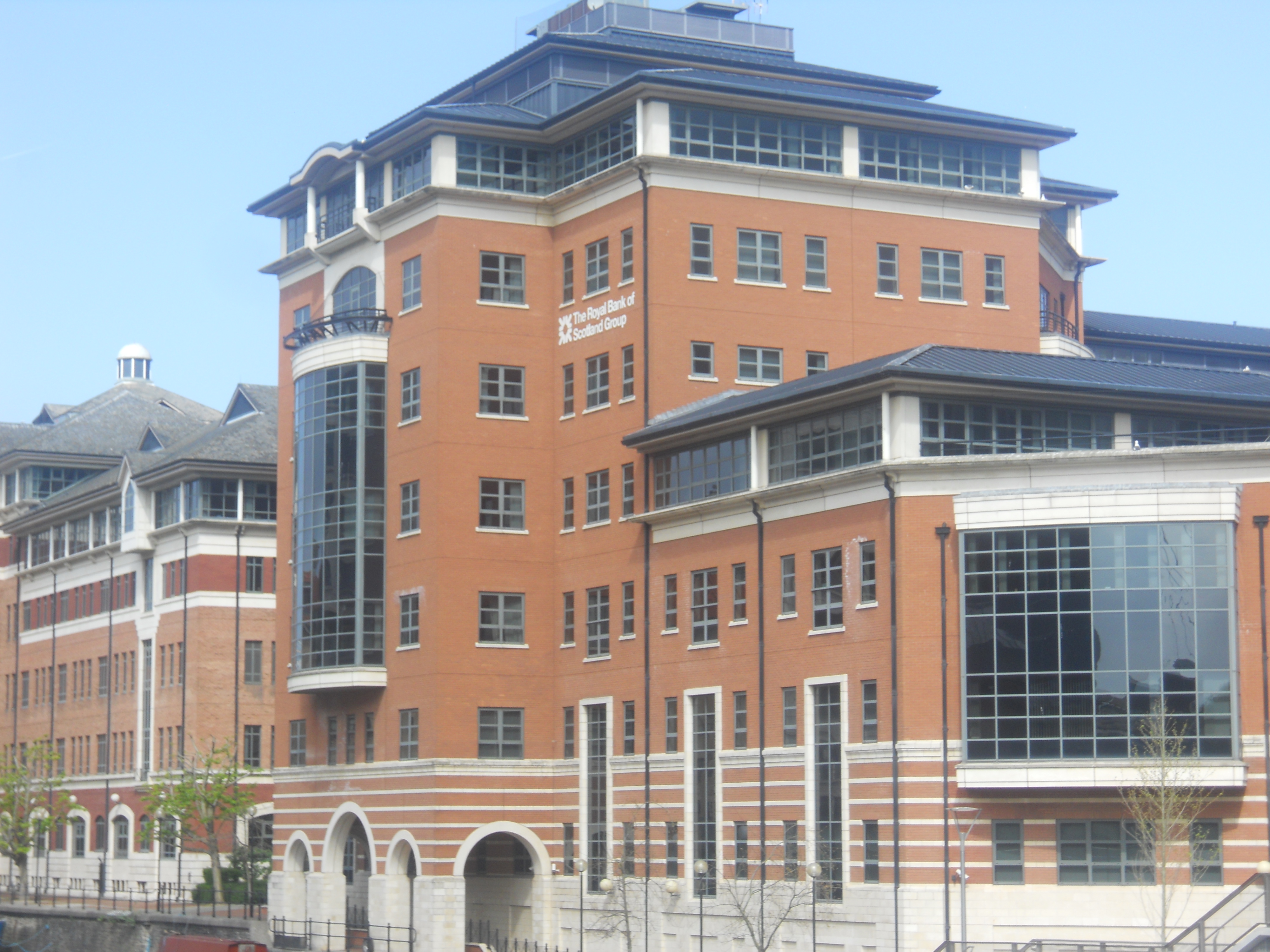
Royal Bank of UK Taxpayers
It occurred to us, that surely now is the time to drop the word Scotland from the name. After all, it is now the Royal Bank of UK Taxpayers.
Perhaps we should all be given a few shares!
Changing Repayment Dates on Loans
I’ve mentioned this before with respect to Zopa.
I just wondered how many of the loans that changed payment dates had a rather chequered history, so I went through all of my loans, where the payment date had changed.
Of the 16 loans that had changed the date, only one was late and the amount owing on that one was just a few pence. Interestingly some were a bit chequered until the date changed, but immaculate afterwards.
So it looks like this feature is good for both borrowers and lenders.
MPs Want to Keep Cheques
Reports are appearing that MPs want to stop banks scrapping cheques.
I did write one a few weeks ago and it took three weeks to clear into my account. So why does anybody bother writing them, except to stretch their cash flow.
I also had three panes of double glazing replaced. I did the transfer before the glazier left. That way, if they don’t get the payment it’s not my fault.
On Line Banking Security
When I was in Greece, I increased my overdraft limit by logging in to my account over the Internet from an Internet cafe. The procedure at Nationwide is simple and relies on memorising three numbers or codes. One is ten digits long, but written down it looks like a US telephone number. So it is stored in my trusty Nokia 6310i, as a phone number complete with the US country code. As I have about a hundred numbers in my phone and fifty are in the US, it would be pretty difficult to find it, especially as I’m lying and you don’t have the other code words. But it does mean, I don’t have to take an obvious machine with me to see how my bank account is doing. I hope they don’t change the system and insist on using the machine to login, as this would be a less secure system. After all, I usually keep my debit card hidden when I’m abroad and only take it out when I need cash from a cashpoint.
I access other systems all the time like American Express and Zopa, but in all these cases, the only thing I need to remember is several code words. Nothing is ever written down.
The security system, I don’t like is that for the John Lewis Partnership Card. If you don’t login for sixty days, you need to ask for a new password and that comes in a secure package that I have difficulty opening with my gammy left hand.
If I didn’t shop at Waitrose, I’d cut the card up.
Security though is not just about logging in, it’s about what information you can glean from your on-line statements. The Partnership card just gives minimal information, but Nationwide gives quite a bit more. Zopa incidentally, is very comprehensive about what it tells you about each transaction. In my view you can never give too much information. How long before cashpoint machines take your picture, when you draw money out? I’ve always believed that you can upload a picture against your credit or bank card, so that if there was thought to be a problem, it could be checked. There are lots of possibilities.
And how about an alarm pin number? Suppose you are being forced to use a cashpoint, by someone with a knife! If you typed in the alarm number, the following would happen.
- The cashpoint would appear to have accepted the correct pin.
- A small amount of money say something like £20 would be dispensed with a message that said you were now overdrawn and that was your lot.
- The card would be retained and of course blocked.
- Nothing would be done to indicate the transaction was anything other than normal.
Responsible Lending
If I walk up the Kingsland Road in Dalston, the road is crawling with money shops, pay day loan companies.pawnbrokers and all of the other dodgy lenders that proliferate these days.
So when someone who works in finance, said there was a thing called The Lending Code, I thought I’d take a look.
It is the sort of worthy document produced by regulators and the like that is manna from heaven to all those dodgy lenders down the Kingsland Road and others who shark loans with large amounts of advertising, sponsorships of Premiership football teams and sometimes with door-to-door salesmen with big boots.
I always remember a story told by a respectable finance guy, who said that when the government restricted the length of time you could take out a loan for and if it was for something like a car, then you could only lend a percentage, it was a licence for finance companies to literally print money. If everybody sticks to the Lending Code, then the costs to borrowers will go up, banks will make higher profits and many will be effectively removed from the list of borrowers. A lot will remove themselves because they won’t be bothered to read the paperwork.
When I was in Greece, I thought I might stay a bit longer and in that case, I would have needed more cash, as Greece is very much a cash society. So I used the Internet to login to my Nationwide account and increase the overdraft. In the end, I came home and haven’t used the limit. But would the Lending Code with all its provisions on overdrafts make such a simple transaction more difficult?
What is really needed is a plain English Lending Code. When I was at ICI, we used to write and distribute flyers about the jobs we did with our computer. They were successful in getting new business and this was because they were read. And why were they read? Because they were a single sheet of A4 paper.
So The Lending Code as implimented by a bank say, should be a series of web or A4 pages related to each area of lending. If it can’t fit on one sheet, then The Lending Code is wrong.
Only in that way could we have a code that could be understood by the man or woman on the Dalston Omnibus! These are the people we need to protect from the lenders. Not those like me that sit in the middle of the lending market and only use it, when they have a well-thought out need.
I like Zopa and I’ve met a few of their borrowers, who seem very happy with the way Zopa does business. In a way, you can almost class Zopa as a group of people coming together to lend money to others. Isn’t that supposed to be what building societies and credit unions were and are about?
In a way though, Zopa, although it is unregulated by the FSA, acts like a mainstream lender, in that it does proper identity and credit checks and gets tough with those that default on their payments. I think, that it might be unique in that it allows borrowers to chsnge their payment day or repay the loan early without penalties, when perhaps their cicumstances change. Both these features, should be in The Lending Code. I can’t even find the word early in The Lending Code.
So yet again the bureaucrats are creating work for themselves in trying to protect the unprotectable.
Icelanders Give the UK and The Netherlands Two Fingers
Th Icedlanders did what was expected and rejected the deal to repay the UK and The Netherlands in a referendum. After all it wasn’t the fault of the good people of Iceland, that their banks went bust.
The trouble is there is a hell of lot more than one born every minute. A few ended up running the Icelandic banks and many more individuals and councils from the UK and The Netherlands invested in banks that were paying a rate that was too good to be true.
If you put any money in something that is outside of both the banking regulations and the UK, you’re asking for trouble. I know people who put all their savings in such as Icesave. They’d have got a better return in Corals, backing horse number 7 in each race.
But the individuals were all compensated by Gordon Brown, using our hard-earned taxes. After all if he hadn’t, the election result might have been different!
Councils, like these in Scotland are still waiting.
Commentators and politicians say the dispute will end up in court. So the lawyers will love that one!
Do We Have Too Many Banks?
I think that the last time I met a bank manager was when I moved my account to Nationwide about ten years ago. And that was more on her account, as she wanted to try and sell me insurances and other things I didn’t need. I now do all of my banking on-line and the only time I go into a branch is to draw money out of a cashpoint. I often go in and have a sit down, so that I can put the twenty pound notes I don’t like somewhere secure in my bag. Years ago, before cashpoints, going to a bank was a much more common occurence, as you had to pay in cheques and get money out.
So do we actually need bank branches these days?
Apart from my sit downs after getting money out, I don’t! It wouldn’t matter to me, if Nationwide scrapped most of their branches, so long as they kept some major ones. In fact, I probably only use no more than four cashpoints locally. Two are the Nationwide branches at Upper Street and Moorgate, and I use a Sainsburys and a Tesco in the Essex Road. None of course charge me anything. Incidentally, why would anybody use a machine that did charge?
The ICB has now reported that the major banks should be reduced in size and that investment banking should be separated from retail. The Telegraph reckons it’s a good British compromise. Share prices in the banks have risen.
But I can’t help feeling that traditional retail banking is dead anyway, as who really wants it? Not me! So long as I have a good on-line money transfer system and access to free cash points, I’ll be happy! I hopefully won’t need another mortgage and I’ll always use Zopa and other professional companies for my savings and insurance.
The Independent Hints Fred the Shred Can’t Spell
This was in Christina Patterson ‘s piece in yesterday’s Independent.
Our rich may not be really, really rich, but they are such sweethearts. Just think of Bob Diamond, who went out of his way to explain to the rest of us the rules about banking and remorse. Or Fred the Shred. Who has, by the way, just got a superinjunction to stop him being called a banker. But perhaps he can’t spell.
What can she have been hinting at?
Incidentally, to my eyes any resemblance between Fred Goodwin and my image of the perfect banker is purely coincidental.
 The Anonymous Widower