The title of this post, is the same as that of this article on the BBC.
This is the sub-heading.
A floating solar farm described as the UK’s largest is to be built in the north of England after planning permission was approved.
These three paragraphs add more details.
The 46,500-panel array will be installed at the Port of Barrow’s Cavendish Dock in Cumbria and will be capable of producing enough energy to power 14,000 homes a year.
It will be built by Associated British Ports (ABP) and will be used to power the area’s advanced manufacturing sector, including submarine-maker BAE Systems.
The company’s divisional port manager Bryan Davies said the solar farm would “drive economic growth” and was a major milestone in the company’s plans to develop Port of Barrow.
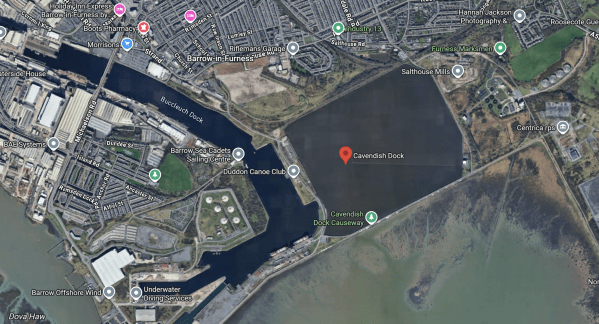
This Google Map shows Cavendish Dock in the centre of Barrow-in-Furness.
Note.
- BAe Systems are in the West side of the map.
- It looks like the picture on the BBC article was taken from the East.
- In the picture the Cavendish Causeway runs across the bottom-left Corner.
- The solar array appears to be in the North side of the dock.
The solar array will be an impressive structure, when it is complete.
November 30, 2025
Posted by AnonW |
Energy | ABP, BAe Systems, Barrow-in-Furness, Floating Solar Power, Port Of Barrow, Shipbuilding, Solar Power, Submarine |
Leave a comment
The title of this post, is the same as that of this article on the BBC.
This is the sub-heading.
Tissue maker Kimberly-Clark has signed a £125m contract with two hydrogen facilities to reduce the amount natural gas used in its production line
These five paragraphs give more details.
The Andrex and Kleenex producer signed a long-term deal receive hydrogen from the upcoming Carlton Power facility in Barrow-in-Furness, Cumbria, and the HYRO plant in Northfleet, Kent, which are expected to be operational in 2027.
The facilities have already secured funding and planning permission and will be built near existing Kimberly-Clark plants.
The company said that, as a result of the deal, from 2027 it expected to see a 50% reduction to its 2024 consumption of natural gas across its UK production lines.
The new facilities will produce and store hydrogen for the exclusive use of Kimberly-Clark.
It would replace fossil-fuel natural gas used for steam generation in the manufacture of toilet and facial tissues, the company said.
I would expect that converting an industrial steam-generator from natural gas to hydrogen operation could be a reasonably straightforward task.
I have these thoughts.
Will Kimberly-Clark Advertise Their Future Products As Carbon-Free?
I suspect they could, if they looked at where everything they used came from.
Will Carbon-Free Tissue Products Sell Better?
This will be the acid test. And of course the sums must add up.
Will Kimberly-Clark Make Their Tissue Products Plastic Free?
There is an article in The Times today, which is entitled Work Starts To Remove ‘Wet Wipe Island’ From Thames, which says this.
The congealed mass of wet wipes has formed on the Surrey side of the river near Hammersmith Bridge and was described on Sunday night as an “embarrassment to the capital”.
Plastic-free products would go a long way to solve the problem of ‘Wet Wipe Island’
Surely, a double change to carbon- and plastic-free will be better than two single changes.
Will Kimberly-Clark Use Hydrogen-Powered Trucks To Deliver Finished Products?
Availability of hydrogen is often cited for not using hydrogen-powered trucks.
But that won’t apply at Barrow-in-Furness or Northfleet.
August 11, 2025
Posted by AnonW |
Business, Energy, Hydrogen, Transport/Travel, World | Barrow-in-Furness, Carlton Power, Decarbonisation, Hydrogen-Powered Trucks, Kimberly-Clark, Northfleet, Plastic, River Thames, Steam, Wet Wipes, Zero-Carbon Steam |
2 Comments
These are my current thoughts on electric trains to Windermere station.
Passengers And Battery-Electric Trains
I don’t think any reputable journalist interviewed passengers on either of the two battery electric services that have successfully run for longer than a couple of days.
Those that used British Rail’s Aberdeen and Ballater service in the 1950s, are probably thin on the ground, although I did meet an elderly lady, who’d regularly used it to go to school and she said the service was reliable.
She also said that the Queen Mother was an enthusiastic passenger.
I rode the Manningtree and Harwich battery electric train during its short trial.
But more significantly, since then I have met two passengers, who used it every day during the trial to commute.
Both would like to see the train return, as it seemed more reliable. I wonder, if like much of East Anglia’s overhead wires, the route suffers from the wind.
It does appear that providing a reliable service with battery electric trains is not a difficult problem.
Two Trains Per Hour To Windermere
In Passing Loop Hope For Windermere, I discuss a passing loop on the Windermere Branch Line to enable two trains per hour (tph) along the line.
The Treasury wouldn’t like this, as it would need twice the number of trains.
But hopefully, it would double the ticket revenue.
Battery-Electric Class 331 Trains
It has been some time now since in the March 2020 Edition of Modern Railways, that it was announced that CAF announced they were building a battery-electric version of the Class 331 train, which I wrote about in Northern’s Battery Plans.
Little has been heard of CAF’s progress since, although I did write Battery-Electric Class 331 Trains On The Radar, which was based on an article in the June 2021 Edition of Modern Railways, which is entitled Northern Looks To The Future.
Lack Of Progress On Battery And Hydrogen Train Projects
Is this typical of battery and hydrogen projects?
Southern’s project on the Uckfield Branch and to close the electrification gap between Ashford and Hastings has only been conspicuous by its absence. This project is important as it releases the Class 170 trains, so that EMR can fulfil franchise commitments.
The project to use hydrogen trains on Teesside has also progressed at a snail’s pace.
It is almost as if someone in the Department of Transport or more likely the Treasury, feels that the best thing to do is to carry on using diesel, as it’s the cheapest alternative.
I don’t think it is any politician, as their public statements seem to be very much in favour of decarbonisation.
Other Electric Trains In The Lake District
I also think, that if battery-electric trains were to be run to Windermere, that they would also run to Barrow-in-Furness. Am I right in thinking that the Furness Line is rather flat, so would be ideal for battery-electric trains?
But I do wonder, if Sellafield and Direct Rail Services are pushing for electrification, as it would surely help their operations, as they could use Class 88 locomotives to bring in the flasks for processing.
Also in Battery-Electric Class 331 Trains On The Radar, I did say this.
I feel it would be possible to electrify the Cumbrian Coast Line using battery-electric Class 331 trains, with a range of at least fifty miles and some short sections of new electrification.
Surely, a battery-electric train along the Cumbrian Coast by the Lake District would be the ideal train for the area.
I can certainly see a small fleet of battery-electric working services between Barrow-in-Furness, Carlisle, Carnforth, Manchester Airport, Sellafield, Whitehaven, Windermere and Workington.
November 30, 2021
Posted by AnonW |
Transport/Travel | Barrow-in-Furness, Battery-Electric Class 331 Train, Battery-Electric Trains, British Rail BEMU, CAF Battery-Electric Trains, Carlisle Station, Class 195 Train, Class 379 Train, Cumbrian Coast Line, Harwich, Hydrogen-Powered Trains, IPEMU, Manningtree Station, Uckfield Branch, Windermere Branch Line |
14 Comments
Moorside is the name given to NuGen‘s new nuclear power complex in Cumbria.
I was drawn to write this post, by this article in Construction News, which is entitled Network Rail and Moorside nuclear power plant developer Nugen are putting together a business case for rail investment in Cumbria that could be worth as much as £400m.
four hundred million pounds could buy a lot of rail infrastructure.
But where exactly is Moorside?
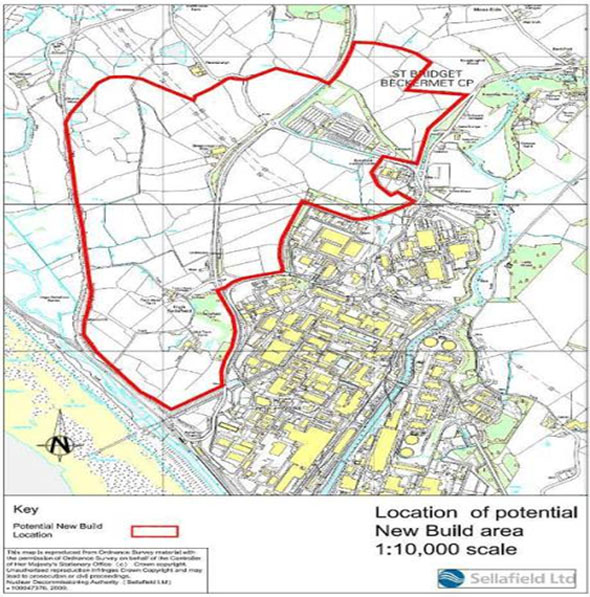
This map was taken from the Our Site page on the NuGen web site, showsthe Moorside site outlined in red.
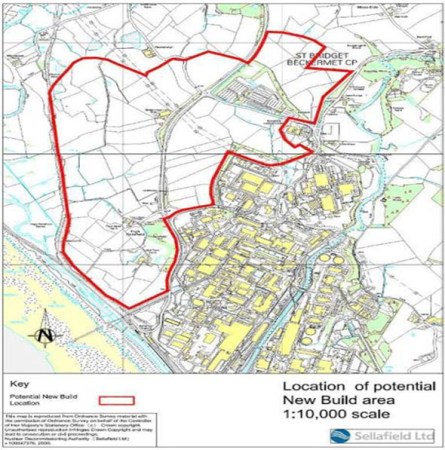
Note the development with the yellow-shaded areas to the South-East of the red-lined area. This is Sellafield.
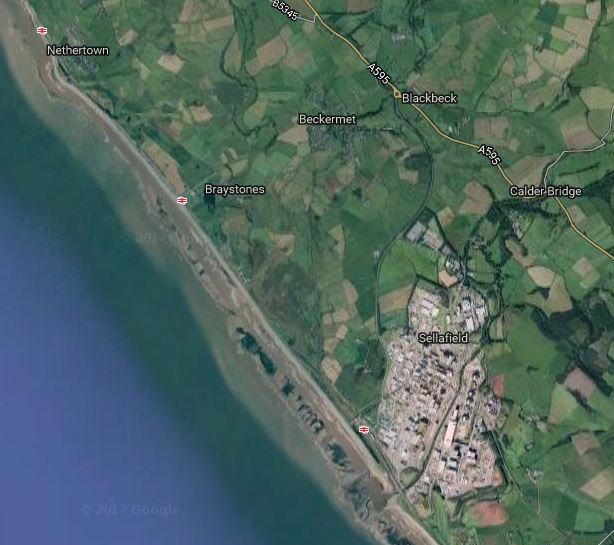
And this is a Google Map of the coast around the nuclear reprocessing complex.
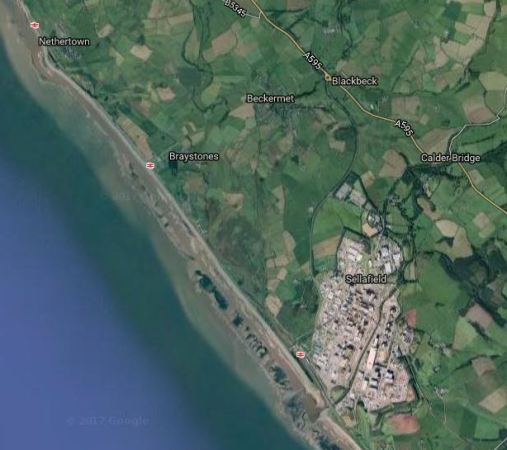
Note the railway stations along the coast. Sellafield station is by the nuclear complex, with Braystones and Nethertown to the North.
All three stations are on the Cumbrian Coast Line, which in addition to the passenger service, is used to transport freight, including nuclear waste to and from Sellafield.
Overlaying the NuGen map on the Coogle Map shows that Moorside will be to the North-West of Sellafield.
The Cumbrian Coast Line and the related Furness Line curve around Cumbria from Carlisle to Carnforth via Workington, Whitehaven, Sellafield and Barrow-in-Furness.
- The line is mainly double track, but with sections of single-track.
- The line is not electrified.
- Most of the trains are elderly diesels.
- The train service is vaguely hourly, but patchy in places.
The nuclear power complex is a ten billion pound project and will require large amounts of heavy equipment and construction materials to be transported the site. Also on a daily basis, large numbers of engineers and construction workers wilol need to get to one of the largest construction sites in the North of England.
Is Network Rail’s £400 million proposed vdevelopment, a reconstruction of the Cumbrian Coast and Furness Lines to the following standard.
- Double track.
- Electrification
- 100 mph line speed where possible.
- Build a new station at Moorside and any other places, where they are needed.
- Step-free stations
- At least two trains per hour in both directions.
- Full wi-fi and 4G on all trains and in stations.
Upgraded to a high standard, it might do more than help construction at Moorside and Sellafield and those that work in the two complexes.
- It might increase quality tourism.
- It could be a diversion route for the West Coast Main Line.
- It might make a London service to Barrow-in-Firness via HS2 a possibility.
Network Rail’s project could do a lot more than service the twin nuclear sites.
I explored the Cumbrian Coast Line in April 2015.
Click here to see my posts.
February 27, 2017
Posted by AnonW |
Transport/Travel | Barrow-in-Furness, Cumbrian Coast Line, Electrification, Moorside, Nuclear Power |
1 Comment
There is a by-election in the Copeland constituency, if you haven’t noticed and this is the BBC’s guide to the election.
When I was at Liverpool University in the 1960s, one of C’s friends used to live near Barrow-in-Furness. I remember we had a drink with her once and she told us how she used to have to take five trains and umpteen hours to get between Barrow and Liverpool.
Liverpool to Barrow-in-Furness now takes just over two and a half hours with a single change at Preston.
So when I heard someone from UKIP say that HS2 wouldn’t benefit Copeland on the BBC, I thought I’d check the times.
HS2 opens to Crewe in 2027 and I suspect that trains going to the North of Crewe will use HS2 to Crewe and then run on the classic lines to go North.
Euston to Crewe currently takes 90 minutes, but after HS2 opens this time will reduce to 58 minutes. Times are from this page in The Guardian.
The fastest trains to Barrow-in-Furness currently take three hours fifty-three minutes with a change at either Preston or Lancaster.
So just reducing this time by the thirty two minutes saved South of Crewe, brings the time down to three hours twenty-one minutes.
But I think we’ll see innovation in HS2’s trains.
It seems to be the policy now for a company to have short and long trains, as both the Class 800 trains and Greater Anglia’s Aventras come in both short and long versions, where two short trains can join together for flexibility of operation.
Could Hs2 take this further and say have five-car short trains, three of which could join together for the fast run to and from London?
So will we see five-car trains that can serve places like Barrow-in-Furness, Blackpool and Burnley, joining at Preston for a fast run on HS2 to London?
I also think that by the mid-2020s, all electric trains will have the capability to fit onboard energy storage to give them access to places like Barrow-in-Furness, which may not be electrified.
So could we see a high speed train serving Barrow-in-Furness in 2027? After all Barrow-in-Furness to the West Coast Main Line is just twenty-nine miles, which by that date, will be totally in range of a train with onboard energy storage.
If you look at the provisional timetable for Phase 1 of HS2 on Wikipedia, you will see that there is one train per hour (tph) to Preston. Could this be a train created by bringing together portions from Barrow-in-Furness, Blackpool and Burnley? I don’t know, but the French do similar things with TGVs.
I wouldn’t be surprised and with selective improvements to the route North of Preston and on the Furness Line, the time from London to Barrow could be under three hours, when HS2 opens to Crewe.
Effectively, by building HS2 to Crewe and using specially-designed trains, towns like Barrow-in-Furness get a high speed connection to Birmingham and London.
Cancel HS2 and Copeland will still be deep in the past, as far as rail travel is concerned.
February 15, 2017
Posted by AnonW |
Transport/Travel | Barrow-in-Furness, High Speed Two, Politics, UKIP, West Coast Main Line |
3 Comments
 The Anonymous Widower