‘I Get To Work On The Most Scenic Railway Line In The World’
The title of this post, is the same as that of this article on the BBC. It is a quote from someone in the BBC article.
This is the sub-heading.
Have you heard the one about the railway line that was threatened with closure, so lots of people started using it and it was saved?
These three opening paragraphs add some detail to the story.
Welcome to the Settle to Carlisle line, the quirky steel road through some of Britain’s most magnificent countryside.
The line starts in Leeds and passes through Shipley and Skipton, but it is the section between North Yorkshire and Cumbria that is world-famous for its views.
Heading north from Settle, the peak of Pen-y-Ghent soon looms large, with Whernside and Ingleborough following a few miles later.
The saving of the line in the 1980s, is one of those classic British tales of a fight against bureaucracy, which like all these tales involved a dog, who gets a heroic mention in the BBC article.
In the next few sections, I will detail how improvements to the rail infrastructure between Bradford, Carlisle, Lancaster, Leeds have gradually developed the rail infrastructure, so that the Settle and Carlisle Line can play an increasing part in improving the economic outlook for a large area of England.
Is The Settle And Carlisle Line In Good Condition?
Google AI gives this answer to the question in the title of this section.
Yes, the Settle-Carlisle line is in good, operational condition and is considered a vital, well-maintained part of the National Rail network.
Despite a history of threatened closures and past structural issues, major investments have secured its future, and it currently carries over 1.2 million passengers a year.
Here is the current status of the line as of early 2026:
Infrastructure Condition: Following significant repairs, including a major £2.1 million project on the Ribblehead Viaduct completed in 2021 and extensive work at Eden Brows (2017), the line’s 14 tunnels and 22 viaducts are in good condition.
Active Usage: It is regularly used by Northern passenger services and is a designated diversionary route for mainline express trains when the West Coast Main Line is closed.
Operational Status: The line is fully operational, featuring regular commuter services, tourist trains, and steam heritage charter trains.
Safety & Upgrades: While it is a historic line, the infrastructure is deemed safe.
Occasional, isolated issues (like the 2022 freight derailment near Carlisle) have been managed with swift repairs.As of early 2026, the line is heavily used, with special passenger services and 150th-anniversary celebrations planned.
It’s probably in better condition, than many houses in the UK.
What Is The Operating Speed Of The Settle And Carlisle Line?
Google AI gives this answer to the question in the title of this section.
The Settle and Carlisle Line generally operates at a maximum speed of 60 mph/97 km/h.
While historically faster, this 60 mph limit is standard for modern passenger and freight services on the route.
Usage Examples and ContextPassenger Services: Northern Rail and various chartered services, including the scenic “Staycation Express” HST 125, operate along the route.
Freight: The line is used for heavy freight, including oil, timber, and cement trains.
Diversions: The line is frequently used as a, albeit slower, alternative route (approx. 2.5 hours for Leeds-Carlisle) during major West Coast Main Line (WCML) closures.
Scenic Tourism: The line is renowned as one of England’s most scenic, carrying over a million travelers annually, with notable sights like the Ribblehead Viaduct.
The Settle And Carlisle Line Is Well Connected To The Rail Network At The Northern End
This OpenRailwayMap shows how the line connects to the West Coast Main Line and the Tyne Valley Line, to the South of Carlisle.
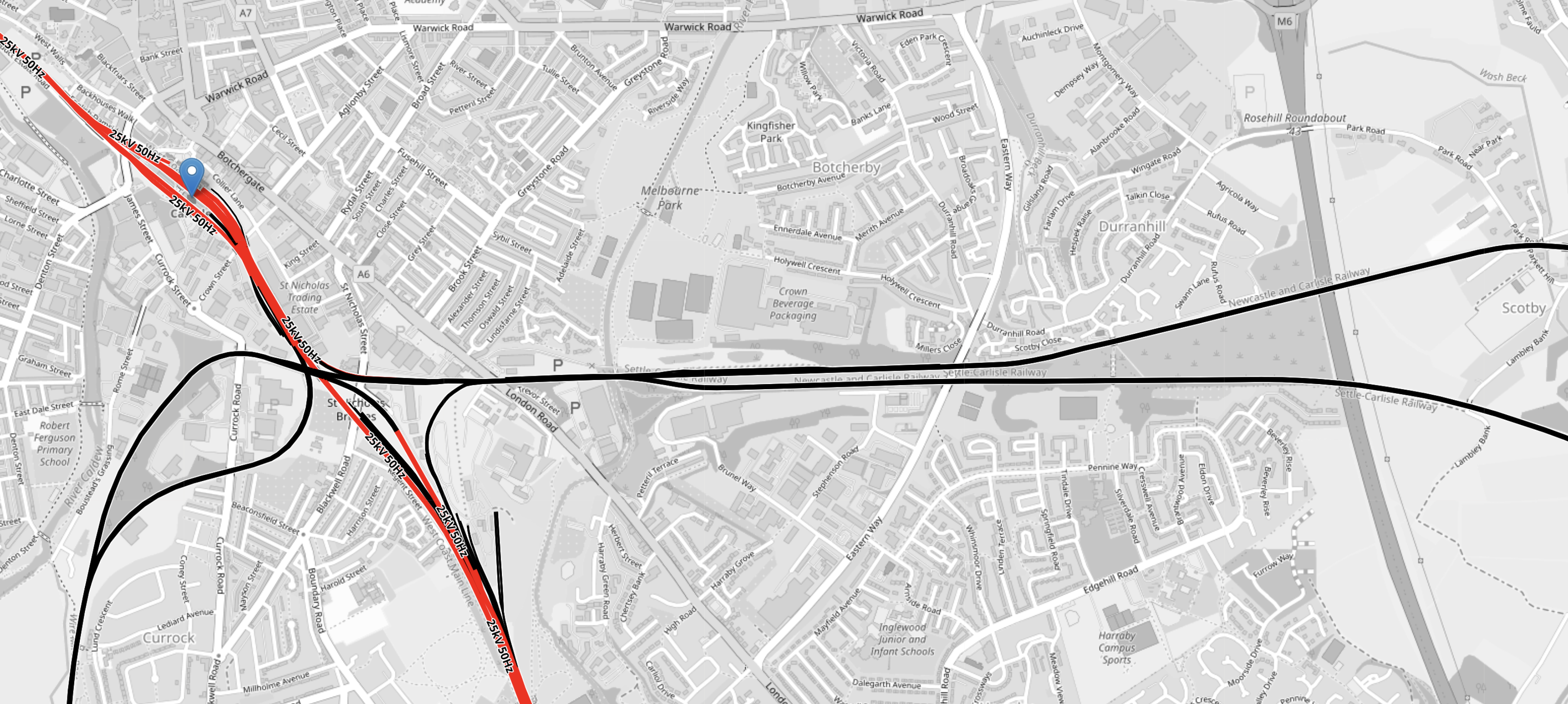
Note.
- Electrified lines are shown in red and lines shown in black are not electrified.
- The electrified West Coast Main Line runs diagonally across the South-West corner of the map.
- The blue arrow on this line, indicates Carlisle station.
- The Northernmost of the two black cross lines is the Tyne Valley Line between Carlisle and Newcastle.
- The Southernmost of the two black cross lines is the Settle And Carlisle Line, which goes South to Settle, Bradford Forster Square, Leeds and Settle stations.
- The line going South-West joins the Cumbrian Coast Line, which joins the West Coast Main Line at Carnforth.
It does appear that the junction South of Carlisle is very comprehensive and allows very flexible routing.
The Settle And Carlisle Line Is Well Connected To The Rail Network At The Southern End
This OpenRailwayMap shows how the line connects to the West Coast Main Line and the Tyne Valley Line, to the North of Skipton.
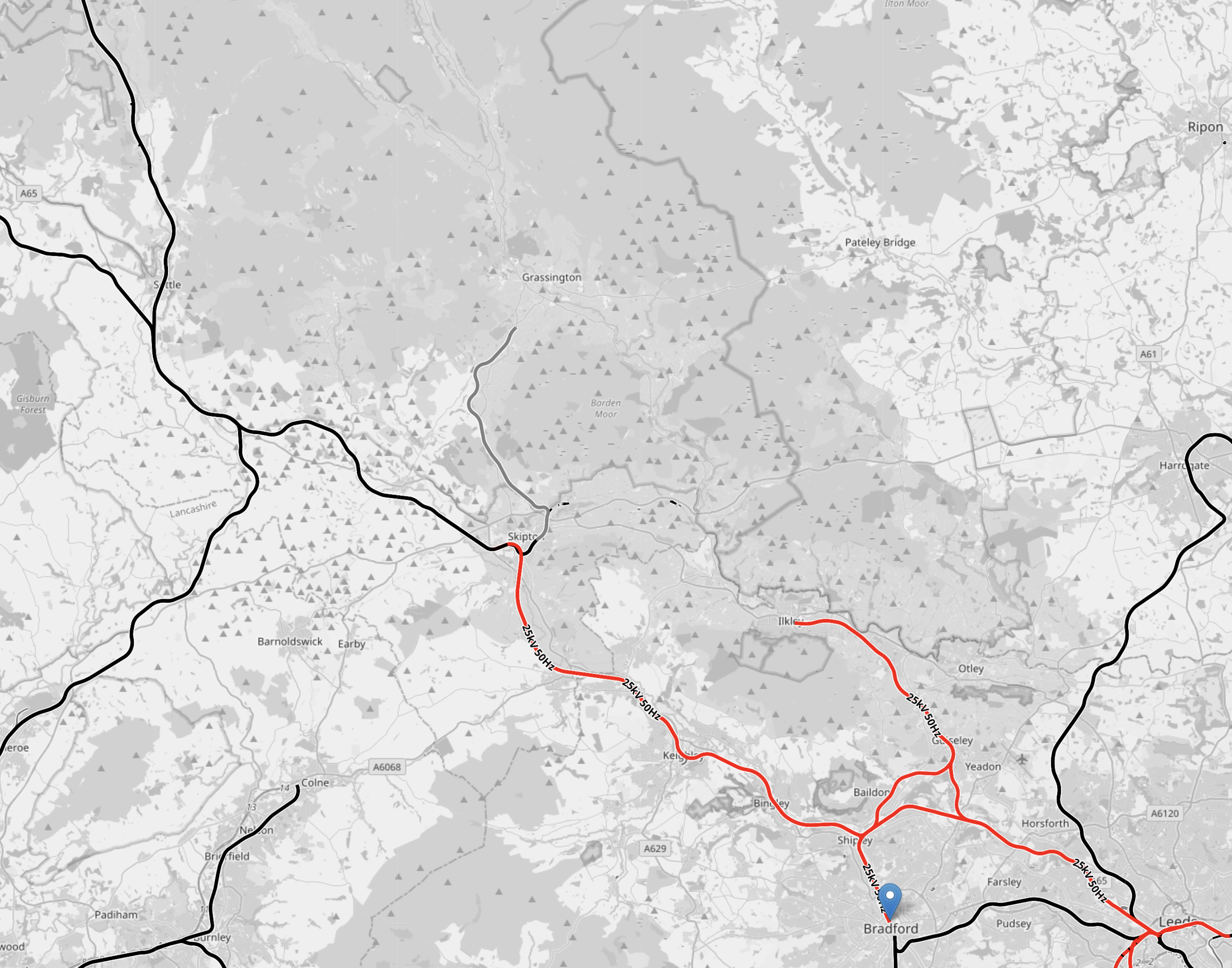
Note.
- Electrified lines are shown in red and lines shown in black are not electrified.
- The blue arrow on this line, indicates Bradford Forster Square station.
- The fully-electrified Leeds station is in the South-East corner of the map. You can just pick out the ee of the name.
- The electrified Leeds-Bradford Line connects Bradford Forster Square and Leeds station via Shipley station and its triangular junction.
- The electrification continues in a North-Westerly direction as far as Skipton, where the red track stops.
- Electric intercity trains can run from London to Leeds, Bradford Forster Square and Skipton.
- Self-powered intercity trains can also run from London to Harrogate, which is on the line without electrification, that runs North from Leeds.
- Leeds receives a London service of two trains per hour (tph).
- Bradford Forster Square station receives a London service of one train per two hours (tp2h) via Leeds.
- Harrogate station receives a London service of 1 tp2h via Leeds.
- Skipton station receives a London service of one train per day (tpd) via Leeds.
The Leeds-Bradford area gets a frequent service to London and the South.
This OpenRailwayMap shows how the Settle and Carlisle Line connects to the electrification at Skipton.
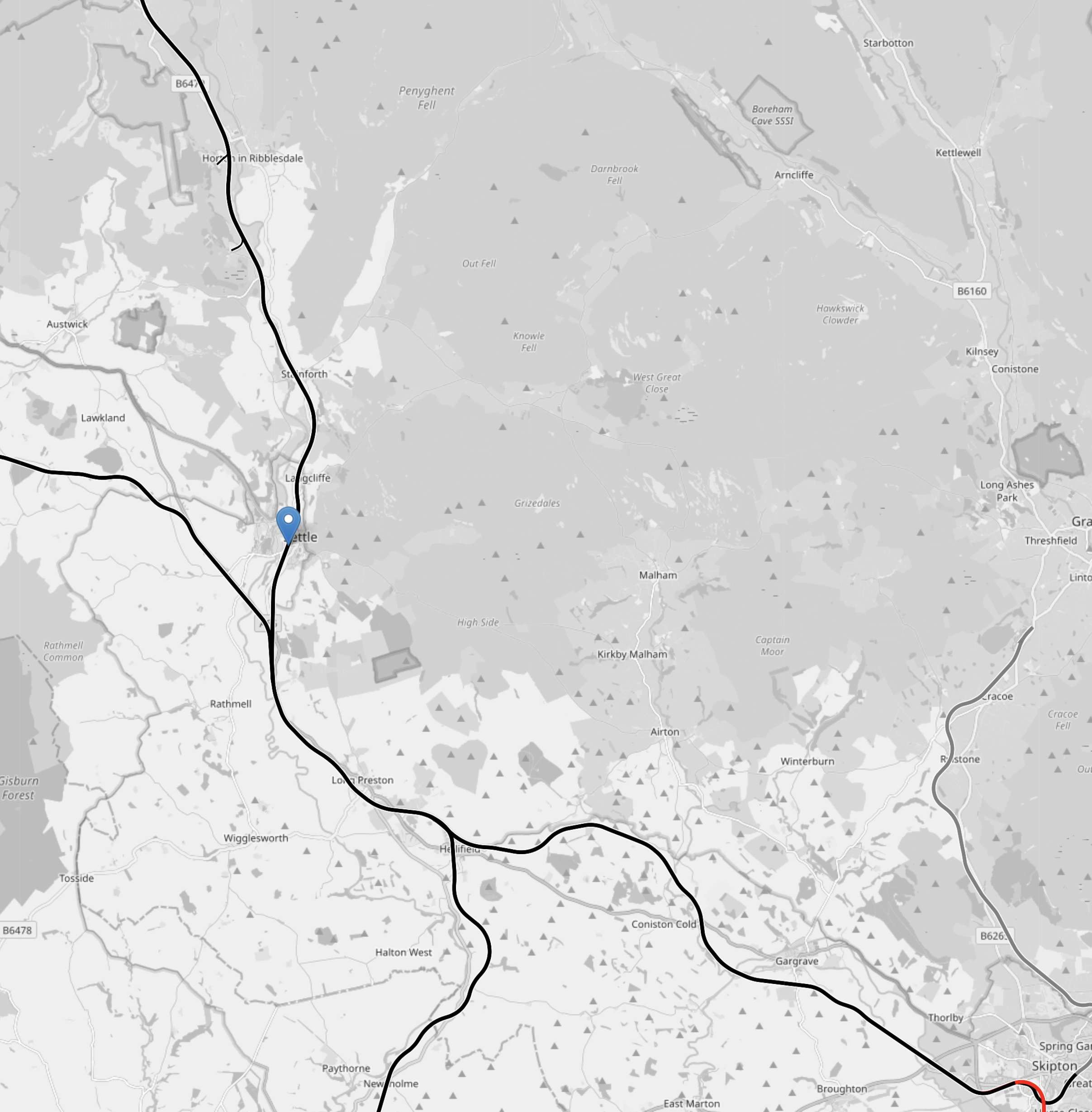
Note.
- Electrified lines are shown in red and lines shown in black are not electrified.
- The only electrified lines on the map are at Skipton station in the South-East corner of the map.
- The blue arrow on this line, indicates Settle station.
- Skipton and Settle stations are 15.2 miles apart.
- Settle and Carlisle are 71.5 miles apart.
To bridge the gap in the electrification between Carlisle and Skipton, trains will need to be able to run 86.7 miles on their own power.
Bridging The Carlisle And Skipton Gap
But once the train gets to Carlisle or Skipton, the train will have the luxury of 25 KVAC overhead electrification to both power the train and charge any batteries.
In my opinion, there are three intercity trains coming into service, that could handle an 86.7 mile gap in electrification.
- East Midland Railways’s Class 810 train, which is a diesel bi-mode with lots of power, which is described in this Wikipedia entry.
- LNER’s Class 802 trains, which currently is a diesel bi-mode, that Hitachi could convert into a Hitachi Intercity Battery Train, which is described on this Hitachi web site.
- LNER’s Class 897 trains, which is a diesel tri-mode, that CAF are building in Spain and Wales, which is described in this Wikipedia entry.
In How Far Will A Hitachi Intercity Battery Train Travel Without Using The Electrification?, I answer the question for both Hitachi and CAF trains.
Surprisingly, I got the answer of a range of 120 miles for both the Hitachi and CAF trains. But could it be that Network Rail and the train companies wanted a range of 120 miles to electrify the UK rail network and so a 120 mile battery range was in the specification.
My estimate of 120 miles for Hitachi’s trains, was also confirmed by the company.
Bridging The Gaps
Some other distances, where gaps must be bridged include.
- Sheffield and South Wigston – 69.4 miles
- Holyhead and Chester – 84.4 miles
- Exeter and Basingstoke – 124,3 miles
- Fishguard Harbour and Cardiff Central – 119.1 miles
- Aberystwyth and Shrewsbury – 81.5 miles
- Bristol Temple Meads and Newbury – 70.8 miles
- Inverness and Aberdeen – 108.3 miles
- Carlisle and Glasgow Central via Dumfries – 115.9 miles
- Hereford to Didcot Junction – 96.9 miles
120 miles could be a good fit.
Could it be that that distance was the range of a steam locomotive on a full load of water?
The Updating Of Bradford Forster Square Station
This is now a four-platform station, with two platforms able to take a pair of 5-car Hitachi or the new CAF 10-car Class 397 trains.
In Bradford Forster Square Station – 20th May 2025, I describe and show pictures of the updated station.
Bradford Forster Square station now gets seven trains per day to and from London King’s Cross via Leeds.
This article on the BBC, which is entitled New Platform’s Opening Gives Bradford More Trains has this sub-heading.
A new £35m platform at Bradford’s Forster Square Station has opened – boosting rail services in the city
£35million seems a lot of money to spend to just increase the number of services between King’s Cross and Bradford, even though 2025 was the year that Bradford was UK City of Culture, but there may be valid reasons to create a new route between London and Scotland, using the Settle and Carlisle Line.
- The Settle and Carlisle Line is one of the UK’s most famous scenic routes with 20 viaducts, 14 tunnels and countless beautiful vistas along its 72 mile track.
- You put the Mona Lisa on display, not in a store.
- LNER now has battery-electric bi-mode trains, with CAF tri-mode trains due to enter service in 2028, that can both handle the 86.7 mile gap in the electrification in silence.
- The CAF trains have extra diesel power, about which CAF is not disclosing much. This to me, suggests some innovative use.
- There appear to be no flights between Leeds/Bradford Airport and Scotland.
- There appear to be no direct trains between Glasgow and West Yorkshire.
- A direct train between Glasgow and Leeds and Bradford Forster Square would add additional connectivity between Scotland and Yorkshire.
- With the cancellation of High Speed Two, we need more train paths between London and Scotland.
- Decarbonisation of aviation is difficult, but replacing fossil-fueled planes with zero-carbon trains is easier.
- A single Class 897 train can carry 569 seated passengers, which is about 3.5 times the capacity of a single Airbus A320.
- The proposed Leeds Metro would bring passengers to the new service.
- Leeds and Bradford could see an upturn in tourism.
I also think the line will not be lightly used due to its iconic status.
How Would A Leeds/Bradford And Scotland Service Call At Bradford Forster Square Station?
- Bradford Forster Square station now gets seven trains per day to and from London King’s Cross via Stevenage, Newark Northgate, Doncaster, Wakefield Westgate, Leeds and Shipley.
- There is one fewer train on Sunday.
- There is a triangular junction at Shipley station, which connects the three electrified lines to Leeds, Bradford Forster Square and Skipton.
This OpenRailwayMap shows Shipley station and the triangular junction.
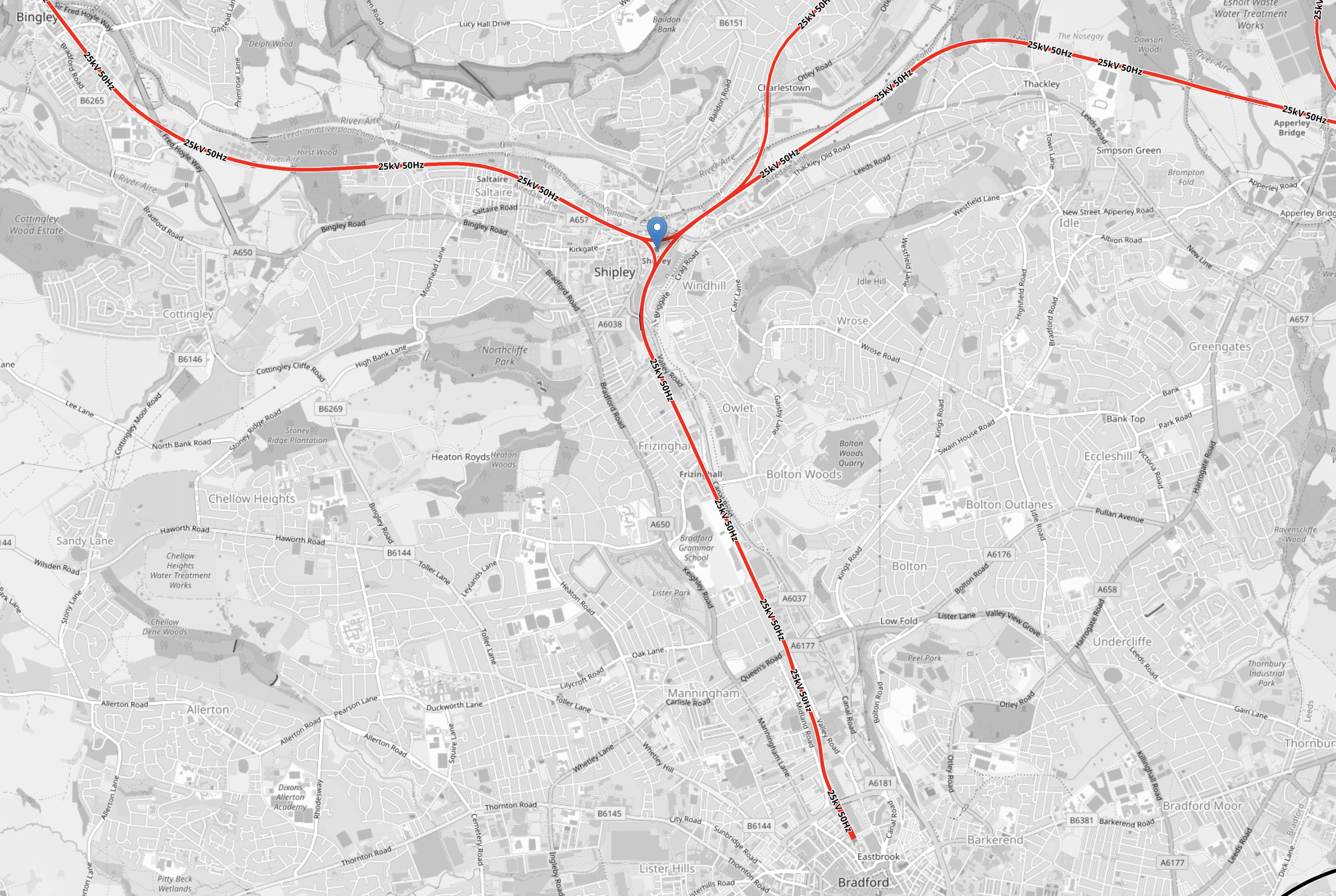
Note.
- All rail lines are electrified and shown in red.
- The blue arrow on this line, indicates Shipley station.
- Shipley station appears to be in the middle of the junction.
- The line going East connects to Leeds station.
- The line going South connects to Bradford Forster Square station, which is at the end of the line.
- The line going West connects to Skipton station and the Settle and Carlisle Line.
Trains returning to London would reverse out of Bradford Forster Square station and take the Eastern route through Shipley and Leeds back to London.
- An appropriate number of trains for Carlisle and Scotland, could surely just reverse out of the station and take the Western route through Skipton station and go on to the Settle and Carlisle Line.
- The trains would call at Wakefield Westgate, Leeds, Shipley, Bradford Forster Square and Skipton stations in the Leeds/Bradford conurbation.
- Other stations could be added to the route if required.
- The trains would effectively reverse direction in their call at Bradford Forster Square station.
- Going North the trains might check their battery levels in Bradford Forster Square station and use a fast-charger if necessary.
- Going South, there would be no need for charging, as the route South from Bradford Forster Square station, is already fully-electrified.
- Would the operator, use this longer stop to replace the crew with a fresh one?
It could be a simple and efficient way to run a London and Scotland service via the Settle and Carlisle Line.
What About Hull, Sheffield And York?
I’m asking this question, as Yorkshire is a large county and this article has only mentioned a few places, where people live and might need to go to London or Scotland.
In February, I wrote Northern Launches New Yorkshire Flyer Fast Service Between Leeds And Sheffield.
I’m fairly sure that Hull, York and other cities and large towns in Yorkshire already have a good regional service to Bradford Forster Square or Leeds station, which will give a good connection to the new service.
Could Dumfries Be Served By Using The Glasgow South Western Line?
This OpenRailwayMap shows the Southern part of the Glasgow South Western Line.
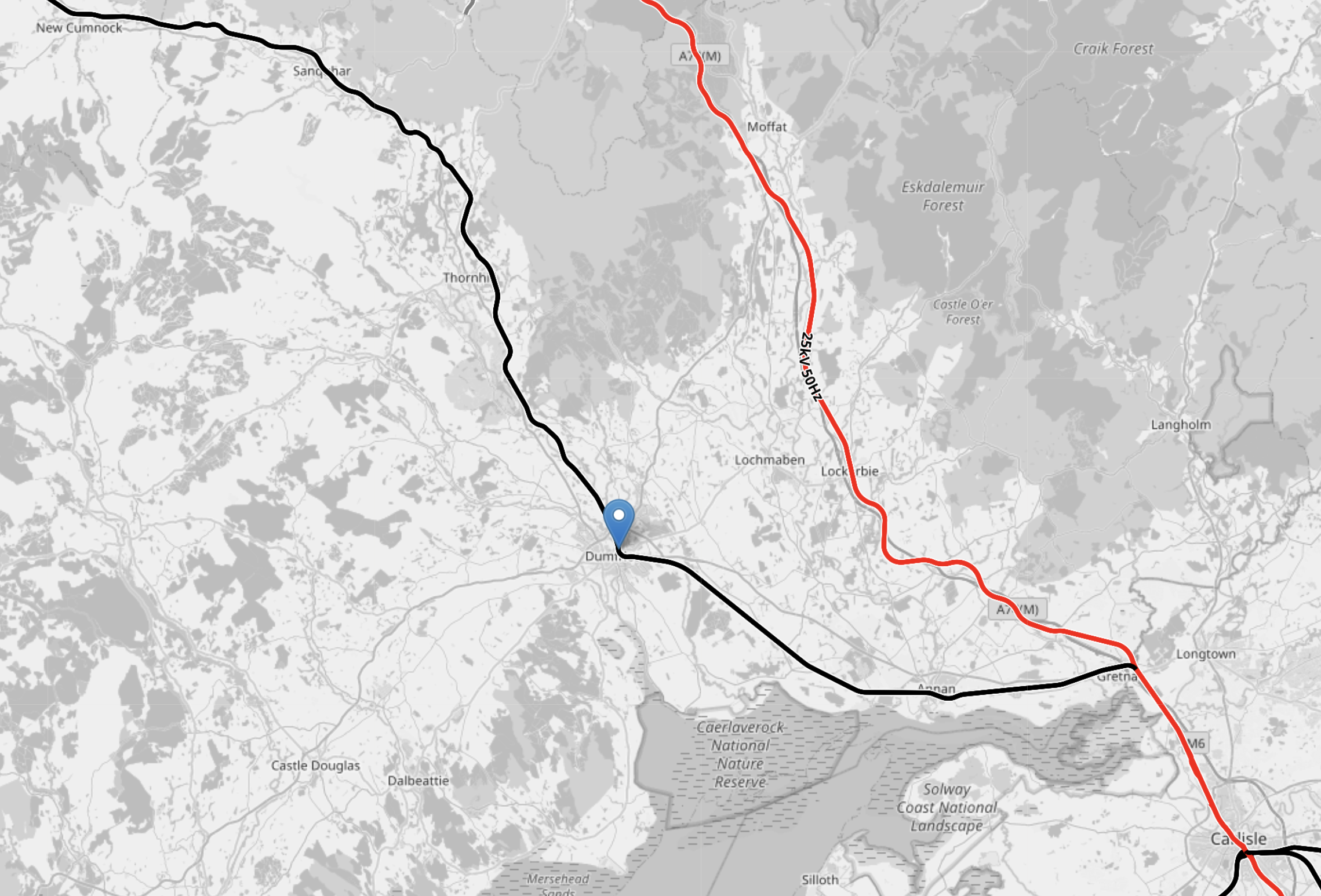
Note.
- Electrified lines are shown in red and lines shown in black are not electrified.
- The blue arrow on the black track, indicates Dumfries station on the Glasgow South Western Line.
- The red track is the West Coast Main Line.
- Carlisle is in the South-East corner of the map.
- Carlisle and Glasgow Central via Dumfries is 115.9 miles
- The Thames-Clyde Express, ran on this route until 1974.
- According to the Wikipedia entry for the Thames-Clyde Express, the train called at Dumfries and Kilmarnock stations.
From this brief look it appears that the new service could include Dumfries and should be able to serve the town on battery power.
Is More Capacity Needed On The West Coast Main Line Between Carlisle And Glasgow?
I asked Google AI, this question, to see if there is capacity.
This was the answer I received.
Yes, increased capacity and infrastructure enhancements are required on the West Coast Main Line (WCML) between Carlisle and Glasgow, as the line is currently full and unable to meet modern, growing passenger and freight demands.
Upgrades are necessary to tackle aging infrastructure, bottlenecks, and the need for more frequent services.
Key Aspects of the Need for Capacity:Full Capacity: The WCML is essentially full, with little space left for growth, despite 75 million passengers using it annually.
Freight and Passenger Growth: Passenger numbers are expected to double by 2050, and the line is a crucial artery for Anglo-Scottish freight.
Infrastructure Age: The northern section is undergoing its largest upgrade in half a century to address reliability issues.
Performance Bottlenecks: Specific locations, such as those north of Carlisle, require signaling and track improvements to prevent delays.
Proposed Upgrades: Current initiatives include a £400m investment until March 2029 for upgrades, including signalling and track renewals, though these are largely to boost reliability rather than provide a massive increase in capacity.
It looks to me, that a bit of a redesign and some use of battery trains on the Glasgow South Western Line, might squeeze a few more trains into the route.
Could A Feeder Network Of Local Trains Be Developed For HS2 At Lancaster Station?
Lancaster station is one of the less important stations that will be served by High Speed Two.
I visited in May 2025 and afterwards wrote Lancaster Station – 23rd May 2025.
This OpenRailwayMap shows the railway network around Lancaster.
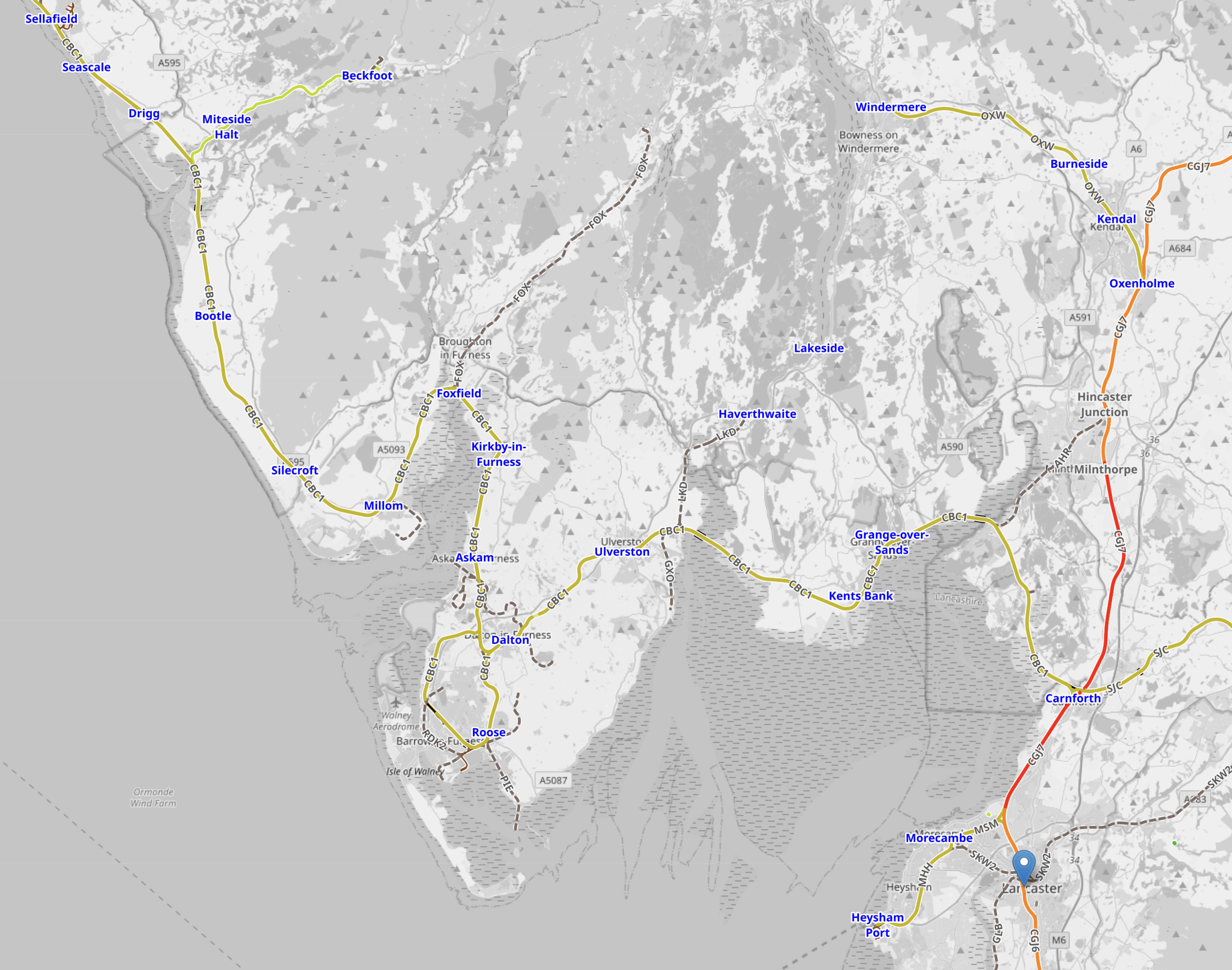
Note.
- The red track on the East side of the map is the electrified West Coast Main Line.
- The location of Lancaster station is indicated by a blue arrow.
- Morecambe, where the Eden Project North is being developed and the important port of Heysham are on the coast to the West of Lancaster.
- Oxenholme station is towards the North-East corner of the map, on the main line.
- The Windermere branch connects to the main line at Oxenholme station.
- HS2 will use the West Coast Main Line and call at Lancaster and Oxenholme.
North of Oxenholme, HS2 calls at Penrith and Carlisle, before going on to Glasgow and Scotland.
West of the main line, the map is dominated by the waters of Morecambe Bay, which in recent decades has produced a lot of our gas, but is now transitioning to an area, that will produce a few gigawatts of wind power.
North of Morecambe Bay, there is the Lake District, with the shipbuilding at Barrow and the nuclear waste processing at Sellafield on the coast.
It is an important area of England, where there is a lot going on!
Tying it all together is the yellow ribbon of the Cumbrian Coast Line, which connects Carnforth and Carlisle on an hourly basis.
- The service calls at Grange-over-Sands, Barrow-in-Furness, Millom, Ravenglass, Drigg, Seascale, Sellafield, St Bees, Whitehaven, Workington, Maryport, Aspatria, Wigton and other places.
- Four services a day link Carlisle and Lancaster stations.
- Carlisle and Lancaster stations are 120.5 miles apart via the coast and according to Google AI, the journey takes between three and three-and-a-half hours.
- In From Barrow-in-Furness To Ravenglass, From Ravenglass to Sellafield and From Sellafield To Carlisle, there are some images, that give a flavour of the route.
This is a route, that is worth decarbonising.
Consider.
- There is a couple of gigawatt of wind power in the bay to charge any batteries with green electricity or make green hydrogen.
- There is a project called BARROW GREEN HYDROGEN, which is located in Barrow-in-Furness.
- Both hydrogen and battery-powered trains could handle the hundred and twenty miles of the Cumbrian Coast Line.
- A zero-carbon train running silently round the Lake District could be a tourist attraction in its own right.
- Hydrogen-powered buses could provide the local transport.
Given the scenery and the closeness to the Lake District and High Speed Two, I suspect that major train manufacturers like Alstom, CAF and Siemens will be keen to bid.
A Taste Of The Future
On Friday, I went to Chester and took a train home from Crewe to Euston.
It was a new Hitachi Class 805, that sped me to London, with just a stop at Milton Keynes.
This picture shows the train arriving at Crewe.
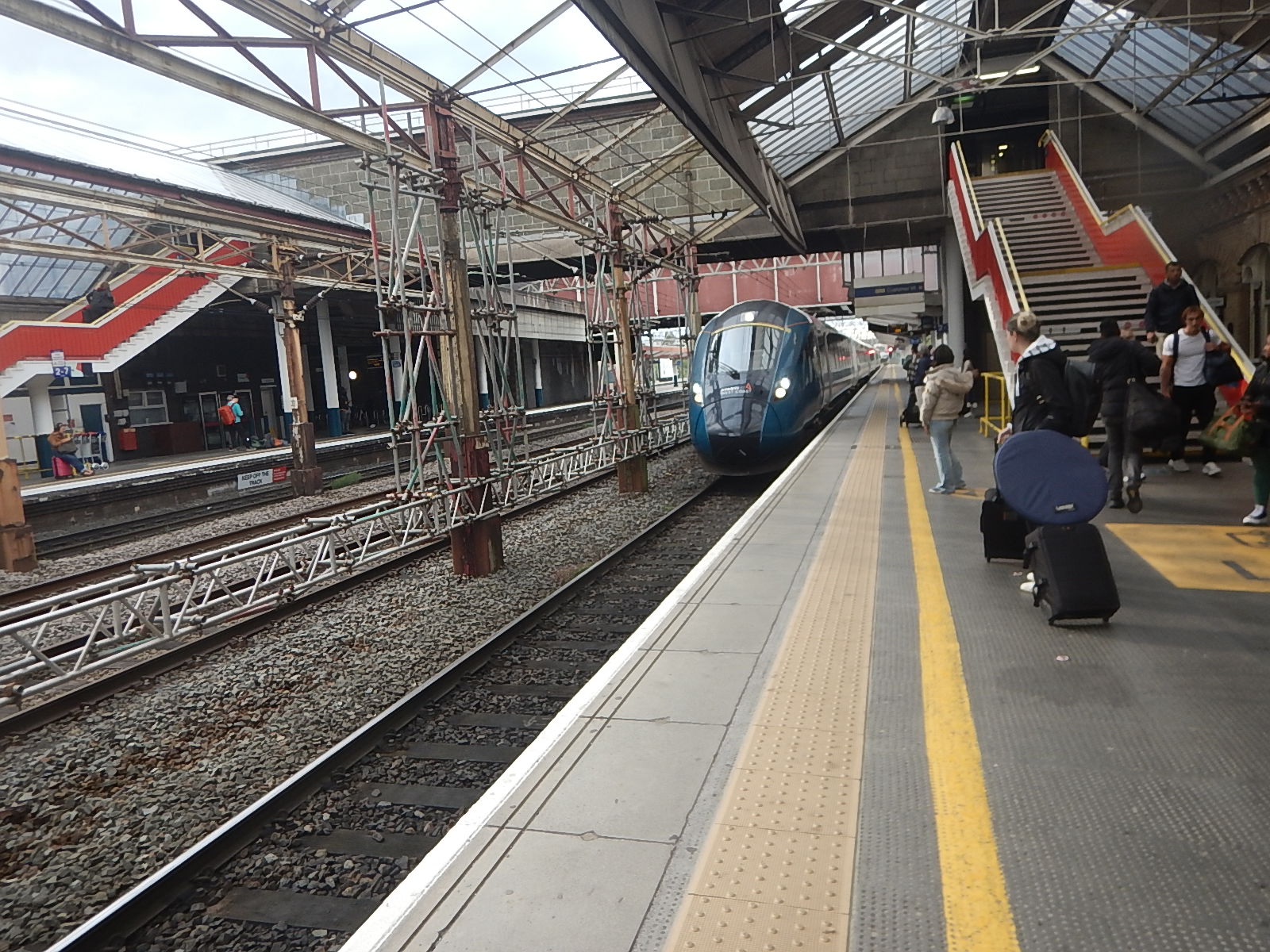
Note.
- High Speed Two it is not, but it went most of the way to Euston at 125 mph in an hour and 50 minutes.
- High Speed Two will take 56 minutes, although that is not cast in stone and steel yet.
- Crewe is one of the towns and cities, that will benefit most from High Speed Two.
But whether High Speed Two is delivered or or not, Crewe’s train service should improve in Spring 2026, as the first Lumo service on the West Coast Main Line service will be starting.
I describe the service in Lumo To Expand Scotland’s Rail Network With New London-Stirling Rail Route From Spring 2026.
This paragraph from the linked post, describes the route.
Lumo’s new route will link London Euston directly to Stirling, also calling at Milton Keynes, Nuneaton, Crewe, Preston, Carlisle, Lockerbie, Motherwell, Whifflet (serving Coatbridge), Greenfaulds (serving Cumbernauld) and Larbert.
It is fully-electrified and can support 125 mph running most, if not all, of the way.
It will certainly give knowledgeable travellers options on how they travel on the West Coast Main Line.
Lumo are also proposing another open access service on the West Coast Main Line to Rochdale, which will increase travel options.
My only worry is that Heidi Alexander will cancel it, on the grounds that open access services abstract the revenue of Great British Railways.
But then after announcing the service in a reception in Holyrood, she surely couldn’t cancel it now.
On the other hand, it could be that this Labour Government has discovered that open access trains are a more affordable way of developing rail services to and from London and over longer distances.
Consider.
- Recently, Lumo has proposed open access services from London to Carmarthen, Paignton, Rochdale and Stirling.
- Recently, Arriva has proposed open access services from London to Cleethorpes, Grimsby and Scunthorpe and between Newcastle and Brighton.
- Recently, Alsthom has proposed open access services from London to Shewsbury and Wrexham.
Not one of these services will cost the government a lot of money, but Network Rail will pick up access charges.
So has Heidi Alexander seen sense and feels that it is better to allow more open access services?
Could Any Other Open Access Services Be Opened On The West Coast Main Line?
London Euston and Rochdale is planned by Lumo and I wrote about it in FirstGroup’s Lumo Seeks To Launch Rochdale – London Open Access Service.
This sentence from the linked post, gives the route.
The trains would call at Warrington Bank Quay, Newton-le-Willows, Eccles and Manchester Victoria.
Other possibilities would surely be Blackpool and Barrow-in-Furness, but Blackpool gets a three trains per day (tpd) service from Euston and frequent trains from Preston.
Barrow-in-Furness could be a very useful destination.
With increased defence spending, the shipyards will be busy.
It could be another gateway to the Lake District.
Services could be extended to Sellafield, Whitehaven and Workington.
This OpenRailwayMap shows the Cumbrian Coast Line between the West Coast Main Line and Barrow-in-Furness.
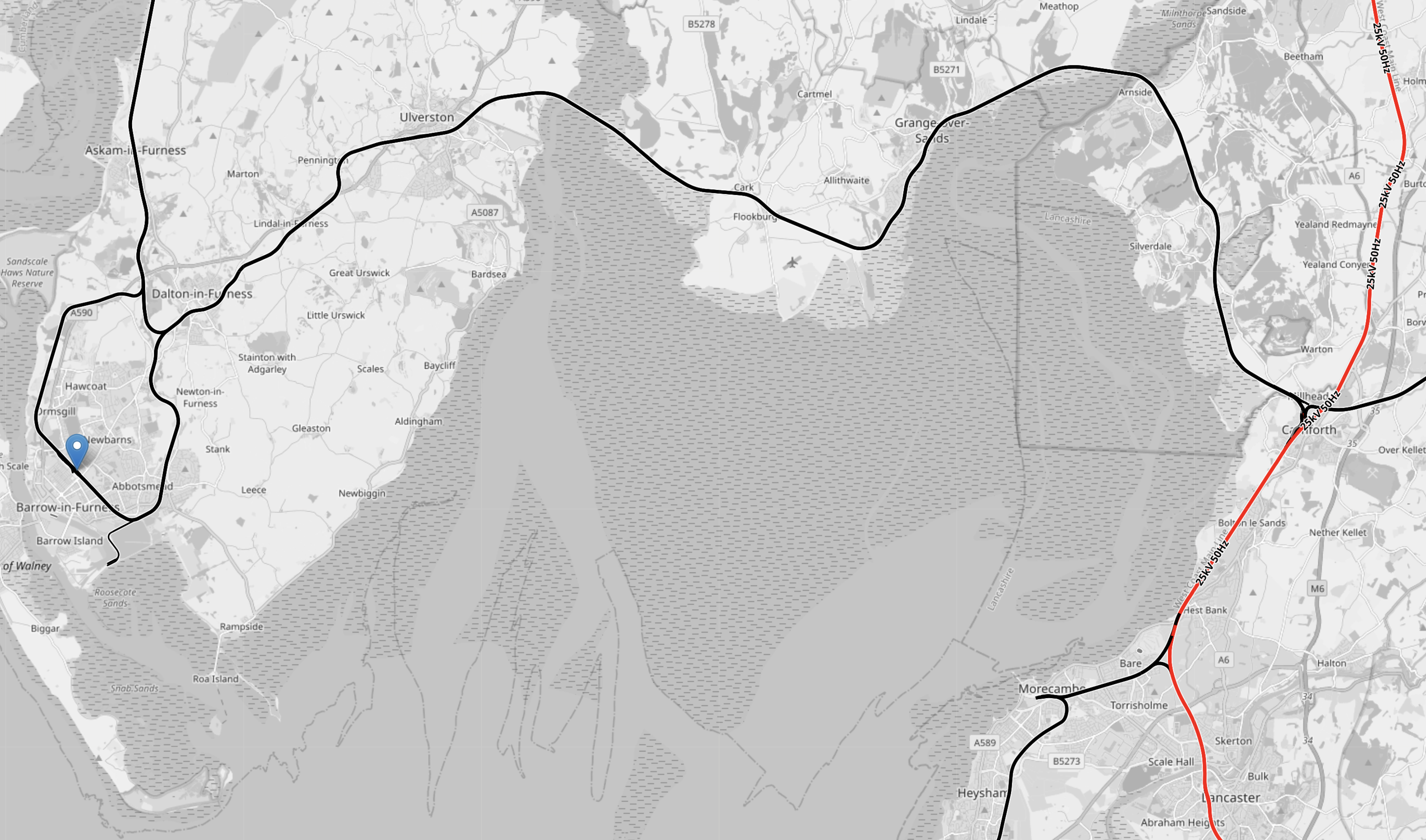
Note.
- The red tracks on the Eastern side of the map is the electrified West Coast Main Line.
- At the bottom of the map on the West Coast Main Line is Lancaster, with its station.
- The black track going West from Lancaster is the Morecambe and Heysham branch.
- The black track going West across the top of the map is the Cumbrian Coast Line.
- Barrow-in-Furness station is indicated by the blue arrow.
- The length of track without electrification on the route is less than thirty miles.
One of Lumo’s battery-electric trains would easily handle a London Euston and Barrow-in-Furness route.
Conclusion
There is obviously scope for new railway routes in the UK and some will be suitable for open access operators.
Perhaps, we need the Office of Road and Rail to be more proactive in deciding, when a route is to be served and then select an operator.
It would need to be an unbiased apolitical process, to stop an incumbent political party running trains to marginal seats, they hoped to win.
Slow Tourism Train Operator Launches First Service
Tyhe title of this post, is the same as that of this article on Railway Gazette.
These are the first two paragraphs.
FS Group’s recently formed tourist train business FS Treni Turistici Italiani has launched its first service.
Branded Espresso Cadore, the overnight service between Roma Termini and Calalzo-Pieve di Cadore-Cortina will run every Friday night until mid-February. On arrival, a connecting bus takes passengers to Cortina d’Ampezzo in 45 min. The return train departs on Sundays, arriving at Roma Termini on Monday morning.
It is surely an interesting concept and I believe it could work on several routes in the UK.
- Settle and Carlisle would be an obvious route.
- Cumbrian Coast Line.
- Bristol and Oxford, which I wrote about in Leisure Market Boom? GWR’s Vision For Direct Bristol-Oxford Services.
There must also be a couple of routes in Scotland and Wales.
As the three routes, I named are electrified at both ends, there is a possibility that they could be run by quiet battery-electric trains.
High Speed Two To Barrow-in-Furness
There has been a lot of speculation about the Northern end of High Speed Two, so I might as well add sort out a few facts and add a bit of speculation of my own.
Barrow-in-Furness Used To Have A Service To London
Barrow-in-Furness station doesn’t have a direct service to London.
This paragraph from the Wikipedia entry, describes how it used to be.
The present station was formerly known as Barrow Central, and at one time it was a terminus for British Rail long-distance or InterCity services. From October 1947 until May 1983 these included sleeper services to and from London Euston. A sleeper service in the London direction only was briefly reintroduced between May 1987 and May 1990.
Note.
- I find it interesting, that the area had both InterCity and sleeper services.
- There are some big employers like BAe Systems and British Nuclear Fuels in the area.
- Rishi Sunak has announced that the Cumbrian Coast Line will be upgraded.
- A High Speed Two service could improve low-carbon access to the Lake District.
- Grimsby/Cleethorpes in Lincolnshire, which probably has a similar economic profile to Barrow-in-Furness appears to be getting a service from London as I wrote about in Azuma Test Train Takes To The Tracks As LNER Trials Possible New Route. So why shouldn’t Barrow-in-Furness have a similar service?
It is my view that Barrow-in-Furness station could support a sprinkling of services.
The Current Barrow-in-Furness Service
Barrow-in-Furness station’s current services are described in these two paragraphs from the Wikipedia entry.
Services to the north are provided on Monday-Saturday by Northern, with services approximately hourly during the day to Whitehaven and Carlisle. One train per day operates to Sellafield specifically for workers at Sellafield nuclear plant (BNFL). Evening trains run only as far as Millom. There are 19 northbound departures each weekday; 15 of these go to Carlisle, three to Millom and one to Sellafield. There are 20 arrivals from the northern part of the line: 15 from Carlisle, three from Millom, one from Maryport and one from Sellafield. Some of these services continue along the Furness Line to Lancaster and Preston.
To the south, there are a mixture of stopping services to Lancaster and a number of through services to Manchester Airport via Manchester Piccadilly. These operate on a broadly hourly frequency, with a few peak extras throughout the week (including Sundays).
Hard facts on what the improvements to the line will be, have not been reported. But it does seem that a doubling of frequency to two trains per hour (tph) is being proposed.
What Are The Government’s Plans?
This news story from the Government is entitled North West To Benefit From £19.8 billion Transport Investment.
Proposed improvements in Cumbria are contained in this paragraph.
A brand new £2.5 billion fund to transform local transport in 14 rural counties, smaller cities and towns. This new money could pay for new stations, further electrification, bus corridors and new integrated public transport networks. The Energy Coast Line between Carlisle, Workington and Barrow will be upgraded, improving capacity and journey times, enabling trains every 30 minutes between Carlisle, Workington and Whitehaven. The upgrade will also accommodate major new freight demands from the new coal mine and provide regular services for the Westlakes Science Park, Nuclear Academy and Sellafield. This could support the creation of over 18,000 jobs.
I have my thoughts.
Will The Route Be Electrified?
The Cumbrian Coast and the Furness Line effectively form a near 120 mile loop between Carnforth and Carlisle stations on the West Coast Main Line.
- A journey from one end to the other takes about three hours and 18 minutes.
- Main towns and places served include Barrow-in-Furness, Sellafield, Whitehaven and Workington.
- A train between Carnforth and Carlisle can stop at as many as 29 stations.
- The route is not electrified, but it connects to the electrified West Coast Main Line at both ends at Carnforth and Carlisle.
This OpenRailwayMap shows Carnforth.

Note.
- The red line is the West Coast Main Line between Carlisle and Lancaster.
- Carlisle is to the North.
- Lancaster is to the South.
- The black line going North-West is the Furness Line to Barrow-in-Furness.
- The black line going East is the Bentham Line to Settle and Leeds.
This OpenRailwayMap shows Carlisle.

Note.
- The red line is the West Coast Main Line between Scotland and Carnforth.
- Scotland is to the North.
- Carnforth is to the South.
- The black line going South-West is the Cumbrian Coast Line to Workington, Whitehaven and Barrow-in-Furness.
- The black line going East is the Settle and Carlisle Line to Settle and Leeds.
If it were to be fully electrified, it could be a diversion route for electrified trains on the West Coast Main Line.
This document on the Government web site is the Train Technical Specification for High Speed Two Classic-Compatible Trains.
The specification says this about the unit and train formation.
The nominal length of the Unit shall be 200m. It has been determined that all Units should
be the same length, with no requirement for a Unit to be capable of being lengthened or
shortened. This supports the overall HS2 business case.The Unit shall be capable of Normal Operation as a single Unit or as two coupled Units.
On the Wikipedia entry for the Cumbrian Coast Line, there is a picture of a very long steam-hauled train on the line.
Full electrification would have these advantages.
- In the next few years several 21st century electrical multiple units will be looking for new places to operate.
- I am fairly certain, that a fully-electrified Cumbrian Coast Line could act as a diversion for High Speed Two and the West Coast Main Line between Carnforth and Carlisle.
- It would enable occasional High Speed Two services to Carlisle via Barrow-in-Furness, Sellafield, Whitehaven and Workington.
- It would also allow electrified freight trains to the new coal mine at Workington and to Sellafield.
But trains from the coal mine would probably need to have hydrogen-hybrid locomotives to get across the Pennines to Teesside for export.
Partial Electrification Of The Line
Partial electrification would probably need the following.
- Installation of electrification between Carnforth and Barrow-in-Furness, so that High Speed Two services can reach Barrow-in-Furness.
- Installation of electrification from Carlisle for enough miles towards Workington to be able to charge the local trains.
- The local trains would need to be able to run about seventy miles on batteries.
Partial electrification would be more affordable, but it would allow the following.
- Battery-electric trains to work between Carnforth and Carlisle.
- It would enable occasional High Speed Two services to Barrow-in-Furness
- Hydrogen-hybrid locomotive-hauled freight trains to the new coal mine at Workington and to Sellafield.
Rail passengers in, to and from Cumbria would probably see a similar level of improvement to that with full electrification.
What Time Would Be Possible At The Present Time?
Consider.
- According to the Wikipedia entry for High Speed Two, two hours and twenty-five minutes is the fastest time between London Euston and Lancaster.
- Trains are timed to take one hour and four minutes with the nine stops, between Barrow-in-Furness and Lancaster.
- To save time some stops could be cut between Barrow-in-Furness and Lancaster.
This would give a London Euston and Barrow-in-Furness time of three hours and twenty-nine minutes, but by removing perhaps five stops, the time could be around three hours and fifteen minutes.
What Time Would Be Possible When High Speed Two Lite Opens To Handsacre Junction?
Consider.
- According to the Wikipedia entry for High Speed Two, two hours and three minutes will be the fastest time between London Euston and Lancaster, after High Speed Two opens to Handsacre junction.
- Trains are timed to take one hour and four minutes with the nine stops, between Barrow-in-Furness and Lancaster.
- To save time some stops could be cut between Barrow-in-Furness and Lancaster.
This would give a London Euston and Barrow-in-Furness time of three hours and seven minutes, but by removing perhaps five stops, the time could be under three hours.
What Frequency Would Be Needed?
LNER seem to run their secondary services to places like Harrogate and Lincoln using a frequency of one train per two hours (tp2h).
That could be an ideal frequency.
Would There Be A Path For The Train To And From London Euston?
This graphic shows High Speed Two services after Phase 2b is completed.
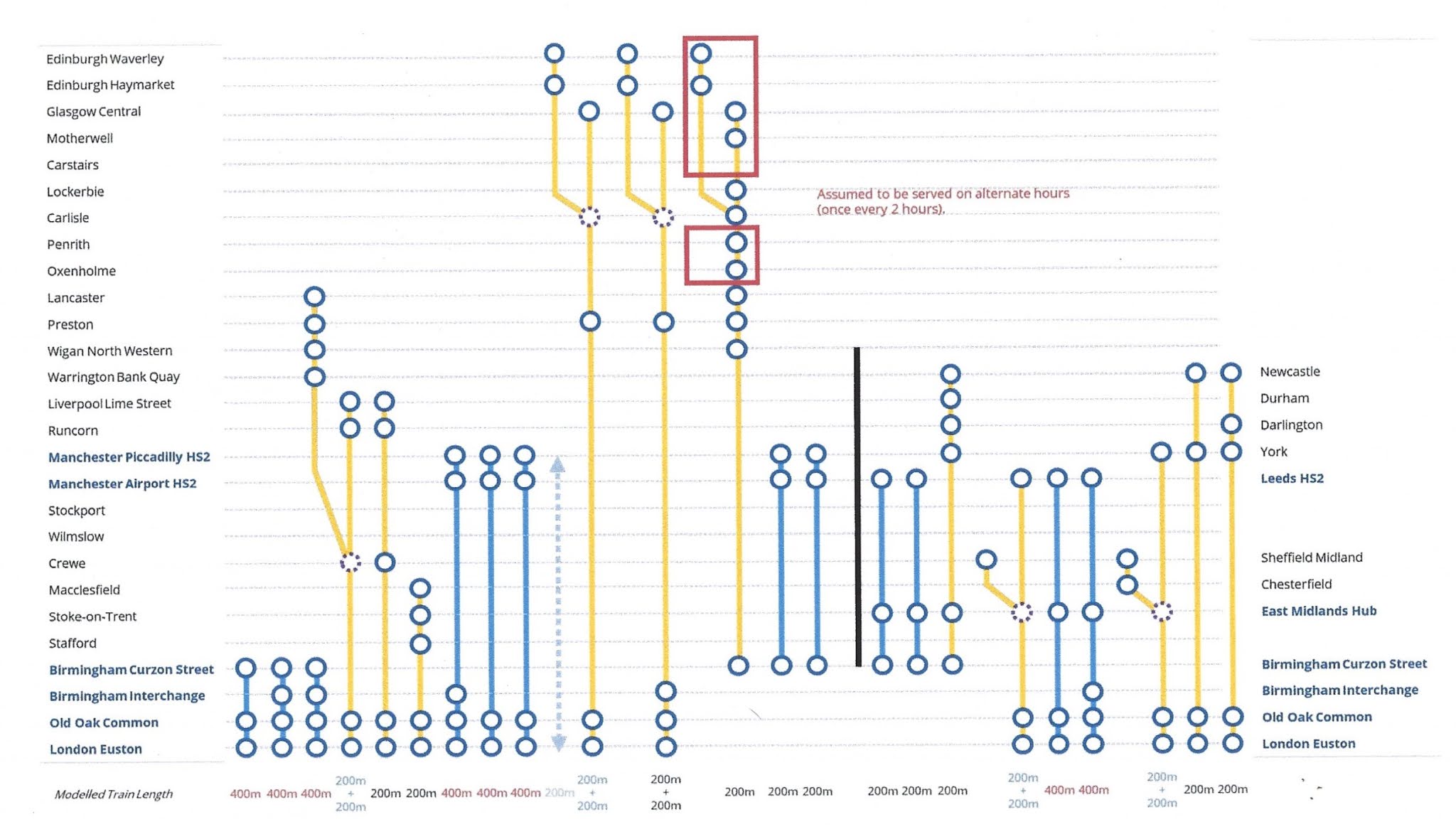
Note.
- Services shown in blue are run by High Speed Two Full Size trains.
- Services shown in yellow are run by High Speed Two Classic-Compatible trains.
- Each of these trains will have a frequency of one tph.
- The nine paths to the right of the vertical black line will not be needed for some time. If ever!
- It looks like a maximum of only eleven paths will be needed to the South of Birmingham.
- It looks like a maximum of only fourteen paths will be needed to the North of Birmingham.
In Will High Speed Two Lite Make Stafford An Important Station?, I totted up all the services through Stafford after High Speed Two Lite opened to Handsacre junction and got these figures.
- Through Stafford station, there are totals of 11 tpd and 14 tph.
- Along the Trent Valley Line, there are totals of 11 tpd and 12 tph.
- North of Stafford on the West Coast Main Line, there are totals of 9 tpd and 12 tph.
- South of Stafford on the West Coast Main Line, there are totals of 2 tpd and 2 tph.
- Between Stafford and Stoke-on-Trent, there are totals of 2 tph.
I accounted for services moving from the West Coast Main Line to High Speed Two.
Consider.
- A large proportion of the route between Preston and Handsacre junction, where the route would join High Speed Two Light has two dedicated high speed tracks and two tracks for freight and local services.
- Digital signalling on High Speed Two has been designed to handle eighteen trains per hour (tph) at 225 mph.
- Surely, the two dedicated high speed tracks, if fitted with High Speed Two digital signalling could handle say 16 tph at 140 mph.
- Network Rail are good at juggling trains to squeeze in more services.
- Extra paths could be created by splitting and joining trains at Crewe or Preston.
My Control Engineering training and practice tells me that it should be possible to add perhaps two tph between Lancaster and Euston.
Could High Speed Two’s Lancaster Service Be Extended To Barrow-in-Furness?
I don’t see why some services could be extended the 34.8 miles to Barrow-in-Furness.
Would Much Work Be Needed At Barrow-in-Furness?
This Google Map shows Barrow-in-Furness station.

Note.
Trains to and from Carnforth come and go from the South East.
Trains to and from Sellafield, Whitehaven and Workington and Carlisle come and go from the North West.
There are three platforms.
Work needed to be done would include.
- Creation of a 200 metre platform for the High Speed Two trains.
- Electrification.
- Addition of charging facilities to the platform for the local trains, which would probably be standard electrification.
Passengers would walk across between the High Speed Two and local trains.
Conclusion
I believe that High Speed Two Classic-Compatible trains could be under three hours between Barrow-in-Furness and London Euston, when High Speed Two Lite opens from Handsacre junction.
National Trust Looks At Car Ban In Lake District
The title of this post is the same as that as that of this article in yesterday’s Sunday Times.
The secondary headline sums up the article.
Nearly 20m visitors a year are ‘loving the national park to death’, and officials are looking at excluding drivers.
So what is to be done?
Can The Railways Help?
In 2015, I spent Three Days in Preston and explored the area by train.
These problems were apparent on the trains and at the stations.
- The capacity, quality and frequency of the trains to Windermere is pitiful.
- The capacity, quality and frequency of the trains along the Cumbrian Coast Line is inadequate.
- Bus information and interchanges could be better.
- Getting a train to Penrith North Lakes station was difficult.
The only line with an acceptable train service is the West Coast Main Line.
Everything else needs major improvements.
These are some random thoughts.
Could Carlisle Become The Rail Tourism Centre For The Borderlands And The Lakes?
These rail lines and services are already or will be connected to Carlisle Citadel station, within the next few years.
- Virgin services on the West Coast Main Line between London and the South and Glasgow and Edinburgh in Central Scotland.
- TransPennine Express services on the West Coast Main Line between Liverpool and Manchester in the South and Glasgow.
- Possible Grand Union services on the West Coast Main Line between London and Stirling for the North of Scotland.
- High Speed Two services between London and the South and Glasgow and Edinburgh in Central Scotland.
- ScotRail services on the Glasgow South Western Line between Carlisle and Glasgow via Dumfries and Kilmarnock.
- ScotRail services on an extended Borders Railway between Carlisle and Edinburgh via Hawick and Galashiels.
- Northern services on the Tyne Valley Line between Carlisle and Newcastle via Hexham and the Metro Centre.
- Northern services on the Settle and Carlisle Line between Carlisle and Leeds.
- Northern services on the Cumbrian Coast Line between Carlisle and Carnforth via Workington, Whitehaven and Barrow.
Carlisle sits at the centre of a network of some of the most scenic rail lines, anywhere in the world.
Rail services in the area with the exception of the through services, provided by Virgin and TransPennine Express are probably considered by their operators to be a pain.
- They are generally not used by commuters.
- There are regular operational problems like floods and landslips.
- They are overcrowded at some times of the year and need expensive new rolling stock.
- Rail tourists from aboard probably complain like mad.
But above all the services probably lose money hand over fist.
What Is The Ideal Train For Scenic Routes?
Two possible trains for scenic routes are now in service in the UK.
The Scottish Solution – Inter7City
ScotRail are now introducing four- and five-car InterCity 125 trains on routes between the seven cities in Scotland.

They will probably do a good job and they have the following.
- Large windows to enjoy the views.
- Many seats have tables.
- An on-board buffet and trolley service.
- Wi-fi and power sockets for phones and laptops.
- The trains should be reliable, as there is a vast knowledge base about running these trains.
- The trains can be easily lengthened, by adding extra cars.
- The trains were 125 mph trains and are probably slower in this application.
But the trains are forty years old and have two enormous diesel engines on each end.
The Swiss Solution – Class 755 train
Greater Anglia are introducing three- and four-car Class 755 trains on rural routes in East Anglia.
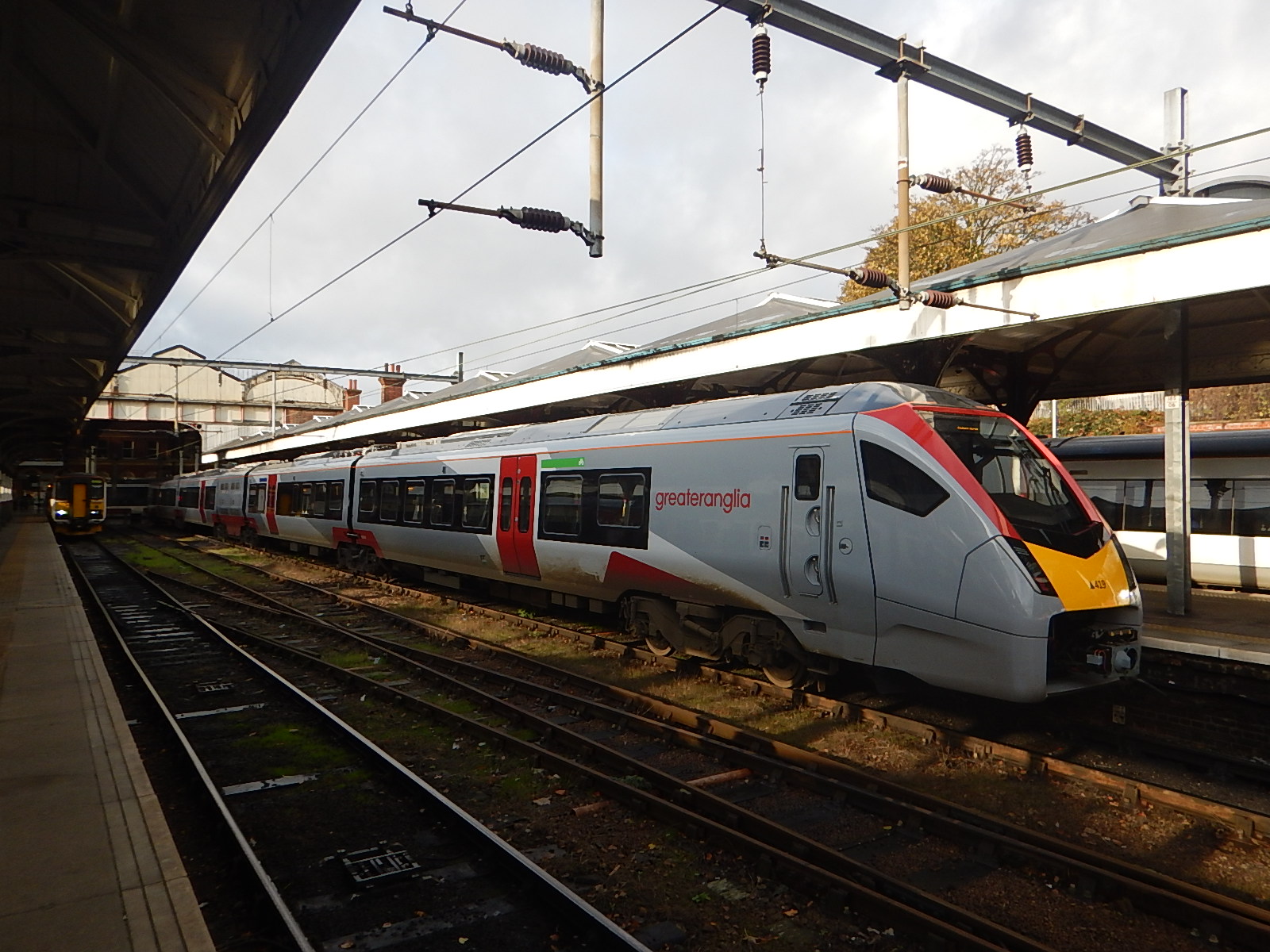
They appear to be doing a good job with high passenger satisfaction and they have the following.
- Large windows to enjoy the views.
- A number of seats have tables.
- Space for bicycles.
- Wi-fi and power sockets for phones and laptops.
- The trains have level access between train and platform.
- Hopefully, the trains will be reliable, as they are brand new and Stadler has been making similar trains for over ten years.
- The trains can use 25 KVAC overhead electrification, where it is available.
- The trains can work in multiple formations.
- The trains can be easily lengthened, by adding extra cars.
- The trains are 100 mph trains.
But the trains still have a diesel power-pack in the middle for operation independently.
In future, these trains will be used to run new services between London and Lowestoft, which is a distance of 118 miles of which 59 miles is electrified.
Similar trains will be fitted with batteries for the South Wales Metro.
Could a train be built with the best of all the features?
I believe the Class 755 train is a pretty good start, but it would have the following extra features.
- Ability to run at up to 125 mph on 25 KVAC overhead or 750 VDC third rail, where the track allows.
- A well-designed buffet.
- 50 mile battery range.
- A stand-by generator.
- The ability to fast-charge the battery at a station stop.
I also think that Hitachi could make a five-car AT-300 train and Bombardier could make an Aventra, that met this specification.
What would a fleet of battery-electric trains do for the rail lines around Carlisle?
- Hopefully, they would become a tourist attraction in their own right and encourage visitors to corm by train.
- Frequencies would be at least two trains per hour on all routes.
This could be a starting point for making the area easier to access.
Should Stations Around The Lakes Be Developed With Bus Interchanges?
I’ve seen the bus interchange at Windermere station, but are other stations around the Lakes as well provided with comprehensive bus routes?
The objective surely should be that if a family wanted to have a day out in the Lakes from their home in Liverpool or Manchester, they should be able to get a train to a convenient station and a bus to their final destination.
Surely, if there is a sensible alternative, then visitors might use it.
Could The Cockermouth, Keswick and Penrith Railway Be Reopened?
The Cockermouth, Keswick and Penrith Railway was finally closed in the 1970s and according to Wikipedia, the track-bed has been used for roads and other developments.
I doubt that the railway could be reopened, but a modern light rail route would probably be a very valuable tourist asset.
But Would Good Train And Bus Routes Cut The Traffic In The Lakes?
I doubt it!
If someone has spent £40,000 or more on an expensive car, they feel they have bought the right to drive it anywhere they want!
The Dutch once talked about road pricing for every vehicle and that government lost the next election.
Conclusion
Traffic congestion in the Lakes, is a problem that threatens other areas, where tourists want to go.
So will as the National Trust are suggesting have to ban cars to restore some sanity?
I suspect so!
But it won’t be popular!
Cumbrian Coast’s Coal Comeback?
The title of this post is the same as that of an article in Issue 874 of Rail Magazine.
When I saw this article, I thought it was rather surprising, as coal is rather the arch-demon to environmentalists.
But this is not about coal for producing electricity, but metallurgical coal, that will be used in steelmaking.
West Cumbria Mining are proposing the mine and ofn their web site, the following is said.
West Cumbria Mining is investing in developing plans for the creation of a metallurgical coal mine off the coast near Whitehaven in West Cumbria to supply the UK and European steel-making coal market, which currently imports around 45 million tonnes per annum.
I would assume the 45 million tonnes refers to the total of the UK and European markets. S there is certainly a large market to supply, if the price is right.
Woodhouse Colliery
This extract describes how the mine will be created.
Woodhouse Colliery would be created using the access tunnels to old anhydrite workings at the former Sandwith Drift Mine, on the edge of Whitehaven. Until 2004, the site was occupied by the Marchon chemical works.
Studies have determined that sufficient coal reserves could be accessed to sustain mining operations for at least 50 years.
This picture was taken from their web site.
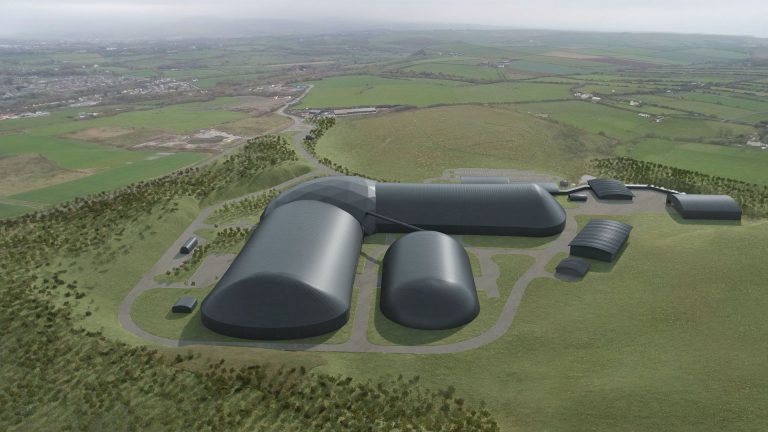
It doesn’t look to be a stereotypical coal mine.
Much of the coal would appear to be mined offshore.
Use Of The Railway
This extract talks about the use of the Cumbrian Coast Line, that passes through Whitehaven.
One of the things that actually makes the project realistic and viable is that we have access to existing infrastructure. There are lots of projects where actually the biggest capital cost is the infrastructure required. We have to remove everything by rail – one: because of the volume of material; but two: we wouldn’t be able to get planning if it was a road solution.
An agreement has been reached with Freightliner to transport the coal to Redcar. With the mine in full production, six trains per day would operate Monday-Friday.
More details about the rail transport are also given.
- There would be a single-track siding for loading.
- The siding would be connected to the mine by a 1.4 mile coal conveyor.
- Everything is covered, so there no dust and gas.
- The loading will be in an acoustically-closed building.
- Trains will have 23 wagons.
- Class 66 or Class 70 locomotives will be used.
It does appear that they are designing most things to a high standard.
These days, if planning permission with conditions is given, the conditions are usually adhered to, as sanctions are now easier to apply through the Courts.
I do have a few thoughts.
Route Between Whitehaven And Redcar
Trains would probably go via Carlisle, Newcastle and Middlesbrough
There would not be much electrification on the route, except for on the East Coast Main Line.
I would estimate that trains would take around three hours between the Woodhouse Colliery and Redcar
Rolling Stock
The article states that the wagons would be a dedicated fleet for the operation.
Surely, they could be designed for fast and quiet operation.
Locomotives
I feel that locomotives that meet the latest European regulations should be used. Class 66 locomotives do not, Class 68 locomotives do!
I also feel that in the next five years or so, more environmentally-friend;y and quieter locomotives will become available.
Improving The Cumbrian Coast Line
The article describes how the Cumbrian Coast Line will be improved if the mine gets Planning Permission.
Conclusion
If we are going to continue to make and use steel in the UK and Europe, it looks like this mine could create wealth in a part of the UK that needs it, without causing too many negatives.
It’s an interesting project.
Where Is Moorside?
Moorside is the name given to NuGen‘s new nuclear power complex in Cumbria.
I was drawn to write this post, by this article in Construction News, which is entitled Network Rail and Moorside nuclear power plant developer Nugen are putting together a business case for rail investment in Cumbria that could be worth as much as £400m.
four hundred million pounds could buy a lot of rail infrastructure.
But where exactly is Moorside?
This map was taken from the Our Site page on the NuGen web site, showsthe Moorside site outlined in red.
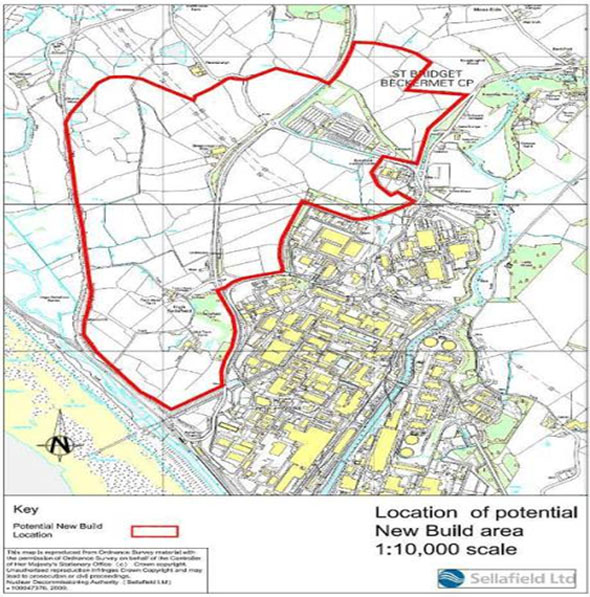
Note the development with the yellow-shaded areas to the South-East of the red-lined area. This is Sellafield.
And this is a Google Map of the coast around the nuclear reprocessing complex.
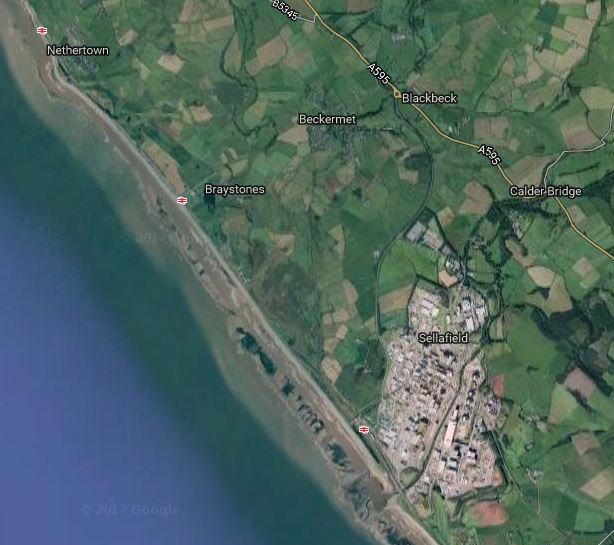
Note the railway stations along the coast. Sellafield station is by the nuclear complex, with Braystones and Nethertown to the North.
All three stations are on the Cumbrian Coast Line, which in addition to the passenger service, is used to transport freight, including nuclear waste to and from Sellafield.
Overlaying the NuGen map on the Coogle Map shows that Moorside will be to the North-West of Sellafield.
The Cumbrian Coast Line and the related Furness Line curve around Cumbria from Carlisle to Carnforth via Workington, Whitehaven, Sellafield and Barrow-in-Furness.
- The line is mainly double track, but with sections of single-track.
- The line is not electrified.
- Most of the trains are elderly diesels.
- The train service is vaguely hourly, but patchy in places.
The nuclear power complex is a ten billion pound project and will require large amounts of heavy equipment and construction materials to be transported the site. Also on a daily basis, large numbers of engineers and construction workers wilol need to get to one of the largest construction sites in the North of England.
Is Network Rail’s £400 million proposed vdevelopment, a reconstruction of the Cumbrian Coast and Furness Lines to the following standard.
- Double track.
- Electrification
- 100 mph line speed where possible.
- Build a new station at Moorside and any other places, where they are needed.
- Step-free stations
- At least two trains per hour in both directions.
- Full wi-fi and 4G on all trains and in stations.
Upgraded to a high standard, it might do more than help construction at Moorside and Sellafield and those that work in the two complexes.
- It might increase quality tourism.
- It could be a diversion route for the West Coast Main Line.
- It might make a London service to Barrow-in-Firness via HS2 a possibility.
Network Rail’s project could do a lot more than service the twin nuclear sites.
I explored the Cumbrian Coast Line in April 2015.
From Sellafield To Carlisle
I continued up the Cumbrian Coast Line to Carlisle taking pictures as I went.
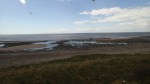

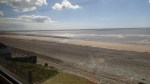



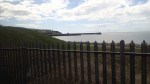



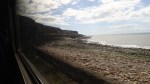
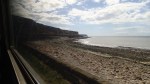

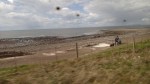




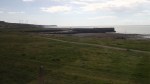
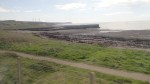
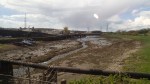
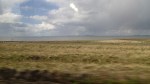

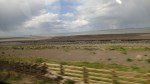



Note that in some of the pictures, you can actually see the Isle of Man. Or I could on the train!
The Cumbrian Coast Line can’t be the easiest line in the country on which to make money, but according to this article on the Northern Rail web site, they are adding extra trains to Sellafield. So at least they’re trying.
Although there are some large employers along the line, surely such a picturesque line should be able to get extra passengers like families and walkers, who might want to spend time in the area. One factor going in their favour is the extra services out of Preston to Manchester, Liverpool and Blackpool. These will make it easier to get people to the line, especially if they ran decent trains on the line, with perhaps a trolley.
At least the line is a Community Rail Line and their web site is cumbriancoastline.co.uk.

