How Much B12 In A Portion Of Chilli-Con-Carne?
I asked Google AI, the title of this post and received this answer.
A standard 1-cup (approx. 240g–250g) portion of homemade or canned chilli con carne typically contains between 0.68 mcg and 1.6 mcg of Vitamin B12. This amount represents approximately 28% to 67% of the recommended daily intake (DV) for adults.
Vitamin B12 Content Breakdown:
Homemade with Beef (Approx. 250g): ~1.6 mcg (67% DV).
Canned Entree (1 cup/242g): ~0.68 mcg (28% DV).
Chilli with Rice (450g meal): ~2.28 mcg (57% DV).
Key Factors Affecting B12 Levels:
Meat Quantity: A higher ratio of ground beef increases the B12 content, as 3 ounces of lean ground beef alone provides 2.4 mcg (100% DV).
Serving Size: A larger, restaurant-sized portion (e.g., 12 oz) will contain significantly more than a standard 1-cup serving.
Chilli con carne is considered an excellent source of Vitamin B12 due to the beef content, which helps meet the daily requirement of 2.4 mcg for adults.
I generally eat, one Marks and Spencer’s Count on Us chilli-con-carne and rice, every week. It doesn’t say on the packaging if it is gluten-free, but my highly-tuned gut says it is.
What Does Google AI Say In Answer To Is Marks And Spencer’s Count On Us Chilli Con Carne And Rice Gluten Free?
The M&S Count On Us Chilli Con Carne and Rice is generally considered safe as it does not list gluten-containing ingredients, but it is not explicitly labeled as “gluten-free” and may have risks of cross-contamination. While many M&S “Count on Us” meals are considered “accidentally” gluten-free, it is advised to check the label for “may contain” warnings before consuming.
I used to have a ginger Glaswegian friend, who had a Michelin star (Not him, one of the others!) He told me that chilli con carne should be gluten-free.
How Much B12 In A Portion Of Beef Lasagne?
I asked Google AI, the title of this post and received this answer.
A standard portion of beef lasagne (approx. 200g-300g) typically contains between 0.6 mcg and 1.7 mcg of Vitamin B12.
This amount provides roughly 25% to 70% of the recommended daily intake (RDA) for adults (which is 2.4 mcg).
Per 100g: A 100g serving contains approximately 0.3 mcg to 0.4 mcg of B12.
Higher-End Estimates: Some nutritional data indicates that a generous, nutrient-dense serving of homemade beef lasagne can have as much as 1.7 mcg of B12.
Source: The primary source of B12 in this dish is the ground beef, with additional amounts from cheese and dairy.
Note: The exact amount depends on the amount of beef and dairy used in the recipe.
I generally eat, one Marks and Spencer’s Made Without gluten-free beef lasagne every week.
Is There Anybody Out There, Who’d Like To Share a Beef Bourguignon?
Recently, Marks and Spencer introduced a range of meat dishes, one of which was Beef Bourguignon.


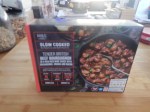
So I bought one today.
- There is a range of about six dishes.
- All of the range seems to be gluten-free and is marked as such.
- As they don’t look gluten-free from the picture, they would be ideal for serving at a mixed meal, where some diners were gluten-free and others were not!
- They seem to be simple to cook.
- The Use-By date is the 27th October.
If I have a quibble, it is that they are only for two and they also say Do Not Reheat on the box, which means that coeliacs like me, who live alone have a problem.
Perhaps they need a single portion.
But to solve my problem, if there is anybody reading this, who is close to Dalston and would like to test the Beef Bourguignon, then get in touch before the 27th!
Should We Stun Animals With Carbon Dioxide?
This post has been prompted by a text from a cardiologist. He said.
Current CO2 crisis reminds me that I think we should be using nitrogen to stun animals before slaughter, not CO2.
I heard a project on Farming Today a few months ago about CO2 stunning and thought it a great mistake as it can stimulate breathing and cause distress in some.
Have you seen anything on using nitrogen?
I haven’t but I must admit, I’ve had the thought myself and have also asked myself, if the gas in food packages is nitrogen, which would be logical to me.
I do have some thoughts.
The Best Beef I Ever Tasted
Over forty years ago, I used to buy beef from a local farmer in Suffolk.
- It would now be considered organic.
- All the farmer’s animals got the best care.
- He used to slaughter the animals himself in the field after giving them a pick of grass, using a captive bolt.
It was certainly, the best beef, I’ve ever tasted. But then the animals suffered no distress.
Medical Uses Of Carbon Dioxide
This is from the Wikipedia entry for carbon dioxide.
In medicine, up to 5% carbon dioxide (130 times atmospheric concentration) is added to oxygen for stimulation of breathing after apnea and to stabilize the O2/CO2 balance in blood.
This would appear to support the cardiologist’s text.
Is Carbon Dioxide Cheaper Than Nitrogen?
I have found these prices for ten litre cylinder of both gases.
- Carbon Dioxide – £78
- Nitrogen – £54
On this quick comparison, there would appear to not be a large difference.
Availability Of Nitrogen
Reading the Wikipedia entry for nitrogen, it appears to me, that production of oxygen-free nitrogen is not that difficult and this may explain the price comparison with carbon dioxide.
Nitrogen And The Death Penalty In The United States
This is a section called Euthanasia in the Wikipedia entry for nitrogen.
Nitrogen gas has become the inert gas of choice for inert gas asphyxiation, and is under consideration as a replacement for lethal injection in Oklahoma.
As nitrogen is an asphyxiant gas, some jurisdictions have considered inert gas asphyxiation by inhalation of pure nitrogen as a means of capital punishment (as a substitute for lethal injection).
I have been totally against the death penalty since meeting Jimmy O’Connor in the 1970s.
Conclusion
It strikes me that nitrogen could be used to stun animals as a more humane alternative to carbon dioxide.
CoolRail To Cut Carbon Footprint Of Fresh Food
The title of this post is the same as that of this article on Railway Gazette International.
These first two paragraphs outline the plan.
Food logistics company Euro Pool System has launched a thrice-weekly CoolRail dedicated temperature-controlled service to transport fresh produce between Valencia in Spain and Rotterdam in the Netherlands.
This is intended to be first route of planned network of CoolRail services which would link Spain with Germany, Scandinavia and the UK.
I can see this method of fresh food transportation growing, especially as CoolRail claim it is as fast as by road and cuts CO2 emissions by 70 to 90 %.
It also appears that the UK through the Channel Tunnel is in CoolRail’s plans.
Fish, Lamb And Beef To Europe
The obvious British export, that could use the service the other way to Europe is probably fish, as a large proportion of UK-landed fish goes to Europe at the present time.
This page on the Seafish web site, gives details about fish imports and exports.
Quality meat, like Welsh lamb and Scottish beef could also be sent to Europe, after being slaughtered in the UK.
What About Quality Food And Drink?
This page on the Scotch Whisky Association web site is entitled Scotch Whisky Exports On The Up in 2018.
This is two paragraphs from the page.
In 2018, the export value of Scotch Whisky grew +7.8% by value, to a record £4.70bn. The number of 70cl bottles exported also reached record levels growing to the equivalent of 1.28bn, up +3.6%.
The United States became the first billion pound export market for Scotch Whisky, growing to £1.04bn last year. The EU remains the largest region for exports, accounting for 30% of global value and 36% of global volume.
That means that Scotland exported to the EU, the equivalent of 461 million bottles of whisky, that is worth around £1.41billion.
A twenty-foot shipping container has a volume of 33.2 cubic metres., so with allowance for packaging, one could probably hold 33,200 bottles worth about £100,000.
To accommodate all Scotch Whisky exports to Europe on the 2018 figures, would need 14,000 containers per year or a very civilised thirty-eight containers a day.
Conclusion
There’s certainly a large market for food transport by rail across Europe and to the UK, some of which will be in containers with refrigeration and some without!
Tagliatelle With Beef And Red Wine Ragu
This is a Lindsey Bareham recipe that I did for supper yesterday. I’d decided to do it in the morning, but when Waitrose were selling 400g packs of diced braising steak for just £2.25, I couldn’t resist making two portions of the ragu, with one for supper and one for the freezer.
I started by taking the whole pack of diced braising steak, which I seasoned and browned it in a couple of tablespoons of hot oil in my Le Creuset shallow casserole.

Browning The Diced Steak
The meat was then scooped out of the casserole and then 100g each of finely chopped onion and celery, together with some garlic, a tsp of thyme and a pinch of chilli flakes were then gently softened in the meat juices and tossed for five minutes.
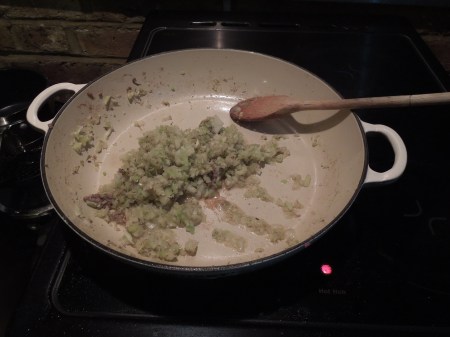
Cooking The Onion, Celery And Spices
I then took 100g of finely chopped chestnut mushrooms and added them to the pan. I cooked this until it was all dark and juicy.

Cooking The Mushrooms
I then chopped the meat and added this to the pan.
150 ml of red wine was added and it was allowed to bubble up for a few minutes, before stirring in a 400g tin of chopped tomatoes.
It was then baked in the oven for 60 minutes at 160°C.
I served it with some of Carluccio’s gluten-free pasta.
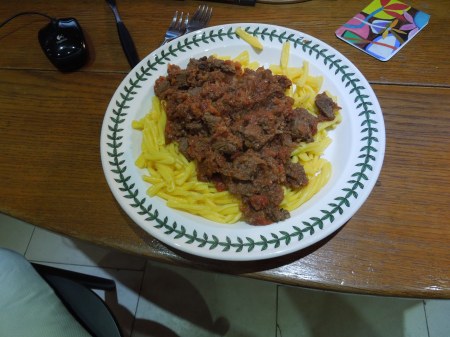
Tagliatelle With Beef And Red Wine Ragu
My one mistake was perhaps not to put in quite enough wine, so it was perhaps a tad dry.
I shall make this again, I see the diced steak on offer at Waitrose. I know I don’t need to economise, but it shows you can make a delicious meal for two with £2.25 of steak, an onion, some celery, a tin of tomatoes, some spices and some wine.
This recipe also shows the usefullness of my shallow casserole. It is definitely something that I don’t regret buying.
When Did We First Test For Horse DNA In Beef?
This may seem to be an obvious question, but I can’t seem to be able to find the answer on the Internet.
There is also the related question of when were we able to test for equine DNA in beef?
After all, if we’ve been able to do this for some years, could we have detected the fact that crooks were putting horse in beef earlier? And then there’s how long has it all been going on?
Perhaps, we should ask people if they find a Findus beef lasagne or any of the other suspect products in the freezer with a date of last year, they should take it to get tested.
Marks And Spencer Get Their Timing Right
Last night, I tried one of Marks and Spencer’s new FullerLonger meals.
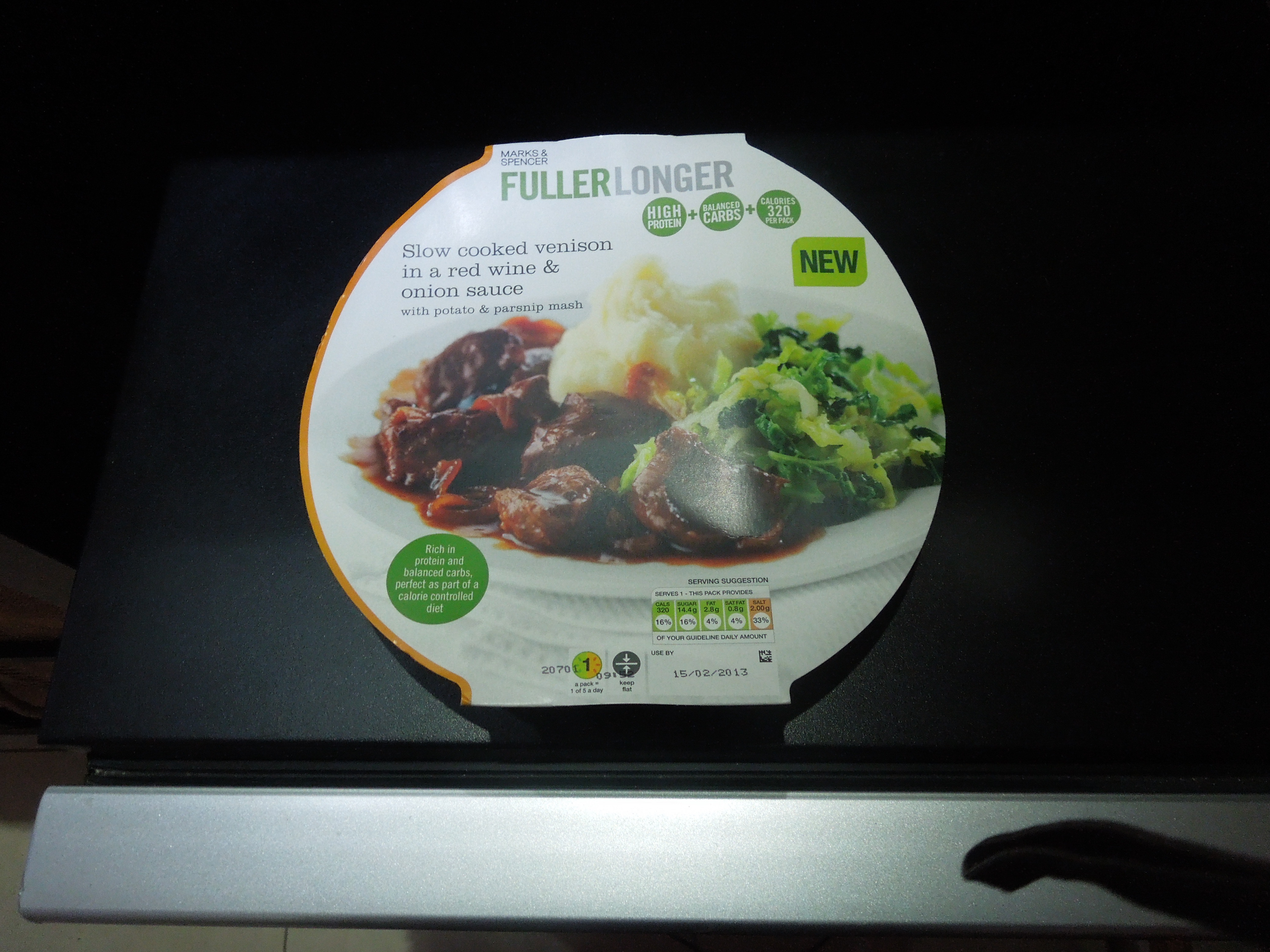
Marks And Spencer’s Venison
As you can see it’s slow-cooked venison in a red wine and onion sauce.
It has only been about a couple of weeks and note the “New” on the packaging.
With all the horsemeat problems, this problem just says impeccable timing by Marks and Spencer, although there is some beef stock and gelatine in the product. And the only allergen is a small amount of skimmed milk!
It’s Burgers Tonight!
After the horseburger scare, I thought I’d have burgers tonight.

It’s Burgers Tonight!
Those in Waitrose, had another pollutant in them; gluten. So as you can see, I got these next door in Marks and Spencer. Note the gluten-free label on the front of the packet where it should be.
Incidentally, I met a couple of ladies, who were buying burgers for their families’ suppers. Perhaps the publicity had jogged their minds, that they hadn’t had them recently? But then we weren’t buying low-cost and/or low quality burgers.
Where’s The Beef?
The proverbial question only had one answer today and that was in the Northgate Arms on Southgate Road about a mile or so north of the infamous Silicon Roundabout.
I had mine with just a few vegetables and a glass of wine.It was definitely worth the walk down the road.
The best beef I ever tasted was some home-killed beef from a farmer friend in Suffolk. But then killing your own is illegal, as it was then, so I suspect that route to good beef is probably closed now.
But then if you want good meat, the less stress the animal gets the better!
 The Anonymous Widower