Hydrogen Trains Are To Roll Between Stade And Bremervörde
The title of this post is the same as part of the title of this article on Hydrogen Central.
The original title mentions Switzerland, but Bremervörde is in Germany to the North-West of Hamburg.
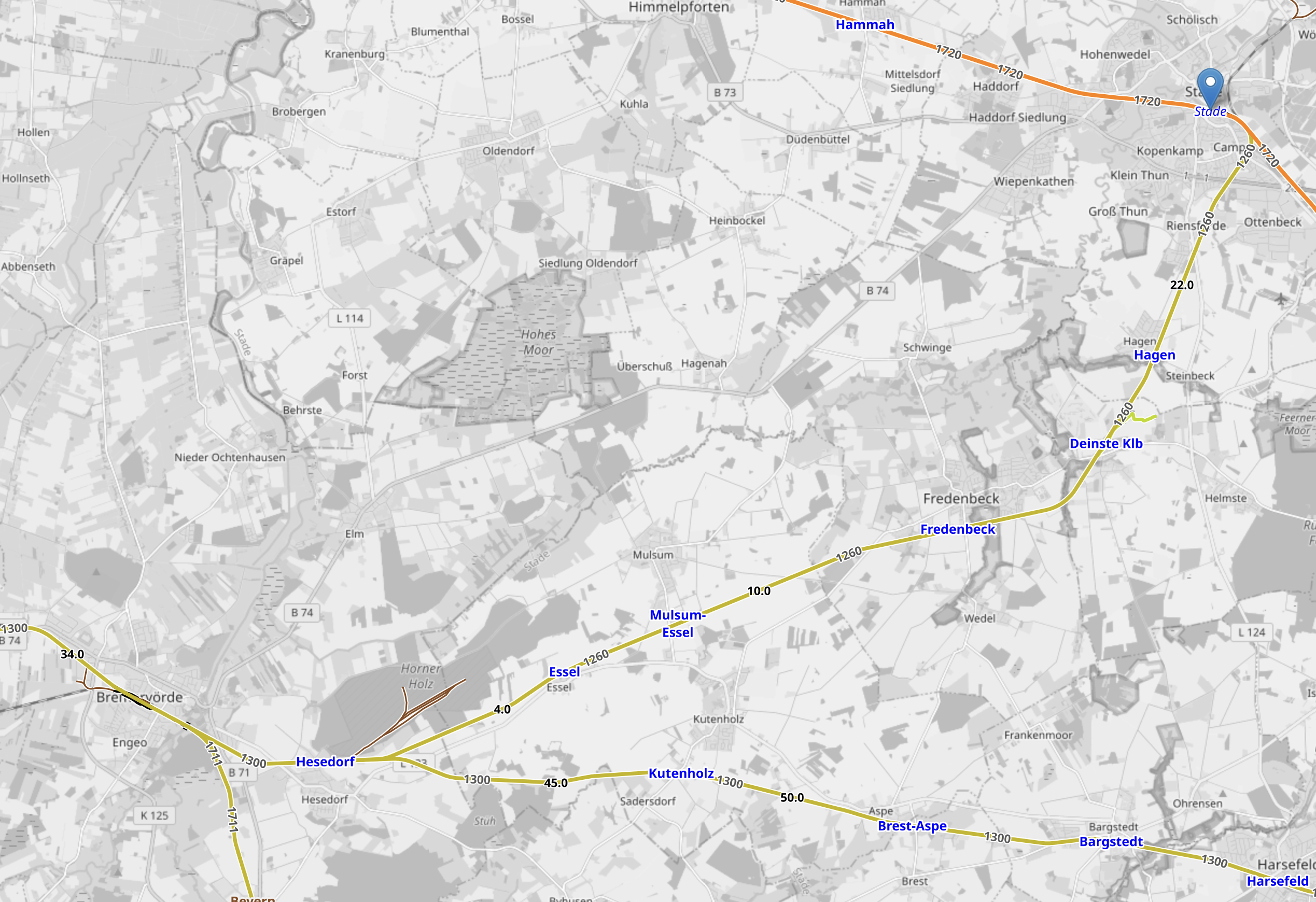
This map from OpenRailwayMap shows the route.
Note.
- Stade is in the North-East corner of the map and marked with a blue arrow.
- Stade station is on the Hamburg S-Bahn and has an hourly fast train between Hamburg and Cuxhaven.
- Bremervörde is in the South-West corner of the map, where the various routes converge.
- Bremervörde station is on the Buxtehude-Cuxhaven Line which is run by the hydrogen-powered Alstom Coradia iLint trains.
- Bremervörde appears to be, where the hydrogen-powered trains are serviced and refuelled.
- Currently, there are no passenger trains between Stade and Bremervörde, except at the weekends, when a heritage service called the Moor Express runs between Bremen Hauptbahnhof and Stade via Bremervörde.
- Freight trains also operate between Stade and Bremervörde.
At first sight it looks like the Stade and Bremervörde route, could be an ideal one to run with hydrogen-powered iLint trains.
- Servicing and refuelling of the trains could be shared with the existing Buxtehude-Cuxhaven service.
- The new service would probably need a few extra identical trains.
- The track is already in use, so probably wouldn’t need too much work.
- As some of the stations are in use by the Moor Express, there may not need to be too much work to bring them up to the required standard.
This re-opening, illustrates the advantage of having a fully-certified, independently-powered train, that can be deployed on non-electrified lines.
Alstom’s Coradia iLint Successfully Travels 1,175 km Without Refueling Its Hydrogen Tank
The title of this post, is the same as that of this press release from Alstom.
This paragraph describes the trip.
Alstom, global leader in smart and sustainable mobility, has demonstrated the effectiveness of its hydrogen powered solutions for long distance transportation. During a long-distance journey, an unmodified serially-produced Coradia iLint train covered 1,175 kilometres without refuelling the hydrogen tank, only emitting water and operating with very low levels of noise. The vehicle used for this journey comes from the fleet belonging to LNVG (Landesnahverkehrsgesellschaft Niedersachsen), the transport authority of Lower Saxony, and has been in regular passenger operation on the network of evb (Eisenbahnen und Verkehrsbetriebe Elbe-Weser GmbH) since mid-August. For the project, Alstom also partnered with the gas and engineering company Linde.
The distance is around 730 miles.
This paragraph describes the detailed route.
Starting in Bremervörde, the route took the Coradia iLint across Germany. From Lower Saxony, where the hydrogen train was built and developed by Alstom, it travelled through Hesse to Bavaria, all the way to Burghausen near the German-Austrian border before coming to a stop in Munich. Following this remarkable journey, the train will now head for the German capital. Several trips through Berlin are on the agenda as part of InnoTrans 2022, the premier International Trade Fair for Transport Technology, to be held from 20 to 23 September.
It looks to be a good test of a hydrogen-powered train.
It looks like Alstom believe that hydrogen trains can replace diesel ones, providing there is a source of hydrogen.
A Pedestrian Level Crossing And A Lone Coradia iLint At Bremervörde Station
öI’d waited at Buxtehude station for a Coradia iLint to appear in vain, so I moved on to Bremervörde station, where I took these pictures.
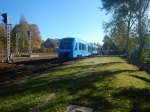


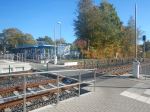
It turned out that one train had returned to the factory, so there wasn’t much to see. Coupled with the news I heard earlier about Not Enough Drivers, I suspect that the Germans seem to be suffering in the same way, as we are on the introduction of new trains.
Will Alstom Use The Buxtehude To Cuxhaven Route As A Test Route For The iLint Train?
I think there are various factors that could make the route between Buxtehude and Cuxhaven stations an ideal test route for hydrogen-powered iLint trains.
Bremervörde Depot
This Google Map shows the area of Bremervörde station.
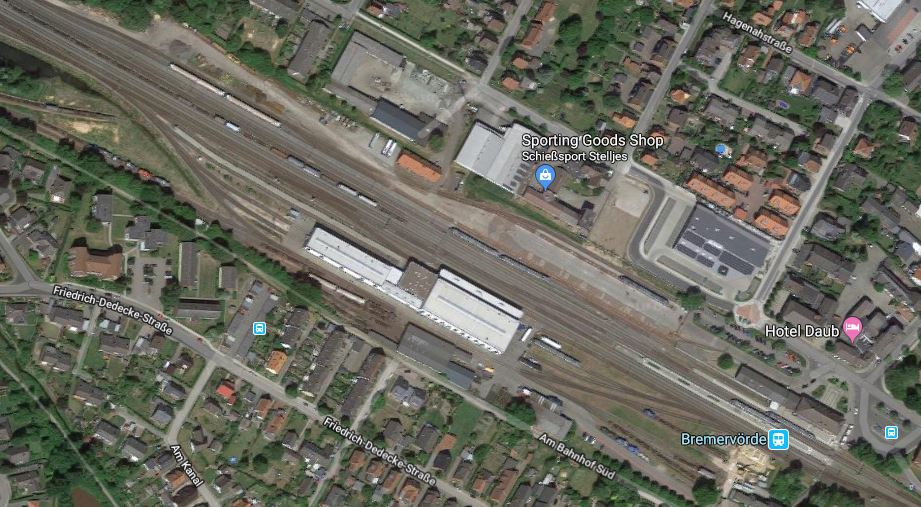
There appears to be a lot of space.
In this article on Railway Technology, which is entitled iLint: The World’s First Hydrogen-Powered Train, this is said.
As part of the deal, Alstom will provide maintenance for the trains over a 30-year period. Meanwhile, leading gas company Linde will supply hydrogen for the new trains and erect the first-ever hydrogen filling station for trains in Bremervörde. The plan is that hydrogen will be produced onsite via electrolysis and wind energy at a later stage of the project.
As I passed through Bremervörde station, on my trip to the line at the weekend, I took this picture.
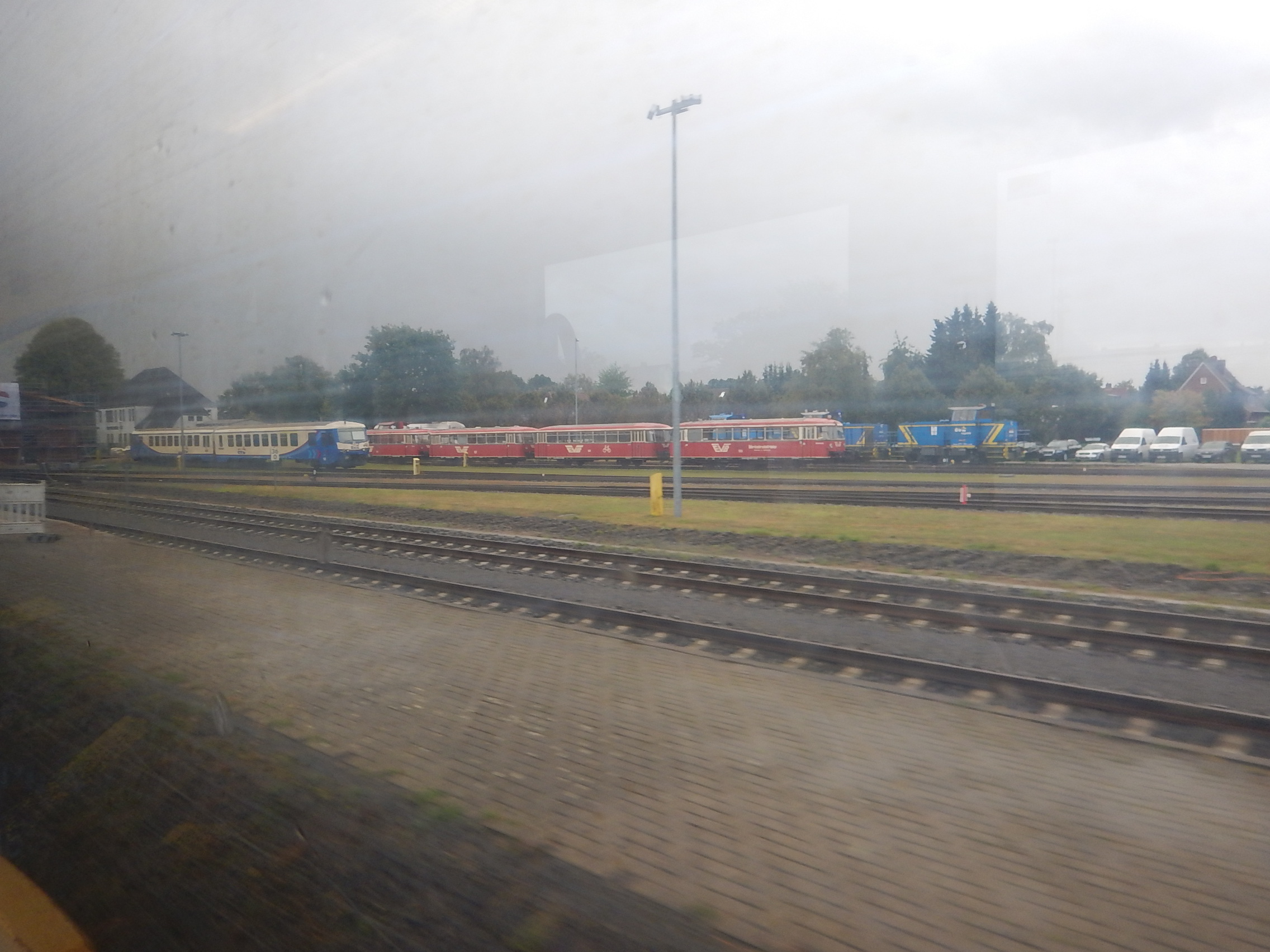
There would be plenty of space for the proposed hydrogen plant and to stable both the working fleet and any other trains, that were being tested for other places in Europe.
Linde would would only have to ensure that the hydrogen plant was sized for all future needs.
The Buxtehude To Cuxhaven Route
The route between Buxtehude and Cuxhaven has the following characteristics.
- It is about a hundred kilometres long.
- It is mainly single track except for the section through Bremerhaven, where it has at least two electrified tracks.
- There are passing places.
- The scheduled service is one train per hour (tph) in both directions.
- The line appears to have reasonably new signalling.
- There are numerous level crossings.
- I didn’t see any other traffic on the line, but I suspect there must be extra paths for freight, service trains, empty stock movements and a heritage service that uses part of the route.
I suspect that it could make an ideal test route, if extra trains could be squeezed in between the scheduled service.
Distance From the Salzgitter Factory
The Lint trains are built at in a factory at Salzgitter, which is between Hanover and Bruaunwieg, which is about four hours away.
The iLint trains could do this making their own small amounts of steam, but they would probably be dragged by a diesel locomotive.
Testing An Electric iLint
I think that we’ll eventually see a pantograph on the iLint, for one of three reasons.
- It would allow running on overhead electrification to charge the battery and reduce hydrogen consumption.
- It would allow creation of a diesel/electric hybrid version, that might be a lower capital cost alternative for shorter lines.
- It would create a battery.electric hybrid for short extension routes.
Alstom could possibly create a range of solutions for a wide range of applications.
The Buxtehade To Cuxhaven route includes a section of electrified line, which would surely be ideal for the testing of these trains.
Conclusion
I think that Alstom will use the route to test hydrogen-powered trains.
A Sighting Of The Two Coradia iLint Hydrogen Trains
I finally got to see the two Coradia iLint trains, parked at Bremervörde station.

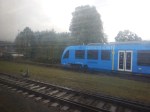
On bahn.de they were talking about weather warnings, so perhaps Alstom and the operator were just being prudent. After all they didn’t want another Hindenburg disaster!
Not that there’s much chance of that these days when modern materials are used to build safe methods of hydrogen storage.
 The Anonymous Widower