Sheffield’s Information-Free Buses And Trams
I chose the Leopold Hotel, as it was in the centre by a tram stop, which made it easy to get to and from the match at Hillsborough. It also meant that to get to the hotel from the train, I just went to the tram stop and used my Freedom Pass to go a few stops up the hill.
But when I arrived at the stop, all it had was details on the tram route. But there was no sign of any local map. As I’d spotted the hotel from the tram before it stopped, I just walked a few metres down the hill and round the corner.
I had planned to have an early supper with an old friend, at the new Carluccio’s on Ecclesall Road. He’d said I’d needed to get an eighty-something. So I walked and found this bus stop.
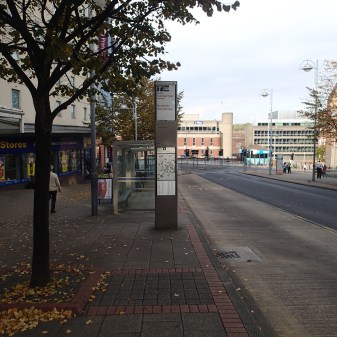
The World’s Most Useless Bus Stop
Note that is says “Buses Do Not Stop Here on the sign. It didn’t have any information that a visitor might like to use to get to the Ecclesall Road. There was no information and nobody around to answer my question.
I eventually walked a couple of hundred metres the other way and found a guy, who told me that any bus from a particular stop went down the Ecclesall Road. The queues incidentally at the stop was manic, mainly because the ticketing system required many to give money to the driver. As usual I had to put my Freedom Pass down and pick up a printed ticket.
And when I did get on a bus, there was no way, I could tell where I was, as it was a silent bus. Luckily, I knew roughly, where I was going and I knew there was a Waitrose on the corner of Ecclesall Road. But I still ended up walking further than I wanted.
At least I could read the name on the bus stops, but how do the visually-impaired manage?
The bus wasn’t that full for the rush hour and that helped me look out. But I still had to fight my way to the front to get out.
If ever a city needed London’s bus spider maps and cash free buses it is Sheffield. How many more passengers would they get, if the buses and trams were organised with the same objectives as London in mind?
But the worst thing about the buses, was coming back from Ecclesall Road was that the buses seemed to have stopped running.
In the end I had to pay £6 for a taxi.
How visitor-friendly is that?
At least when I need to go to Sheffield in the future, I now know that unless I’m going to somewhere near a tram stop, the best course of action will be to stay at home.
Could London’s Passenger Counting Technology Look For Non-Payers?
I took another trip on a crowded 141 bus today and it had the passenger counting technology on board.
Passengers were fascinated and obviously some were using it to determine whether to go upstairs.
It struck me that as those entering the bus have to touch-in, by correlating this with spaces, it might be possible to determine how many passengers hadn’t touched-in.
It wouldn’t actually identify them individually, but by simple arithmetic it could probably identify routes with the highest levels of non-payers.
So if a particular area on route XX showed a high-level of non-payers, that is obviously where you send your inspectors.
Transport for London’s Latest Plot To Get Us To Climb Stairs
London’s buses are effectively computer terminals and displays, that just happen to carry passengers about the city.
These pictures that I took on route 141, show the latest software upgrade.
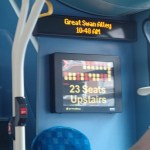

The clock has been shown on the Next Stop display for some time, but the display, showing how many spare seats are on the upper deck, is new.
Will it help to increase the loading of buses? The only problem, is that the system is not as attractive as a comely conductress calling politely for everybody to please move along the bus!
There’s more about the technology here on the IanVisits web site.
And Now We’ve Got A Blue Bus!
Adidas really know how to annoy Londoners, as they’ve now given us this disgusting blue bus.
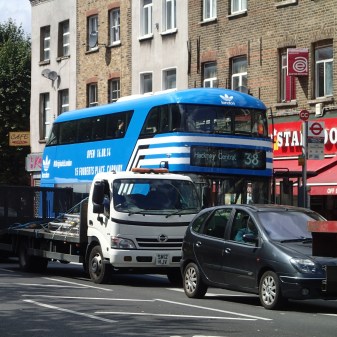
And Now We’ve Got A Blue Bus!
The colour annoyed me so much, that I’ve decided to create the tag, Crap Marketing, in its honour.
A Road Death Database
The BBC has put together a database of all road deaths in the UK from 1999 to 2010.
I have looked at some areas and you can draw some interesting conclusions.
If I look at a typical London Borough like Hackney, the number of deaths is generally between 70 and 90. But some rural areas, despite less population have figures well over a hundred.
And then there’s the Oxford and Cambridge effect. Oxford has 34 deaths and Cambridge has just 16. Both these cities have extensive Park and Ride networks, good bus services and bikes are used quite a bit. But then Ipswich and Norwich also have low figures, but Colchester, Milton Keynes and Peterborough are higher.
So does a decent public transport network cut road deaths, as the drunks and the bad drivers are on the buses rather than in their cars?
If you look at the big northern cities like Liverpool, Leeds, Manchester and Newcastle, the figures would appear to be similar, but Newcastle is a lot less. Why?
Only by a serious analysis can we tell what is the reason!
Are Transport for London Doing Bit Of Route Proving?
I noticed this evening that London bus route 453 is to be Routemasterised next month.
I obviously don’t have the figures that TfL do, but is it a choice with a lot of implications for future public transport in the capital.
Route 453 has its Northern terminus at Marylebone, which is on the Bakerloo line. The route then calls at the following stations, which are also on that line.
- Baker Street
- Oxford Circus
- Piccadilly Circus
- Charing Cross
- Lambeth North
- Elephant and Castle
It then continues to New Cross, New Cross Gate and a couple of places mentioned as possible stops on the Bakerloo Line Extension.
As buses these days have extensive data collecting capabilities through Oyster, are TfL hoping to get specific traffic information, that might help in deciding where and when to extend the Bakerloo line? They might also be hoping that a quality bus route might flush out a few more passengers. The numbers using route 38, since the full Routemasterisation in May, certainly hasn’t decreased markedly, although in the summer there have been a few half-empty buses.
TfL obviously knows what to expect, as they have now converted several routes to New Routemasters.
But the only fact we know about traffic changes when New Routemasters take over a route, is that no statistics have been published.
I’d have loved to write a software system to analyse bus route performance.
It’ll be interesting to see how it all works through in the future.
If I take the route I know best, the 38, what would happen if the buses got to be very full?
I am drawn to the conclusion, that all TfL would do, would be to draft a few more buses on the route, which will be very easy, if there is only one type working the route.
Try doing that in a hurry with a tram route!
Inflated Balloons Are Allowed On Birmingham Buses
Unlike in Liverpool, inflated balloons are obviously allowed on Birmingham buses, as no-one objected to this group of people doing so.
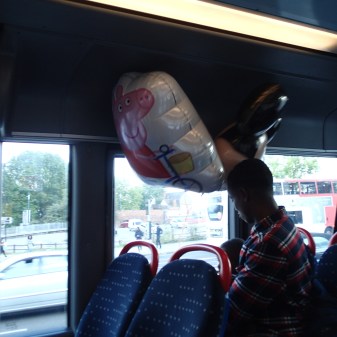
Inflated Balloons Are Allowed On Birmingham Buses
Why should Liverpool have a ban, when no-one else seems to?
A Routemaster Of My Own
London is very quiet at the moment, as the well-off seem to have gone to Chelsea on Sea and Chiantishire and the plebs to the costas. This bus today was so quiet that I was the only passenger.
It did liven up a bit, when the tail gunner joined, as she was a bubbly Italian girl from Mestre near Venice.
I wonder how her currently good English will be honed on the platform of a new Routemaster?
London’s Plans For Trams
In TfL’s Transport Plan for 2050, trams don’t get much of a mention.
The document talks in vague terms about increasing frequency and capacity on the existing Tramlink and about extending it to Sutton.
So does this mean that effectively any new tram routes are off the agenda as TfLbelieves like I do after seeing the operation of bus route 38 in recent months, that new Routemaster buses are a more flexible and affordable option.
Are The Hackney Flyers The World’s First Bus-Trams?
With the publication of Boris Johnson’s vision of transport in London in 2050 , it would seem that we have the vision of transport sorted. The report’s plans for rail are detailed here in Modern Railways. Here’s a flavour.
The draft includes plans to maximise capacity of and extend Tube services, and approve Crossrail 2. ‘Further Crossrail projects may be required’ – an east-west alignment is mentioned, but with no specific proposals at this stage. Working with Network Rail, there is also huge opportunity to double capacity on the capital’s rail network, says the plan, and upgrades to main radial routes are outlined.
But all the reports and commentators seem to miss, the quiet revolution that is taking place in Hackney and several other places in London.
The most common journey I do, is get a bus from just round the corner from my house to the Angel or perhaps further. I have a choice of three buses to the Angel; the 30, 38 or 56.
When I moved here four years ago, the service wasn’t bad, but I often had to wait what seemed to be a few minutes.
A few months ago, the route 38 was converted to brand-new Routemasters and now everybody seems to choose one of these Thomas Heatherwick-designed buses if you have a choice, if say a 56 and a 38 arrive together.
Perhaps it’s because they get to the Angel faster, which they seem to do. Not that I’ve measured it! It may be just a perception. But they are definitely more comfortable and better if you’ve got shopping or parcels with you.
All buses have improved further since buses went cashless, as no longer does the driver wait whilst he sorts out passengers with cash.
The Transport Plan does mention buses, but only briefly.
However, after the experience here in Hackney, is London doing enough to use the humble bus to ease London’s transport problems?
I believe for instance, that if say you were thinking of running a tram between say Kings Cross and Elephant and Castle, you could create a dedicated bus lane and run a squadron of two-man operatord Routemasters on the route!
It would be more affordable than the tram and if say you got the route slightly wrong, all you’d need to do would be to move a few kerbs and white lines and tell the drivers about the new route. There would of course, be no construction chaos, like they had in Edinburgh.
If say you replace the route with an Underground line, the buses just get redeployed and you remove the road markings.
So did Thomas Heatherwick design the Hackney Flyer or the world’s first bus-tram?
 The Anonymous Widower