French Companies Unite On Superconducting Cable Project For Distant Offshore Wind Farms
The title of this post, is the same as that of this article on offshoreWIND.biz.
This is the sub-heading.
Air Liquide, CentraleSupélec, ITP Interpipe, Nexans, and RTE have joined forces to develop a project that connects distant offshore wind farms to shore via a High Voltage Alternating Current (HVAC) superconducting transmission system.
This introductory paragraph adds some detail.
The SupraMarine demonstrator project will study the electrical connection between offshore wind farms and the coastline using High-Temperature Superconducting (HTS) cables. Cooled by liquid nitrogen, the cables are said to transport electricity with near-zero energy loss.
Note.
- No details of the target distances are indicated.
- There is a detailed exploratory diagram.
It is certainly an ambitious project, but I feel it could have substantial uses.
I have a few thoughts and questions.
Can Sodium Metal Be Used For High Voltage Electrical Underground Cables?
Google AI answers this question as follows.
Yes, sodium metal was investigated and used in trial runs for high-voltage underground electrical cables in the late 1960s and early 1970s, as a potentially cheaper and more flexible alternative to copper and aluminum. However, it is not in common use today due to safety concerns and unfavorable lifecycle economics compared to aluminum.
When I was at ICI around 1970, they were researching the use of sodium for high voltage power cables.
- ICI had access to large amount of sodium chloride in Cheshire.
- The sodium metal can be obtained by electrolysis.
- Renewable electricity for electrolysis will be plentiful.
- Someone told me that their prototype cable was a polythene pipe with Sodium metal in the middle.
- I’ve read somewhere that sodium cables have interesting safe overload properties.
- I can understand the safety concerns and unfavorable lifecycle economics, especially where water is concerned.
Perhaps, French technology has improved in the sixty years?
Will Sodium Metal Be Used In The French Superconducting Cable?
Nothing has been disclosed!
But the office chat at ICI from those, who knew their sodium and their polythene, as they’d been working at ICI Mond Division for decades, was of the opinion that sodium/polythene cables were possible!
From The Diagram, It Looks Like Power Is Needed At Both Ends Of The Superconducting Cable
The diagram shows wind turbines at one end and the grid at the other end of the cable.
So will a battery or some other form of stabilisation be needed for when the wind isn’t blowing?
Will The French Superconducting Cable Have A High Capacity?
The basic capacity of a cable depends on three properties.
- The resistance of the cable.
- The cross-section area of the cable.
- The design of the cable must also be able too conduct away the heat generated by electricity flowing through.
Will The Technology Work For Interconnectors?
I don’t see why not!
Is Carbon Black Used To Make Offshore Electrical Cable?
I asked Google AI, the answer to this question and received this answer.
Yes, carbon black is extensively used to make offshore electrical cables. It serves two primary functions: providing electrical conductivity to specific components and offering UV protection to outer jacketing materials.
That seems a positive answer.
It also could be a very complementary one.
HiiROC have a process that splits any hydrocarbon gas including natural gas, chemical plant off gas and biomethane, into turquoise hydrogen and carbon black.
Two methods of bringing energy to the shore from an offshore wind farm are electricity and hydrogen, through a cable or pipe respectively.
This looks to me, that there could be a possibility to use one of Baldrick’s cunning hybrid plans to bring energy onshore using both hydrogen and electricity.
Effectively, the transmission and use of the system, would use both the hydrogen and carbon black produced by HiiROC.
Prysmian Completes HVDC Submarine Cable Testing
The title of this post, is the same as that of this article on renews.biz.
The article has this sub-heading.
The ‘first’ 525kV extruded wire can increase maximum transmission capacity up to more than 2.5GW.
This paragraph gives the implications of this new maximum transmission capacity.
This will enable a massive increase of the maximum transmission capacity of bi-pole systems up to more than 2.5GW, which is more than double the value achieved with 320kV DC systems currently in service, Prysmian said.
As in the future we will have many more large offshore wind farms in the UK, this surely must mean that we will find connecting them up a lot easier.
A Mess Of Cables
Cables seem to come with the ability to get tangled. I just had to sort this mess out today.
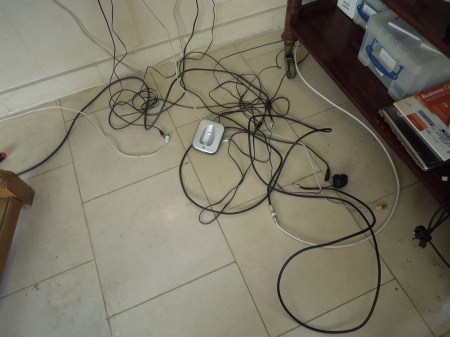
A Mess Of Cables
Roll on the day, when everything is wireless!
 The Anonymous Widower