Class 710 Trains And Software Problems
There is a lot of chatter in various web sites and publications, and from some London Overground employees, that the late arrival of the Class 710 trains, is down to bugs in the train software.
I have heard or read phrases like “computers-on-wheels” and “thirteenth software upgrade”, which surely doesn’t bode well.
I am reminded of something said, by a Senior Maager of a Computer Company at a conference in the 1960s.
If it takes, one man a year to write a program, then it will take two men, two years and two hundred and fifty-six men, two hundred and fifty-six years.
I have written a lot of software and generally my work was accepted as good. Or at least, no-one ever told me anything I wrote was rubbish!
My guess is that Bombardier have used too many programmers and many are too far from Derby.
Gospel Oak-Barking Fleet Plan Remains Unclear
The title of this post is the same as that of this article on Rail Magazine.
In the article, there is a picture of 378232 at Barking station.
According to the Wikipedia entry for Class 378 trains, this unit is listed as being four-cars and TBA (To Be Allocated?)
So is it a spare train, that is used for driver and staff training and route proving?
It was certainly doing the latter at Barking.
The Situation On The Gospel Oak To Barking Line Is Critical
This page on the Barking-Gospel Oak Rail User Group web site is their latest newsletter, which was issued on the 14th of January.
These are the headlines on the newsletter.
- Train Service On Brink Of Collapse
- Not Enough Trains For Viable Service
- TfL Has No Idea When New Trains Will Be Fit For Service
- Rail Users Demand Mayor Takes Action To Restore Reliable Train Service Now
- Rail Users Demand Compensation After Years Of Misery
It’s all strong stuff.
Trains that work are urgently needed to replace the diesel Class 172 trains, which will all leave by the end of April or even March.
Possible Replacement Trains
These types of trains have been touted as replacement trains.
Class 315 trains
TfL has started to send some Class 315 trains, made redundant by TfL Rail, for scrapping.
Could some of these be held back for use on the Gospel Oak to Barking Line?
- They should fit the route.
- London Overground already runs these trains to Cheshunt, Chingford and Enfield Town.
- The expertise and driving experience must be there to run a service.
But, as there have been no reports of any Class 315 trains on the route, I suspect that there’s a reason, why these trains can’t fill the gap.
Could it be the disability regulations, which kick in at the end of 2019?
The proposed Class 710 rains ordered for both Gospel Oak to Barking Line and the Watford DC Line are dual voltage.
As the Willesden TMD was built to handle trains with the ability to use third-rail electrification, is this ability needed to access the depot?
But Class 315 trains are 25 KVAC only, so this could mean they are unsuitable.
Class 365 Trains
Class 365 trains got ScotRail out of trouble, but like the Class 315 trains, they are 25 KVAC only, so may have the same stabling issues.
They would also be a new train class for London Overground.
Class 319 Trains
Class 319 trains are dual-voltage and could probably be used on both routes, but they would need a refurbishment and would also be a new train class for London Overground.
Class 378 Trains
Class 378 trains already work the Watford DC Line and after the test of a four-car unit to Barking, London Overground probably know how difficult, it would be for four-car trains to work the route.
The trains are dual-voltage and London Overground’s strategy of basing trains for both routes at Willesden TMD would probably be possible.
Drivers and other staff know them very well, as do the passengers.
I am drawn to the conclusion, that of the trains available in the event of non-delivery of Class 710 trains, the Class 378 trains are the best choice.
How Many Trains Are Needed For The Gospel Oak To Barking Line?
The full service was run by a fleet of eight Class 172 service.
As the same number of Class 710 trains have been pencilled in for the route, I must assume that this is the number of trains required. I think six trains are needed for the service, with two in reserve or maintenance.
How Many Class 378 Trains Are Needed For A Full Overground Service?
If I go through the routes of the original Overground, I find the following.
Dalston Junction And Clapham Junction
Trains take 46 minutes to go South and 44 minutes to come North and a round trip would take two hours.
This means thatthe current four trains per hour (tph) service would need eight trains.
Dalston Junction And New Cross
Trains take 22 minutes both ways and a round trip would take an hour.
This means that the current four tph service would need four trains.
Highbury & Islington And Crystal Palace
Trains take 44 minutes to go South and 43 minutes to come North and a round trip would take two hours.
This means that the current four tph service would need eight trains.
Highbury & Islington And West Croydon
Trains take 52 minutes both ways and a round trip would take two hours.
This means that the current four tph service would need eight trains.
Euston And Watford Junction
Trains take 47 minutes to go South and 50 minutes to come North and a round trip would take two hours.
This means that the current three tph service would need six trains.
Stratford And Richmond/Clapham Junction
Between Stratford and Richmond, trains take 59-64 minutes to go West and 62 minutes to come East.
Between Stratford and Clapham Junction, trains take 62 minutes to go West and 64 minutes to come East.
The round trip times are very similar and are around two and a half hours.
This means that the current eight tph service would need twenty trains.
Summarising, these services gives.
- Dalston Junction and Clapham Junction – 8 trains
- Dalston Junction and New Cross – 4 trains
- Highbury & Islington and Crystal Palace – 8 trains
- Highbury & Islington and West Croydon – 8 trains
- Euston and Watford Junction – 6 trains
- Stratford and Richmond/Clapham Junction – 20 trains
This gives a total of 54 trains. As there are fifty-seven Class 378 trains, this means there are three spares to cope for maintenance and breakdowns.
London Overground have plans to increase frequencies and they are detailed in this table.
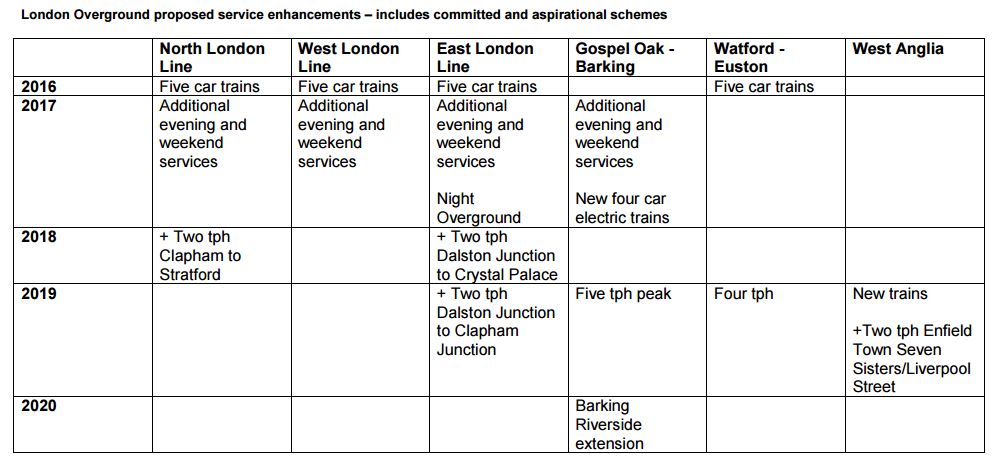
Note that four extra services are planned for the East London, North London and Watford DC Lines.
- Two extra tph between Stratford and Clapham Junction, which has already been implemented.
- Two extra tph between Dalston Junction and Clapham Junction. This would mean that twelve trains would be needed for this service.
- Two extra tph between Dalston Junction and Crystal Palace. This would mean that twelve trains would be needed for this service.
- One extra tph between Euston and Watford Junction. This would mean that eight trains would be needed for this service.
Summarising again gives.
- Dalston Junction and Clapham Junction – 12 trains
- Dalston Junction and New Cross – 4 trains
- Highbury & Islington and Crystal Palace – 12 trains
- Highbury & Islington and West Croydon – 8 trains
- Euston and Watford Junction – 8 trains
- Stratford and Richmond/Clapham Junction – 20 trains
This gives a total of 64 trains.
As London Overground only has 57 Class 378 trains, this proposed timetable is impossible without some new Class 710 trains.
London Overground plan to use some of the Class 710 trains to release Class 378 trains from the Watford DC Line, to reinforce East London Line services.
So it looks like the late delivery of the Class 710 trains has also scuppered London Overground’s plans to increase services on the East London Line.
How Many Class 378 Trains Could Be Scraped Together?
This table shows the number of Class 378 trains needed for the current service.
- Dalston Junction and Clapham Junction – 8 trains
- Dalston Junction and New Cross – 4 trains
- Highbury & Islington and Crystal Palace – 8 trains
- Highbury & Islington and West Croydon – 8 trains
- Euston and Watford Junction – 6 trains
- Stratford and Richmond/Clapham Junction – 20 trains
This gives a total of 54 trains. With just three trains spare.
As the Gospel Oak to Barking Line needs eight trains to run a full service, this is not enough.
What strategies can be applied to increase the number of trains available?
Reduce The Stratford And Clapham Junction Service To Two tph
The Stratford and Clapham Junction service was two tph until recently, when it was raised to four tph.
Reducing it back to two tph, would reduce the number of trains required on Stratford and Clapham/Richmond services by five.
This would give eight spare trains, which would be almost enough to run a full service on the Gospel Oak to Barking Line.
Provided of course, that there was a hundred percent availability, which is rather an impossible dream.
Introduce The Class 710 Trains On The Watford DC Line
The Class 710 trains for the Gospel Oak to Barking Line are dual-voltage trains, which will also run on the Watford DC Line. So would it be a sensible idea to introduce these trains first on the Watford DC Line?
- The third-rail electrification on the line is at least fifty years old, so must be fully tested.
- The drivers have extensive route knowledge of running electric trains on the route.
- Willesden TMD, where the Class 710 trains are stabled, is on the Watford DC Line.
- The route is only shared with the Bakerloo Line.
- The route is to be equipped with six Class 710 trains anyway.
Every Class 710 train introduced will release a Class 378 train.
But if the Class 710 trains don’t work, this is no help!
Introduce The Class 710 Trains On The North London Line
Running on the North London Line is more complicated than the Watford DC Line, but five-car Class 710 trains, are planned for this route.
They could be introduced to release Class 378 trains.
The Four-Car Train Problem
Every four-car train created means that a trailer car is removed from a five-car Class 378 train.
I would assume that it is most likely, these spare cars will be put into store until the, the new Class 710 trains finally enter service.
Or would they be added to other Class 378 trains to create six-car trains, which would then be run on the North or West London Lines, where the platforms could be almost long enough? Selective door opening on the trains could also be used at short platforms.
Conclusion
I feel if the London Overground swap trains around and perhaps reduce the Stratford and Clapham Junction service to its old level of 2 tph, then enough Class 378 trains would be available to run a full four-car service on the Gospel Oak to Barking Line.
Do Aventras Use Supercapacitors?
In this article in Global Rail News from 2011, which is entitled Bombardier’s AVENTRA – A new era in train performance, gives some details of the Aventra’s electrical systems. This is said.
AVENTRA can run on both 25kV AC and 750V DC power – the high-efficiency transformers being another area where a heavier component was chosen because, in the long term, it’s cheaper to run. Pairs of cars will run off a common power bus with a converter on one car powering both. The other car can be fitted with power storage devices such as super-capacitors or Lithium-ion batteries if required. The intention is that every car will be powered although trailer cars will be available.
Unlike today’s commuter trains, AVENTRA will also shut down fully at night. It will be ‘woken up’ by remote control before the driver arrives for the first shift
This was published over seven years ago, so I suspect Bombardier have refined the concept.
The extract makes three interesting points.
All Or Most Cars Will Be Powered
In A Detailed Layout Drawing For A Class 345 Train, I give the formation of a Crossrail Class 345 train.
DMS+PMS+MS1+MS3+TS(W)+MS3+MS2+PMS+DMS
Note.
- M signifies a motored car.
- Eight cars have motors and only one doesn’t.
- The train is composed of two identical half-trains, which are separated by the TS(W) car.
- There are four wheelchair spaces in the TS(W) car.
Are the MS!, MS2 and MS3 cars identical?
In addition, I have been told, that all cars in Class 720 trains are motored.
It does seem that Bombardier have fulfilled their statement from 2011.
Remote Wake-Up
This is mentioned in the extract, but there are few other references to it. I quoted a report from the Derby Telegraph, which has since been deleted, in Do Bombardier Aventras Have Remote Wake-Up?.
Supercapacitors And Lithium-Ion Batteries
According to the extract, the trains have been designed to accept supercapacitors or lithium-ion batteries if required.
As the other two statements in the extract appear to be likely, I will continue to believe that all Aventras can have some form of energy storage.
Crossrail
I’ll look first at Crossrail’s Class 345 train.
In How Much Energy Does A Crossrail Class 345 Train Use?, using the train’s data sheet, I came to the conclusion, that electricity usage of the trains is 2.67 KWh per car per kiometre or 3.29 KWh per car per mile.
In the linked post, I also calculate the kinetic energy of a fully-loaded nine-car Crossrail train.
I’ll repeat it.
- If I take a nine-car Class 345 train, this has a mass of less than 350 tonnes and a maximum speed of 145 kph.
- 1500 passengers at 80 kg each works out at another 120 tonnes.
- So for this crude estimate I’ll use 450 tonnes for the mass of a loaded train.
This gives the train a kinetic energy of 101 KWh.
As the Class 345 trains are effectively two half trains, with two PMS cars with pantographs, it is likely that they have at least two cars that are ready for supercapacitors or lithium-ion batteries.
The Design Of Crossrail
Crossrail could best be described as the Victoria Line on steroids.
- Both lines were designed to run in excess of twenty-four trains per hour (tph) across London.
- The Victoria Line was built to deep-level Underground standards, with one of the most advanced-for-its-time and successful train operating systems of all times.
- Crossrail is a modern rail line being built to National Rail standards, with world-leading advanced technology, that takes full account of modern environmental standards and aspirations.
Costs were saved on the Victoria Line by leaving out important parts of the original design..
- The route was cut back to Walthamstow Central, from the proposed terminus at Walthamstow Wood Street or possibly South Woodford or Woodford.
- Some stations like Highbury & Islington were built to a totally inadequate low-cost design.
- Third escalators at stations were changed into stairs.
- Step-free access was non-existent at the opening, but has been added to some stations since.
- Cross platform interchange with the Chingford Branch Line was left out at Walthamstow Central station.
Costs were saved on Crossrail, by using high-quality design.
- Crossrail and the Great Western Main Line electrification share a sub-station to connect to the National Grid.
- The number of ventilation and access shafts was reduced significantly, with one in a new office block; Moor House.
- Electrification uses a simple overhead rail, which is only fed with power at the ends.
I also believe that the Class 345 trains, which were designed specifically for the route, were designed to save energy and increase safety in the tunnels.
Regenerative braking normally saves energy by returning braking energy through the electrification, so it can be used to power other nearby trains.
Batteries For Regenerative Braking
However, in recent years, there has been increasing interest in diverting the braking energy to onboard energy storage devices on the train, so that it can be used when the train accelerates or to power systems on the train.
The system has these advantages.
- Less energy is needed to power the trains.
- Simpler and less costly transformers can be used for the electrification.
- The onboard energy storage can be used to power the train after an electrification failure.
- In tunnels, there is less heat-producing electricity flowing in all the cables.
Obviously, keeping the heat down in the tunnels is a good thing.
A Station Stop On Crossrail Using Regenerative Braking And Energy Storage
Imagine a fully-loaded train approaching a station, at the maximum speed on 145 kph.
- The train will have a kinetic energy of 101 kWh.
- As it approaches the station, the brakes will be applied and the regenerative brakes will turn the train’s energy into electricity.
- This energy will be stored in the onboard energy storage.
- As the train accelerates away from the station, the electricity in the onboard energy storage can be used.
The only problem, is that regenerative braking is unlikely to recover all of the train’s kinetic energy. But this is not a big problem, as the train draws any extra power needed from the electrification.
To make the system as efficient as possible, the following must be fitted.
- The most efficient traction motor.
- Onboard energy storage capable of handling the maximum kinetic energy of the train.
- Onboard energy storage with a fast response time.
The train will probably be controlled by a sophisticated computer system.
What Size Of Onboard Energy Storage Should Be Fitted?
Obviously, this is only speculation and a best guess, but the following conditions must be met.
- The onboard energy storage must be able to capture the maximum amount of energy generated by braking.
- The physical size of the energy storage system must be practical and easily fitted under or on the train.
- The energy storage system should be able to store enough energy to be able to move a stalled train to safety in the event of complete power failure.
Note that an energy storage system with a 100 kWh capacity would probably take the train somewhere around four to five kilometres.
Obviously, a series of computer simulations based on the route, passengers and various other conditions, would indicate the capacity, but I feel a capacity of around 120 kWh might be the place to start.
Where Would The Energy Storage Be Placed?
With nine cars, and with eight of them motored, there are a several choices.
- One energy storage unit in all motored cars.
- One energy storage unit in the three MS cars.
- One energy storage unit in each half train.
I’ve always liked the concept of an energy storage unit in each powered car, as it creates a nice tight unit, with energy stored near to where it is generated and used.
But there is another big advantage in splitting up the energy storage – the individual units are smaller.
Could this mean that supercapacitors could be used?
- The main need for onboard energy storage is to handle regenerative braking.
- The secondary need for onboard energy storage is for emergency power.
- There is no needon Crossrail as yet,to run the trains for long distances on stored power.
- Supercapacitors are smaller.
- Supercapacitors can handle more operating cycles.
- Supercapacitors run cooler.
- Supercapacitors have a fast response.
If running for longer distances were to be required in the future, which might require lithium-ion or some other form of batteries, I’m sure there will be space for them, under all those cars.
I wouldn’t be surprised to find out that Crossrail’s Class 345 trains are fitted with supercapacitors.
Note, that a Bombardier driver-trainer, talked of an emergency power supply, when I asked what happens if the Russians hacked the electrification.
Class 710 Trains
London Overground’s Class 710 trains are a bit of a mystery at the moment as except for a capacity of seven hundred passengers disclosed in this article on the International Railway Journal little has been published.
Here are my best guesses.
Formation
Based on the formation of the Class 345 trains, I think it will be.
DMS+PMS+MS+DMS
Effectively, this is a half-train of a seven-car Class 345 train, with a DMS car on the other end.
Dimensions
I have a Bombardier press release, which says that the car length is twenty metres, which is the same as Class 315, Class 317 and Class 378 trains and a whole load of other trains, as twenty metre cars, were a British Rail standard.
I doubt there will be much platform lengthening for these trains in the next few years.
Weight
The Wikipedia entry for Aventra gives car weight at between thirty and thirty-five tonnes, so the train weight can be anything between 120-140 tonnes.
Passenger Capacity
I wrote about this in The Capacity Of London Overground’s New Class 710 Trains.
This was my conclusion.
It appears that seven hundred is the only published figure and if it is, these new Class 710 trains are going to substantially increase public transport capacity across North London.
They are certainly future-proofed for an outbreak of London Overground Syndrome, where passenger numbers greatly exceed forecasts.
As some of the trains are being delivered as five-car units, there is always the option of adding an extra car. Especially, as the platforms on the line, seem to have been built for five or even six car trains.
London Overground have not made the platform length miscalculations of the North and East London Lines.
For the near future they’ll hold around 700 passengers at 80 Kg. each, which means a passenger weight of fifty-six tonnes.
Full Train Weight
For various train weights, the fully-loaded trains will be.
- 120 tonnes – 176 tonnes
- 130 tonnes – 186 tonnes
- 140 tonnes – 196 tonnes
Until I get a better weight for the train, I think I’ll use 130 tonnes or 186 tonnes, when fully-loaded.
Speed
I wrote about this in What Is The Operating Speed Of Class 710 Trains?.
This was my conclusion.
But what will be the operating speed of the Class 710 trains?
I said it will be somewhere between 145 kph (90 mph) and 160 kph (100 mph)
Consider.
- I think that 145 kph, will be able to handle the two planned increased frequencies of four tph.
- 145 kph is identical to the Crossrail trains.
- 160 kph is identical to the Greater Anglia trains.
- 160 kph seems to be the speed of suburban Aventras.
It’s a difficult one to call!
I do think though, that trundling around the Overground, they’ll be running at the same 121 kph of all the other trains.
Kinetic Energy
The kinetic energy of a 186 tonnes train at 121 kph is 29 kWh.
Could Supercapacitors Handle This Amount Of Energy?
I’m pretty certain they could.
Conclusion
Supercapacitors are a possibility for both trains!
I’ll review these calculations, as more information is published.
Will The East London Line Ever Get Six-Car Trains?
On the East London Line yesterday, I was in the front car and it was noticeable how passengers moved backwards and forwards along the train so they could find a seat and also get in and out easily at the stations with short platforms.
It got me thinking, about whether six-car trains could be run on the East London Line.
Before I discuss this, I’ll give a few facts. Some are history and some are future plans.
The Original Line
I can remember taking the London Underground era line between New Cross Gate and Whitechapel stations, to get between Haywards Heath and Mile End stations. I had a client at the former and my youngest son, used to live by the latter.
The trains were four-car A60/62 Stock with a length of just 65 metres!
There were five intermediate stations, which coming North were as follows.
- Surray Quays
- Canada Water
- Rotherhithe
- Wapping
- Shadwell
The platforms and those at Whitechapel, were probably not much longer than the original trains.
The platforms have been improved in recent years.
- When the Jubilee Line was built, Canada Water station was rebuilt, but the platforms on the East London Line were not substantially lengthened.
- When the Overground was created in the early part of this century, the platforms ended up at their current length of around eighty metres.
- Recently, to create a better interchange for Crossrail, the platforms at Whitechapel station have been lengthened to around a hundred metres.
So there is now four short platforms on the East London Line.
The Class 378 Trains
The Class 378 trains were originally ordered as three-car trains, which were about sixty metres long.
Was this short length to fit the short platforms or was it because it was felt that these trains would be adequate for the route?
By the time, the trains entered service in 2010, the trains had all been extended to four-cars.
But this was still inadequate and in 2013 an order was placed to lengthen all trains to five cars, which was completed in January 2016.
Fitting Five-Car Trains Into Four-Car Platforms
Travel in the last coach of a train between Shadwell and Canada Water stations and when a station stop is made, you are left in the tunnel.
Some or all the doors don’t open and a announcement tells you, that if you want to get out, you should move forward in the train. This picture shows the last carriages of a train at Canada Water station.
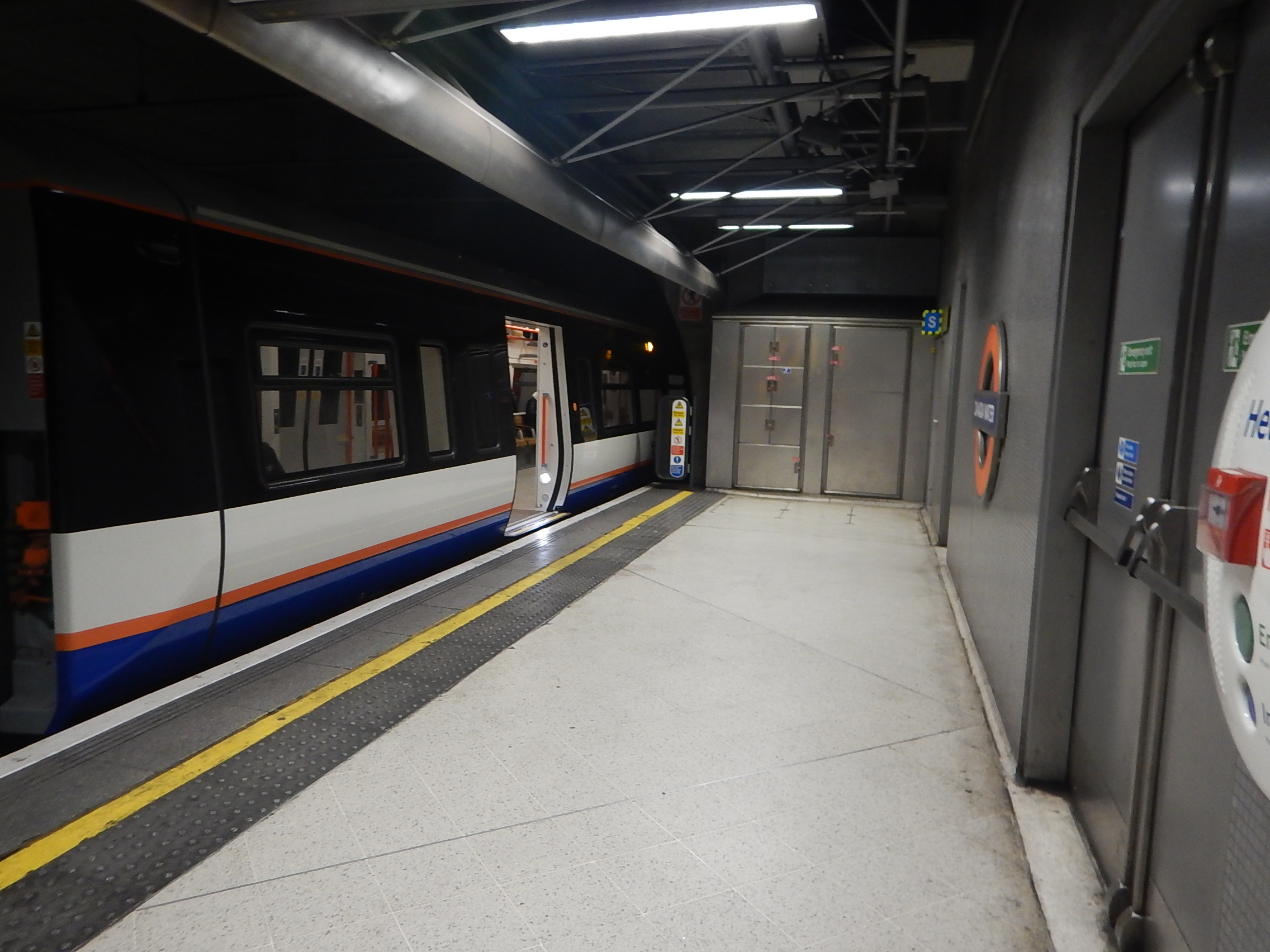
The less-than-perfect arrangement works very well.
- The walk-through nature of the trains means passengers can easily walk forward if required.
- The announcements are numerous and clear.
- Only Canada Water station, with its interchange to the Jubilee Line is a busy station.
But what probably makes the system work so well, is the fact that East Londoners are the World Champions at ducking and diving and they adjust their behaviour to the less-than-perfect arrangement.
The Length Of The Northern Platforms
Travelling home to Dalston Junction station in the last carriage, I got the impression, that all platforms are built to comfortably accept five-car trains.
It also appears that the two central bay platforms at Dalston Junction station were built for five-car trains.
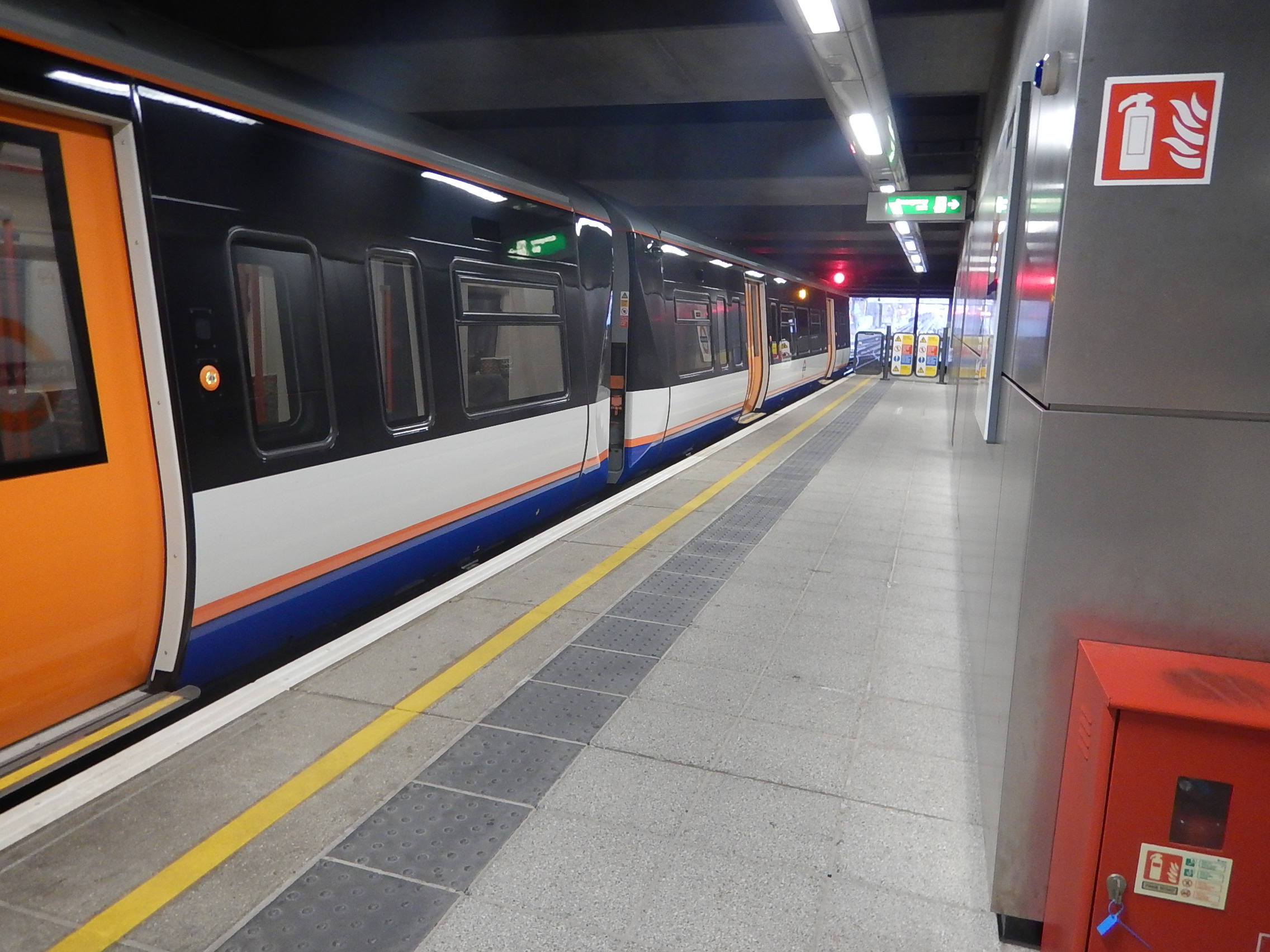
This picture shows Platform 2 at Dalston Junction station.
The Length Of The Southern Platforms
I have looked at nearly all the Southern platforms on all four Southern branches and there seems to be few if any platforms, that couldn’t take a six-car train. It should be noted that most platforms are shared with Southern services which are run by longer trains.
These pictures show Sydenham station.
Platform lengths like these are typical of many stations.
Work would be needed at Platform 2 at Clapham Junction station.
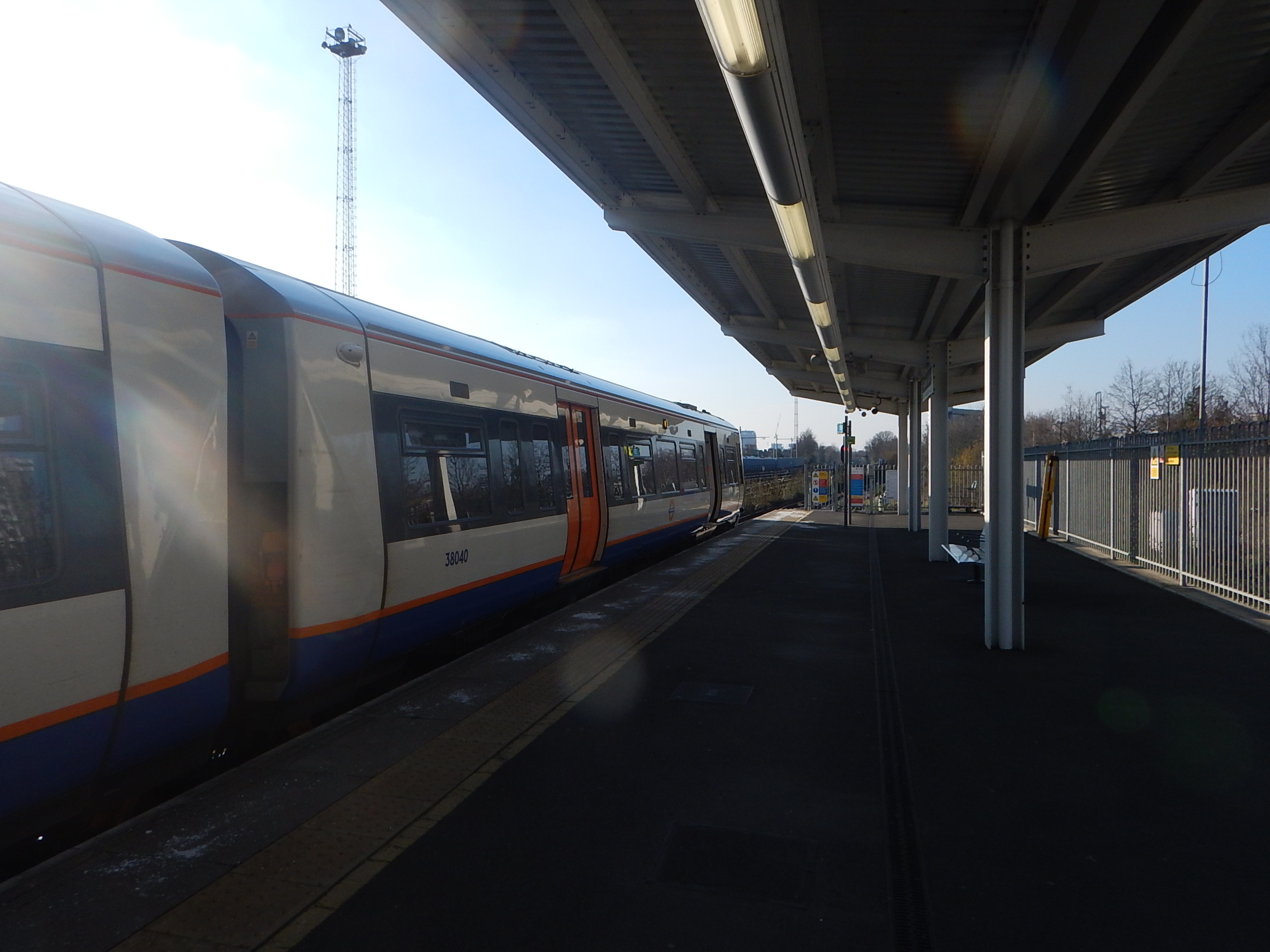
But there is space to extend the platform.
There are no problems at West Croydon station, where it seems all trains now use the bay Platform 1.

There appear to be no plans to increase services to West Croydon station from four tph, but turning the trains in the bay platform might make scheduling easier.
The Rebuilding Of Whitechapel Station
Whitechapel station is being rebuilt to provide an interchange between Crossrail, the District and Hammersmith & City Lines and the East London Line.
- The rebuilt East London Line platforms appear to be long enough for six-car trains.
- There will be two footbridges over the East London Line.
- There will be lifts and possibly escalators.
It will be a major high-capacity interchange.
The connection to Crossrail at Whitechapel station may actually take pressure from the Canada Water station.
Will passengers from the Northern section of the East London Line change at Whitechapel for Crossrail, if they are going to the West End or Canary Wharf, rather than using the Jubilee Line from Canada Water station.
As Crossrail will open up a large number of new routes, I believe, Whitechapel station will become one of the most important interchanges in East London.
East London Line Frequency Will Be Increased
This table shows Transport for London’s plas for the London Overground.
Note.
- In 2018, two extra trains per hour (tph) are planned to be run between Dalston Junction and Crystal Palace.
- In 2019, two extra tph are planned to be run between Dalston Junction and Clapham Junction.
This will mean that the frequency through the core of the East London Line will rise from 16 tph to 20 tph. This will be a train every three minutes.
It also means that the London Overground will be running ten tph between Whitechapel and Sydenham stations, with a call at New Cross Gate, which could become an important interchange.
Platforms Would Need To Be Lengthened
I think that, unless someone can come up with an innovative solution, that there will need to be some platform l;lengthening to accommodate six car trains on the East Londoin Line.
The tricky problem would be extending the platforms at Shadwell, Wapping, Rotherhithe and Canada Water stations.
Could Frequencies Be Increased?
After the increase of frequencies to Crystal Palace and Clapham Junction to four tph, there will be twenty tph, through the core of the East London Line.
With five-car trains, this would be a hundred cars per hour and with six-car trains, it would be 120 cars per hour.
Suppose another four tph, were to be squeezed through the core, then this would be 24 tph. With five-car trains, this would be 120 cars per hour.
There would be two main alternatives to increase the frequency.
- Run six tph on all the four routes.
- Add a new route, with a frequency of four tph.
Note.
- Twenty-four tph, is a frequency that is proposed for Crossrail and Thameslink using digital signalling.
- There will be one train every two and a half minutes.
- No major engineering work would be required at the stations with short platforms.
I very much feel, that increasing the frequency of trains, will be more affordable than using six-car trains.
The Problem Of Creating Six-Car Trains
Note these points about running trains through the core of the East London Line.
- Class 378 trains have an end door, so that passengers can be evacuated in the Thames Tunnel.
- Aventras don’t have end doors and would need to be updated.
- Five-car Class 378 trains can be replaced by Aventras on the North London Line and the Watford DC Line, to release more trains for the East London Line.
But the biggest problem, is probably that Bombardier don’t make Electrostars any more, and the factory ihas been turned over to Aventra production.
Conclusion
I will be very surprised if Network Rail’s original plan on six-car trains on the East London Line happens in the next few years.
Thoughts On The Lateness Of Crossrail
This article on the BBC is entitled Crossrail Delay: New London Line Will Open In Autumn 2019.
This is the first paragraph.
London’s £15bn Crossrail project is to open nine months after its scheduled launch to allow more time for testing.
I spent most of my working life, writing software for the planning and costing of large projects and despite never having done any serious project management in anger, I have talked to many who have, both in the UK and around the world.
So what are my thoughts?
Crossrail Is A Highly-Complex Project
The project involves the following.
- A 21 km double-track tunnel under London.
- New Class 345 trains
- Four different signalling systems.
- Rebuilt stations at West Drayton, Hayes & Harlington, Southall, West Ealing, Ealing Broadway. Acton Main Line, Forest Gate, Manor Park, Ilford
- Refurbished stations at Hanwell, Maryland, Seven Kings, Goodmayes, Chadwell Heath, Romford, Gidea Park, Harold Wood, Brentford and Shenfield.
- Major interchanges with existing stations at Paddington, Bond Street, Tottenham Court Road, Farrington, Liverpool Street, Whitechapel and Stratford.
- New stations at Custom House, Canary Wharf, Woolwich and Abbey Wood.
Some parts are easy, but a lot are very difficult.
A Shortage Of Specialist Workers
I believe that certain factors could be reducing the pool of workers available to Crossrail.
Less workers than needed would obviously slow the project.
Having to pay more than budgeted to attract or keep workers will also raise costs.
My thoughts on what is causing a possible shortage of specialist workers follow.
Crossrail-Related Development
If you own a site or a building, near to one of Crossrail’s stations, then your property will substantially increase in value, when the line opens.
Walk past any of the Crossrail stations in Central London and some further out and you will see towers sprouting around the station entrance like crows around a road-kill.
Developers know how to cash-in on the best thing that has happened to them since the Nazis flattened acres of Central London.
New sites are also being created over several Crossrail stations including Moorgate, Farringdon (2 sites), Tottenham Court Road (2 sites), Bond Street (2 sites) and Paddington.
But do all these extensive developments, mean that there are not enough sub-contractors, specialist suppliers, electricians, chippies, air-conditioning engineers, plumbers and other trades to do all the work available in London?
I also suspect a developer, building an office block to the world’s highest standard could pay better and faster, than a Crossrail supplier under pressure.
Underground Working
Working underground or in mining is dangerous.
In the 1960s, women were totally banned from working below the surface.
It must have been around 1970, when I met one of ICI’s archivists; Janet Gornall, who a few years previously had organised storage of their masses of historical documents, in the company’s salt mine at Winsford. The mine is still used for document storage, by a company called Deepstore.
Health & Safety found out that Janet would be supervising and indexing the storage underground, so that if any document was required, they could be easily retrieved. This caused them to give the scheme a big thumbs down.
Questions were even asked in the House of Commons, but nothing would change Health & Safety’s view
In the end a simple solution was found..
- As the boxes came up from London they were piled up in a large building on the surface, in the position Janet wanted them underground.
- The pile of boxes was then moved underground and stacked in exactly the same way.
- Nowadays, anybody can work underground, but they must have training and be certified for such work.
Crossrail thought the number of certified underground workers might not be enough, so they set up the Tunnelling and Underground Construction Academy (TUCA) at Ilford. This article on the Crossrail web site is entitled A Legacy To The Construction Industry.
Some points about TUCA.
- It is now part of Transport for London.
- It was funded by Crossrail and the Skills Funding Agency.
- TUCA is Europe’s only specialist soft-ground tunnelling training facility.
I wrote about TUCA in Open House – TUCA, after a visit in 2012.
I was told on my visit, that the Swiss have a similar facility for rock tunnelling and that there were plans for both academies to work together.
Trainees from all over the world would get training in an exotic Swiss mountain and then go on to enjoy the wonders of Ilford.
But at least they’ll be safe workers for all types of tunnelling.
I do wonder if some of the Crossrail delays has been caused by a lack of properly trained underground workers, as now the tunnelling is completed, many have moved on to the next project.
Thames Tideway Scheme
The Thames Tideway Scheme is a £4billion scheme to build a massive sewer under the Thames to clean up the river.
Many Crossrail engineers, tunnellers and workers are now working on the new scheme.
Brexit
Stuttgart 21 is one of numerous mega-projects in Europe.
Many of the workers on Crossrail were originally from Europe and now with the uncertainties of Brexit, some must be moving nearer home, to work on these large European projects.
Well-Paid Jobs In Sunnier Climes
Don’t underestimate, the effect of the Beast From The East last winter.
Skilled personnel have always gone to places like the Middle East to earn a good crust.
With Crossrail under pressure, how many of these key workers have gone to these places for the money?
Conclusion
I wouldn’t be surprised to find that a shortage of specialist workers is blamed for the delays.
In the BBC article, there is this quote
We are working around the clock with our supply chain and Transport for London to complete and commission the Elizabeth line.
Fairly bland, but does the supply chain include specialist suppliers and workers, which are under severe pressure from other projects to perform various works?
It’s probably true that there is only a finite pool of these companies, tradesmen and workers and at least some of the best will have been lured away.
Station Problems
In this article in the Architects Journal, which is entitled Crossrail Delayed Until Autumn 2019, this is said.
Crossrail then revealed in February that it had overspent its budget for the year to 30 March 2018 by £190 million.
At the time TfL said works at Whitechapel station, designed by BDP, and Farringdon station, designed by AHR, were completed later than expected, and there were delays to work at Weston Williamson’s Woolwich station and John McAslan + Partners’ Bond Street station.
I’ll look at Whitechapel station as an example.
You don’t need to be an expert to figure out that Whitechapel station is running late.
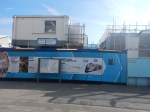

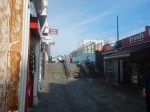

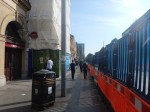

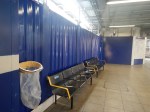
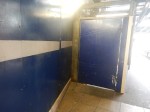
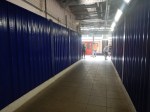
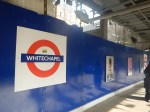
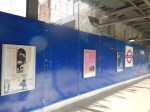
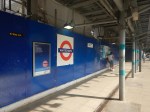
Look at all the blue hoardings.
- I know this only shows what is visible to the public.
- The Crossrail platforms deep underground could be ready.
- The main entrance to the station is still shrouded in plastic.
- The escalators to get down to Crossrail, will be between the two District/Metropolitan Line platforms.
This Google Map shows the area of Whitechapel station.
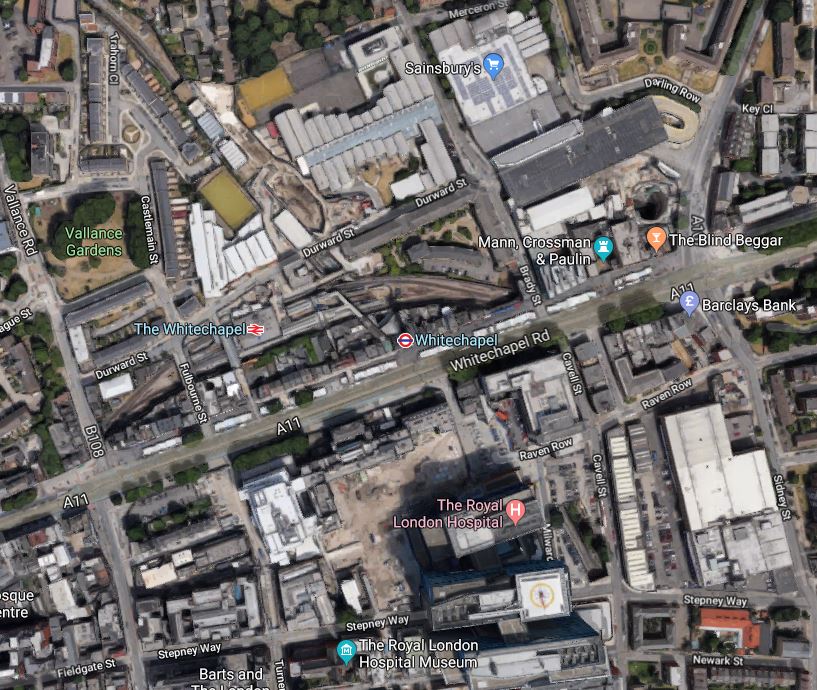
Note how the site is hemmed in, by important buildings including a Sainsburys supermarket and Swanlea School.
See An Innovative Use Of The School Holidays, for an insight about how the builders of the station coped with the lack of space.
I also feel that Whitechapel is an incredibly complex station to build.
- It is crossed by two important railways; the District/Metropolitan Line and the East London Line.
- Innovative techniques from the coal mining industry had to be used to dig the escalator tunnel.
- Whitechapel will be the station, where passengers change between the two Eastern branches.
I do wonder, whether a different design would have been easier to build.
For instance, could Sainsburys have been paid to shut their superstore and that site used to build the station?
But Crossrail has chosen a design and now they must build it.
The New Class 345 Trains
The new Class 345 trains for Crossrail are an almost totally new design called Aventra by Bombardier, that I believe has been specifically created to make the operation of Crossrail as efficient as possible.
The trains must have something about them, as since launch they have attracted five more substantial orders, from five different operators.
The introduction into service of the Class 345 trains, has been reasonably straightforward, but not without some issues.
But I do question, the launching of Aventra trains solely on a line as complex as Crossrail.
Would it have been easier to have built the Class 710 trains first and thoroughly debugged them on the Gospel Oak to Barking Line.
But then that electrification was late.
Four Types Of Signalling
Crossrail needs trains to have four different types of signalling.
- CBTC – Communications-Based Train Control
- ETCS – European Train Control System
- AWS – Automatic Warning System
- TPWS – Train Protection & Warning System
I know that as Crossrail runs on other lines with these signalling and going to a single system like ETCS would need to the changing of signalling systems on much of the railways in the South-East and the trains that use them.
It appears that there are problems for the trains running into Heathrow and one of the reasons for the Crossrail delayed opening, is to allow more time to test the trains and the signalling.
From my experience of writing complex software systems, where my software needed to interface with two operating systems, I know that you can never put too much time into testing complex systems.
So where is the dedicated test track, where trains can simulate the signalling of Crossrail routes, day in and day out?
I believe that not enough time and money was allocated to test this complex system.
Crossrail has found out the hard way.
Europe Has A Lack Of Train Test Tracks
A lot of European nations are ordering new trains and the UK is probably ordering more than most.
Reading the railway stories on the Internet, there are lots of stories about trains being brought into service late. And not just in the UK, but in Germany and Italy for example.
Crossrail identified that there was a need for a training academy for underground workers.
Did anybody do the calculations to make sure, there was enough test tracks for all the trains being built in Europe?
However, it does look as though Wales is coming to rescue Europe’s train makers, as I describe in £100m Rail Test Complex Plans For Neath Valley.
I suspect Crossrail wish this test complex had been completed a couple of years ago.
A Shortage Of Resources
For successful completion of projects on time and on budget, there must be enough resources.
I believe that, when the lateness and overspend on Crossrail is analysed, shortage of resources will be blamed.
- Shortage of people and suppliers, that has not been helped by other projects taking advantage of new opportunities offered by Crossrail.
- Shortage of space for work-sites at stations.
- Shortage of places to fully test trains and signalling.
I suspect that the last will be the most serious.
Hugo Rifkind On A Late Crossrail
In an excellent article in today’s copy of The Times entitled Leavers Have A Cheek Trying To Block HS2, Hugo Rifkind says this about Crossrail.
You think we’ll remember, 50 years from now. that Crossrail took six months longer than expected?
Rubbish. London will rest on it like a spine and boggle that we ever managed without.
I think Rifkind is right.
Will Hutton
Will Hutton has written this article in the Guardian, which is entitled Don’t Moan About Crossrail. Once Complete, It Will Be A Rare Triumph In Our Public Realm.
He says this.
Let’s sing a different tune. The railway line, more than 60 miles long, linking Reading and Heathrow in the west to Shenfield and Abbey Wood in the east – adding 10% to London’s commuter rail capacity – and set to carry around 200 million passengers a year, will be a fantastic achievement. Its 13-mile-long tunnels run more than 100ft under the capital’s streets, navigating everything from underground sewers to the deep foundations of skyscrapers with superb engineering aplomb. The longstanding reproach is that Britain can’t do grand projects. Crossrail, now christened the Elizabeth line, is proof that we can.
He then goes on to criticise the structure of the construction project, the salaries paid and the current Government.
But I suspect that in a few yeas time, Hutton, Rifkind and myself could have a quiet pint and say Crossrail got it right.
Current Developments That Will Help Bridge The Delay
It’s not as if, no new transport developments won’t happen in the time before Crossrail eventually opens in Autumn 2019.
Trains Providing More Capacity
These trains will be providing extra capacity.
- New Class 717 trains will be running on the services to and from Moorgate station.
- New Class 710 trains will be running on the Gospel Oak to Barking Line.
- New Class 710 trains will be running on the Lea Valley Lines to Cheshunt, Chingford and Enfield Town stations.
- New Class 710 trains will be running on the Watford DC Line.
- Cascaded Class 378 trains and new Class 710 trains will be running extra services on the original circular service of the London Overground.
- More Class 345 trains will be providing all of Crossrail’s services to Heathrow and Shenfield.
- New Class 720 trains or something similar or older, will be providing four trains per hour (tph) between Stratford and Meridian Water stations.
Note that before the end of 2019, nearly a hundred new trains will be delivered.
New And Rebuilt Stations
There will be some new or rebuilt stations.
- Acton Main Line
- Forest Gate
- Gidea Park
- Hayes & Harlington
- Manor Park
- Maryland
- Meridian Water
- Northumberland Park
- Tottenham Hale
- West Drayton
- West Ealing
- West Hampstead
This list may contain other stations.
Underground Improvements
There will also be Underground improvements.
- The Central Line Improvements Programme will increase capacity and reliability on the Central Line.
- The Metropolitan Line is being upgraded with new signalling.
- Up to ten Underground stations may be made step-free before the end of 2019.
The improvements to the Central and Metropolitan Lines, through Central London will compensate for the delaying of Crossrail’s core tunnel.
A Few Questions
I have to ask questions.
Will The High Meads Loop Be Used?
This would provide an excellent interchange between the following services.
- Local services to Hertford East and Bishops Stortford stations, including the new STAR service, along the West Anglia Main Line.
- Stansted Express and Cambridge services to and from Stratford.
- Fast Greater Anglia services to Chelmsford, Colchester, Southend and further, along the Great Eastern Main Line.
- Crossrail services between Liverpool Street and Shenfield.
- Central Line services.
There is also only a short, but tortuous walk to the Jubilee Line for London Bridge and Waterloo stations and Central London.
Based on the experience of the Wirral Loop under Liverpool, which handles sixteen tph, I believe that the High Meads Loop could handle a substantial number of trains, that instead of using the crowded lines to Liverpool Street station, would use the new uncrowded route from Tottenham Hale to Stratford via Lea Bridge station.
Moving services to Stratford from Liverpool Street would also free up platforms at the major terminus, which could be used to provide extra services on the Great Eastern Main Line.
The extra capacity might also enable the lengthening of the Crossrail platforms at Liverpool Street to be extended, so they could take full-length Class 345 trains.
No new extra infrastructure would be required at Stratford, although in future, a platform to connect the loop to Stratford International station would be nice.
I will be very surprised if the High Meads Loop is not used creatively in the future.
Will Some New Pedestrian Tunnels At Stations Like Liverpool Street And Paddington Be Opened?
I use Moorgate and Liverpool Street stations regularly.
There are blue walls everywhere, behind which the Crossrail infrastructure is hiding.
I do hope Crossrail and Transport for London are looking at the possibilities of using completed infrastructure to create new walking routes in stations to ease congestion.
Conclusion
Crossrail was designed to be opened in four phases over two years.
I am drawn to the position, that because of various resource shortages and the testing of trains, perhaps the project could have been arranged as perhaps a series of smaller projects delivered over a longer period of time.
At Least Three Class 710 Trains Were Hiding At Willesden TMD
Today, I spotted at least three Class 710 trains hiding behind Willesden TMD.


You certainly can’t miss them with their orange fronts.
Latest On The New London Overground Class 710 Trains
The August 2018 Edition of Modern Railways has a two-page article on the latest on the new Class 710 trains for the London Overground.
Seating Arrangement
Wikipedia says this about the seating.under Background And Specifications.
The units will be delivered in two sub-classes; an AC-only version with longitudinal and transverse seating (very similar to the S8 units on the Metropolitan line of the London Underground) for use on the West Anglia and Romford-Upminster services, and a dual-voltage version with longitudinal seating for the Watford DC and GOBLIN services.
But it now appears that all the seats on the trains will be longitudinal ones.
I use the current trains a lot to go to Walthamstow and I also use the Class 378 trains, which have longitudinal seats, frequently on the North and East London Lines of the Overground.
I probably aren’t bothered too much about longitudinal seats, but I suspect there will be others who will complain.
This discussion of RailForums is entitled Annoying Things About The Class 378. Search for “seat” and you don’t find many complaints about the longitudinal seating, which is also used on much of the Underground.
On the other hand, if all the trains have identical interiors, this must save on construction and maintenance costs.
If the interiors are basically similar to the Class 378 trains, it must also save on staff training costs.
I actually think, that the biggest complaint will not be about the new trains, but why don’t the older Class 378 trains have wi-fi and USB charging points!
Eight-Car Trains On West Anglia Routes
The article also states that services on West Anglia routes to Cheshunt, Chingford and Enfield Town stations will work as eight-car trains or a pair of four-car trains.
If they are always working in pairs, why not build them as eight-car trains in the first place?
In A Detailed Layout Drawing For A Class 345 Train, I said that the formation of a Class 345 train for Crossrail is as follows.
DMS+PMS+MS1+MS3+TS(W)+MS3+MS2+PMS+DMS
Note.that the train is composed of two identical half-trains, which are separated by the TS(W) car.
As the Modern Railways article says that these trains are to be the last to be delivered, would it not be sensible to fully understand the four-car units and then decide if instead of pairs of four-car units, they were built as eight-cars.
Consider.
- Trains would be formed of identical four-car half-trains.
- An eight-car Class 710 train would be nearly fifty metres shorter than a nine-car Class 345 train.
- Passengers would be able to walk through the whole train.
- Passengers can position themselves for their best exit at their destination station.
- Would passenger security be better on a train, where passengers could walk all the way through?
- I have seen drivers on Class 345 trains change ends inside the train
- Aventras and other modern trains are fitted with intelligent control systems, that determine the number and type of the intermediate cars in the train.
- Two Driving Motor Standard Cars (DMS) would be replaced with simpler Trailer Standard (TS) or Motor Standard (MS) cars.
- The choice of a TS or MS car would depend partly on performance issues, which could be tested with the earlier four-car trains.
- Building and maintenance cost savings by reducing the number of driving cars, must be possible.
- Capacity could be increased by adding cars in the middle, if platforms were long enough!
- Would providing overnight stabling for fifteen eight-car trains be easier than for thirty four-car trains?
It should also be noted, Cheshunt station has a very long platform without a roof. Passengers could walk to the front of the train inside a warm dry train. This already happens with the Class 378 trains at Highbury & Islington station.
Romford-Upminster Shuttle
The Modern Railways article says this about the service on the Romford-Upminster Line.
TfL is still considering whether to utilise a ‘710’ on the Romford to Upminster shuttle or to retain an older unit for the line.
I wrote about this in A Heritage Class 315 Train For The Romford-Upminster Line, after this article in London Reconnections, which is entitled More Trains for London Overground: A Bargain Never to be Repeated, said that it is possible that this line could be served by a Class 315 train, held back from the scrapyard.
I came to this conclusion.
If it is decided that a Class 315 train is to be used on the Romford to Upminster Line, I believe that the service could be marketed as a quirky heritage unit, that in conjunction with its main purpose of providing a public service, could also be used for other education, training, marketing, innovation and research purposes.
Eversholt Rail Group might even shift a few redundant Class 315 trains!
Why not?
Chingford Upgrades
The Modern Railways article says this.
A £7million investment has seen the stabling facility at Chingford upgraded, including the addition of an AVIS-scanner here as well.
These pictures show the investment.
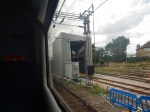
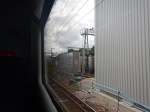
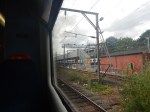
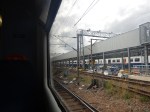



With the Automatic Vehicle Inspection System (AVIS), Chingford is becoming more than a stabling facility.
Note the large maintenance structure, so that trains can be worked on in the dry.
A Few Questions Of My Own
I have a few of my own questions.
If The Thirty Four-Car Trains For West Anglia Routes Are Converted To Eight-Cars, What Happens To The Spare Driving Motor Cars?
If the thirty four-car trains are converted to fifteen eight-car trains, it appears to me that Bombardier could have at best many of the long-lead components for thirty Driving Motor Standard (DMS) cars. At worst, they would have thirty DMS cars for Class 710 trains.
But London Overground will have need for a few more trains in a few years.
In Increased Frequencies On The East London Line, I showed this London Overground table of improvements.
LO Improvements
Note that two extra tph are proposed on the Liverpool Street to Enfield Town service. I calculate, that this would need another two Class 710 Trains.
Similarly, to add two tph to the Liverpool Street to Cheshunt service, would appear to need another three trains.
The Mayor is also looking favourably at creating the West London Orbital Railway.
I estimate that the two proposed routes would need around four trains each to provide a four tph service, if they could be run using dual-voltage Class 710 trains with a range of perhaps ten miles on battery power.
What Is Happening About The Hall Farm Curve?
I heard from someone, who should know, that the Hall Farm Curve and the Coppermill Curve will be reinstated.
These curves would allow the following.
- A direct service between Chingford/Walthamstow and Stratford.
- Better access to the upgraded stabling at Chingford.
But I think these curves would be invaluable in maintaining services, during the construction of Crossrail 2.
Will A Bay Platform Be Developed At Lea Bridge Station?
I also wonder if a bay platform will be developed at Lea Bridge station, which would enable a four tph service to be run between Lea Bridge and Chingford stations, if Chingford Branch trains couldn’t get into Liverpool Street station, because of construction works.
I certainly feel that the curves connecting the lines at Coppermill Junction will have a major part to play in the development of East London’s railways.
 The Anonymous Widower