How The Class 717 Trains Are Financed
This is a paragraph in an article in Rail Technology Magazine, which is entitled Brand-New £200m Class 707s Undergo Testing Ahead Of Autumn Roll-out.
The 25 six-car trains, financed by Rock Rail Moorgate, will be the first to be introduced in the UK using a new model for financing rolling stock. In an unprecedented move, the trains will be financed through long-term investment from pension and insurance companies.
So many of us will own a portion of these trains, through our pensions and insurance policies!
Great Northern’s Class 717s Under Test
The title of this post, is the same as that of this article on Global Rail News.
The title also says it all and it would seem that the aim of having Class 717 trains in service this year on the Northern City Line is feasible.
The article also says that twelve trains have been completed and another twelve are being built.
I suppose Siemens had an advantage, in that except for the end doors, they are probably very similar to the Class 707 trains.
A Good Timetable Change In May For De Beauvoir Town
I live in the North of an area in London called De Beauvoir Town.
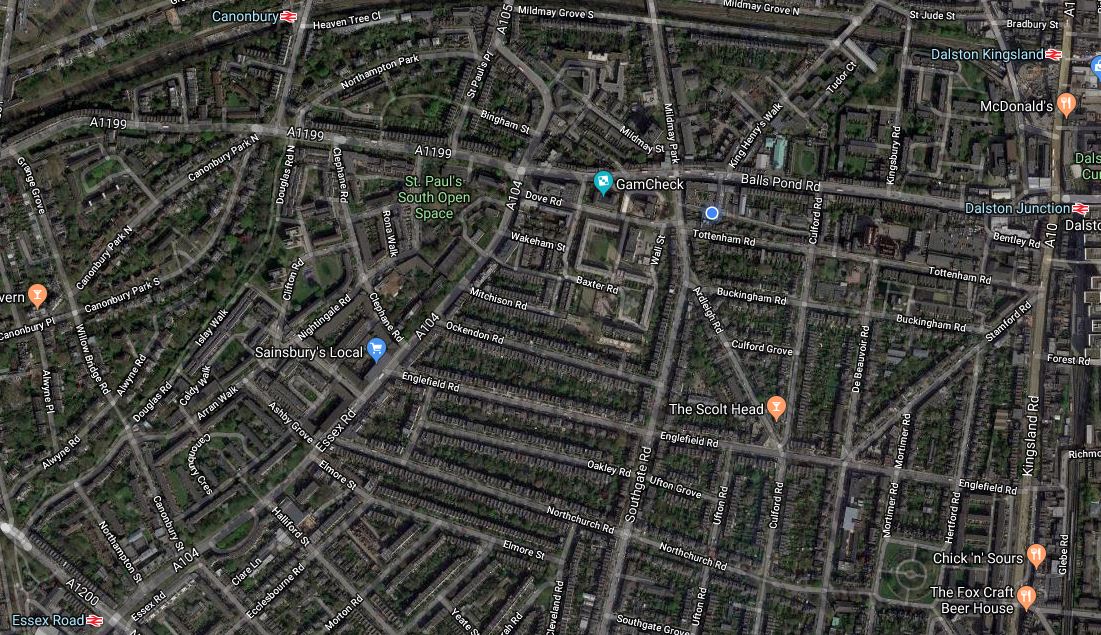
On the map, I live close to the junction of Mildmay Park/Southgate Road and the Balls Pond Road of Round the Horne fame!
The junction is a major bus interchange, with buses going regularly in all directions.
- North to Manor House, Turnpike Lane and Wood Green.
- South to Old Street, the City and London Bridge
- West to Highbury and Islington station, the Angel and the West End.
- East to Hackney, Waltham Forest and the River Lea.
All these buses was one of the reasons I moved here.
But note the railway stations ringing the area.
- Canonbury station is to the North-West about fifteen minutes walk away
- Dalston Kingsland station with its new M & S Food is a similar distance in the North-East corner of the map.
- Dalston Junction station is also in the North East corner.
- Essex Road station is in the South-West corner of the map.
But that is not all!
- Haggerston station is within walking distance on a good day, off the map to the South-East.
- Highbury and Islington station is a short bus ride off the map to the West.
- Angel station is a short bus ride off the map to the South-West.
- Manor House station is a short bus ride off the map to the North.
- Hackney Downs station is a short bus ride off the map to the East.
I can also get direct buses from local stops to Euston, Kings Cross, London Bridge, St. Pancras, Victoria and Waterloo.
From December 2018, I’ll be able to get a bus from the junction to the new Crossrail station at Moorgate/Liverpool Street.
Is there a better place to live for public transport?
On the twentieth of May, the date of the rail timetable change, things will get better.
An article on the timetable change in the May 2018 Edition of Modern Railways says this.
London Overground’s East London Line services are being recast in conjunction with the new Thameslink timetable. On the North and West London Lines, the off-peak timetable is being enhanced to match broadly the peak service, providing 8 tph between Stratford and Willesden Junction for most of the day seven days a week, with four continuing to Clapham Junction and the other four to Richmond.
London’s ugly duckling of the last century, is turning into a whole bevy of swans.
The service on the North London Line has improved several-fold since I moved here and will now be eight tph or a train every seven and a half minutes.
The East London Line will be recast, with another two tph this year to Crystal Palace station and two more next year to Clapham Junction station.
And then there’s the Northern City Line to Moorgate, that calls at Essex Road and Highbury and Islington stations!
In First ‘717’ In UK In June, I wrote about what will be happening in the May 2018 timetable change.
I said this.
From the May 2018 timetable change, the service levels will become.
- Four tph to Welwyn Garden City
- Five tph to Hertford North, with two tph extended to Stevenage or Watton-at-Stone.
- No direct services will run to Letchworth Garden City. Change seems to be a cross-platform interchange at Finsbury Park.
The service termination at Watton-at-Stone station is only temporary until Network Rail build a new bay platform at Stevenage station.
These changes mean that there will be nine tph between Alexandra Palace and Moorgate stations.
This represents a fifty percent increase in service frequency.
First ‘717’ In UK In June
The title of this post is the same as that of a short article in the May 2018 Edition of Modern Railways.
This is the first paragraph.
The first Class 717 EMU, built by Siemens for Govia Thameslink Railway’s Great Northern suburban services into Moorgate, is due to arrive in the UK in June.
The article also makes these statements, about the new Class 717 trains.
- The first unit is planned to enter service in September.
- The full fleet of 25 x 6-car units will be deployed in Winter 2018.
- The current Class 313 trains will be replaced.
- The new trains will have no toilets or First Class.
- The new trains will have power points and wi-fi.
By virtue of the cross-platform connection between the Northern City Line and Victoria Line, these trains will improve a valuable link between North East London and the City of London.
When Crossrail opens in December 2018 at Moorgate station, the Northern City Line will have a step-free below-ground connection to Liverpool Street station and all the Underground lines serving the two stations.
Ducking and diving will move to a whole new level.
What Will The New Trains Do For Me?
For my own part, if the frequency on the Northern City Line is increased, I shall use the line from Essex Road station to get to Moorgate for Crossrail and the Central Line.
I suspect my house will go up in value!
How Will The New Trains Affect The Service?
The New Trains Are Faster
The current Class 313 trains are 75 mph trains, whereas the new Class 717 trains are 100 mph trains.
This increased operating speed will have two effects, when running on the East Coast Main Line and to Letchworth Garden City.
- Time might be saved.
- As their operating speed is the same as Thameslink’s closely-related Class 700 trains, they might make keeping to time easier.
Time savings on the Hertford Loop Line, will be more difficult, as the line only has a 75 mph operating speed.
However, speed improvements on the Hertford Loop Line would surely result in faster trains to Hertford, Letchworth Garden City and Stevenage.
The New Trains Could Change Voltage Faster
Trains on the Northern City Line need to change voltage at Drayton Park station. I have observed Class 700 trains, do this on Thameslink and they do it without fuss and very reliably.
The Class 717 trains will probably use the same pantograph, so we could be seeing a smoother and faster changeover.
The New Trains Will Probably Be Ready For ERTMS
The Class 700 trains are fitted for ERTMS, so they can work the Thameslink tunnel under Automatic Train Operation.
As this method of signalling and control will be fitted to the East Coast Main Line to improve caacity, the new Class 717 trains will probably be ERTMS-ready.
It should be noted that the Hertford Loop Line has been used as an ERTMS test track and I suspect engineers know the performance improvement ERTMS would bring to the line.
I suspect in a few years, the Northern City Line and services out of Moorgate will be run automatically, with the driver monitoring the system.
The New Trains Will Stop In A Shorter Time At Stations
The new Class 717 trains will have the these advantages of modern trains over the current ones.
- They will be able to accelerate to line speed in a shorter time.
- They will be able to brake faster.
- Wider doors and larger lobbies will enable shorter loading and unloading times.
- The trains will have better systems to help the driver.
These will all result in time savings at each stops.
Currently, the four destinations have the number of stops to Moorgate.
- Hertford North – 49-53 minutes – 12 stops
- Letchworth Garden City – 75 minutes – 19 stops
- Stevenage – 68-72 minutes – 14 stops
- Welwyn Garden City – 47-48 minutes – 16 stops
Because of the high number of stops, saving a minute at each stop would speed up the train service.
Less Trains Could Be Needed For The Current Service
As an example, take the Moorgate to Letchworth service.
The current service is one train per hour (tph), which takes 75 minutes. In its simplest form, allowing for turnround at both ends, trains take up to three hours for the round trip, so three trains are needed for the service.
But if the faster Class 717 trains can save a minute at each stop and run faster on the East Coast Main Line, it might be possible to reduce the round trip to several minutes under two hours. If that is possible, then only two trains would be needed for the route.
Improve The Hertford Loop Line
With its low operating speed of 75 mph, the new Class 717 trains can’t take full sadvantage of their increased speed.
There are already plans for new bay platforms at Gordon Hill and Stevenage stations, so what other plans are being progressed to improve the Hertford Loop Line?
The New Trains Could Have Less Seats And More Capacity
I can only give a rough estimate for this as I can’t find the capacity of a Class 717 train.
These are cars, car length and capacity for various trains.
- Class 707 trains -five x 20 m. – 275 seats + 533 standing
- Class 717 trains – six x 20.2 m. – No figures.
- Class 313 trains – three x 20.2 m. – 232 seats
- 2 x Class 313 trains – six x 20.2 m. 464 seats
A rough calculation for the Class 717 train using the figures for a similar Class 707 train and adjusting for another ytailer carriage gives the following.
339 seats + 657 standing = 996 total
Incidemtally, I’ve stood on a crowded Class 707 train, and it was not an unpleasant experience, as there were plenty of handholds.
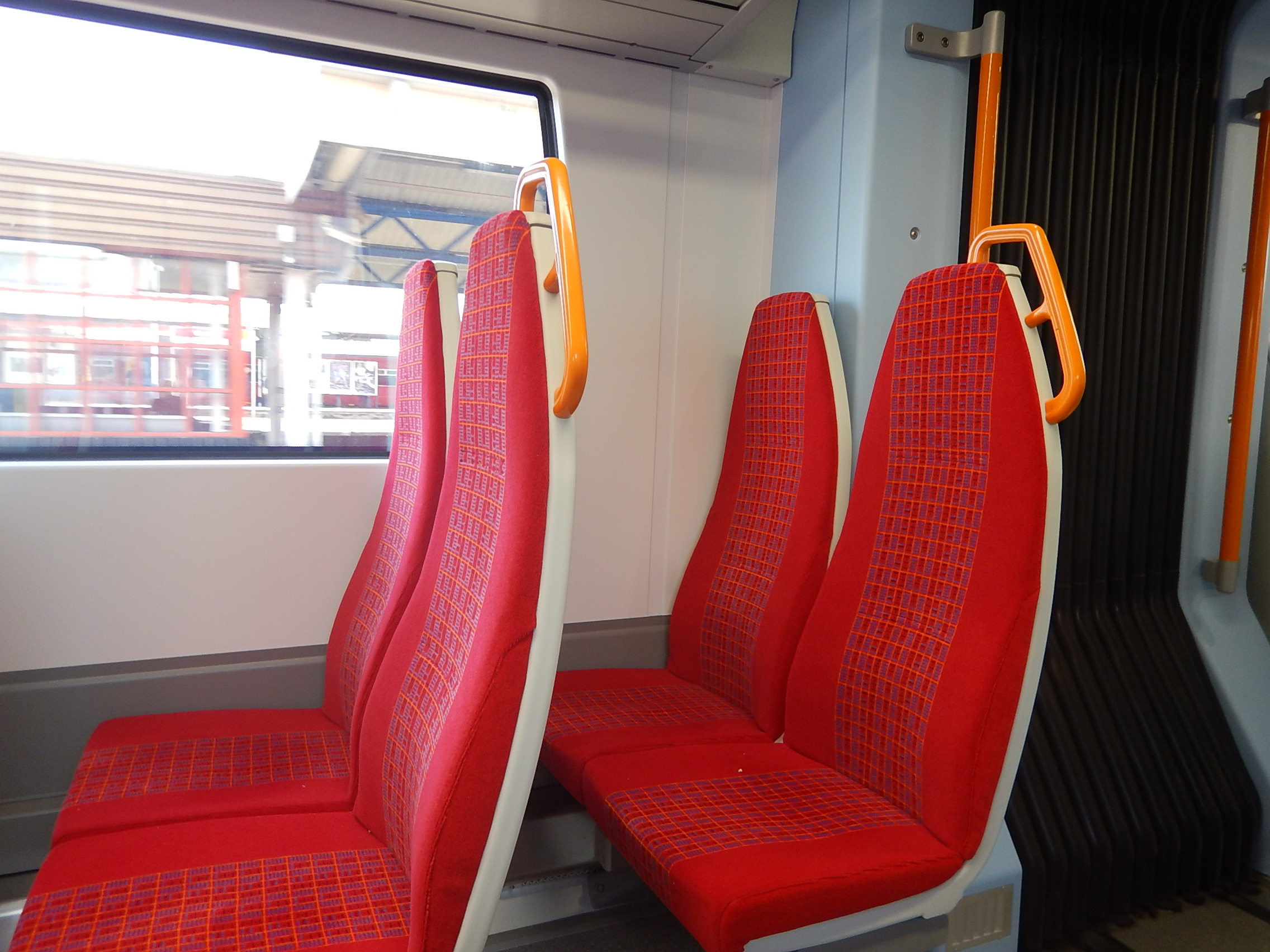
This picture shows handholds on the seats and between carriages.
I hope the Class 717 trains have 2 + 2 seating, like the Class 707 trains.
Improved Services To And From Moorgate
Current services to and from Moorgate station are as follows.
- Three tph to Welwyn Garden City
- Three tph to Hertford North, with one tph extended to Letchworth Gsrden City.
This means that there are six tph between Alexandra Palace and Moorgate stations.
From the May 2018 timetable change, the service levels will become.
- Four tph to Welwyn Garden City
- Five tph to Hertford North, with two tph extended to Stevenage or Watton-at-Stone.
- No direct services will run to Letchworth Garden City. Change seems to be a cross-platform interchange at Finsbury Park.
The service termination at Watton-at-Stone station is only temporary until Network Rail build a new bay platform at Stevenage station.
These changes mean that there will be nine tph between Alexandra Palace and Moorgate stations.
This frequency is already achieved in the Peak, from Monday to Friday. But it now appears, it will be running all day from the May 2018 timetable change.
I found this document on the Rail Delivery Group web site, which is entitled 6,400 Extra Trains A Week To Run To More Places, More Often.
It says these services will be added in 2019.
- An increase of 2 Hertford Loop trains per hour, Moorgate-Hertford
- An increase of 1 Hertford Loop train per hour, Moorgate-Stevenage
- An increase of 1 train per hour, Moorgate-Welwyn Garden City
In the May 2018 edition of Modern Railways, this is said.
New Class 717 EMUs will eplace the current Class 313s on these services from the autumn, with a further frequency boost planned in May 2019.
Adding this all together gives the following.
- Five tph to Welwyn Garden City
- Seven tph to Hertford North, with three tph extended to Stevenage.
This means that there will be twelve tph between Alexandra Palace and Moorgate stations. Or a train every five minutes.
It would appear that the overall effect of what Govia Thameslink Railway is doing is as follows.
- Restricting the running of Moorgate services on the East Coast Main Line.
- Provide a five tph Turn-Up-And-Go service from Welwyn Garden City.
- Provide a seven tph Turn-Up-And-Go service from Hertford North.
- Provide a six tph Turn-Up-And-Go Thameslink service from Stevenage.
- Provide a three tph service to Moorgate from Stevenage and Watton-at-Stone. Could it be expanded to a Turn-Up-And-Go four tph.
- Stations North of Stevenage will be served by Thameslink services to Cambridge and Peterborough.
- Thameslink services will stop at Stevenage and Finsbury Park for interchange with Moorgate services.
Will all of of this, downgrade Welwyn North station, by offering better services at Knebworth, Stevenage, Watton-at-Stone and Welwyn Garden City stations?
Consider.
- Welwyn North station handles about 600.000 passengers a year.
- Welwyn North station only has a service of two tph.
- Welwyn North station lies on the double-track section of the East Coast Main Line over the Digswell Viaduct.
- Knebworth station handles 600,000 passengers a year, but is on a four-track section of the line.
- Watton-at-Stone station, which is perhaps four kilometres to the East handles 100,000 passengers a year, but appears to be short of car parking.
I’m pretty certain, that if Welwyn North station could be closed, then the notorious bottleneck of the Digswell Viaduct could be eased.
So are Network Rail and Govia Thameslink Railway working towards a situation, where this will be able to happen.
They could do the following.
- Provide more car parking at Knebworth, Stevenage, Watton-at-Stone and Welwyn Garden City stations.
- Build a new Park-And-Ride station in South Stevenage on the Hertford Loop Line.
- Improve timings between Stevenage and Moorgate.
- Extend more Hertford North services to Stevenage. Six tph would probably be the limit for a single bay platform at Stevenage.
Shutting Welwyn North station would be controversial and heavily resisted.
How Many Trains Will Be Needed?
In May 2019, I think the service will be as follows.
- Five tph to Moorgate to Welwyn Garden City
- Four tph to Moorgate to Hertford North,
- Three tph Moorgate to Stevenage.
I’ll now look at each separately.
Moorgate To Welwyn Garden City
Trains take just under around 47-48 minutes and there are sixteen intermediate stops.
Currently, I suspect a train takes two hours to do a round trip, which would allow up to 12-13 minutes to turn round at each end.
- Three tph would need six trains.
- Four tph would need eight trains.
- Five tph would need ten trains.
But supposing the Class 717 trains, with faster running on the East Coast Main Line and faster stops could reduce this to under thirty minutes with a round trip of an hour.
- Four tph would need four trains.
- Five tph would need five trains.
Note.
- Currently, all trains are turned in Platform 4.
- Will Platform 4 be able to handle four tph after the May 2018 timetable change?
- Will Platform 4 be able to handle five tph after the May 2019 timetable change?
- There are sidings easily accessible to the North of Platform 4.
- Trains leaving Welwyn Garden City for Moorgate use a flyover to cross to the Up Slow line.
If five tph with just five trains is possible, it’s well worth achieving. But it could be a hard ask!
Moorgate To Hertford North
Trains take around 49-53 minutes and there are twelve intermediate stops.
This service would be another two hour round trip.
- Three tph would need six trains.
- Four tph would need eight trains.
- Five tph would need ten trains.
The new Class 717 trains couldn’t probably do the trip in thirty minutes, but a ninety minute round-trip would surely be possible.
- The proposed four tph would need six trains.
Note.
- Four tph is the frequency that will be running from May 2019.
- Four tph could also be easily handled in the bay platform at Hertford North station.
Any track improvement would help.
Moorgate To Stevenage
Trains take around 68-72 minutes and there are fourteen intermediate stops.
The new Class 717 trains with their faster running and faster stops, should be able to do this trip under the hour, with a possible two-hour round trip.
If this could be achieved the service would need the following trains.
- The proposed three tph would need six trains.
- Four tph would need eight trains.
Improving the Hertford Loop Line, so that the Class 717 trains could fully use their 100 mph operating speed could be key.
Summarising The Trains Needed
Summarising gives.
- Three tph between Moorgate and Stevenage would need six trains.
- Four tph between Moorgate and Hertford North would need eight trains with a two hour round trip.
- Cut that to a ninety-minute round trip and six trains could be needed.
- Five tph between Moorgate and Welwyn Garden City could possibly be run with five trains or need as many as ten.
A pessimistic answer for the number of trains could be as high as 24, which fits well with a fleet of twenty five trains.
But an optimistic solution might need.
- Six trains for Stevenage
- Six trains for Hertford North
- Five trains for Welwyn Garden City
This would leave several trains for increasing frequency.
Increasing The Service After May 2019
Improving The Hertford Loop Line
If the Class 717 trains could use their speed, this would enable faster journeys and could allow extra paths for more trains.
ERTMS On The Moorgate Lines
It is already used by Thameslink and is scheduled to be used on the East Coast Main Line.
Will it be added to the Hertford Loop Line and on the Northern City Line?
ERTMS and a degree of Automatic Train Control, could be a game changer.
Fitting the necessary equipment to the Class 717 trains, shouldn’t be the most difficult of jobs, as the system is already fitted to Thameslink’s Class 700 trains.
Increased Frequency Into Moorgate
Consider.
- Currently, in the Peak, the Class 313 trains running under control of conventional signalling manage 11 tph at times.
- From May 2019, Gover Thameslink Railway will be running 12 tph into Moorgate all day.
- Thameslink and Crossrail should be handling 24 tph, by the end of 2019.
- Brixton station on the Victoria Line handles upwards of thirty tph with two platforms.
- Transport for London and Londoners have a lot of experience about loading and unloading trains.
Look at this schematic of the vast Crossrail complex linking Liverpool Street and Moorgate stations.
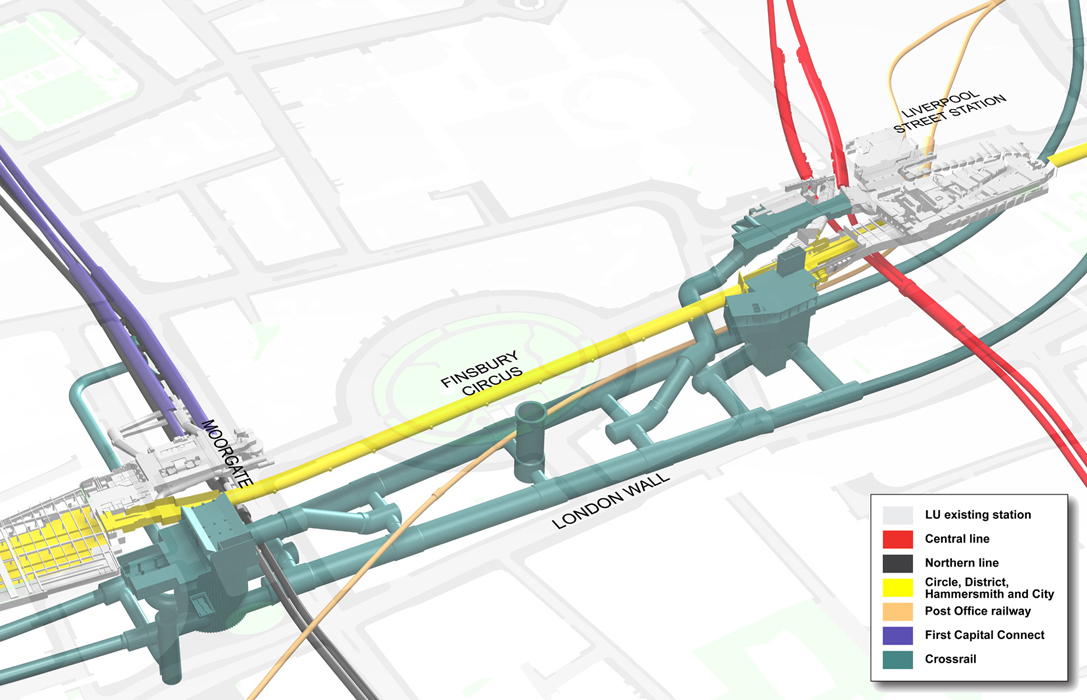
Note the Northern City Line in dark blue at the left, with a new pedestrian tunnel linking to Crossrail. This will help handle the passenger flows between Crossrail and the Northern City Line.
With ERTMS and Automatic Train Control, I wonder what, is the maximum number of trains that can be handled at Moorgate?
Twelve is obviously possible with the current infrastructure, as it is only one more than what is currently achieved in the Peak.
My experience says that with good electronic and organisational systems, that fifteen tph should be possible in both directions between Moorgate and Finsbury Park stations.
An Extra Train To Stevenage
Current plans envisage three tph between Moorgate and Stevenage.
The new bay platform at Stevenage would easily handle four tph and if the sufficient trains are available, I could see this extra service implemented.
The following frequencies would be achieved.
- Four tph – Stevenage and Watton-at-Stone.
- Eight tph – Hertford North.
The Northern City Line would obviously need to be able to handle the extra train.
Gordon Hill Station As An Extra Terminus
Gordon Hill station is sometimes used as an extra terminus to turn trains from Moorgate in the Peak.
I can see this continuing, as surely it increases the capacity at the Moorgate end of the line.
Conclusion
It will be interesting to swee how this line develops in the future.
Gibb Report – Moorgate Services Could Be Transferred To The London Overground
The Gibb Report, looks in detail at services out of Moorgate station on the Northern City Line in detail.
Note that current plans for this line include.
- New Class 717 trains to replace the Class 313 trains, which are little better than scrapyard specials.
- Higher frequency and faster services to Hertford North, Letchworth Garden City, Stevenage and Welwyn Garden City.
- Better Off Peak services.
- A step-free connection at Moorgate to Crossrail and four Underground lines.
It could also be rebranded as the Great Northern Metro.
Chris Gibbs flags up various issues with this service. He says this about the infrastructure.
25 new Class 717 six-car trains are being built by Siemens as a dedicated fleet for this route, and will be maintained by GTR at their Hornsey Depot. The line between Drayton Park and Moorgate is a former underground line transferred to BR in 1976 and partly converted for main line trains.
It retains various Underground characteristics, such as third rail electrification with a fourth return rail, and tripcocks at all signals, and I believe Old Street and Moorgate stations are owned by London Underground as part of shared stations, and are in need of modernisation. The track and signalling is owned and operated by Network Rail.
I would add a personal observation. Highbury and Islington station is a station where the below-ground platforms are in desperate need of improvement and step-free access. Over the last year or so, with GTR’s labour troubles, the operation of the station at times, has not been smooth, much to the exasperation of London Underground/Overground staff.
Chris Gibbs also notes several issues with the employment of staff after 2018.
Other current Great Northern services run between Kings Lynn, Cambridge, Peterborough and Kings Cross, and these will be part of the Thameslink operation from 2018, with most services continuing to destinations south of London and a few running to Kings Cross. I understand Great Northern drivers will be “temporarily” split between Metro and Thameslink in 2017 to avoid them all having to learn the cross London routes and Class 700 trains, so there may then be a some division for TUPE purposes.
At present it is proposed not to initially train about 100 drivers on Class 700 trains, spread across several locations, and it is proposed to open new drivers depots, for example at Welwyn Garden City and Finsbury Park. These proposals have not yet been approved by DfT, and recruitment has not yet begun. However there is still risk that splitting the driver workforce, who currently enjoy variety of work, may be unpopular, and more work is required to evaluate this. All Great Northern Metro services are currently DOO.
It looks like a disaster waiting to happen to me.
He finishes his discussion on the Great Northern Metro like this.
I believe there is an option to transfer the Great Northern Metro operation to TfL and it’s London Overground concession in 2018. If TfL / the London Overground concessionaire were to take the lead in this transfer, and the implementation of the new trains and service, this could reduce risks associated with the Thameslink programme, led by GTR.
However to do this, a decision should be made immediately, and discussions commenced with
TfL, GTR and the London Overground concessionaire.
Personally, I think that this would be a very good idea.
In this area of London, we have three stations that need to be dramatically improved; Old Street, Essex Road and Highbury and Islingtont.
All are on the Northern City Line and they could start with a deep clean at Essex Road, which was probably cleaner when it opened in the same year my father was born.
But being serious, these three stations could be serious development opportunities.
- Highbury and Islington is a major interchange that hasn’t been rebuilt properly since it was bombed in World War 2 and was changed on the cheap to squeeze the Victoria Line through underground.
- Essex Road could also be redeveloped with a modern step-free station underneath.
- Old Street is now surrounded by towers and the road layout is being simpified, so why not put a massive tower on the site and build a modern station underneath?
Having only one operator at the stations must surely ease redevelopment.
I think if the split between GTR and the Great Northern Metro was thought through properly, there could be advantages all round.
- All services North of Welwyn Garden City on the East Coast Main Line and the Cambridge Line would be provided by GTR.
- All Hertford Loop Line services would be provided by London Overground.
- All Hertford Loop Line stations would be managed by London Overground.
- All stations South of Welwyn Garden City on the East Coast Main Line would be managed by London Overground.
- A turnback platform would be built at Stevenage.
- Welwyn Garden City and Stevenage stations would be updated to allow easy interchange between GTR and Great Northern Metro services.
- Alexandra Palace station is developed, so that cross platform interchange is possible between GTR and Great Northern Metro services.
It certainly looks like a properly integrated 100 mph suburban rail route can be built to Stevenage, with similar fleets of 100 mph Class 700 trains and Class 717 trains on Thameslink and the Great Northern Metro respectively.
The East Coast Main Line would work as now.
- Great Northern Metro services between Moorgate and Welwyn Garden City
- Outer suburban services between Kings Cross and Stevenage, Peterborough and Cambridge.
- In 2018, Thamelink will link St. Pancras to Stevenage, Peteborough and Cambridge.
On the Hertford Loop Line, there would just be a Great Northern Metro service between Moorgate and Stevenage, via Hertford North.
There could be possible problems and questions.
- Would residents of Hertfordshire, object to services being controlled by the London Mayor?
- Who would pay for the required turn-back platform at Stevenage?
- Could London Overground absorb the route without too many problems?
- Would there be enough paths on the East Coast Main Line?
- Where would the depot for the Class 717 trains be located?
- How will Siemens respond to the change of operator for their Class 717 trains?
But there are some other factors in favour.
- The Great Northern Metro service on the Hertford Loop Line would effectively be an independent double-track railway capable of handling as many six-car Class 717 trains as were desired. The current three trains per hour (tph) is probably way below the theoretical capacity, which is probably determined by the single platform at Stevenage.
- London Overground successfully integrated the Lea Valley Lines into their operation.
- London Overground and the Great Northern Metro both work under DOO.
- Hopefully, Transport for London have the knowledge to integrate the Class 717 trains into the tunnels to Moorgate. But they have an excellent museum!
- London Overground’s working practices would appear to be similar to those on the Great Northern Metro.
- London Overground’s station manning policies are better for passengers and may even be better for staff, who always seem to be courteous and enjoying their work.
But surely the biggest thing in the transfer’s favour, is that it gives responsibility to new train introduction and updating of the Great Northern Metro to another operator, who has a proven record in this field, so that GTR can concentrate on launching Thameslink services.
Collateral Benefits Of Updating Great Northern Metro Services
After train replacement the Great Northern Metro will be run by modern 100 mph trains, as opposed to 75 mph scrapyard specials.
Currently, the Class 313 trains take the following times.
- Moorgate and Hertford North – 45 minutes – 13 stops
- Moorgate and Letchworth Garden City – 79 minutes – 16 stops.
- Moorgate and Stevenage – 63 minutes – 15 stops.
- Moorgate and Welwyn Garden City – 49 minutes – 16 stops
As modern trains can save a minute or two on each stop, there must be the possibilities of faster services, with the serious possibility of Letchworth Garden City within an hour from Moorgate, with the new 100 mph Class 717 trains.
Stevenage would certainly be well within the hour and I suspect that because of the extra speed an additional fourth train could be run to both Hertford North and Welwyn Garden City, with all Hertford North trains running on and terminating at Stevenage, once the turnback platform is built.
To run four tph each route would require just eight trains or sixteen trains in total.
If you split the order for twenty-five trains into two, that would mean twelve trains would be available for each route, which are enough trains to have the following service.
- 6 tph – Moorgate to Welwyn Garden City
- 6 tph – Moorgate to Stevenage via Hertford North
These are the sort of frequencies that train operating companies like to run in South London.
Alexandra Palace to Moorgate would have a massive twelve tph.
The current timetable handles this frequency in the Peak, so it could be possible all day, with very little work needed on the infrastructure. London Underground would probably laugh at 12 tph, when you consider the Northern and Victoria Lines handle three times as many trains to a two platform below ground terminal.
But is it really needed?
If you look at the timing of the fast Class 387 trains between Stevenage and Finsbury Park, they take around twenty minutes going fast down the East Coast Main Line, as against the Class 313 trains which take forty-four minutes using the Hertford Loop Line. On a rough estimate the new Class 717 trains might be able to do this trip in perhaps twenty-five minutes on an updated Hertford Loop Line.
A fast high-capacity service on this route that has been neglected, must be capable of development with perhaps a Park-and-Ride and a couple of new stations.
It may not be a bad idea to update the Hrtyford Loop Line with modern signalling and to allow faster running, as surely if the normal trains on the loop were modern 100 mph units, then extra paths could be found to act as diversion routes for the bottleneck of the double-track Digswell Viaduct.
It’s amazing how faster trains can unlock the potential of a rail route.
Conclusion
Chris Gibb has made an interesting proposal.
There are good reasons to transfer the Great Northern Metro to London Overground.
- London Overground have the expertise to introduce the new trains.
- Transport for London have the expertise to redevelop the stations on the route at the Southern end.
- GTR will be able to concentrate on Thameslink
- Moorgate, Old Street, Essex Road and Highbury and Islington stations become Transport for London-only stations.
- London would gain a new Metro line between Moorgate and Alexandra Palace via Highbury and Islington and Finsbury Park, that extends into Hertfordshire and has a frequency of at least twelve tph.
- Crossrail gets another North-South feeder line.
- Highbury and Islington and Finsbury Park will become high quality interchanges.
- The Hertford Loop Line can be developed independently of Thameslink and the East Coast Main Line to be a high-capacity North-South Metro from North London to Stevenage.
- The Victoria Line gets a cross-platform connection to the Great Northern Metro for Crossrail at Highbury and Islington.
The only problem, is that it might remove some of the reasons for extending Crossrail 2 to New Southgate.
Overall it strikes me that GTR have been working totally without any vision or any idea about how their new trains will transform the Great Northern Metro.
How Will House Prices Be Affected By The New Trains In Cuffley?
This was a question, that I was asked by someone, who is thinking of buying a house in the area.
It’s funny how people care more about the price of their house, than getting to work easier and in a reliable way in reasonable comfort, which surely must improve their work performance.
So I did a full analysis of the numbers of trains on the lines out of Moorgate to Hertford North, Welwyn Garden City and Letchworth Garden City to see what they showed.
A Numerical Analysis Of Great Northern’s New Class 717 Trains
I think there are enough trains to run four trains per hour on both routes.
So an extra train an hour must have an affect, if the service is increased!
This question led me to write Could Passenger Services Be Run On The Canonbury Curve?
I am convinced that we’ll be seeing lots of changes on the trains out of Moorgate station and linking from Finsbury Park to Canonury and the East London Line will have lots of benefits for everyone in the North and East of London.
Could Passenger Services Be Run On The Canonbury Curve?
The Canonbury Curve is described like this in the Wikipedia entry for Canonbury station.
To the west of the station is the Canonbury curve, a freight-only connection through the Canonbury tunnel to the East Coast Main Line at Finsbury Park.
The curve is an electrified single-track.
This picture shows where the curve joins and leaves the North London Line.

The Canonbury Curve To The East Coast Main Line
I don’t know how much traffic uses the line, but I think it is only a few freight trains.
This map from carto.metro.free.fr shows the track layout of the Canonbury Curve.
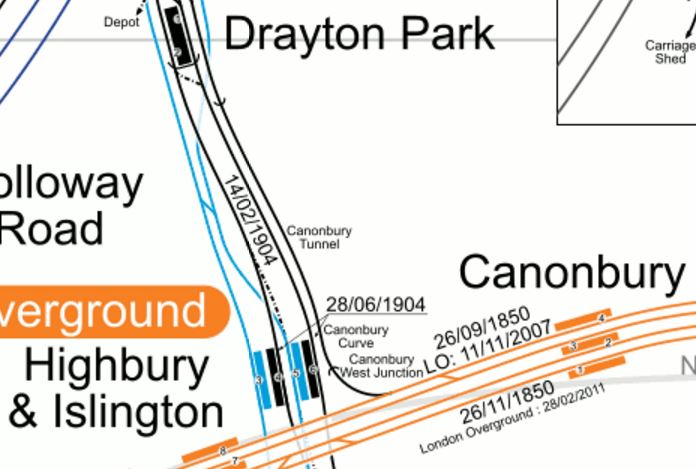
The Canonbury Curve
Note that it only has a connection to the North London Line, which is the more Northerly of the two pairs of lines. The East London Line is the other pair of lines and only carries third-rail electric services to Dalston Junction and on to the South.
In order for trains to go between Finsbury Park and the East London Line, there would need to some changes to Canonbury West Junction.
This Google Map shows Canonbury West Junction in detail.
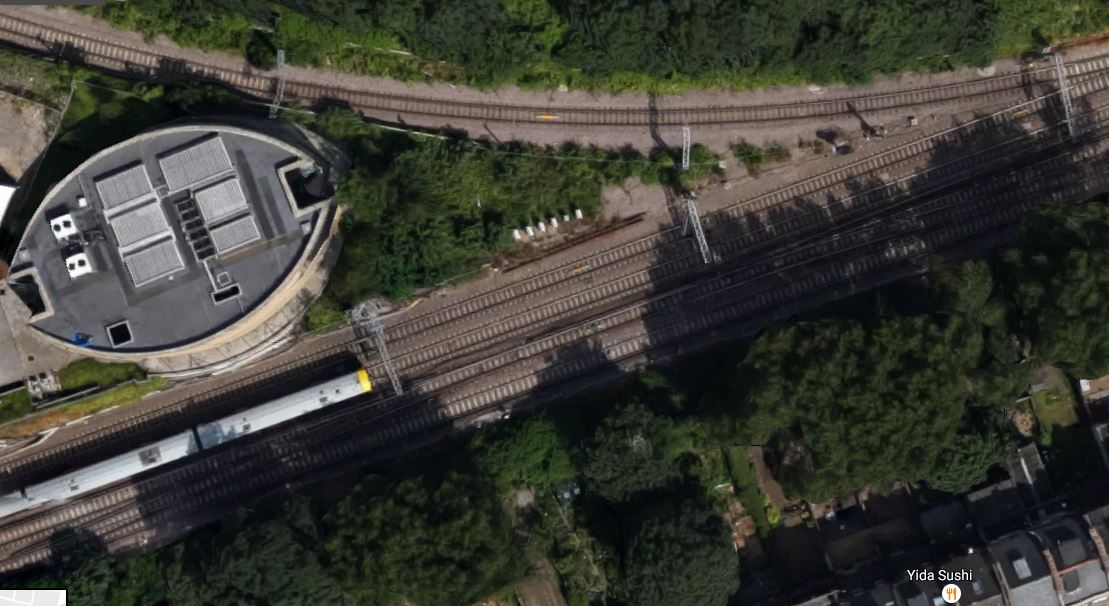
Canonbury West Junction
The elliptical-shaped tower is an evacuation and vent shaft for the Channel Tunnel Rail Link.
There does seem to be space between the lines and I suspect that it would be possible to modify Canonbury West Junction.
The line is also visible as it passes by Drayton Park station to the South of Arsenal’s Emirates Stadium.
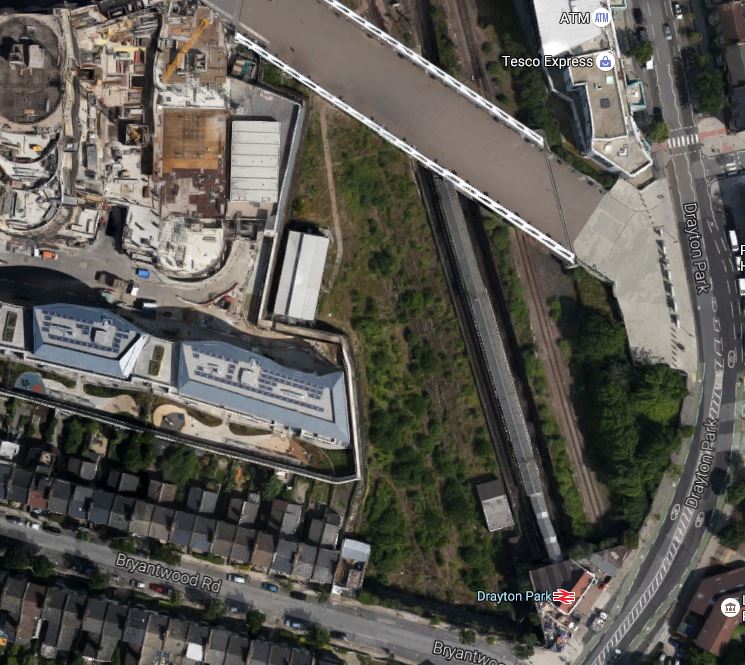
Drayton Park Station
The line is the single track line to the right of the platform roof of the station. This image doesn’t show a true picture, as the line is at a higher level than the Northern City Line.
I think it is true to say, that there is quite a bit of space around Drayton Park station.
When the line gets to Finsbury Park station, the track seems to be extremely complicated, but I’m sure that it is possible to run a passenger train between Canonbury and Finsbury Park stations, as freight trains already make the journey.
A Second Thameslink Route Between Finsbury Park And East Croydon
I feel that a train service could be run between Finsbury Park and East Croydon stations via the Canonbury Curve and the East London Line.
It would require the appropriate political and commercial wills. Some track modifications would be needed.
In the next few sections, I will describe the various issues that will effect, whether such a service is created.
Objectives Of The Route
As a passenger from the East, I see the major objective is to link all those, who travel to and from London’s Eastern boroughs, like Bromley, Croydon, Greenwich, Hackney, Haringey, Lewisham, Tower Hamlets and Waltham Forest, with a better North-South railway.
But Govia Thameslink Railway, London Overground and Sadiq Khan may see things differently.
The East London Line may terminate in a decent purpose-built terminal at Highbury and Islington station, with these connections.
- North London Line to the West.
- Northern City services to the North.
- Victoria Line services to the West End and four major stations.
- Victoria Line to Waltham Forest.
But the termini in the South mean there is often a second change to get where you actually want to go.
- Many passengers want to go to East Croydon station rather than West Croydon station.
- There is no direct link to Thameslink, with all the extra destinations that would bring.
- Getting to London Bridge, Gatwick Airport, Kent and the South Coast is not easy.
I’m not the only one who is unhappy, as there has been a petition to the London Assembley to get Thameslink to call at Norwood Junction.
I think a lot of the problems were caused by the following.
- The East London Line was designed after Thameslink.
- Thameslink designers thought the East London Line was a short route from Whitechapel to New Cross and New Cross Gate.
- Thameslink is a National Rail project, whereas the East London Line is promoted by Transport for London.
On the other hand, East London does particularly well with two branches of Crossrail, so the connection to the East London Line at Whitechapel, will truly be a Jewel In The East.
Extending the East London Line to Finsbury Park in the North would give the following improvements.
- Links to the Piccadilly and Victoria Lines
- Links to Great Northern services to Hertford North, Welwyn Garden City, Letchworth Garden City and Cambridge
- Links to Thameslink services to Peterborough and Cambridge.
Connecting to East Croydon in the South would also be valuable.
- Links to Outer London suburban services to places like Epsom, Caterham and Oxted.
- Links to Thameslink services going to Gatwick Airport, Brighton and the South Coast.
- Links to London Tramlink across South London.
This connectivity at the North and South termini will not only make it better for those living in East London, but visitors and commuters needing to go to the area will find their journey much improved.
Now is the time to properly link Thameslkink and the East London Line to the benefit of users of both systems!
It could be the third line in London’s Crossrail/Thameslink network.
Advantages For Myself
I wouldn’t be being totally honest, if I didn’t point out my personal advantages of a Finsbury Park to East Croydon service.
I live within walking distance of Dalston Junction station and I would get single-change access to places like Brighton, Cambridge, Gatwick Airport and Peterborough.
But then so would the hundreds of thousands of people, who or work live near stations between Canonbury and Norwood Junction on the East London Line.
Thameslink, The Northern City Line And The Canonbury Curve
Thameslink, the Northern City Line to Moorgate and the line through the Canonbury Curve all come together at Finsbury Park station.
There would be opportunities to create a cross- and same-platform interchange between all three services.
I do think that the Northern City Line will because of its important link to Crossrail at Moorgate grow into a high-capacity link between Crossrail, the City of London and Canary Wharf at its Southern end and Finsbury Park, North London and Hertfordshire at its Northern end.
Added together Thameslink and the Moorgate trains could create a 12 tph service up the East Coast Main Line, as far as Welwyn Garden City.
My thoughts on this line are laid out in A North London Metro.
How Many Trains Would Be Needed To Run A Service Between Finsbury Park And East Croydon?
As things stand the current Class 717 trains, that have been ordered for the Northern City Line, couldn’t work the route, as the route is only able to accept five-car trains, but it could probably be run by the following.
- Five-car versions of the Class 717 trains.
- London Overground’s Class 378 trains
- Appropriate versions of the new Class 710 trains.
Current timings on the various sections are.
- Finsbury Park to Highbury and Islington – 4 minutes – Great Northern
- Highbury and Islington to New Cross Gate – 26 minutes – London Overground
- New Cross Gate to East Croydon – 22 minutes – Southern
So this would give a timing of 52 minutes, which could probably be beaten by a direct modern train, that could change current collection on the fly and took the Canonbury Curve short cut.
Any time around fifty minutes, would mean that a train could do the round trip in two hours and that eight trains being needed to run a 4 tph service.
The Design Of An Ideal Terminus
The branches of the East London Line at Clapham Junction, Crystal Palace, Dalston Junction, Highbury and Islington and New Cross end in their own dedicated bay platforms. At West Croydon, a reversing siding is used, as I wrote about in The Bay Platform And The Reversing Siding At West Croydon.
As rarely do any operational problems surface, I feel that a single platform or reversing siding would be sufficient for a route, that is not much longer than Highbury and Islington to West Croydon.
Passengers would also require.
- Decent step-free interchange between services.
- Lots of useful connecting trains and buses.
- Shops, kiosks and cafes.
- An attraction like a market, museum, shopping centre or an entertainment venue.
Perhaps even a place to sit in the sun, like the park at Crystal Palace or Dalston Square at Dalston Junction.
Looking at this, what idiot thought about using the dreadfully dreary and totally useless West Croydon?
An interesting concept is that the last two or three stations are used as a joint terminus, to give passengers more choice of onward routes, either by foot or by train, tram or bus.
You have Cannon Street, which is the actual terminus, but all services will also stop at London Bridge, when Thameslink is complete.
Other pairs include.
- Liverpool Street and Stratford
- Charing Cross, Waterloo East and London Bridge
- Edinburgh Waverley and Edinburgh Haymarket
- Birmingham New Street and Birmingham International
- Manchester Piccadilly and Manchester Oxford Road.
- Highbury and Islington and Dalston Junction
Some have been purposely designed that way, whilst others have just happened.
In the case of choosing the two termini for the Finsbury Park to East Croydon route, they must be within a time that allows the train operator to to use a sensible operating policy to run trains.
It looks like, that if the trip time is fifty minutes or less, that is ideal, as the round trip can be two hours. But even if it’s a few minutes longer, you just add another train into the fleet and work on a two hours fifteen minutes cycle say.
The Northern Terminus
In this example, I have used Finsbury Park station as a Northern Terminus, but I think that as long as Finsbury Park is served by the route, a station to the North could be used instead.
A few thoughts.
- Using Drayton Park could mean an extra change for passengers.
- Crossrail 2 could be coming to New Southgate and/or Alexandra Palace in the future
- A terminus North of where the Hertford Loop Line joins the East Coast Main Line might be confusing and/or annoying for passengers.
- There needs to be space for an elegant solution to the step-free change of train.
I think there are two main possibilities; Finsbury Park and Alexandra Palace.
In some ways, Alexandra Palace would work better as there is more space.
In Could A Reversing Siding Be Built At Alexandra Palace?, I examined the possibility of building a reversing siding at Alexandra Palace station.
I came to the conclusion that it is feasible and also found out that one already exists at Bowes Park station.
So a train reversing at the Northern end of the new route would go through the following procedure.
- The train from the South, would arrive at a down interchange platform in Finsbury Park, where all down Thameslink and local services call, probably with Main Line services on one platform face and Hertford Loop Line services on the other.
- Reversing trains would probably use the Hertford Loop Line platform.
- After discharging passengers, it would proceed to the down Hertford Loop Line platform 4 at Alexandra Palace.
- Any passengers still left, would leave the station or catch another train.
- The train would then proceed to the reversing siding between the two lines of the Hertford Loop Line.
- The train would then start its return journey in the up Hertford Loop Line platform 1 or 2 at Alexandra Palace.
- The train would then return to Finsbury Park.
- It would call in the up interchange platform, before continuing on its way.
Effectively, the route would have a two station terminus with interchange to other trains at both Finsbury Park and Alexandra Palace, with train reversing at the latter.
Note.
- As a maximum of six tph will be using the Hertford Loop line, there is plenty of spare capacity to fit in another four trains.
- Reversing sidings are always useful when there are problems like failed trains or blockades.
- It could be used by Northern City services to Moorgate.
- If it could take an eight-car Class 700 train, it might have uses for Thameslink.
It is one of those small lengths of railway, that if it were properly designed could have a lot more uses than is obvious.
I am also actually surprised that as the space is there between the tracks of the Hertford Loop Line, that it hasn’t been used for something productive before.
The Southern Terminus
Just as the Northern end of the route must serve Finsbury Park, the Southern end must serve East Croydon, as so many services call at the station.
- Thameslink
- Gatwick Express
- Southern services all over the South.
- Tramlink
Another possibility would be to perhaps have a dedicated bay platform at South Croydon station, with services calling at East Croydon before reversing in a dedicated bay platform or a reversing siding at South Croydon.
South Croydon station also has form as a past Southern terminus for the West London Line route to Milton Keynes Central.
This Google Map shows the South Croydon station and the area immediately to the South.
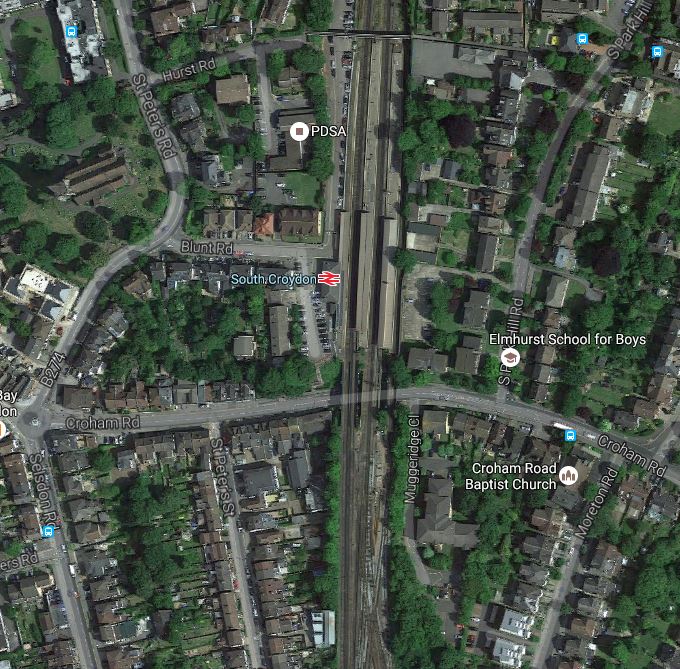
South Croydon Station
At a quick look, it would appear that fitting a bay platform into the Northern end of the station could be difficult.
But, there could be space in the tangle of lines South of the station to create a reversing siding.
There’s certainly more space than there is at East Croydon.
Perhaps, if the station was to be properly sorted as a Southern terminus for the East London Line, it could also become the terminus for an uprated service on the West London Line to the West Coast Main Line.
Drayton Park Station
This map from carto.metro.free.fr shows the lines through Drayton Park station.
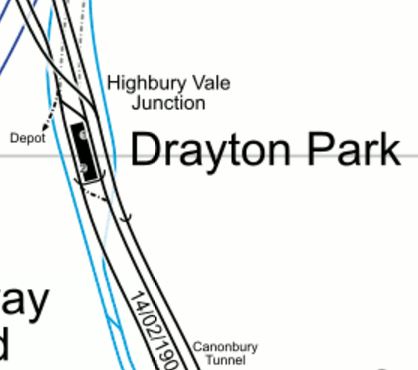
Drayton Park Station
The lines either side of the island platform are the two tracks of the Northern City Line to Moorgate.
The line on the right in the map, links Finsbury Park station to the Canonbury Curve through the Canonbury Tunnel. This line is at a higher level, as this picture taken looking South along the platform at Drayton Park station shows.

Drayton Park Station
The line is behind the retaining wall at the left. It’s position is betrayed by the overhead wires visible in the picture.
If a platform was to be put on this connecting line at Drayton Park, it would not be simple.
But help could be at hand!
In the map of the tracks at the station, there is a disused track labelled Depot. There is quite a large area of land around the station and any housing built on the site, should surely incorporate a new station underneath, with provision for a platform on the connecting line.
It would be a disaster, if housing was built all over the Drayton Park station site, without leaving provision for a station on the Canonbury to Finsbury Park Line.
The Canonbury Curve
As I pointed out earlier, the Canonbury Curve would need modification to enable trains to get between Finsbury Park and Canonbury stations.
This map from carto.metro.free.fr shows the Overground through Canonbury and the two Dalston stations.
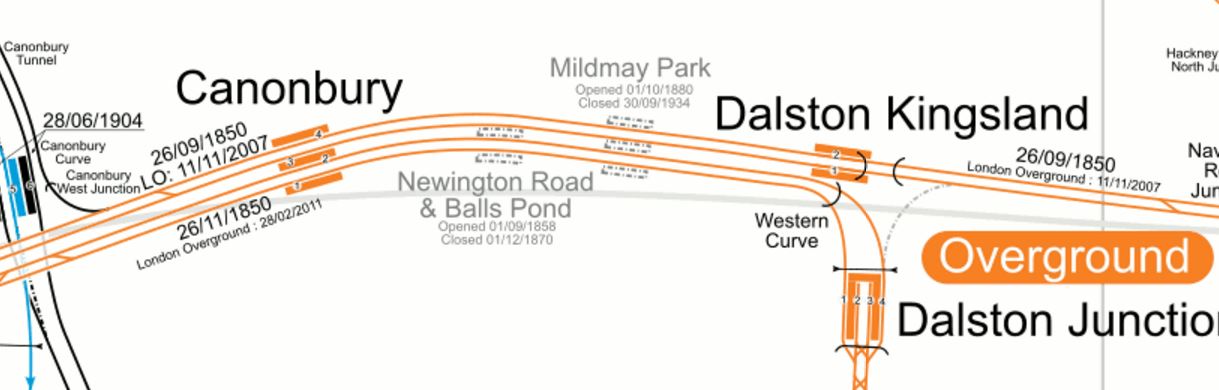
North And East London Lines Through Canonbury And Dalston
The various East-West tracks through the area from North to South are.
- The Eastbound North London Line to Stratford
- The Westbound North London Line to Highbury and Islington and Richmond.
- The Southbound East London Line to Dalston Junction and Croydon
- The Northbound East London Line to Highbury and Islington
A Finsbury Park to Dalston Junction service would do something like the following.
- Take the Canonbury Curve to the Eastbound North London Line.
- Stop in Plstform 4 at Canonbury station.
- Cross over to the Southbound East London Line using two new crossings.
- Continue South after stopping in Platform 4 at Dalston Junction station.
A service going the other way would do something like the following.
- Call in Platform 1 at Dalston Junction station.
- Cross over to the Westbound North London Line using two new crossings. (One would probably be used both ways.)
- Stop in Platform 3 at Canonbury station.
- After leaving Canonbury station take the existing crossover to the Eastbund North London Line.
- Take the Canonbury Curve to Finsbury Park station.
I don’t know whether my route would be possible, but I’m sure that an expert at Network Rail could come up with a workable and very safe solution.
At least there are factors that help.
- The line has been rebuilt in the last few years, so it must be well-documented.
- There are a lot of crossovers South of Dalston Junction station.
- The signalling is capable of handling bi-directional running.
But the most important factor is that to the East of the former Mildmay Park station, there is space for more track, as it would sappear there was an island platform between the pairs of lines. It is actually shown on the map of the lines through Canonbury and Dalston, earlier in this section.
These are some pictures of the lines between the Canonbury Curve and Mildmay Park.


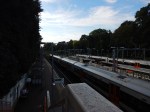


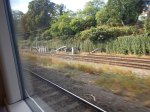
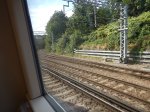
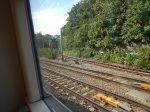
I was really surprised to see how much space there is between Dalston and Highbury and Islington and I don’t believe it would be an impossible task to create a route between Dalston Junction and Finsbury Park stations via the Canonbury Curve.
I think the biggest problem could be where to switch from the third-rail electrification of the East London Line to the overhead electrification of the North London Line and the Canonbury Curve.
One of the solutions would be to use trains with on-board energy storage and they would automatically deploy pantograph or pick-up shoe, once they were on the electrified sections.
Six-Car Trains On The East London Line
Over the years there have been mixed messages about whether six-car trains will ever run on the East London Line.
The problems of lengthening some of the platforms at stations like Shadwell, Wapping and Rotherhithe mean that the current five-car trains need to use selective door opening.
But as this is probably the only problem to running longer trains, I suspect that running six-car Class 378 trains through the Thames Tunnel, is still an option to increase capacity on the East London Line.
So if six-car Class 378 trains with selective door opening can run from Dalston Junction to Surrey Quays and several stations in the South, surely six-car Class 717 trains could do the same, if they had selective door opening fitted.
As both trains are walk-through trains, selective door opening is not a great inconvenience to passengers, as with comprehensive information on the train, the passengers move to doors that open.
I can’t see any reason, why with a few simple modifications, Great Northern’s Class 717 trains could not use the East London Line to connect North and South London.
Frequency Between Finsbury Park And East Croydon
London Overground’s services on the East London Line and some other lines is based on the rule of four.
If you provide at least four tph, then passengers will turn up and go.
So there must be at least four trains between Finsbury Park and Croydon in both directions in every hour.
The upper limit to the frequency would probably be determined by two main questions.
- How many trains could negotiate through the Canonbury Curve and Canonbury station in an hour?
- How many spare paths exist through the Thames Tunnel?
The question also has to be asked if four tph were going to East Croydon, do four tph still need to go to West Croydon?
I think all this will mean that the probable frequency will be four tph.
Alternative Routes
I have been parochial and have concentrated on the core service between Finsbury Park and East Croydon, which would be of the greatest benefits to those like me, who live on the current East London Line.
But if trains can work the route profitably, why does there have to be a limit of where they can go?
Possible termini in the North include all of the current ones used as termini by services into Moorgate.
- Alexandra Palace
- Gordon Hill
- Hertford North
- Letchworth Garden City
- Welwyn Garden City
I have added Alexandra Palace, as it could have a reversing siding and could be invaluable in maintaining the stability of the service. It is also the last station on the route, that serves both Northern branches.
In the South, the possible termini include the following.
- Caterham, which was a Thameslink possible and has now been discarded.
- Gatwick Airport, because it likes to have its fingers in everything.
- Purley, because Southern are using it as a station to split Caterham and Tattenham Corner services.
- South Croydon, because it has form and is in a convenient location.
- Tattenham Corner, which was a Thameslink possible and has now been discarded.
I calculated the core time between Finsbury Park and East Croydon using these current journeys.
- Finsbury Park to Highbury and Islington – 4 minutes – Great Northern
- Highbury and Islington to New Cross Gate – 26 minutes – London Overground
- New Cross Gate to East Croydon – 22 minutes – Southern
This gives a time of 52 minutes, between Finsbury Park and East Croydon which until proven otherwise is a good base time.
It is also the current scheduled time for London Overground’s Highbury and Islington to West Croydon service.
The following should be borne in mind.
- New trains could shave a twenty seconds or so from each of the nineteen stops.
- Cutting the corner using the Canonbury Curve should save time.
- Modern trains would be able to change voltage quicker.
I would think that a sub-fifty minute time between Finsbury Park and East Croydon is possible.
The times between Finsbury Park and my possible Northern termini are.
- Alexandra Palace – 7 minutes
- Gordon Hill – 21 minutes
- Hertford North – 37 minutes
- Letchworth Garden City – 62 minutes
- Welwyn Garden City – 20 minutes
And those between East Croydon and possible Southern termini are.
- Caterham – 25 minutes
- Gatwick Airport – 15 minutes
- Purley – 6-9 minutes
- South Croydon – 3 minutes
- Tattenham Corner – 33 minutes
When linked to passenger statistics and the capacity on the various routes, I suspect that some routes could be shown to be a lot better than others.
Conclusions
If the following projects can be successfully delivered.
- A suitable Northern terminal platform or other arrangement.
- A suitable Southern terminal platform or other arrangement.
- An updated Canonbury Curve to connect the East London Line to Finsbury Park station.
- The procurement of suitable dual-voltage trains.
I can see no reason why a train service from Finsbury Park to East Croydon couldn’t be successfully run via the Canonbury Curve.
It would give the following benefits.
- Extra connectivity for those going to and from stations between Finsbury Park and East Croydon.
- Better access to Canary Wharf, Dalston, Gatwick Airport and Shoreditch.
- It would take some of the pressure off Moorgate services, if Crossrail loads them up.
- Development of a quality Southern terminus, might enable a better service from East Croydon to Old Oak Common and the West Coast Main Line using the West London Line.
Perhaps though, the biggest benefit would be that more trains could be running on the East London Line, without needing extra platform capacity at the current termini.
O
A Numerical Analysis Of Great Northern’s New Class 717 Trains
Great Northern is replacing forty-four Class 313 trains of three-cars with twenty-five Class 717 trains of six-cars to work all services out of Moorgate station and probably some out of Kings Cross station.
So 132 carriages are being replaced with 150, which increases the space by about six percent.
But how many trains are actually needed to work the various routes?
Moorgate To Welwyn Garden City
Moorgate to Welwyn Garden City is a 3 trains per hour (tph) service.
The trip takes 51 minutes, so this means a train can go from Welwyn Garden City to Moorgate and back in under two hours.
We get the number of trains as follows.
- 3 tph needs 6 trains.
- 4 tph needs 8 trains.
- 6 tph needs 12 trains.
Moorgate To Hertford North
Moorgate to Hertford North is a 3 tph service.
,The trip takes 50 minutes, so the needs for the Hertford North are as follows.
- 3 tph needs 6 trains.
- 4 tph needs 8 trains.
- 6 tph needs 12 trains.
Moorgate To Letchworth Garden City
As the extended train to Letrhworth Garden City takes 25 minutes from Hertford North, this probably means that the trains needed for the extended service are as follows.
- 1 extended tph needs another train.
- 2 extended tph needs another 2 trains.
Total Trains On The Northern City Line
So this gives the following totals for trains on the Northern City line.
- 3 tph on each route with 1 tph to Letchworth Garden City needs 13 trains.
- 4 tph on each route with 1 tph to Letchworth Garden City needs 17 trains.
- 4 tph on each route with 2 tph to Letchworth Garden City needs 18 trains.
- 6 tph on each route with 1 tph to Letchworth Garden City needs 25 trains.
I don’t think we’ll see six tph on both routes, as that could be too many trains for the tunnel to Moorgate, which probably has a capacity of less than 10 tph.
Kings Cross To Foxton
In addition, Great Northern run an hourly service between Kings Cross and Foxton, which could use the new trains.
The service takes 75 minutes.
So as the service actually starts and finishes at Cambridge, this probably means the round trip is three hours, so the service will require the following number of trains.
- 1 tph would require 3 trains.
- 2 tph would require 6 trains.
Conclusion
The mathematics say to me, that the number of trains ordered is enough for the following services.
- 4 tph from Moorgate to Welwyn Garden City – 8 trains
- 4 tph from Moorgate to Hertford North – 8 trains
- 2 tph extended from Hertford North to Letchworth Garden City. – 2 trains
- 2 tph from Kings Cross to Foxton and Cambridge – 6 trains.
Although this doesn’t mean that this will be the service pattern.
It’s just if Great Northern wanted to go from 3 tph to 4 tph on the Northern City routes and increase other services, they have ordered enough trains.
Related Posts
Could A Reversing Siding Be Built At Alexandra Palace?
 The Anonymous Widower