Crossrail’s Giant Pimple
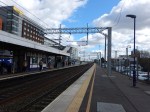
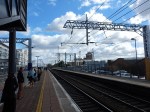
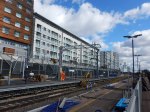
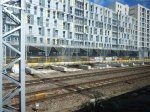
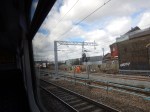
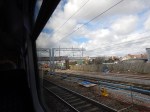
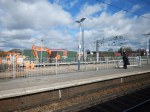
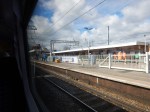
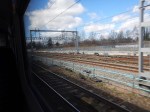
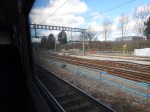
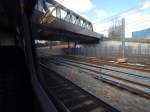
If you travel North from Canary Wharf on a 277 bus towards Hackney and Highbury and Islington station, as you go under the railway bridge that carries the c2c trains between Fenchurch Street and West Ham stations, you’ll see a Cerossrail building site on your left.

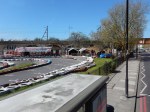
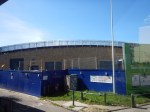


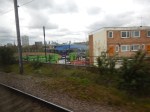
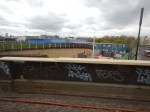

It looks like a small hill or just a giant pimple in the corner of Mile End Park.
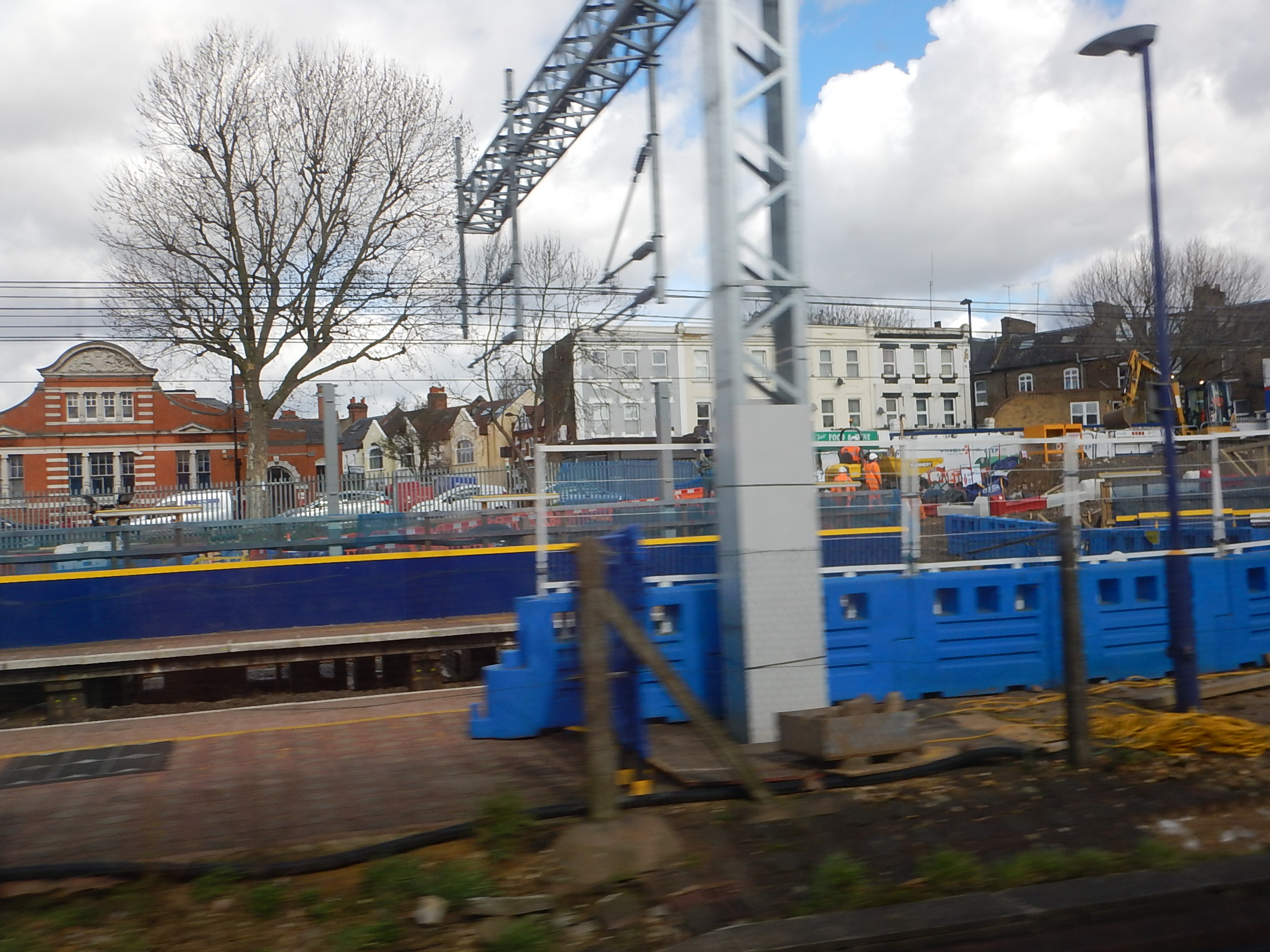
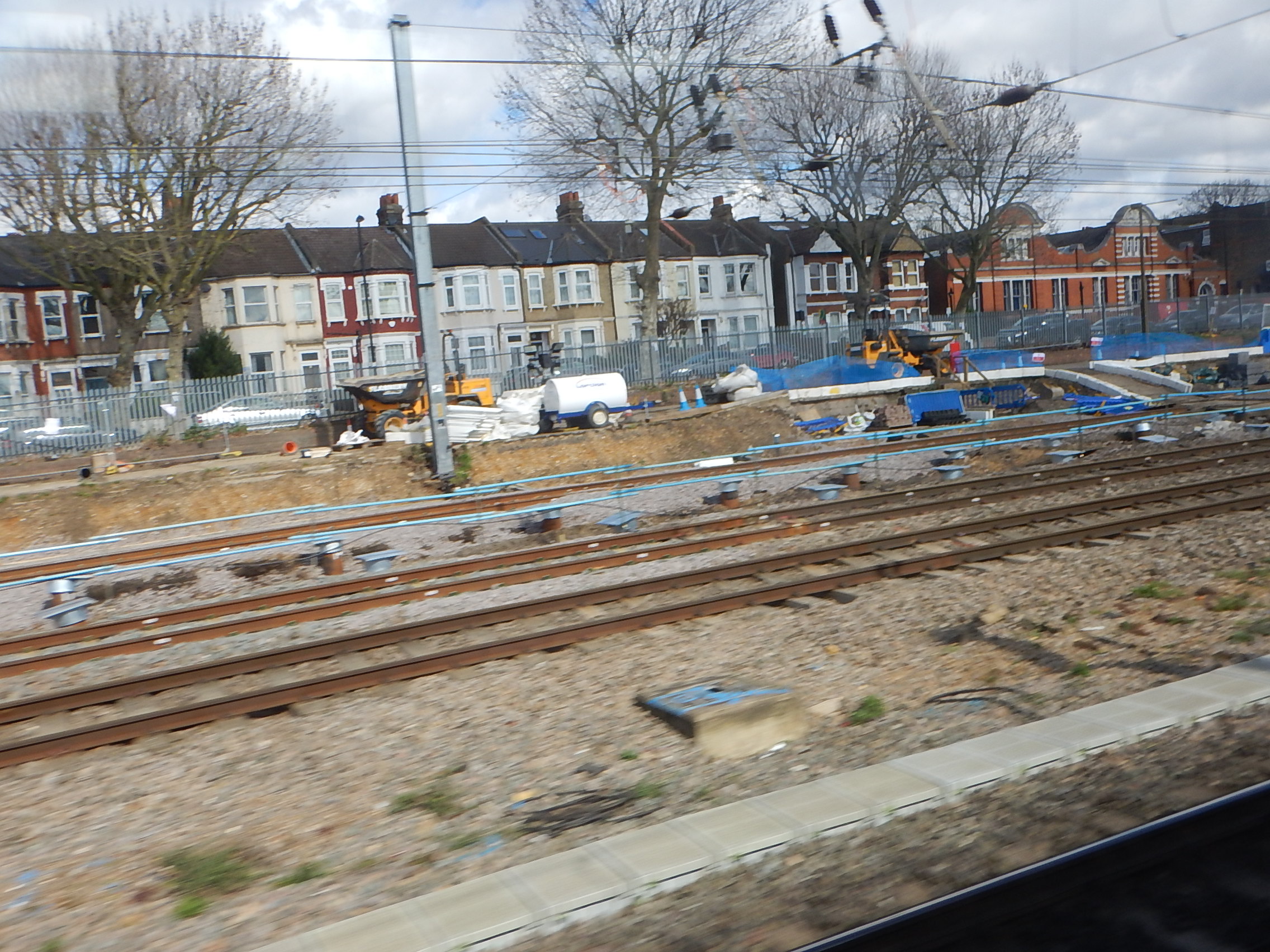
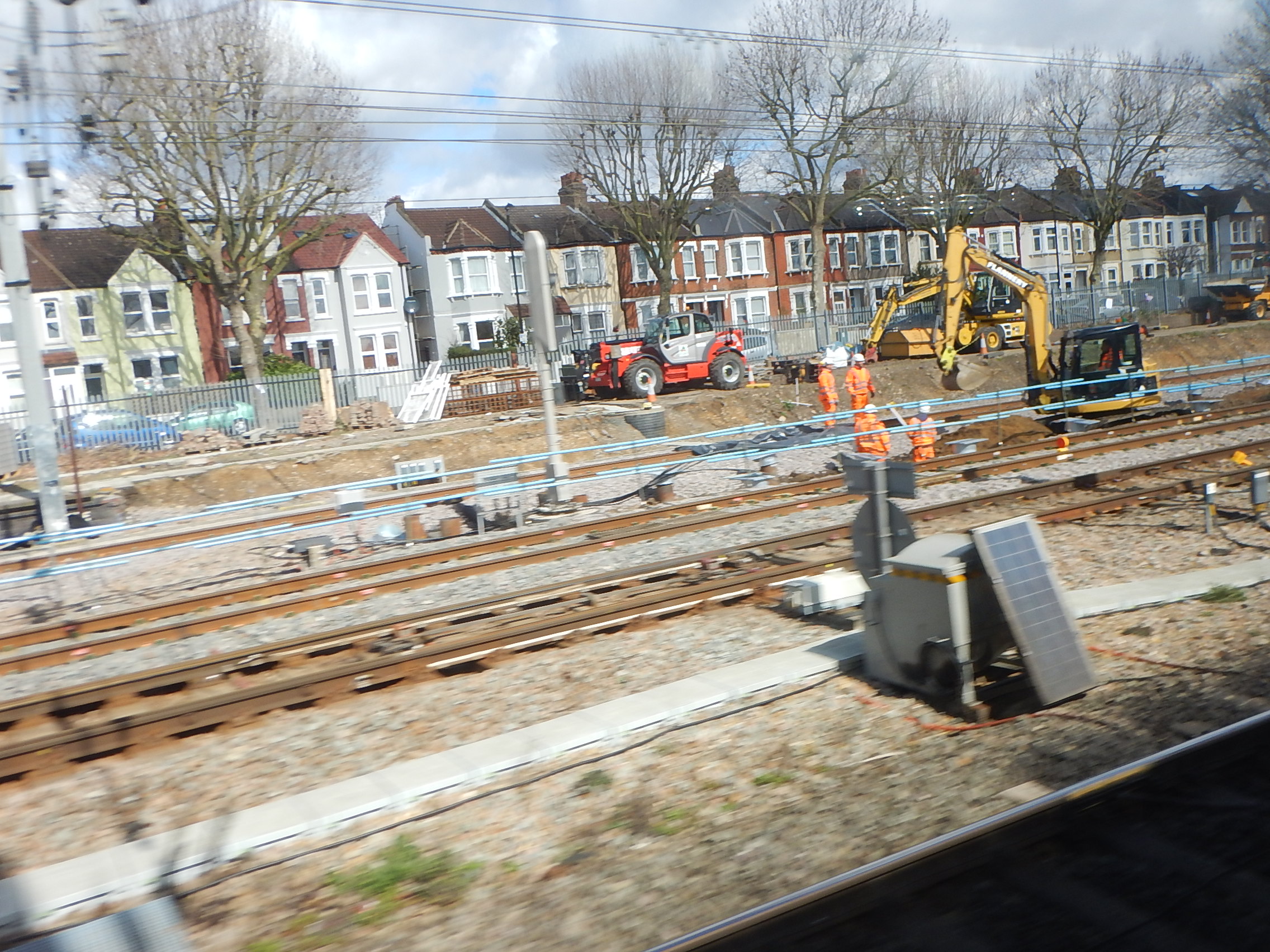
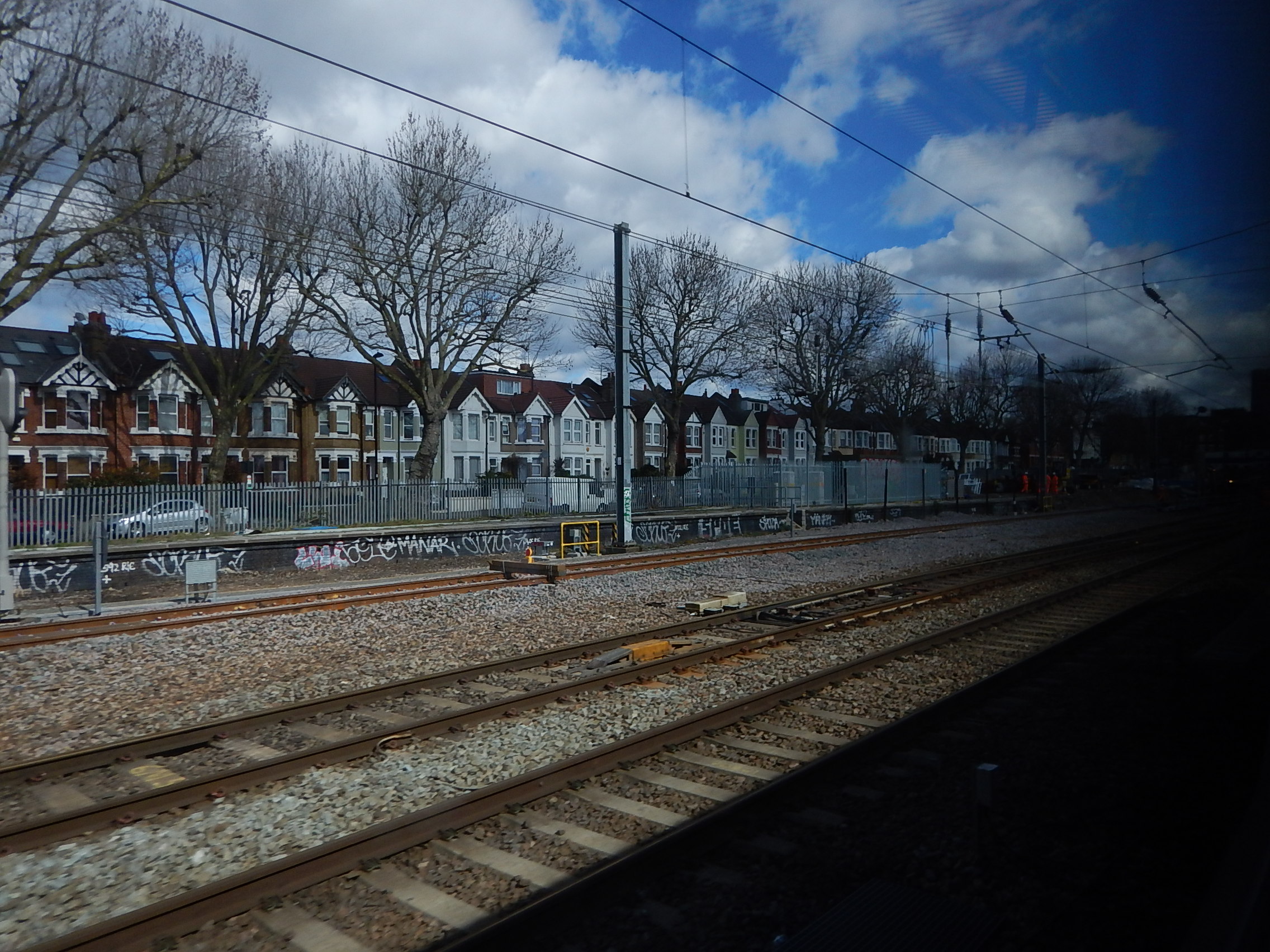
Note that the last three pictures were taken from a c2c train passing over the railway bridge.
It’s actually the vent and evacuation shaft for Crossrail and it has been arranged, so it can be used as a view point for the nearby football pitches.
Abbey Wood To Romford In Forty Minutes
I didn’t believe this figure when I calculated it yesterday, so I’m laying it out properly.
Crossrail have said that the two Eastern branches of the line;Abbey Wood and Shenfield will both run a dozen trains an hour.
- Whitechapel to Abbey Wood would take 15 minutes
- Whitechapel to Canary Wharf would take 3 minutes
- Whitechapel to Romford would take 24 minutes
- Whitechapel to Shenfield would take 38 minutes
- Whitechapel to Stratford would take 5 minutes
These times are from Crossrail’s journey time calculator.
But obviously, when changing trains at Whitechapel to go from say Abbey Wood to Romford, you’d have to wait for the next train going the other way.
So as there are twelve trains an hour in the peak, that would mean a wait of up to five minutes.
Or would it?
All the trains on Crossrail will be tightly controlled to keep to an exact schedule, so that twenty-four trains an hour can go through the core tunnel between Whitechapel and Paddington. Think Victoria Line with full-size trains carrying fifteen hundred people a train.
So if it was timed that trains from Abbey Wood turned up at Whitechapel at 0, 5, 10, 15 etc. minutes past the hour and trains left Whitechapel for Shenfield at say 1, 6, 11, 16 etc. you’d have a minute to walk a few metres across the platform to await the arrival of your onward train.
Trains from Shenfield could arrive at Whitechapel at 2, 7, 12, 17 etc. with trains leaving for Abbey Wood at 3, 8, 13, 18 etc.
Obviously, the flow of trains to and from the West would have to be at precise frequency of twenty-four trains per hour or one train every two and a half minutes.
I think trains could be timed to the second!
These train times of mine are just speculation, but I can’t see why the interchange at Whitechapel needs to take more than a minute.
So adding up the times to Abbey Wood and Romford from Whitechapel with a minute for the change gives 15+24+1 = 40.
Stratford to Canary Wharf would take 3+5+1 = 9, which is the same time as on the Jubilee Line.
The East of London doesn’t know the revolution that will be happening to their lives.
Whitechapel station will truly be the Jewel In The East and one of the most important transport interchanges in the UK, let alone London.
Reversal Stations
In Crossrail In East Docklands, I said this about Whitechapel station.
Whitechapel station will be Crossrail’s Jewel In The East and the most important interchange for the line in East London.
- It links both eastern branches of Crossrail to the Metropolitan and District Lines.
- It provides an interchange to London’s important but sometimes forgotten East London Line.
- An extended Whitechapel station would provide much better access to the East of the City of London.
But perhaps more importantly, Whitechapel is the reversal station for passengers travelling between one Eastern branch of Crossrail and the other.
A reader has asked me what I mean by a reversal station.
Look at this map from carto.metro.free.fr, which shows the lines around and through Whitechapel.
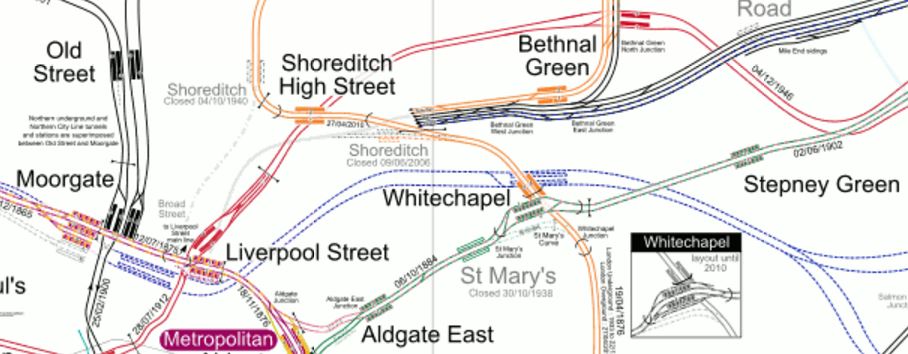
Lines Through Whitechapel
The Crossrail tracks, which are shown in blue, come from the West and go through the two platforms at both Liverpool Street/Moorgate and Whitechapel, before dividing into the two branches to Abbey Wood and Shenfield, a mile or so South of Stepney Green.
Note.
- Liverpool Street and Moorgate will share a massive doubled-ended Crossrail station with an island platform, that connects to all the lines at the two stations it connects.
- Whitechapel has a massive underground station with another island platform, where all Eastbound trains use the North side of the platform and the Westbound trains use the South.
I call Whitechapel a reversal station, as it means that any passenger arriving from the East wanting to go West on the other branch, just walks across the platform and gets an appropriate train.
As a dozen trains an hour will be using each branch, that means the maximum wait will be five minutes, but if say the trains were timed to pair up at Whitechapel, so that an Eastbound Shenfield train was always in the station with or just after a Westbound train Abbey Wood and vice-versa, the interchange time would be determined by how long it took passengers to walk across.
The interchange is totally step-free for transferring passengers and can be paired with a very wide platform to make the interchange easy for everyone.
It is a simple but absolutely brilliant concept!
The designer of the station obviously liked it so much, he did it again at Whitechapel.
Arrive at Whitechapel on an Eastbound Metropolitan or District Line train and if you need to go back West on the other line, you just walk across for the train you want. These trains don’t pair up, but then the signalling wasn’t designed to be this sophisticated in the middle of the last century.
This interchange on the Sub Surface Lines has only started recently and I wonder how often it is used by passengers.
Are there any other stations, where this passenger reversal is or could be used?
Hayes And Harlington
A similar technique could have been used at Hayes and Harlington station to link the two Western branches of Crossrail, which have the following services.
- Four trains per hour serve the Heathrow Branch.
- Two trains per hour serve both Reading and Maidenhead.
But using a similar layout to Whitechapel with a spacious island platform and scheduling the trains appropriately, might effectively give Reading four services an hour to Heathrow, which would involve nothing more than a step-free interchange at Hayes and Harlington.
It would certainly have been more affordable than tunneling into Heathrow from the West.
This map from carto.metro.free.fr shows the lines through Hayes and Harlington and the Junction for Heathrow.
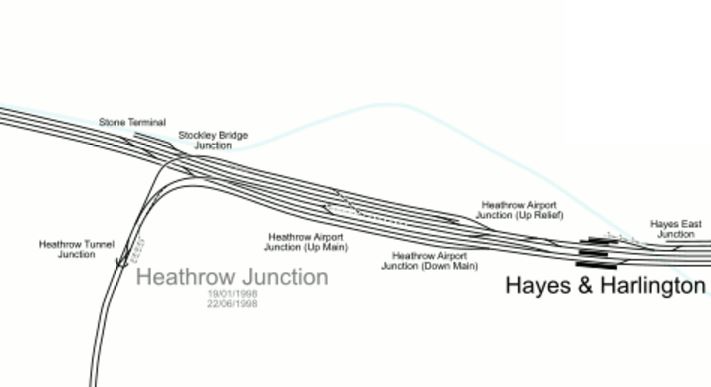
Lines Through Hayes And Harlington And Heathrow Junction
It’s probably too late now to adjust all the tracks and platforms at Hayes and Harlington station and the Stocley Viaduct, but I do believe that something could be setup at the station to improve access to Heathrow from the West until the full tunnelled link is built.
I believe that good design here, could have enabled a much more affordable Western Link for Heathrow, without any need to tunnel into the Airport.
An ideal solution would incorporate.
- Two tracks into Heathrow.
- Step-free and preferably step-across interchange at Hayes and Harlington station for passengers from Reading.
- Connection to Great Western Railway’s local trains in the Thames Valley.
- Contactless ticketing using bank cards between London, Heathrow and London.
- All Crossrail trains from London to serve all terminals.
Point five must be possible, as I’m sure the tunnels under Heathrow have a larger capacity than is being used.
But Heathrow are holding Crossrail, London and Londoners to ransom!
But then we hold all the cards, as no Mayor and few Londoners, would ever support the expansion of Heathrow!
This Google Map shows the current Hayes and Harlington station.

Hayes And Harlington Station
This description of platform use is from Wikipedia.
The station has five platforms, four being through platforms and one being a terminus bay platform. Platforms 1-2 are used only during engineering works; platforms 3 & 4 are for stopping services to and from Heathrow Airport, Reading and Oxford; platform 5 is a bay terminus platform, which is sometimes used during peak times, amended services and during engineering works. Platform 5 is capable of holding an eight-car train; platforms 2, 3 and 4 can hold seven-car trains and platform 1 can hold a five-car trains. All lines at Hayes & Harlington are electrified. On platform 5 there is an alternative entrance leading to High Point Hayes, the entrance has Oyster Pay & Go readers, platforms 3 & 4 are connected by a bridge towards the end of the platforms.
Stations are numbered from the South.
What would need to be done is create an island platform between the two relief lines that will be used by Crossrail.
This would mean that a passenger between Heathrow and Reading, would just walk across the platform and wait for their train. As at Whitechapel, the first train would arrive a few minutes before the second left. It would be easy to arrange with Crossrail’s modern signalling and train control.
Under Crossrail in the Wikipedia entry for the station, these modifications are listed.
- New station building
- 4 new lifts to provide step-free access
- Platforms 1-4 extended
- New 200m bay platform 5 constructed (replacing existing bay)
- New platform canopies to platform 4 and 5
- Track work to widen the island platform 2/3 and to provide access to the new bay platform
Does point six mean that Platform 2 is Crossrail for Reading and Heathrow and Platform 3 is Crossrail for London?
I hope so, as that would give a step-across interchange between Reading and Heathrow.
But there is no mention of the layout of the two fast lines, which are currently served by platforms 1 and 2.
In Hayes And Harlington Station – 28th March 2016, there are several pictures of the station and the lines don’t appear to have been slewed to the South to enable the Crossrail Lines to be either side of an enlarged island platform 2/3.
It was probably just too difficult.
Old Oak Common
There are proposals to add a branch of Crossrail that would go up the West Coast Main Line to perhaps Milton Keynes. The logical place for Crossrail to join the West Coast Mail Line (WCML) is near Old Oak Common station.
I believe this could be another reversal station like Whitechapel, where the Western and WCML branches split to the West of the station.
This map shows some of the proposed track and station layout at Old Oak Common.
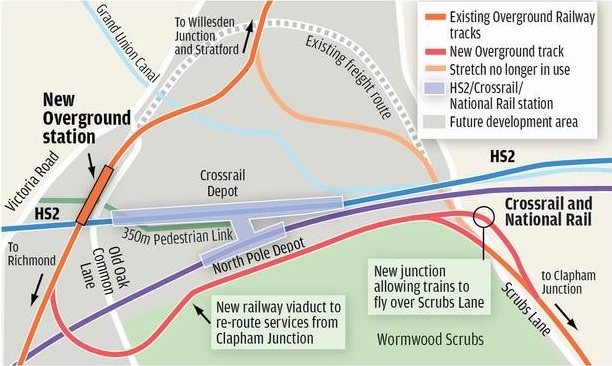
Rail Lines At Old Oak Common
The WCML is off the North of this map.
Get this connection right and there would be step-across access between the WCML to Milton Keynes and all stations to Heathrow on Crossrail.
Willesden Junction On The North And West London Lines
The North London and West London Lines divide to the west of Willesden Junction station.
Passengers between say Richmond and Imperial Wharf stations can use Willesden Junction station as a step-across to reverse direction. The timetable gives five or six minutes for the change, which is acceptable, but not as quick as I believe Whitechapel will be.
St. Pancras Thameslink
When the Thameslink Programme is completed, the Thameslink platforms at St. Pancras International will become a reversal station for passengers wanting to change between the Great Northern and Midland Main Line branches.
But it will not be a simple walk across a platform, but a hike over a footbridge, albeit one with step-free access.
The only Central London station on Thameslink, which will be an island platform will be London Bridge, where platforms 4 and 5 will serve Thameslink.
East Croydon
In an ideal world all Northbound Thameslink services at East Croydon station would call at the same island platform and all Southbound services would call at the opposite face of the island. I think that sixteen trains per hour will use the various Thameslink routes through East Croydon. On a dedicated platform, that is only one train every four minutes and the East London Line handles that with ease!
I think that the number of Thameslink trains through East Croydon is not very ambitious, in contrast to the number through the core of twenty-four trains per hour, which is ambitious, but not unduly so!
But I can’t find any information as to whether this will happen.
Where will passengers wanting to travel between Caterham and Tattenham Corner stations change trains?
It does strike me, that the care applied to the design of Crossrail, is lacking in the Thameslink Programme.
They obviously used ordinary envelopes, rather than special engineering ones!
Just compare the mess that is East Croydon station to the much larger, more complicated and impressive Reading station.
If Croydon is serious about being important, it needs a gateway station like Ealing Broadway, Huddersfield, Leeds, Liverpool, Manchester Victoria, Northampton, Nottingham, Stratford or Reading, rather than an overcrowded badly-designed stop on the Brighton Main Line, that just makes visitors say, they’ll never return.
East Croydon also needs a proper connection to the East London Line. The current terminus of West Croydon is one of the worst designed pieces of railway infrastructure in the world. It’s equivalent to putting a main station for Liverpool in Birkenhead or one for Newcastle in Sunderland.
West Croydon station should be shut as soon as possible and East London Line services transferred to East Croydon.
Manchester Piccadilly
Whilst I’m in attack-dog mode, the two worst platforms in the country are platforms 13 and 14 at Manchester Piccadilly station.
- These platforms were designed to get passengers as fit as possible, by locating them some distance from the main station facilities.
- They are too small and always crowded.
The plans to remedy the overcrowding, include building two new platforms further out at great expense.
This may solve the problem, but I’d like to see answers to these questions first.
- How many trains per hour stop at each platform? A platform like this should be able to handle sixteen trains per hour both ways, as does Canada Water on the Overground.
- How many passengers use this island platform to reverse direction?
- How many passengers get off one train here and get on another in a few minutes? I’ve done that myself on those platforms, a few times.
- How would platform utilisation change with two and three-car trains changed for larger ones?
- Could a reorganisation of services and the Ordsall Curve, increase seats on various routes, but reduce the number of trains through these platforms?
- What difference would contactless ticketing using bank cards make to passenger throughput?
- Is it necessary that every train stopping at Piccadilly always seems to stop at Oxford Road?
As an aside here, I could rightly claim that I’ve written more successful resource scheduling programs, than anybody else ever has!
I know it was designed in the 1960s, but I believe that by applying some modern data analysis and desjgn, that platforms 13 and 14, with more space, escalators and lifts everywhere, better facilities and perhaps a direct entry to the Metrolink station underneath, could go a long way to handling more traffic.
The East-Facing Bay Platforms At Reading Station
This picture shows the east-facing bay platforms at Reading station.
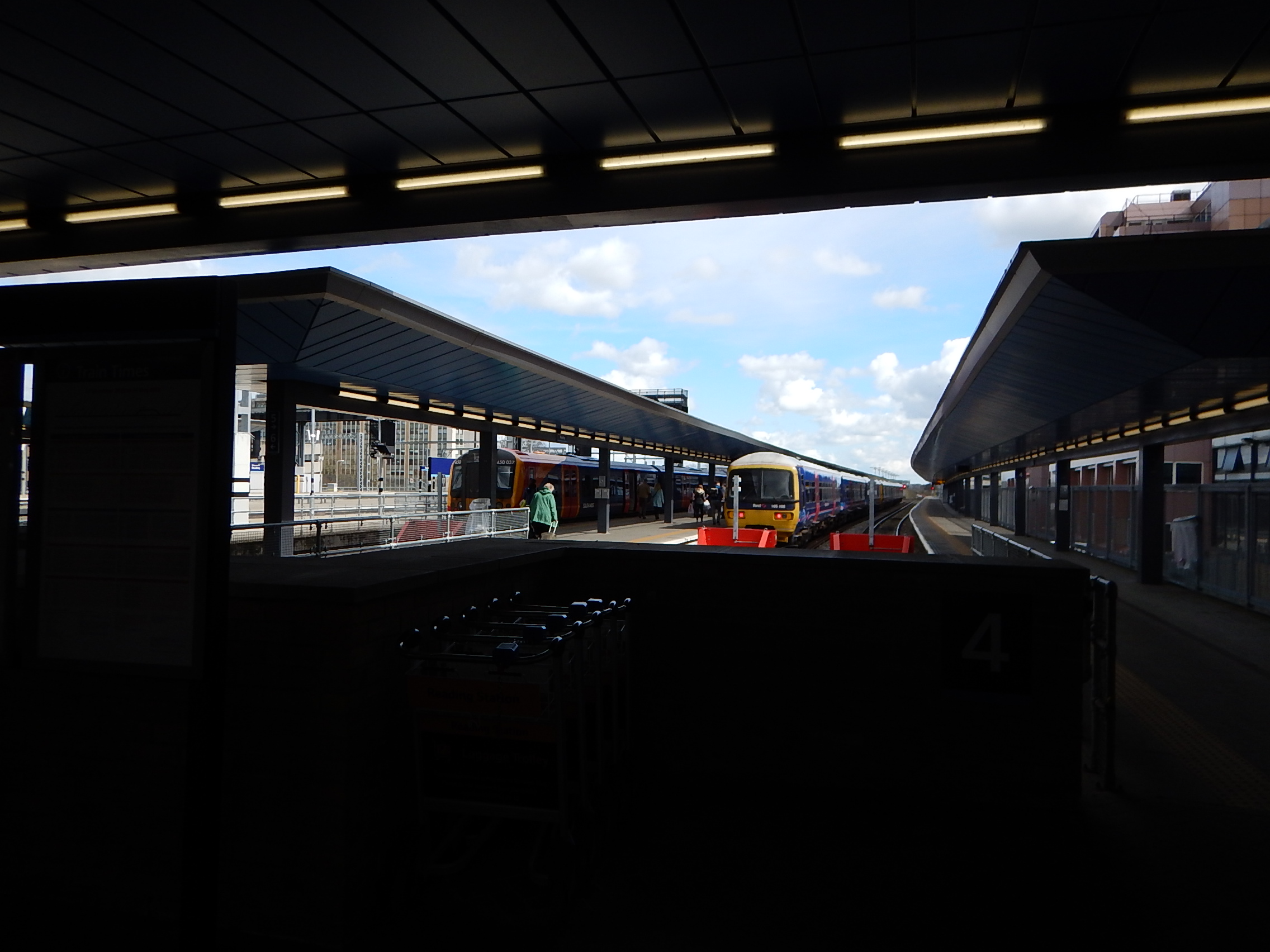
Bay Platforms 4, 5 and 6 At Reading Station
Note that they are numbered 4, 5 and 6 from the right. The train on Platform 5 is a Great Western Railway service for Gatwick Airport via Guildford. with a South West Trains service for Waterloo on Platform 6.
Gatwick Via The North Downs Line
Trains go to Gatwick using the North Downs Line, which is a double-track line effectively in five sections.
- Reading to Wokingham – electrified
- Wokingham to North Camp – not electrified
- North Camp to Shalford Junction – electrified
- Shalford Junction to Reigate – not electrified
- Reigate to Redhill and Gatwick – electrified.
According to Wikipedia, there needs to be work at Redhill and Gatwick Airport stations, but I believe that is underway.
Wikipedia also states that the line has an operative speed of 70 mph. The journey currently takes 76 minutes.
Once Crossrail and Thameslink are fully open, it would surely be quicker to change at Farringdon.
- The fastest journey between Farringdon and Gatwick Airport is now 54 minutes.
- The Crossrail route calculator says that Reading to Farringdon will take 57 minutes.
So that means that at 111 minutes, surprisingly the London route is thirty five minutes slower and needs a change of train.
Note these further points about the North Downs route.
- A well-driven electric train like a 110 mph Class 387 train might even be able to do the journey a few minutes quicker than the current 76 minutes, if the line were to be electrified.
- It is my belief, that the current piecemeal nature of the third-rail electrification would enable a Class 387 IPEMU to run between Reading and Gatwick Airport, using the batteries as required.
- I don’t think the batteries would need charging at the end of the journey, as both ends of the route are electrified.
- The line has ten level crossings, which must speed the trains, if some were removed.
- There must be other track improvements.
- Class 387 trains have also been fitted with an Airport Express interior for Gatwick Express.
- Can an Airport Express be battery-powered? Engineers like me, would say yes, but Marketing Departments would be sceptical.
I believe that ultimately a Class 387 train or an IPEMU with a similar performance could do Reading to Gatwick Airport in an hour, without further electrification.
Hanwell Station – 28th March 2016
I took these pictures as I went over the Hanwell Viaduct and Through Hanwell station.

All seems to be getting ready for electric services to start in May
Hayes And Harlington Station – 28th March 2016
It would appear to my untrained eye, that most of the overhead wires needed for Crossrail are now up and ready at Hayes and Harlington station.







This station was originally wired some years ago for Heathrow Express, but it looks to me, that some of it has been replaced.
In the April 2015 Edition of Modern Railways, there is an article, which is entitled Operators Vying For Class 387s. This is said.
GWR is anxious to receive units so it can begin driver training ahead of introducing an electric service between Paddington and Hayes & Harlington in May. However, Govia Thameslink Railway is seeking to retain the sets for a longer period due to delays in introducing new Class 700 EMUs into passenger service as a result of a number of issues.
So as it looks that in a couple of weeks or so, the bay platform 5 at Hayes and Harlington station will be ready to run an electric service to Paddington, you can understand why GWR are anxious. After all, at least one of the Class 387 trains destined for GWR has even got the right colour doors.
If a May start is envisaged for an electric service between Paddington and Hayes and Harlington, does that mean that the days of the direct Paddington to Greenford service is numbered. Work does seem to be progressing on the bay platform at West Ealing station.
Southall Station – 28th March 2016
I took these pictures today at Southall station.




It looks like as at Hayes and Harlington station, some of the catenary has been replaced or updated.
West Ealing Station – 28th March 2016
I took these pictures as I passed through West Ealing station.

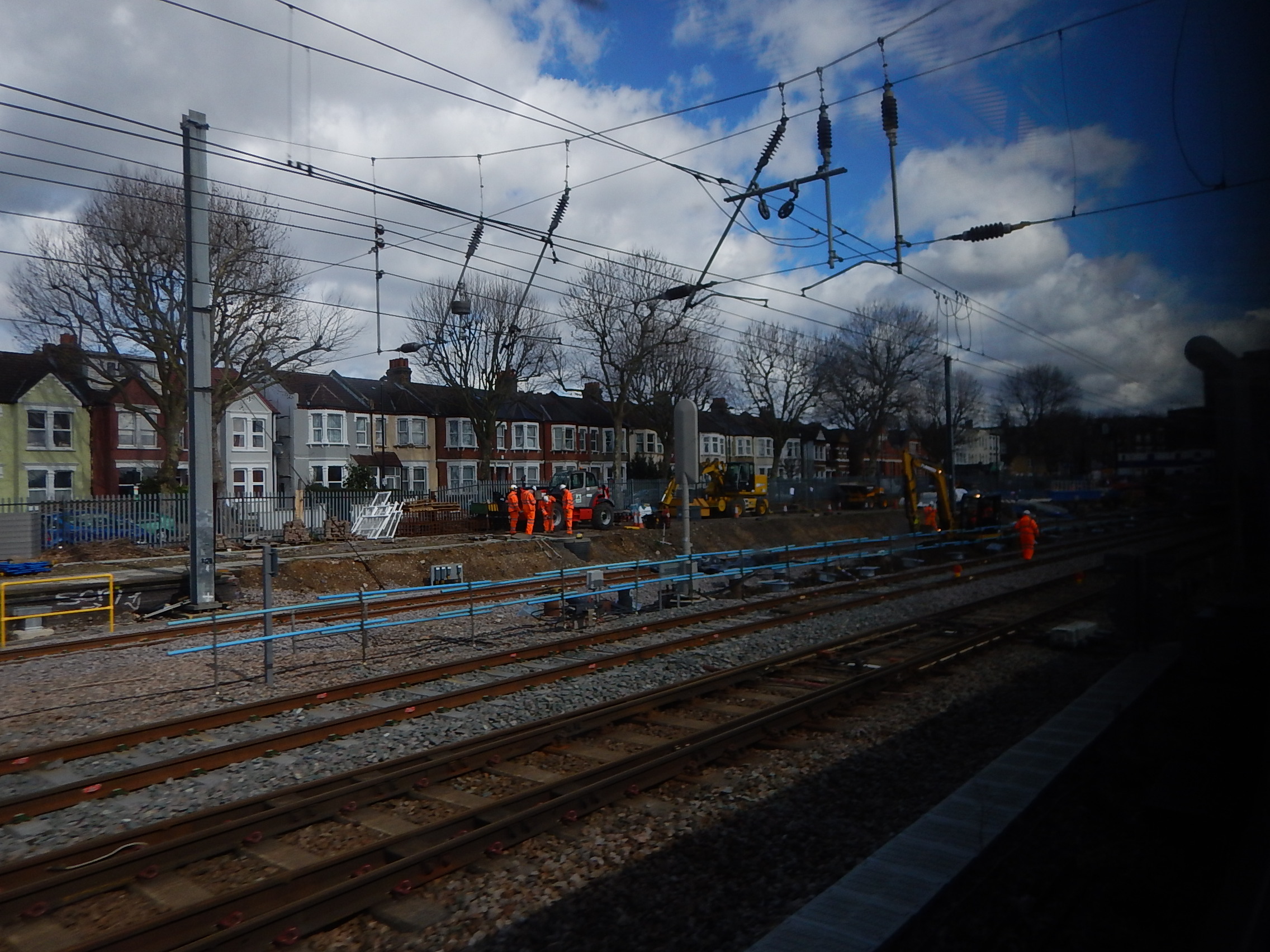
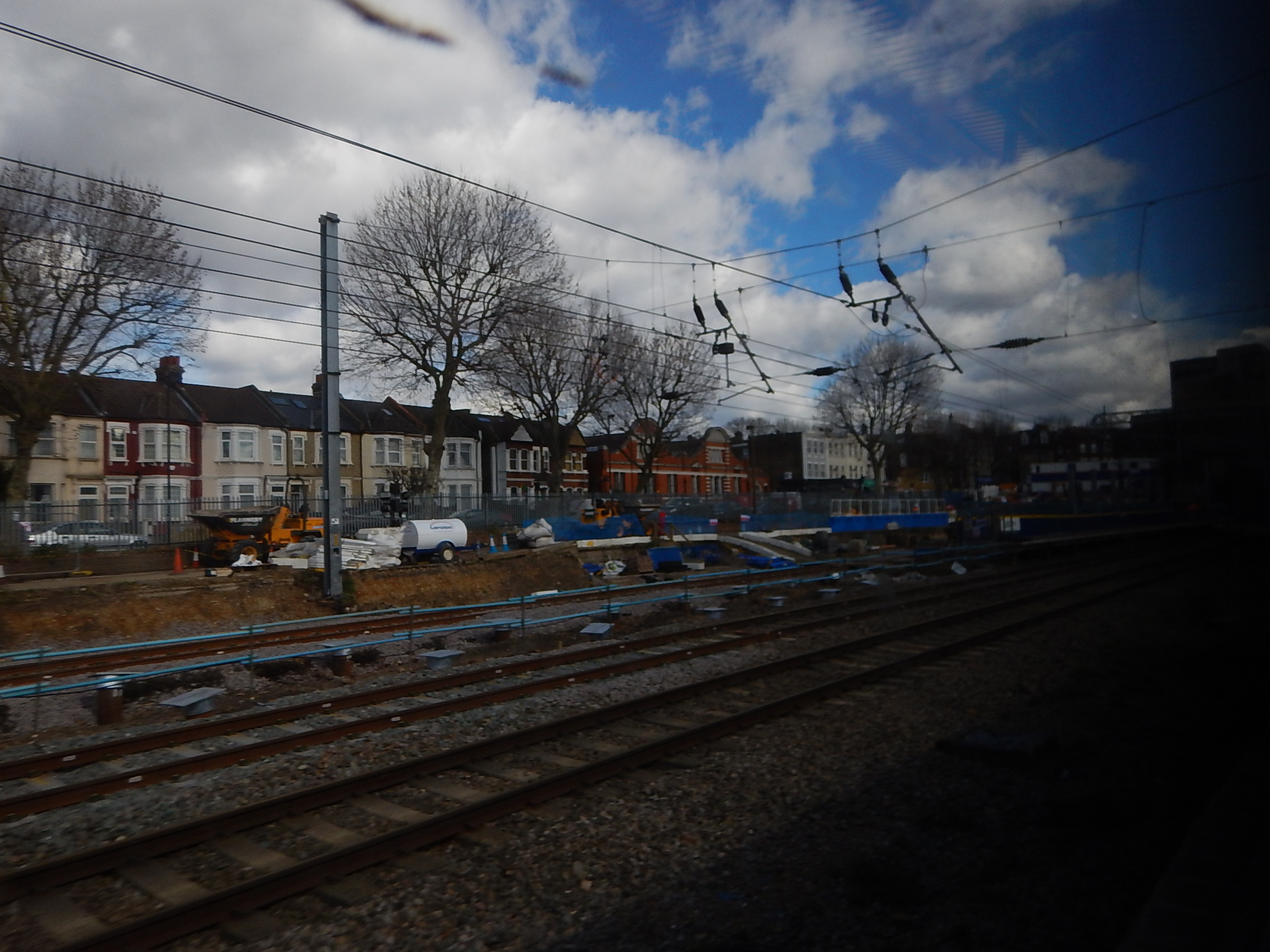
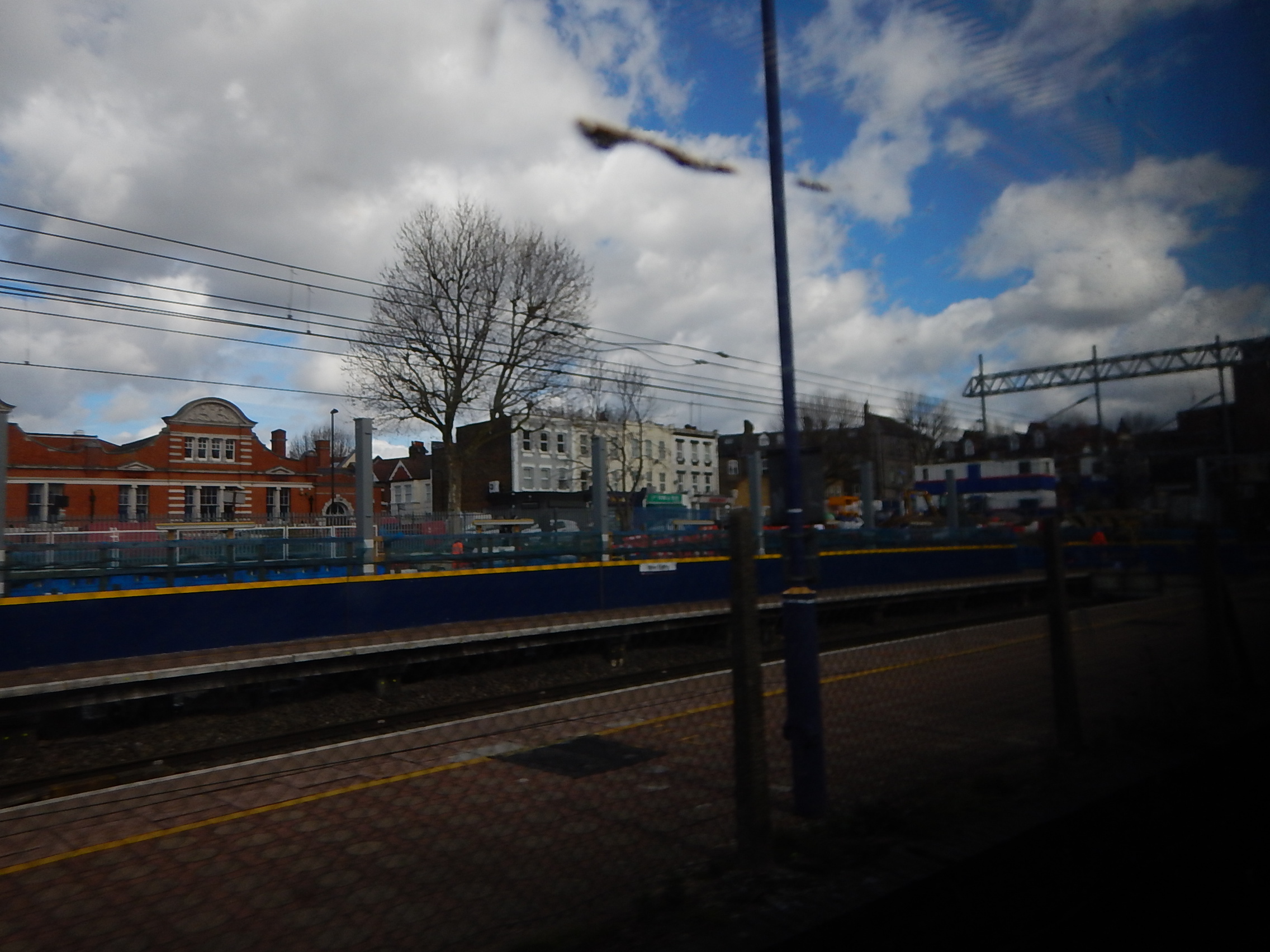
The only definite conclusion I made, was that I will have to visit to be able to make any conclusions about how the Greenford Branch will be run after it loses its direct connection to Paddington.
Wikipedia says this about how Crossrail will affect services on the Branch, in a Future section.
In 2017 Crossrail is due to begin using two of the four tracks of the Great Western Main Line and the Greenford service will terminate at West Ealing, rather than continue to Paddington, to obviate interference with Crossrail, and to create track capacity for increased services to Heathrow. In compensation the branch line service will increase from two to four trains per hour.
When this will happen, I can only guess that it will be at the same time, as electric services start between Paddington to Hayes and Harlington.
At present the trip between West Ealing and Greenford takes just seven minutes, so if one train was to work the branch, there would be no problem doing the four seven minute legs required for two trips per hour, but four trips with eight legs might be a bit tighter, especially if something delayed the train like say a party of thirty schoolchildren or a group of three or four in wheelchairs with their carers wanting to go shopping.
Given too,that a good service for passengers would probably need.
- Similar frequencies of the Paddington to Hayes and Halington service and the Greenford Branch line.
- The Greenford Branch train would probably arrive at West Ealing a few minutes before a train to Paddington.
- The train from Paddington would probably arrive at West Ealing a few minutes before the Greenford train left.
In my view good connections are essential, as a lot of people will not be pleased to have lost their direct service to Paddington.
This map from carto.metro.free.fr shows the layout of the lines at West Ealing.
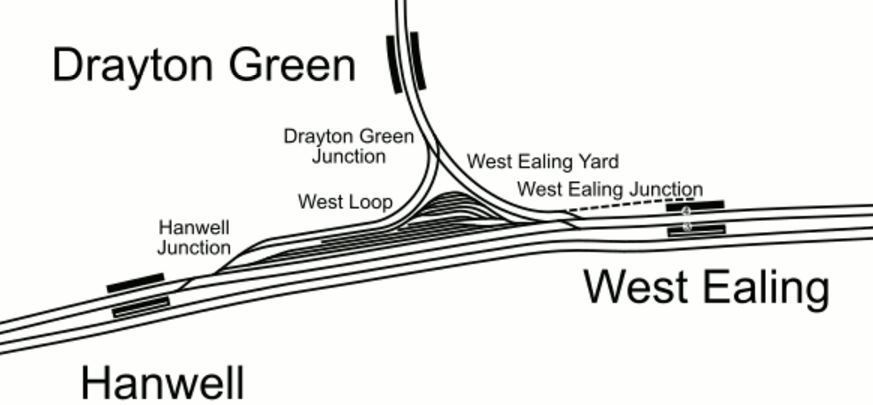
Lines At Wes tEaling
Note how there is a connection to the West.
This second map from carto.metro.free.fr shows the layout of the lines at Greenford.
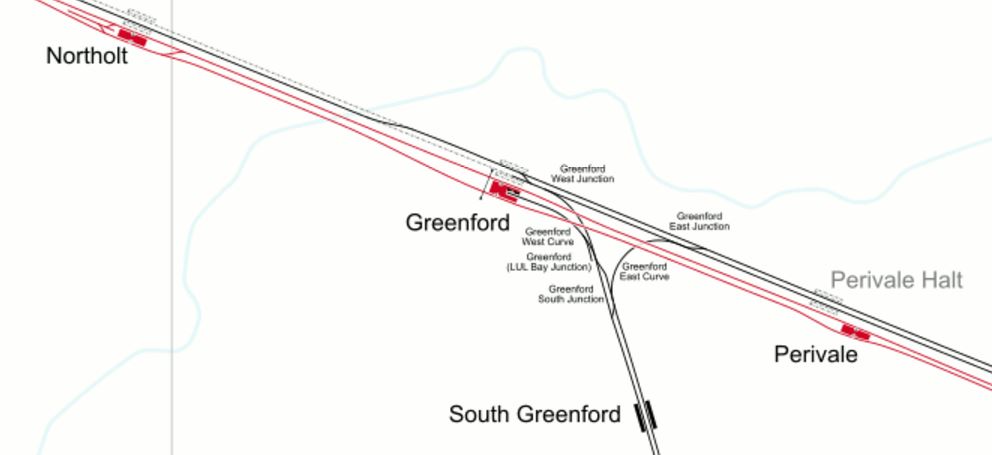
Lines At Greenford
Given that to the West of Greenford, the lines connect to Chiltern, you just wonder if someone has a plan to improve connectivity in North West London.
But the branch does have some negative factors, that mitigate against development.
- There would appear to be no suitable Southern terminal to the West of the branch.
- Three of the stations on the branch can only handle two-car trains.
- The branch is not electrified.
- The terminus at Greenford is a bay platform, squeezed in between two Underground tracks.
A lot will depend on the trains and the operators of the Greenford Branch, as to what happens.
At present, the branch is run by GWR, but there has been talk about the branch coming under control of London Overground.
GWR would probably run the line as they do now, with a two-car diesel Class 165 train.
Would London Overground run the line with a IPEMU version of their new Class 710 train, as Aventras can be fitted with on-board energy storage?
Acton Dive-Under – March 26th 2016
The track is now going in.


Modern Railways reported in the April 2016 Edition, that the civils are completed and the track is goin in. The article also says.
The new junction will enable long empty stone trains to snake westward out of the yard while eastbound Crossrail trains roll through beneath. Segregating the freight and Crossrail trains ads so much reliability into the timetable, it is well worth the investment to create it.
This article on IanVisits is entitled A look at Crossrail’s critical Acton dive under and was written in September 2015, gives a lot more details of the dive-under with quite a few pictures from inside.
Changing Trains At Slough
Yesterday I changed trains at Slough station and took these pictures.
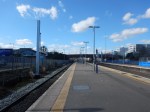
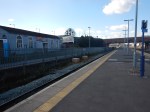
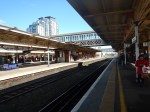

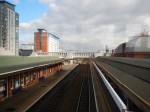
Two pictures were taken a few weeks ago and are added to make the gallery more complete.
The new pictures were taken from Platform 2, which when the electrification is complete and Crossrail has opened, will be the platform serving fast trains to the West.
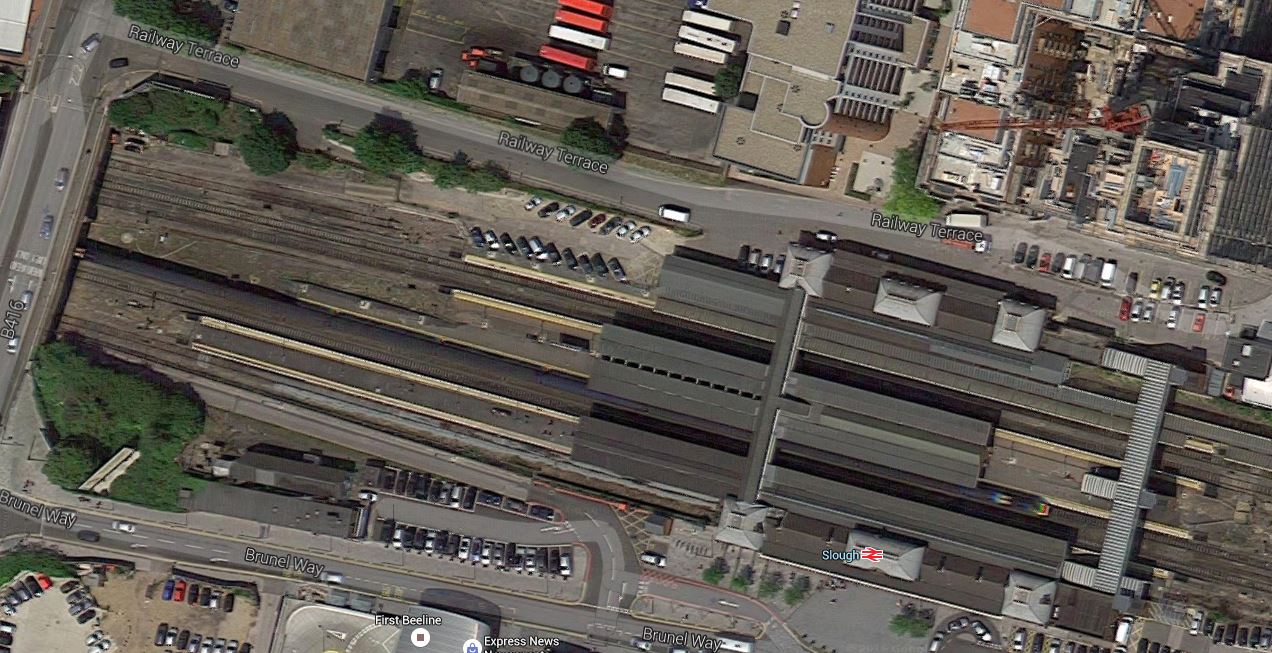
This Google Map shows the layout of the station.
Slough Station
If you look at the left (West) end of the station, you’ll see the extended platform that in addition being Platform 2, also serves the bay platform 1 for Windsor Branch Line services. I took the pictures from this platform.
Platforms 3 and 4 form a long island platform in the middle of the station, with Platform 5 on the far side.
When Crossrail opens, platforms 4 and 5 will be for that service and platforms 2 ans 3 will serve the main lines.
I am puzzling about how the wires will be passed through the station.
Note the following from my pictures and the Google Map.
- The station is Grade II Listed, with lots of period details.
- A lot of the canopies over the platform are good Victorian examples.
- The station has two footbridges; a restored old one and a new modern one.
- The modern one has probably been built to double as a gantry for the overhead wires, but has the old one been strengthened.
- There is a solitary electrification mast on the island platform and this is paired with one on the far side of Platform 1.
- There is evidence that double foundations are being built for a very large gantry at the far western end of the platforms.
I think that over the next couple of months or so, a lot of clues to Network Rail’s electrification design, will become visible at Slough.
 The Anonymous Widower