Should Crossrail Go To Dartford And Gravesham?
here has been a call this week reported in the Kent News by local council leaders for Crossrail to be extended to Dartford and Gravesham.
Given that there is a garden city planned at Ebbsfleet, on the face of it, this could seem to be a good idea. This map taken from the Garden City web site, shows the layout of the new city.
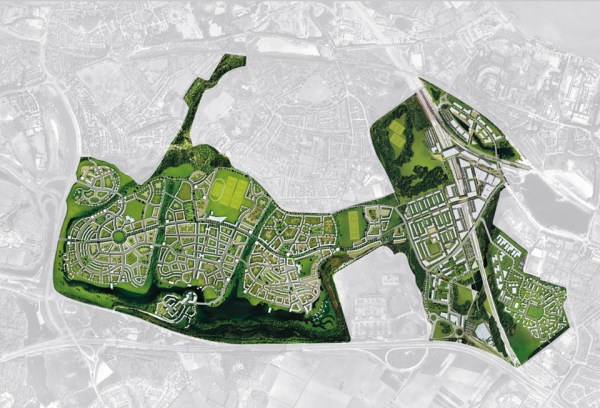
Ebbsfleet Garden City
Note Ebbsfleet International station in the top right. The map below shows the area from Google Earth.
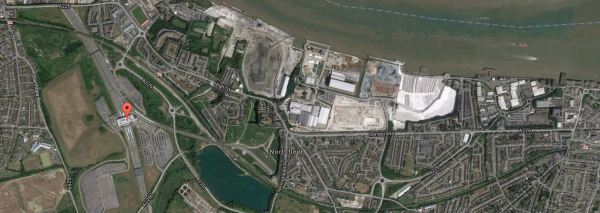
In addition to Ebbsfleet International, three stations are shown. From west (left) to east, they are Swanscombe, Northfleet and Gravesend on the North Kent Line.
Note how there is a loop on the North Kent line to serve Ebbsfleet.
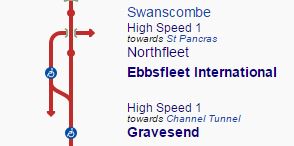
Rail Lines At Ebbsfleet
I use the Southeastern HighSpeed service to get to places like Rochester, Dover and Broadstairs, generally joining the service at Stratford or St. Pancras. It is a good, fast service with modern Class 395 trains, but often when I travel the trains are run almost for my benefit alone.
I think that a general sorting out of train services in Kent, and particularly the Highspeed service will happen. Consider the following.
1. Hastings, Bexhill and Eastbourne could be added to the Highspeed network, by electrifying the Marshlink line. These trains will go straight through Ebbsfleet on HS1.
2. There is no easy connection between HS1 and Crossrail, unless you walk between Stratford International and Regional stations. In fact HS1 doesn’t connect easily to lots of places, due to not stopping at Stratford, where the interchange, except to the DLR is dreadful anyway.
3. Rochester, Strood and North Kent generally needs all the help it can get to lift the economy.
The obvious thing to improve things would be to have cross platform interchange between the North Kent Line, Crossrail and HS1, at Ebbsfleet International. Or if that is not possible, due to the design of the current station, they could apply the rules that have been so superbly demonstrated at Reading, Leeds and Derby.
London Connections has an article, where it discusses extending Crossrail to the east in Kent. It says this.
The original proposal was for Crossrail’s south-eastern arm to terminate at Ebbsfleet. Ebbsfleet seemed an obvious choice, but more thorough analysis showed some disadvantages. Curtailing it at Abbey Wood had distinct attractions to the planning team who would naturally would take a risk-adverse attitude to the project.
From an operational point of view, it would eliminate the need for Crossrail trains to run on third rail routes and therefore simplify train construction and add robustness to the plan. It would also leave this route self-contained and not at the mercy of trains on the south-eastern sector, which was already notorious for being vulnerable to problems anywhere on the crowded network affecting the whole service. It also had the added attraction of reducing the cost of a minimal-viable Crossrail project.
So yet again, Southern Railway’s third-rail electrification throws a spanner in the works.
It certainly needs a bit of planning to sort out the problems of the past.
I suspect that engineers, architects and real railwaymen, will sit round a table in a pub somewhere and get the special engineering fag packets and strong coffee out.
They do have some formidable resources at their disposal.
1. The dual-voltage Class 395 trains, which if more were needed could probably be built in the UK.
2. Acres of space at Ebbsfleet International.
3. A new cross-platform interchange between the Kent Lines and Crossrail at Abbey Wood.
4. In a few years time, ERTMS will have arrived to enable trains to go a lot more places on the comprehensive network south of the Thames.
5. Transport for London may well have succeeded in adding the lines to South East London to the London Overground, that they were refused this year. This would have enabled Dartford, Gravesend, Rochester or even Ebbsfleet to be the terminal of an extended New Cross branch of the East London Line.
6. Transport for London has all of the traffic statistics from payment cards, so they just need to analyse rather than speculate.
I have a feeling that there may be a better solution to getting better access to Dartford and Gravesham, than the simplistic one of extending Crossrail.
More Pictures From Crossrail
Crossrail is certainly a gift to photographers, as these pictures in City AM show.
Sorting The Under/Overground Around Gunnersbury
After I wrote this article about reversing loops instead of termini, I wondered if I could find any references to operating problems on the Piccadilly Line loop that serves Termial 4.
I didn’t find anything but I did find an article on London Reconnections called Upgrading The Piccadilly: Calling Time On Mind The Gap?
It is a well thought-out article that starts by talking about the new trains and the problems of platform-edge doors. It then goes on to suggest what it thinks appears to be the bad idea of transferring the Ealing Broadway branch of the District line to the Piccadilly line.
This is the map of the area.

Gunnersbury Triangle
The triangle of lines in the area is bordered at the West or left by the North London Line (orange), the District and Piccadilly lines from Acton Town to Turnham Green at the top right and the District line to Richmond at the bottom right. Chiswick Park station is marked with the red arrow.
The article then goes on to suggest reasons why it might not be a bad idea and that Chiswick Park station might be put on the Richmond Branch of the District line.
I think the Overground and Crossrail could be the key to what happens in this area.
1. Transport for London’s Infrastructure Plan for 2050, talks about linking the Gospel Oak to Barking Line to Hounslow through the area. It would branch off just south of South Acton station.
Acton To Houslow Link
The line is there and I suspect, it will be used to provide a link between West and North London.
2. Crossrail calls at Ealing Broadway station, so will it be better if it joins up with the Piccadilly or District lines?
There are probably advantages for both lines and I won’t choose what is better. But note that the District line has two interchange stations with Crossrail and the Piccadilly has just the one at Heathrow.
3. There are also proposals to create another rail route into Heathrow. One is Airtrack, which goes through Clapham Junction and Richmond.
4. There is also the problems of installing platform-edge doors on the western reaches of the Piccadilly Line, as outlined in the London Reconnections article.
I think the only certainty is that these and many other factors will result in major changes in this area.
And the solution will be very radical.
One thing though convinces me that something must be done. I was on Chiswick Park station today, and in about ten minutes, I met two young ladies; one French and one Italian, who had got seriously confused by the track layout in the area.
Crossrail In North Woolwich
After I came across on the Woolwich Ferry yesterday, I got a 474 bus to London City Airport to get the DLR home. I took these photos of the concrete enclosed furrow that will be Crossrail.
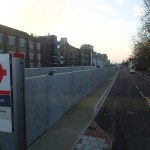


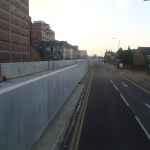
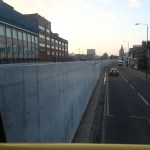

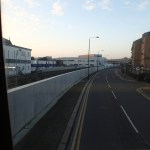
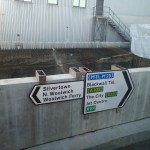
It seems to me that the architect of the Berlin Wall is alive and working on Crossrail.
There is also this map from Google.
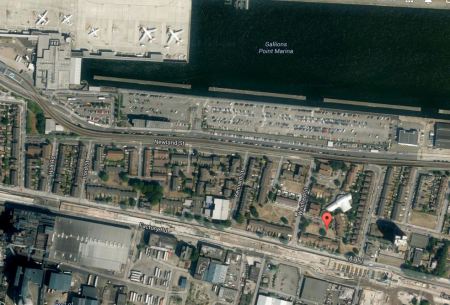
The bus went along the road labelled as the A112.
Squeezing A Bridge Between Working Railways
Crossrail has shown some impressive pieces of engineering to the media. But I’ve seen little about the work that is going on at Whitechapel station where Crossrail goes underneath the Overground, which contrary to what you might think, goes underneath the Underground. These pictures show how one of London’s most delapidated stations is being transformed.
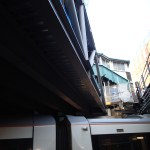
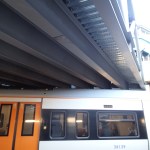
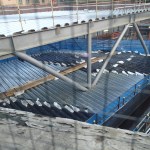
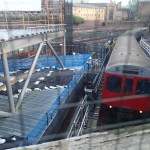

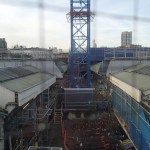
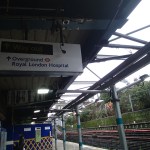
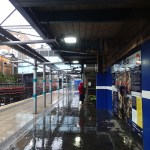
I’m not sure, if the impressive steel bridge is for the Underground lines or passengers. But inserting it isn’t camel-going-through-the-eye-of-a-needle stuff, but something a lot more challenging. Especially, if you’re doing it in the space between two busy rail lines. Luckily for Crossrail, when the East London Line was rebuilt a few years ago, the decision was made not to convert it to overhead electrification.
Look at this section on the Crossrail web site, which shows some images, which help you to make sense of what I photographed. Helpfully, the architect has drawn the trains in the right colours.
Custom House Is Looking Like A Station
The combined Crossrail/DLR station at Custom House grows every week.
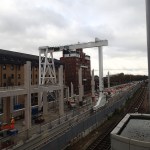
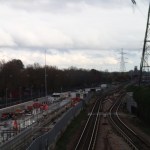

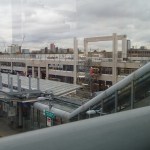

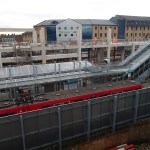
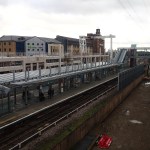
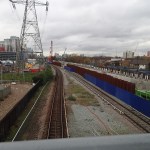
It’s now beginning to look like a station and you can see how it will connect to the Docklands Light Railway.
I have a feeling, that when Crossrail opens, this station will get a high rating.
As it is built in a factory, the engineers have told me, that the quality of the concrete is excellent.
Is Everything A Short-Term Fix At Willesden Junction?
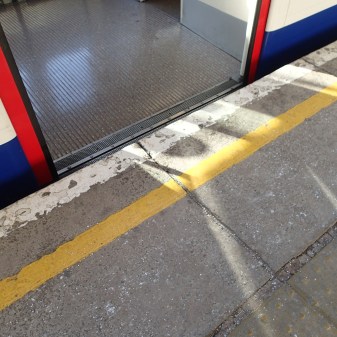
In posts yesterday, I highlighted the problems with platform/train gaps and the dreadful interchange at the North London Line platforms at Willesden Junction station.
But is all the work done to lengthen the platforms for five-car trains just a short-term measure, which doesn’t address these problems at all?
Obviously, work has to be done on the low-level platforms and as they don’t have too many problems, except for the step up and down into Bakerloo Line trains, it will make the low-level station a good one with step-free access, a cafe and toilets.
The Tube/Overground Mismatch
But upstairs, I can’t help feeling that solving the problems are virtually impossible, without a complete rebuild of the station. But look at this map of the proposed layout of the lines at Old Oak Common.
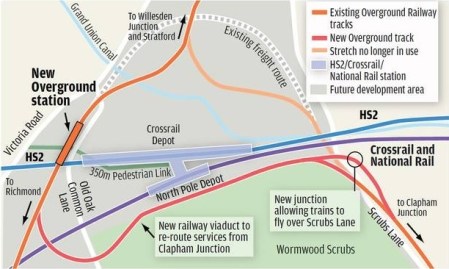
Rail Lines At Old Oak Common
This would link HS2 and Crossrail to the North and West London Lines at a new station at Old Oak Common.
So if the Old Oak Common area is developed with a new station, would this have a knock-on effect at Willesden Junction? This could ich mean that the station had to be changed substantially or possibly was no longer needed.
The big problem is what to do with the interchange between the North London Line and the Bakerloo and Watford DC Lines.
There have been plans for the Bakerloo Line to take over the Watford DC Line north of Harrow and Wealdstone. This would mean diverting the North London Line via Queen’s Park and Primrose Hill.
This would fit in well with the combined North/West London Line station at Old Oak Common. On the other hand, it would mean a few station closures and stations between Queen’s Park and South Hampstead would leave their links to Euston.
Old Oak Common station is still very much at the planning stage and if the ideas get firmed up to a mega-interchange, it should make it easier to sort out the North London Line and the Watford DC Line.
There is also the question of how the Croxley Rail Link will affect ridership on the Watford DC Line. The fastest jouneys to Euston Square from Watford Underground station, are now about 45 minutes, whereas the DC Line takes 52 minutes from Watford High Street. However by going one-stop the wrong way to Watford Junction station, you can do it in 35 minutes. As London Midland runs several trains an hour into Euston in about twenty minutes, this might be a preferred option.
If Crossrail goes up the West Coast Main Line, as is also being proposed, then the trains would surely stop at Harrow and Wealdstone and Watford Junction.
Transport for London have a lot of deep thinking to do.
Crossrail Build A Temporary Station
Crossrail don’t seem to do rubbish, as these pictures of the temporary station at Abbey Wood show.
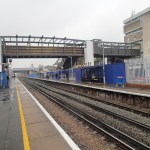
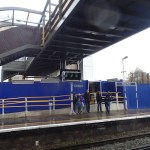
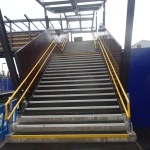
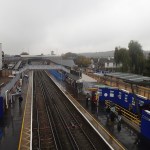
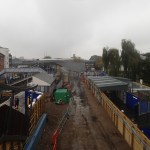
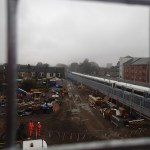


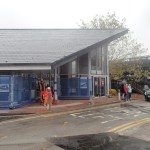

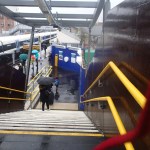
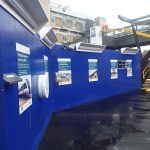
It will probably be better without the rain and when they have finished the lifts. But how many times have you seen lifts in a temporary building. I’ve only seen them once befire and that was at the site of Crossrail’s Custom House station.
The New Age Of The Train
The Independent today has an article which talks about the proposed costs of building HS2. Buried in the text is this paragraph.
Tomorrow, George Osborne, the Chancellor, will announce plans for what has been dubbed HS3, a line across the Pennines that would act as a major economic boost to the North. Writing on page 42 today, the Shadow Chancellor, Ed Balls, and former Transport secretary Lord Adonis dismiss the promise as “pre-election posturing”.
I shall be awaiting what the Chancellor says with interest.
The problem of trains in the North has existed for years and so if the Labour Party was in government unchallenged for over ten years, what did Balls and Adonis do about the problem?
Since 2010, and the Coalition Government, the closet trainspotter, has signed off the first part of the improvement in the North, the Northern Hub and extended electrification in the area.
In my view this improvement across the Pennines is the most important rail project outside London.
It is worthwhile looking at the list of large rail projects that are scheduled for completion in the current decade.
Crossrail and Thameslink
Crossrail and Thameslink should always be thought of together, as they will have an important hub at Farringdon and will revolutionise travel across the wider South East and possibly further. So many journeys like Ipswich-Gatwick, Reading-Cambridge and Brighton-Heathrow will be easy journeys with a just a change or two.
Last night, I had an awful taxi journey back from the Gherkin, as roadworks meant that the whole area was gridlocked. The taxi driver was sceptical about trains, so I asked him, where he lived. As he said Goodmayes, I asked him how he got to Gatwick and he replied it was an awful drive of well over an hour. By train today it takes nearly an hour and a half, with two changes, although both are step-free at Stratford and London Bridge. After Crossrail/Thameslink is fully open the first leg to Farringdon will take 24 minutes and currently the Farrington-Gatwick link takes 50 minutes. But there is only one change at Farringdon and I suspect that trains on the Farringdon-Gatwick leg will be much more numerous and perhaps even quicker.
This sort of improvement will be delivered all over the South East.
But that is not the end of it!
Many towns and cities will be just a train ride away from a Crossrail or Thameslink terminus. Bristol, Norwich, Nottingham, York, to name just three, all have fast trains, that link to the network. So for many there will be no humping heavy cases across the Underground network to go to and from places like Heathrow, Gatwick, Brighton, Cambridge and the Thames Valley.
I think the only problem many passengers will have is choosing the best change to get to their destination. For instance with a journey from Nottingham to Gatwick or Brighton, would you change at Bedford, Luton or St. Pancras. I suspect it wouldn’t be the badly-designed St. Pancras. So if one of the others was just a simple walk across that would get the traffic.
Some main lines out of London and the areas they serve though, are not well-connected to Crossrail or Thameslink. If I go round London, the only major lines that come to mind are the West Coast Main Line and South Western Main Line. There are published ideas about taking Crossrail to Tring or Milton Keynes, which solves the problem of the former, but getting to Waterloo or Clapham Junction from Crossrail or Thameslink is a problem. But then Basingstoke to Reading is down to be electrified as part of the Electric Spine, so surely if this is done properly, this could mean Basingstoke was almost part of Crossrail.
Great Western Main Line Electrification
After Crossrail, the full modernisation of the Great Western Main Line is the next most expensive project at £5-billion.
It is comprehensive and includes resignalling and electrification of the line all the way to Swansea.
It will be interesting when both this project and Crossrail are complete how the passengers use the two lines to get to say Bristol and South Wales. I for one, might get my Crossrail train to Reading to pick up the Great Weatern there, if the interchange is easier.
I suspect too, that in the first few years of the next decade there are various tweaks to the Great Western/Crossrail interface.
Plans at present are for a lot of Crossrail trains to turnback at Paddington, but will train companies tend to run some of these trains past Reading to perhaps Oxford or Basingstoke.
It will all depend on what the passenger statistics throw up!
Northern Hub
Talk to most people, including many in the North, about the Northern Hub and they won’t have heard of it. Even if they’ve seen some of the related projects like Huyton station.
If Crossrail is unlocking tremendous potential for London’s rail network, then the Northern Hub should do the same for the Greater Manchester area. On a personal note, getting from London to places like Bolton, Burnley, Blackburn and Huddersfield should be a lot easier, but even from December 2015, the first tangible benefit of the Northern Hub should be seen, when faster electric trains between Liverpool and Manchester start to run. So they are 1980s-vintage Class 319 trains, but being Mark 3 coach-based, they should scrub-up well and be magnitudes better than Northern Rail’s scrapyard specials.
Electric Spine
If the Northern Hub is invisible, then the Electric Spine is even more so, although it is costed at £800-million.
It will have a big effect, as it creates an all-electric railway from Southampton to the Midlands and ultimately Sheffield, Doncaster and the North, which will enable more freight trains to travel up and down the spine of the country, helping to free up road space on the A34 and the motorways.
Midland Main Line Electrification
Th Midland Main Line electrification is effectively now part of the Electric Spine and the two proects should probably be treated as one large one.
East-West Rail Link
The East West Rail Link is the reinstatement of the old Varsity line between Oxford and Cambridge, via Bletchley and Bedford.
The Western section will be opened first and part of it will be in the Electric Spine. This section of the line will also be used by Chiltern’s new Oxford service, which according to this press release should be fully running by Spring 2016.
But the line’s main use will be probably be freight winding it’s way between Southampton and the West Coast and Midland Main Lines. In some way the East West Rail Link is a new section of the M25 for freight trains.
Cardiff Valley Lines
I explored the Cardiff Valley Lines on my recent trip to Cardiff. This £350-million project is a follow on to the Great Western Electrification. A good proportion of the track-work seems to have already been done.
Greater Bristol Metro
The Greater Bristol Metro is a proposal to upgrade all the local lines around Bristol. The upgrade is not as comprehensive as that in South Wales, but it should provide a substantial improvement to train services in the area.
Waverley Line
Like the East-West Rail Link, the Waverley Line or Borders Railway is another reinstatement of a line closed in the 1960s. I said in this post, that this line has more significance than anybody thinks. If it’s the success I think it will be, it could mean that we see more proposals for reopening lines turning from dreams to reality.
Class 88 Locomotive
I like to think I’m an innovative engineer and the Class 88 locomotive is the sort of idea I like. It is effectively an electric engine with an onboard diesel engine, so that it can work away from the wires if necessary.
I was talking to a freight locomotive driver yesterday and as an example, he said that they have to use diesels like Class 66 or Class 70 to take trains into Felixstowe, as they can’t put wires up in the port, due to cranes loading and unloading the trains.
But I do think that the concept of the Class 88, may well be well suited to the UK, where there are still a considerable number of places like Felixstowe, where there is no overhead wiring, but electric lines aren’t far away.
If the first engines delivered in the next few years, prove to be up to the work, I could see lots of Class 88s working the network.
Conclusions
It is a good time to be any sort of railway engineer!
But the public don’t seem to realise what is happening for the better! And in some places like South Wales, they still think it won’t happen!
There’s certainly an awful lot of taxpayers investment going in! Only time will tell, if it’s worth it!
Pudding Mill Lane Station – 24th October 2014
Crossrail claim, that the Pudding Mill Lane DLR station, is the first one they have delivered.
It is certainly impressive, with a high level of attention to detail.
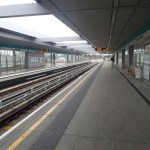
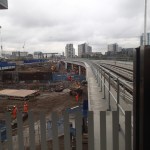
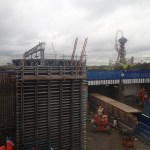
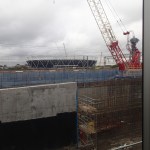
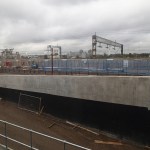
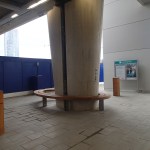

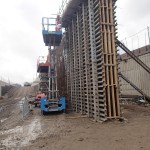
Note in the pictures the retaining wall for the Crossrail lines disappearing into the ground at the station to go under London. Apparently, the piling rig being used is one of the biggest in the world.
I did like the idea of using wooden rather than steel posts to prevent vehicle entry,! Especially, as they are worthless to scrap metal thieves.
It does look that this DLR station will be the place in Central London, where you will take kids of all ages to see the new Crossrail trains running.
It is also interesting to look at the architect’s drawings and pictures for the station.
 The Anonymous Widower