How To Annoy Customers
I just sent this message to John Lewis Card Services.
I shall be cancelling my card at the earliest possible opportunity.
I have a problem with my left arm, due to it being broken by the school bully and a stroke which didn’t help.
So for convenience, i don’t use any web sites that use the shift keys in passwords.
Why do people do this?
Passwords should always be able to be typed with one hand.
For instance, why couldn’t I use say “donald=13”?
No-one would guess that!
‘Wheelchair vs. Buggy’ Case Goes To The Supreme Court
The latest in this story from Wetherby is in this article on the BBC, which is entitled Supreme Court to hear ‘wheelchair vs buggy’ bus case.
I think it is interesting that this case comes from Wetherby, which I suspect doesn’t have such an intensive bus service as I have here in London or as there is in Manchester, Newcastle or Liverpool.
In London, I have never seen an argument over the wheelchair space on a bus, although I have seen some severe, but helpful reorganising, when a wheel-chair needs to be accommodated.
In London because bus frequencies are higher and there are generally shelters these days, I would suspect that most people, be they able-bodied, in a wheel-chair or with a buggy, accept that they may have to wait for the next bus.
But if there is only one bus an hour, it’s chucking it down and there’s no shelter, it’s more likely that passengers will refuse to co-operate.
So one way to mitigate problems like this, is to provide a better bus service, with more buses, better shelters and improved information.
But that all costs money!
I am not disabled, although I don’t drive because of an eyesight problem. I also because of my stroke, could have ended up in a wheelchair, so I sympathise, with those who have to use a wheelchair or electric buggy to get about.
I regularly, see passengers in wheelchairs use London buses, with their central entrance/exit, which leads straight into the wheelchair space. The design, also means the driver can deploy the ramp and do everything they need without leaving the cab. In loading a wheelchair, I’ve also seen buggy-pushers take advantage of the deployed ramp to get out of the bus to fold the buggy before getting back on.
But outside of London, where often the wheelchair user has to get in the front entrance by the driver, this creates all sorts of delays and I’ve seen on a crowded bus, virtually everybody on the lower-deck get off, to allow the wheelchair to pass through.
I wonder if outside of London, there is more resentment of wheel-chair users on buses, than there is in the capital.
In my view, all new buses should be designed for central wheelchair entrance/exit as this is so much more efficient.
I once had a discussion with a Manchester Buses union rep on a Manchester bus. He was all for the London system of no-money-on-buses, with a front entrance and central-exit passenger flow, as it cut attacks on staff.
Since then, London has gone even further and now with the ability to use any contactless bank card as a ticket, London now has one of the most advanced bus-ticketing system in the world.
We need a standardised bus-system all over the UK. It might actually encourage more people to use this often-neglected form of public transport, which would generate more revenue for a better system.
Disabled Passenger Numbers Hit Record Levels
The title of this post is that of an article in Rail Technology Magazine.
It certainly shows that rail companies are going the right way!
One thing you notice in London is the increase in the number of disabled and blind passengers being guided by staff.
Perhaps the perceived increase in London is due to their simple policy on help. This is said.
On the Tube, TfL Rail and Overground, station staff will also accompany you to the train and help you on board and, if needed, can arrange for you to be met at your destination. Anyone can use this service, but it is particularly used by blind and visually impaired passengers and people using boarding ramps onto trains.
If you would like to use this service, ask a member of staff when you arrive at the station.
I hope things are as relaxed elsewhere.
It’s Not About The Wheelchairs
First Bus are probably delighted that they have won the court case about whether wheelchair users have priority over babies in buggies. This is the first paragraph in the BBC web report.
Bus companies are not required by law to force parents with buggies to make way for wheelchair users in designated bays on vehicles, senior judges ruled.
I travel regularly on London’s extensive bus network. A couple of years ago, there was a wheelchair bay full of buggies and a lady in a wheelchair wanted to board. On London buses, the wheelchair bay is opposite the middle door, which is the one with the automatic ramp. So the driver asked if the bay could be cleared, as he lowered the ramp. One lady took her buggy down the ramp and another folded hers and passengers made sure they had one of the spacious double seats by the middle door. The lady in the wheelchair then pushed herself into the space and as there was enough space the first buggy was able to be squeezed in too!
It had all been a sensible dance up and down the ramp and the bus was fairly quickly on its way, after an amicable confrontation.
On new Routemasters, with their bigger space by the door, better layout and completely flat floor, I’ve never seen anything other than minor problems.
Compare London with what happened at Reading when I went to see Ipswich play in August.
Returning from the Madejsky stadium after the match, there was a long queue for the buses. In front of me in the queue was a guy in a wheelchair. As the downstairs of the almost brand-new double-decker was full, with at least ten standing in the wheelchair space, to get the wheelchair rider on the bus, meant virtually unloading the bus and starting again. A lot of fans were not happy.
If the bus had had a central door and wheelchair ramp, what took perhaps well over five minutes, would have been much easier and probably a lot quicker.
Given all the other advantages with two or more entrance buses, like faster loading and unloading and a possible reduction in the number of attacks on staff, isn’t it about time that all the city bus services of the UK, were made to follow London.
How about adding talking buses, bus maps understandable to everybody and cash ticketing to bring the rest of the country into the twenty-first century?
Highbury And Islington Post Office Is Now Shut
The convenient Post Office at Highbury and Islington Station has been closed.
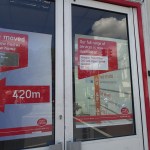
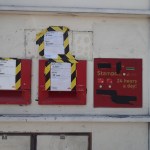
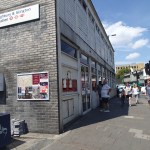
To be fair, it had seen better days and its closure probably makes it more likely, that one of the worse stations in London gets developed as a station for the twenty-first century, hopefully with step-free access everywhere.
Bannockburn Riding for the Disabled
I was alerted to the plight of this organisation by Melanie Reid in her Saturday column in The Times.
Riding for the Disabled was one of the charities C and myself supported, so she would be totally behind my donation to help the Bannockburn RDA in their fight against a difficult landlord.
If you would like to donate, you can use Just Giving.
It’s Only A Toilet For A Train
Some of the designs that impress me are ones where something is properly redesigned for the twenty-first or even the twenty-second century, often re-using the current outdated infrastructure.
That is why I like some of the architecture in the UK like the British Museum, the Tate Modern and Kings Cross Station have been extended in a modern style.
The UK Rail Industry has several stations on my list of good improvements, but it is also good at updating rolling stock. The stopgap High Speed Trains are still thundering to the extremes of the UK and who would predict, when the last one is retired from active service? If I live to a hundred, I suspect that some of these trains will outlive me! After all they would become a marketing man’s dream on a long tourist route like down to Cornwall, up to the North of Scotland or perhaps across Australia or Argentina, offering unprecedented comfort in a vintage train. We’ve also got the example of the HST’s humble cousins, the Class 455, which scrubbed up so well, some passengers thought they were new trains.
The UK Rail Industry has an expensive road block coming up in 2020, with the Persons of Reduced Mobility (PRM) legislation coming into force. Many older trains like the Class 156 would have to be scrapped and replaced if they couldn’t be updated to meet the new regulations.
But never underestimate the power of good design and engineering and one of the biggest problems of the refurbishment of the Class 156 described here, namely a fully-accessible toilet has been solved.
The new toilet has been designed and built by PCC.eu and they call it a Comfort Zone. I first saw it described in this month’s Modern Railways.
As I travel occasionally on some of the Greater Anglia trains, that have now been updated, I shall be interested to see how it works in practice.
As the floorspace needed is smaller than the traditional PRM toilet and providing decent on-train facilities is not just a UK problem, it looks to me that this is a classic where-there’s-muck-there’s-money design.
It also shows that one of the best ways to make money is to design or invent something.
Could This Happen In The UK?
This article on the BBC web site is about how the French have ordered 2,000 new trains that are too wide for the platforms.
The French train operator SNCF has discovered that 2,000 new trains it ordered at a cost of 15bn euros ($20.5bn; £12.1bn) are too wide for many regional platforms.
But could it happen here?
The front cover of the February 2014 edition of Modern Railways has a headline of Mind the Gap. Inside it describes how at some London Underground stations there is a problem of large gaps between trains and station platforms with the new S Stock.
But the London Underground problem is for a different reason. As the lines get upgraded and new trains are delivered, London Underground is endeavouring to get the platform-train interface to help passengers and especially those with accessibility problems. And they have some curved platforms that make this difficult and will need rebuilding.
Regularly on the Overground, I see a wheelchair-bound passenger push themselves effortlessly into and out of the Class 378 trains, where the interface is easy. As the Overground platforms are lengthened for the new trains, any small gap problems are probably being addressed.
On the Continent except on Metros, there is usually a step-up into the train, which with heavy cases or a baby in a buggy is a slower process.
I wonder how long it is before some anti-Europe and anti-metrication politician or dinosaur, blames the EU and/or metrication for this French problem.
After all, the French are only probably doing what London Underground are and adjusting the platforms to their shiny new trains.
But are the new French trains solving the problem of access?
I can’t find any detailed descriptions of the trains or even their class, so I can’t answer that one.
This train-platform problem will happen more in the future, as many train platforms in the developed world were designed in the steam era and have been updated over the years. I suspect we’ll probably find some newish stations may have to be rebuilt for the next generation.
So we will see more of approach taken by the French and London of ordering a train, that you want for passenger needs and then adjusting those stations that don’t fit the new trains.
After all you would prefer to have the same type of train for all your lines like London Overground has done with the Class 378 rather than have a special version for some stations. If you look at the Class 378 as a go-anywhere train on the Overground, it has a dual-voltage and selective door opening capabilities to cope with lines without overhead electrification and short platforms.
I suspect that the French problems are worse as it’s a much larger number of trains and stations and there are politicians with axes to grind.
A Nice Touch On The Milan Underground
I saw this plate on a handrail on the Milan Underground.
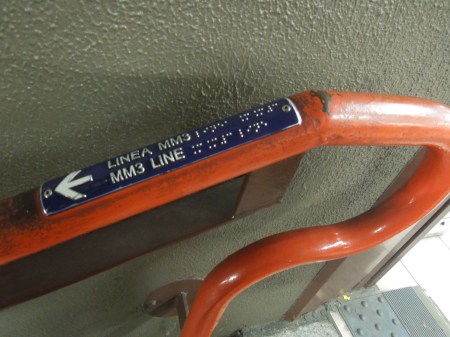
A Nice Touch On The Milan Underground
My eyesight may not be good enough to drive, but my brain compensates by turning my head to make my walking safe.
But it is touches like this, that must help those with limited vision to navigate a city safely and successfully.
To contrast, in Turin I’d seen a partially-sighted guy with a cane, having trouble with an escalator on the Metro.
A Problem With Disabled Toilets
I went to the toilet at Gatwick and despite it being a long walk from the Departures Lounge, I had no problems.
But it wasn’t so easy for a guy on two crutches I met, who looked distinctly unhappy. He told me the problem was that as the disabled toilet is the only place where smokers can’t be spotted, they use it as a smoking room. He said that it was particularly disgusting and smelt very strongly of smoke.
I bet those smokers don’t smoke in their own toilets at home!
 The Anonymous Widower