Masts Are Sprouting On The Goblin
I took these pictures of the new electrification masts going up on the Gospel Oak to Barking Line (GOBlin)
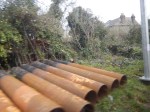
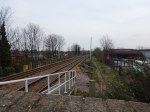
The piles seem to be very strong, but the masts are a touch more dainty, than those on the Great Western Main Line.
A Modern Electrified Metro Network Using IPEMU Technology
An IPEMU is an Independently Powered Electric Multiple Unit, which is a standard electrical multiple unit, which incorporates on-board energy storage, which can be charged on electrified lines and then used to power the train, where no electrification exists.
- At present a range on the on-board energy storage is typically fifty to sixty miles with adequate performance.
- The storage can be used to capture braking energy, which is then used to restart the train at a station.
- Every feature of a modern electric train can be provided.
The first IPEMUs to be delivered could be the Class 710 trains for the London Overground.
If you look at cities like Edinburgh, Glasgow, Liverpool, London, Leeds and Newcastle with comprehensive local metro networks of trains, they are mostly fully electrified, with perhaps the occasional line run by diesel trains.
Electric trains are preferable to diesel ones for several reasons.
- They have a better performance.
- They are quieter and don’t emit noxious fumes.
- They are easier to purchase.
But above all passengers like them better and they attract passengers and generate revenue and profits.
On the other hand.
- It is expensive to put up overhead wires and get power to the wires.
- Bridges need to be raised or track lowered to make space for the wires.
- Installation of electrification is disruptive.
- There are often heritage and/or environmental issues with the overhead wires or installing them.
But consider the cities or towns like Bristol, Cardiff, Norwich and Peterborough.
All have or will soon have the following.
- An electrified main line running through.
- A fully electrified central station.
- Branches and local lines fanning out from the central station, run by diesel multiple units.
- Most local services are less than eighty miles in total for an out and back journey from the central station.
- Other services go to another electrified central station, within the range of an IPEMU.
I think it goes without saying, that the current system in the town or city works after a fashion, even if the services are infrequent, too small and are worked using scrapyard specials.
Suppose the objectives for your new metro are as follows.
- Services are run by modern four-car electric trains, that meet all current and envisioned access and customer requirements.
- Services are run by a standard train, so if the network expands, more trains can be easily built!
- The ability to lengthen the trains, say for an important sporting or cultural event.
- Enough trains to run four trains per hour services on important lines and perhaps one per hour on lines that get much lesser use.
- Most services run out and back from the central station.
- As little disruption as possible, whilst creating the metro.
I believe that IPEMUs can be used to create such a metro, in the following manner.
- Get electricity to the central station.
- Check that all bridges, tunnels and stations on the lines can allow an IPEMU to pass.
- Upgrade and test the signalling for the new trains.
- Lengthen platforms on the lines to take the IPEMUs.
- Wire up the platforms in the central station and for possibly a few miles around the station.
- Test each line and convert them to IPEMU operation, as works are completed and IPEMUs become available.
One great advantage is that a lot of the testing can be done using a dummy IPEMU.
- It would be the same type of train as an IPEMU, but powered by a diesel engine.
- It would have the same cab as an IPEMU, so that all driver sight-lines and operations could be checked.
- It would have full signalling and other displays and instrumentation of an IPEMU.
- It would probably have a pantograph and a battery, so it could check all the overhead wires could charge the batteries of the IPEMU.
Real passengers could even be used for tests and asked for their opinions.
So where couldn’t this type of approach be used?
A Trip To Aylesbury Vale Parkway Station
Aylesbury Vale Parkway station is one of Chiltern Railway’s termini in Buckinghamshire.
It is on the London to Aylesbury Line with services to Marylebone via Amersham, with a journey time of five minutes over the hour.
Plans also exist for the station to be calling point on the proposed service between Marylebone and Milton Keynes. The plans for the station in Wikipedia say this.
East West Rail plans to extend passenger services northwards to Bletchley and Milton Keynes by 2019 using parts of the former Varsity Line. The platform has been built to accommodate a second track if ever implemented, which would create an island platform. At present trains (currently run only as specials onBank Holidays) between Aylesbury and Quainton Road cannot serve Aylesbury Vale as there is no platform on the through route.
The track between Aylesbury and the new station was upgraded to continuous welded rail with a maximum line speed for DMU passenger trains of 60 mph (97 km/h). It is proposed that when services are extended to the north, trains will run via High Wycombe and not Amersham. Trains currently serving the station will thereafter terminate at Aylesbury.
These are some pictures I took of the station.
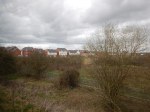
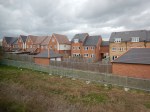
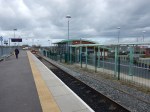
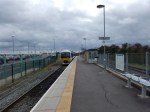


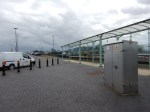
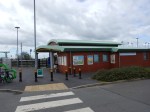
It is just a simple affair with a bus stand, car parks and the usual facilities, that appears will be soon surrounded by houses.
Chiltern Railways And Electrification
Before discussing how services will link up and down the London to Aylesbury Line, I will look at Chiltern Railways and electrification.
Under Developments and Announcements in the Wikipedia Entry for the East West Rail Link, this is said.
On 10 January 2013 Network Rail announced its intention to construct the western section between Bedford and Oxford, Aylesbury and Milton Keynes, as part of their five-year strategic business plan (2014–2019). The target date for train services to be operational on this section is December 2017. Electrification of the line between Oxford and Bedford was also included in the budget and target completion date was March 2017.
So electrification of the East West Rail Link is included in the project, even if the dates in the announcement are very much out of date now.
Given the following facts about the Chiltern Main Line, I believe it is likely that at some point, everybody will look seriously at providing electric trains from Marylebone to Birmingham Snow Hill station.
- The line has a close relationship with the East West Rail Link and other electrified or soon-to-be electrified lines.
- Chiltern finds it difficult to acquire more diesel-powered trains to fulfil their ambitions.
- Chiltern would like to run faster, larger, more efficient and greener electric multiple units.
Under Electrification in the Wikipedia entry for Chiltern Railways, this is said.
No section of the line is electrified, but in 2010 the chairman of Chiltern Railways, Adrian Shooter, indicated that electrification is being considered, though not in the immediate future. He added: “We could do some very interesting things with high-acceleration EMUs and possibly some further infrastructure work.
At some time in the next ten years, we’ll probably see electric trains between Marylebone and Birmingham Snow Hill.
But there will not necessarily be full electrification, as I believe IPEMU technology will change the way electrification is carried out.
Consider as well that the Chiltern Main Line is just one hundred and eighty kilometres long and the current maximum range of an IPEMU is being quoted as about sixty miles or just under a hundred kilometres, so with the following electrification.
- Marylebone and for perhaps twenty miles or so to handle local metro services.
- Birmingham Snow Hill, Birmingham Moor Street and the Snow Hill Lines, where there are local metro services.
- Banbury to Leamington Spa and other places, so that freight trains powered by bi-mode Class 88 locomotives, could use the line efficiently.
The Local lines from Marylebone and the Snow Hill Lines would be electrified using the techniques in A Modern Electrified Metro Network Using IPEMU Technology
IPEMUs would be able to run the full length of the line without the need for full electrification in an environmentally-sensitive area, inhabited by touchy people.
Northward To The East West Rail Link And Milton Keynes
Northward from Aylesbury Vale Parkway station, the Wikipedia entry for East West Rail Link, says that the line will be single track and allow 90 mph working. But as my pictures and a quick gander on Google Maps show, there is quite a bit of space available around the current single track. So as the East West Rail Link seems to be being designed as a double-track 100 mph railway, with full electrification, I think there are three possible options between the East West Rail Link and Aylesbury Vale Parkway and Aylesbury stations.
- Double-track 100 mph with electrification.
- Single-track 90 mph with electrification.
- Single-track 90 mph without electrification.
I think the line will be built with some form of electrification, so that electric trains can run from Aylesbury to Milton Keynes.
The line is also used by some freight trains, so double-track might be a good idea.
Aylesbury To London Via Amersham
Returning from Aylesbury today, I was surprised to see that the train ran from Amersham to Harrow-on-the-Hill on the same tracks as the Metropolitan Line. In fact for sixteen of the thirty-nine miles of the line from Marylebone to Aylesbury Vale Parkway, the line has full London Underground electrification.
Amersham to Aylesbury is about fifteen miles, with the distance between the two Aylesbury station being four miles, which means that Harrow-on-the-Hill to Marylebone is just a few miles.
So if an IPEMU could use the London Underground’s rail-based electrification, starting at Milton Keynes the train would easily arrive at Harrow-on-the-Hill with a full battery, that would take the train to Marylebone and back.
I don’t believe that the technical problems of an IPEMU starting at any station between Aylesbury and Milton Keynes and going to Marylebone and back are insurmountable.
Aylesbury To London Via High Wycombe
This uses the single-track Aylesbury to Princes Risborough Line, which is about a dozen miles long, before running to Marylebone along the Chiltern Main Line, which is another forty miles or so.
So some electrification will be needed.
According to Wikipedia, Chiltern have various plans to improve their network.
- The restoration of the quadruple track between South Ruislip (Northolt Junction) and West Ruislip, allowing trains to call at both stations without blocking the line. Triple track currently exists at West Ruislip, with the up platform loop still in situ, and at South Ruislip, with the Down Main through line also in situ. This would involve the reconstruction of the new down platform at West Ruislip, and the reconstruction of the up platform at South Ruislip. This ‘Chiltern Metro’ service was not programmed into the last round of franchising agreements.
- Restoration of fast through lines at Beaconsfield as part of a longer-term aspiration for a 90-minute journey time between London and Birmingham
- Double-track the line from Princes Risborough to Aylesbury.
- New Chiltern Metro Service that would operate 4+tph for Wembley Stadium, Sudbury & Harrow Road, Sudbury Hill Harrow, Northolt Park, South Ruislip and West Ruislip. This would require a reversing facility at West Ruislip, passing loops at Sudbury Hill Harrow, and a passing loop at Wembley Stadium (part of the old down fast line is in use as a central reversing siding, for stock movements and additionally for 8-car football shuttles to convey passengers to the stadium for events)
Some would also fit well with adding electrification, so I think that enough electrification can be added to allow an IPEMU to go from Aylesbury to Marylebone.
Oxford To London
Given that there will be electrification between Oxford and Bicester Village stations courtesy of the East West Rail Link, IPEMUs could start at Oxford and reach Princes Risborough, from where they used the same methods as Aylesbury and Birmingham services to get to London.
This article on the BBC, which is entitled Cowley line passenger train service planned for Oxford, says this.
Chiltern Railways has revealed plans for a passenger service to run on the Cowley branch in Oxfordshire.
The line, currently only used for freight, would see two new stations on the route at Oxford Science Park and Oxford Business Park.
So if this service goes to London, it would certainly be another job for an IPEMU.
Watford Junction To Amersham And Aylesbury
The Croxley Rail Link has been designed so it can have a link to Amersham. Wikipedia says this about the link.
A further proposal is to use the existing but seldom-used Metropolitan line chord which allows trains to run from Watford towards Amersham via Rickmansworth. In conjunction with the Croxley Rail Link, this route would allow direct services between Watford Junction and Amersham, thus improving local public transport in Hertfordshire and Buckinghamshire.
These are pictures I took, as the train passed the junction of the branch line to Watford.
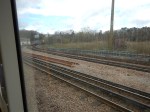
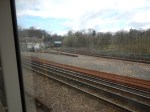
It would certainly be a new use for a substantial piece of infrastructure, but would it do much more than link Amersham to Watford Junction.
Chiltern Trains could run an IPEMU from Watford Junction to Aylesbury Vale Parkway calling at all stations, but as passengers could also get to Aylesbury from Milton Keynes, I wonder if it would be well used.
No Progress On Chase Line Electrification
This morning, I went up the Chase Line to Rugeley Trent Valley station and took a few pictures.
I am not publishing any of the pictures, as nothing seems to have changed since I wrote Up And Down The Chase Line in September last year.
I am still puzzled at the lack of progress!
The West-Facing Bay Platforms At Reading Station
Reading station has three west-facing bay platforms, numbered 1, 2 and 3.
They are used as follows.
- Platforms 1 and 2 for local services to Basingstoke, Newbury and Bedwyn.
- Platform 3 for Cross Country reversing trains.
Whilst I was at Reading yesterday, a Cross Country train reversed in a higher numbered platform.
These are some pictures of the bay platforms.
The View From Above
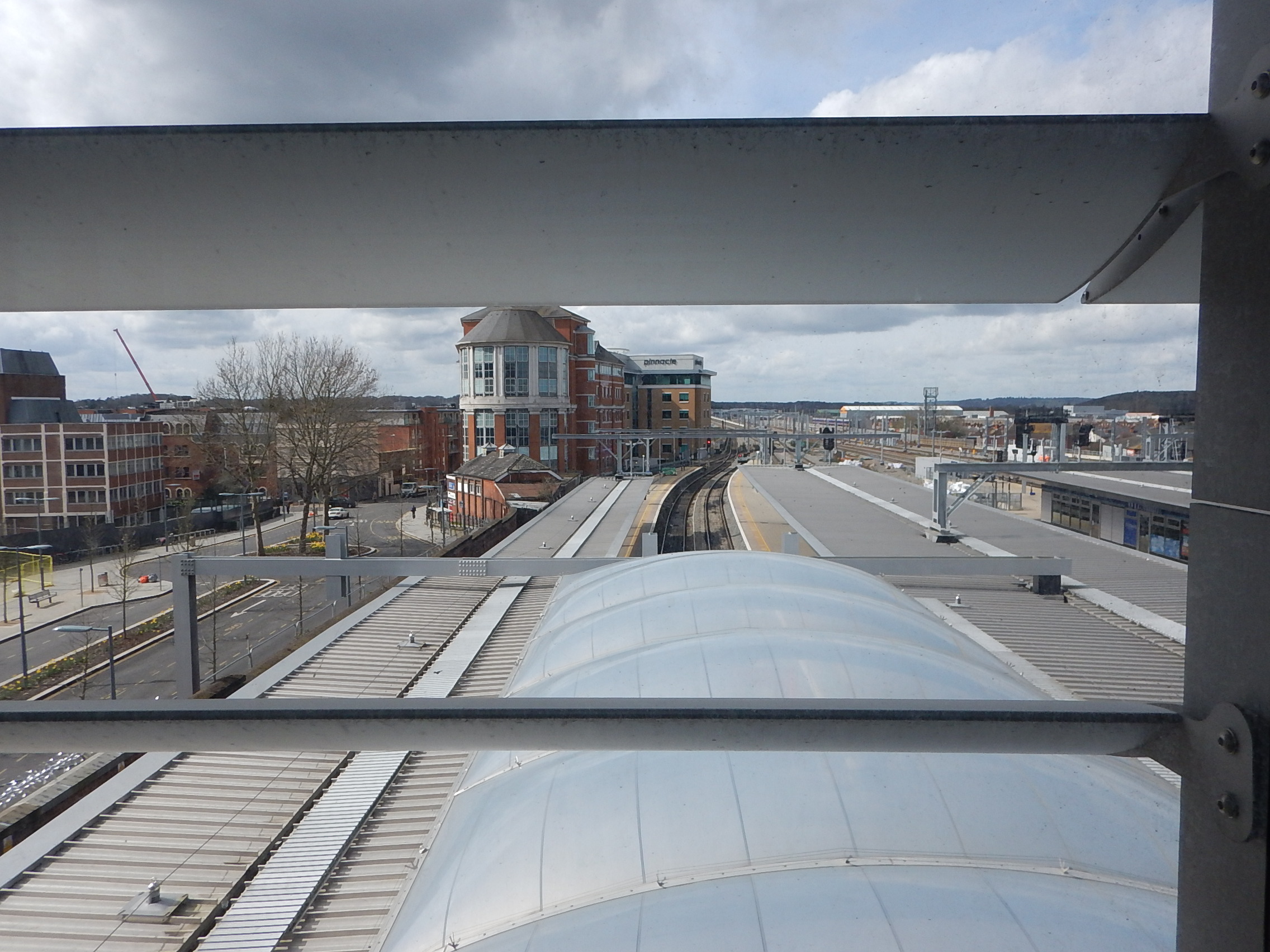
The Layout Of Bay Platforms 1, 2 and 3 At Reading Station
Note that the electrification gantries are in place across the three tracks.
The Platforms From Ground Level
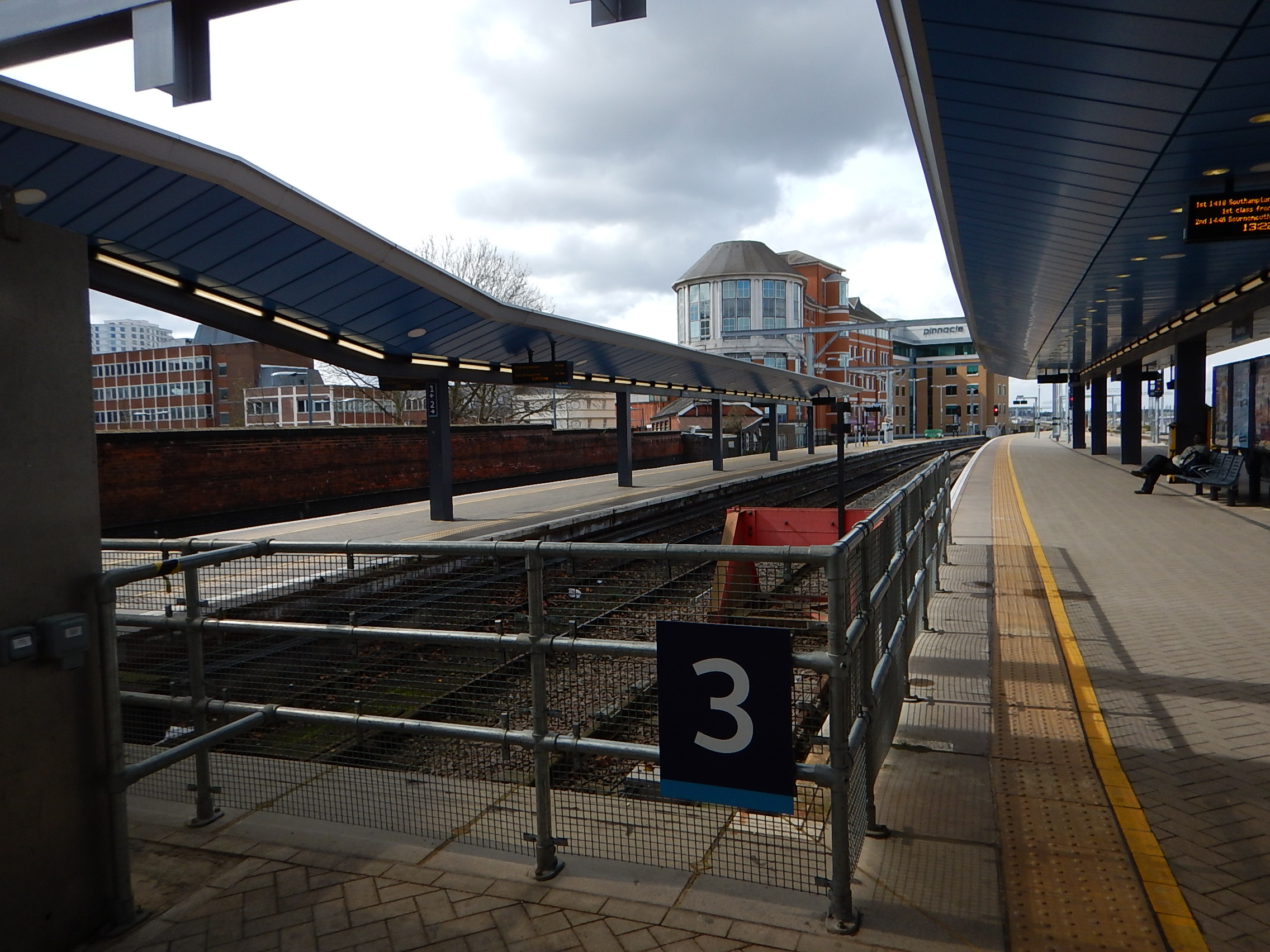
Platforms 1, 2 and 3 At Reading Station
Note how good the access is to the platforms. To the right of Platform 3, is platform 7, which is used for Down trains for the Berks and Hants route and for reversing Cross Country services.
So passengers arriving on a Cross Country train from say Manchester to Bournemouth or Newcastle to Southampton train on Platform 7 have these choices if they need to change trains.
- They could walk across from their train to a local service from platforms 1, 2 or 3.
- They could walk to the other end of the platform and get a local train from the east-facing platforms 4, 5 or 6.
- They could use lifts or escalators to cross the massive bridge to get a train on the Great Western Main Line to London or the West.
- They could also walk across to local services or in future, Crossrail to London.
And of course, they could walk out of the nearby station entrance and get a bus, taxi or their own transport.
Is there a station in the UK, where changing trains comes with so less hassle?
Ready For The Electrification
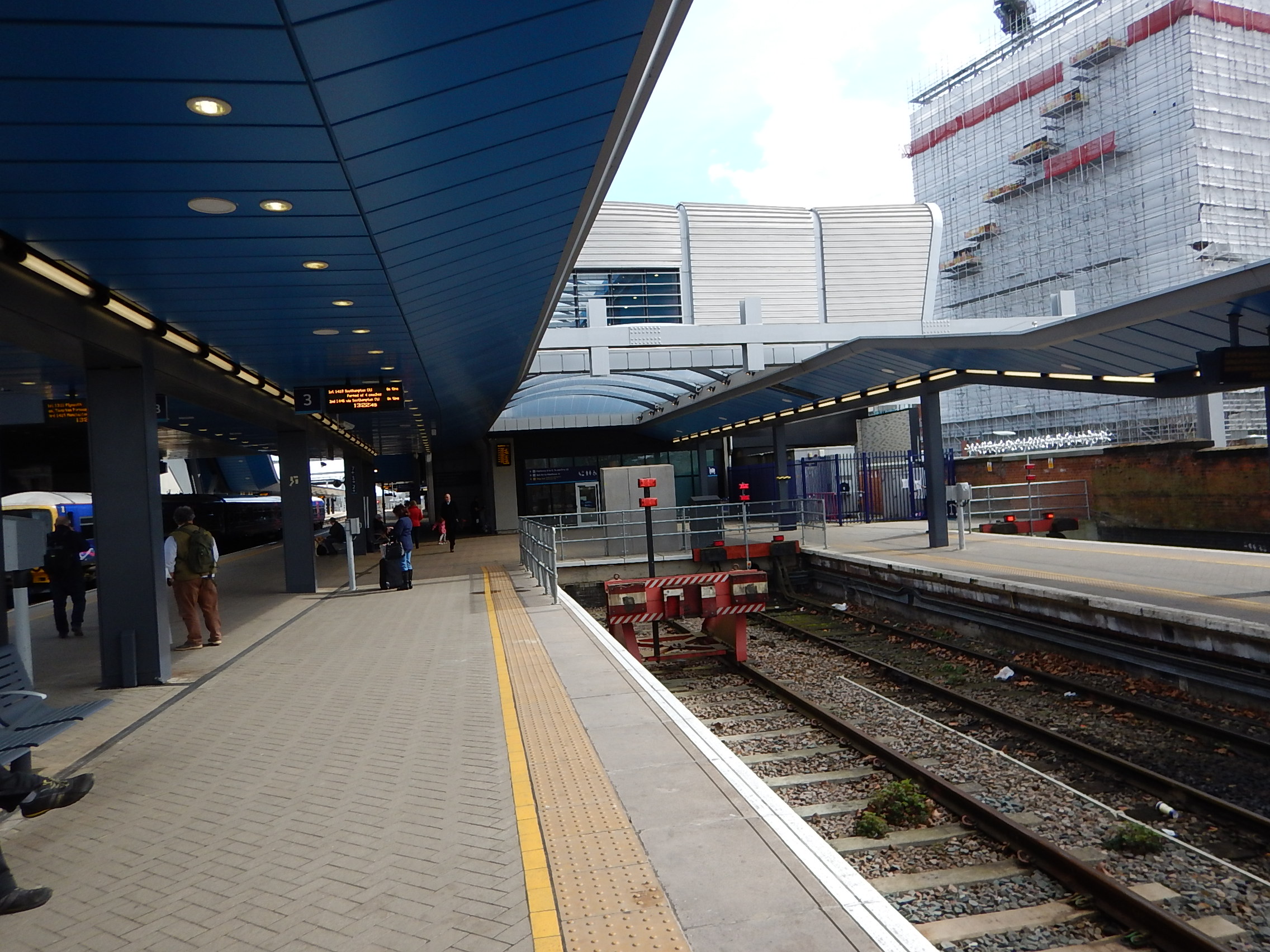
Looking Back At The Buffer End Of The Bay Platforms 1, 2 And 3 At Reading Station
Note that the gantries seem to have been designed into the station and are ready for the wires, with a nice secure steel plate to which to bolt them.
I can’t see the Heritage Taliban arguing about this design of catenery.
The Length Of The Platforms
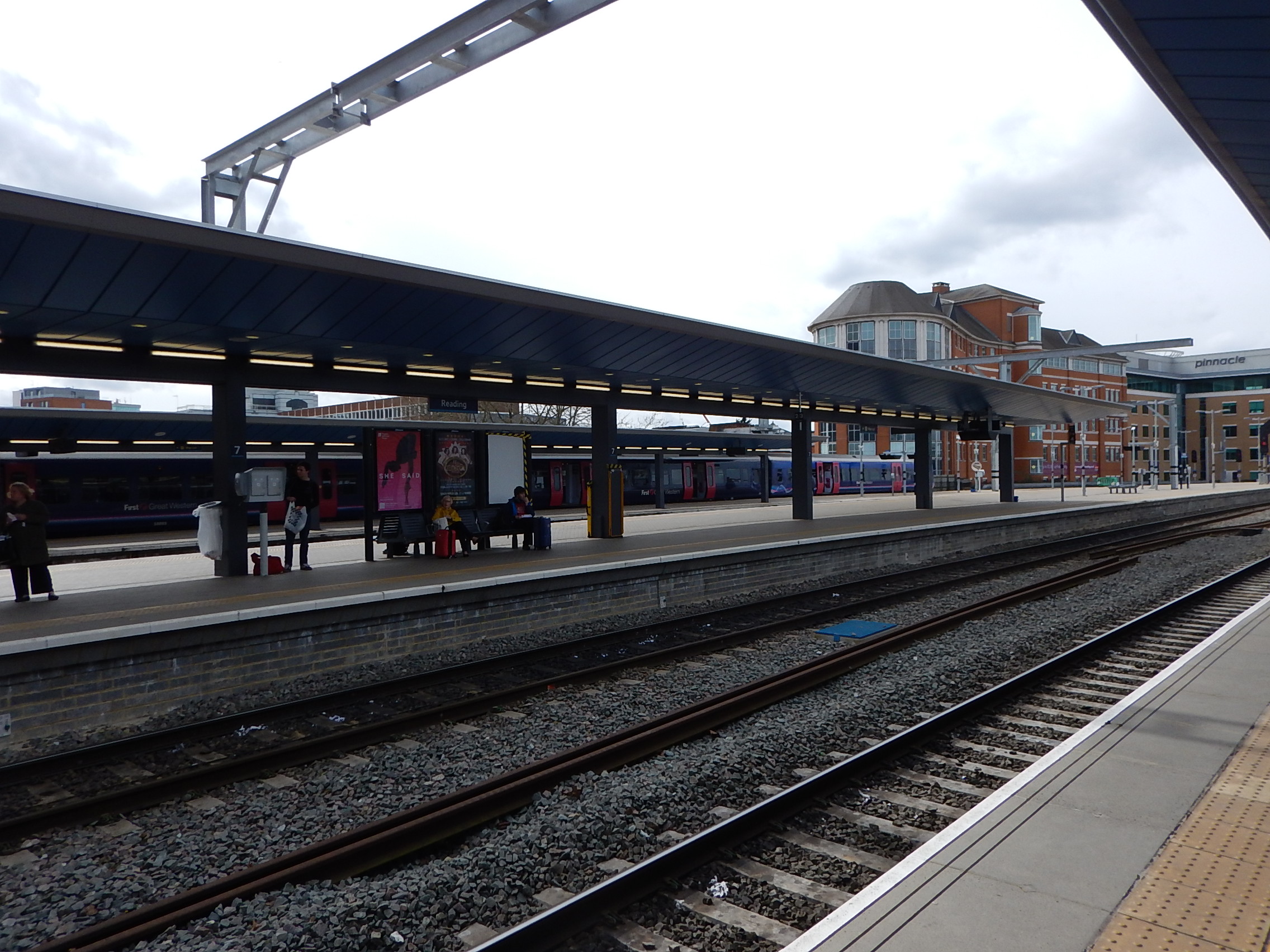
Platform Length Of The Bay Platforms 1, 2 And 3 At Reading Station
Note the three-car diesel multiple unit in the platform. I haven’t measured the platform, but I think they are long enough for a five car Class 800 train.
Future Use Of The Bay Platforms
At I said earlier the three platforms are used for local services to Basingstoke, Newbury and Bedwyn and reversing Cross Country trains., but there are two major purposes for which the bay platforms might be used.
The Test Track for Class 800 Trains
When the electric track between Didcot and Reading has been energised, it will be used as a test track for the new Class 800 trains. This article from the Witney Gazette gives more details.
The first three trains are due to be shipped to the UK early next year to begin an extensive test programme, which will include high-speed running on the line between Didcot and Reading once the installation of overhead electric power cables is completed later next year.
Roger Ford in the April 2016 Edition of Modern Railways said this.
Energisation for test running is now scheduled for September this year.
So will one of the bay platforms be used to reverse the train?
I’ve no idea! But the showman in me, would certainly do it, just for the publicity it would generate!
On a serious side, tests could also be performed on the train/platform/passenger interfaces.
Charging Platforms for IPEMUs
Great Western Railway would probably want to get their Class 387 trains into revenue service as soon as possible.
In the September 2015 edition of Modern Railways, there is an article entitled Class 387s Could Be Battery Powered. This is said.
Delivery as IPEMUs would allow EMUs to make use of as much wiring as is available (and batteries beyond) while electrification pushes ahead under the delayed scheme, and in the longer term would allow units to run on sections not yet authorised for electrification, such as Newbury to Bedwyn. The use of IPEMUs might also hasten the cascade of Class 16x units to the west of the franchise.
To run IPEMUs from Reading to Bedwyn or Basingstoke, would need them to be charged.
These bay platforms would be ideal for charging the trains and would mean that Basingstoke, Bedwyn and Newbury would get electric shuttles to Reading.
Conclusion
The team that designed Reading station, deserve a few gold stars.
Electrification At Didcot Parkway – 29th March 2016
On the 25th of March, I wrote Electrifying Didcot Parkway, after I passed through Didcot Parkway station on the way to Oxford.
Yesterday, as I passed through on the way to Bath, I took this picture of the forest of masts at the station.

A Forest Of Masts At Didcot Parkway
It does appear to me, that more have gone up over Easter, but because WordPress doesn’t let me look at galleries, I can’t be sure.
I also took this picture looking towards Oxford.
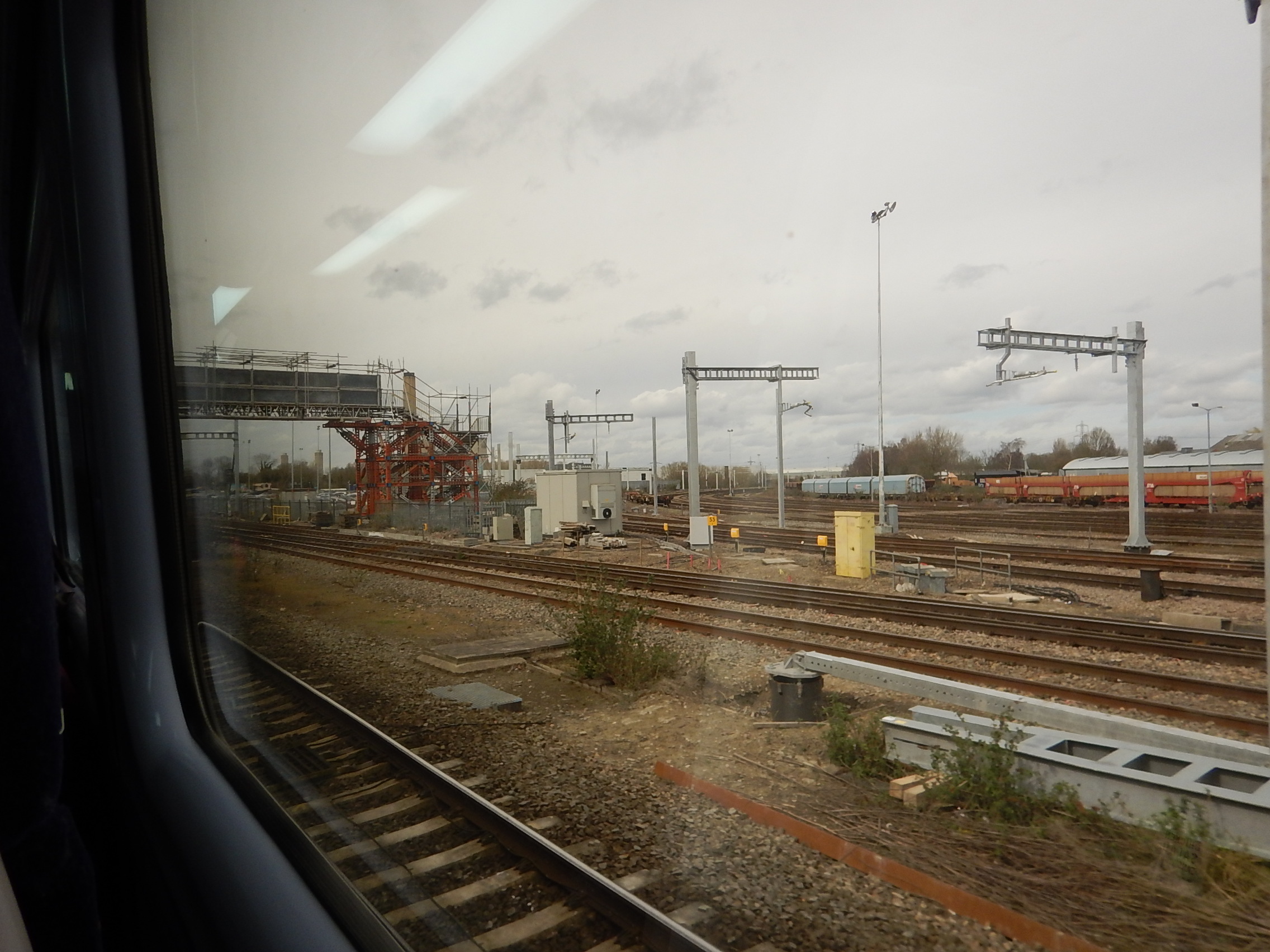
Masts Marching Towards Oxford
It would appear that the electrification is going to go at least as far as Didcot North Junction, where the West Curve from the direction of Swindon joins the Cherwell Valley Line. This schematic was clipped from Wikipedia.
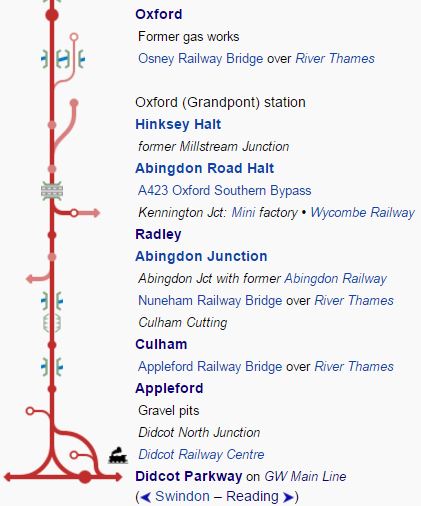
Didcot To Oxford On The Cherwell Valley Line
And this is a Google Map of the same area.
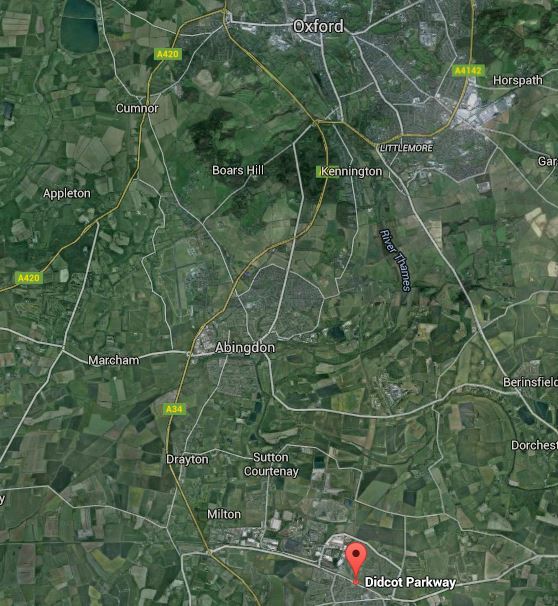
Didcot To Oxford
I estimate that from Didcot North Junction to Oxford station is about ten or twelve miles.
This would mean that if an IPEMU could reach Didcot Parkway station using overhead electrification, it could undoubtedly reach Oxford and then get back to Didcot.
Between Reading and Didcot, it would appear that the wires are going up.
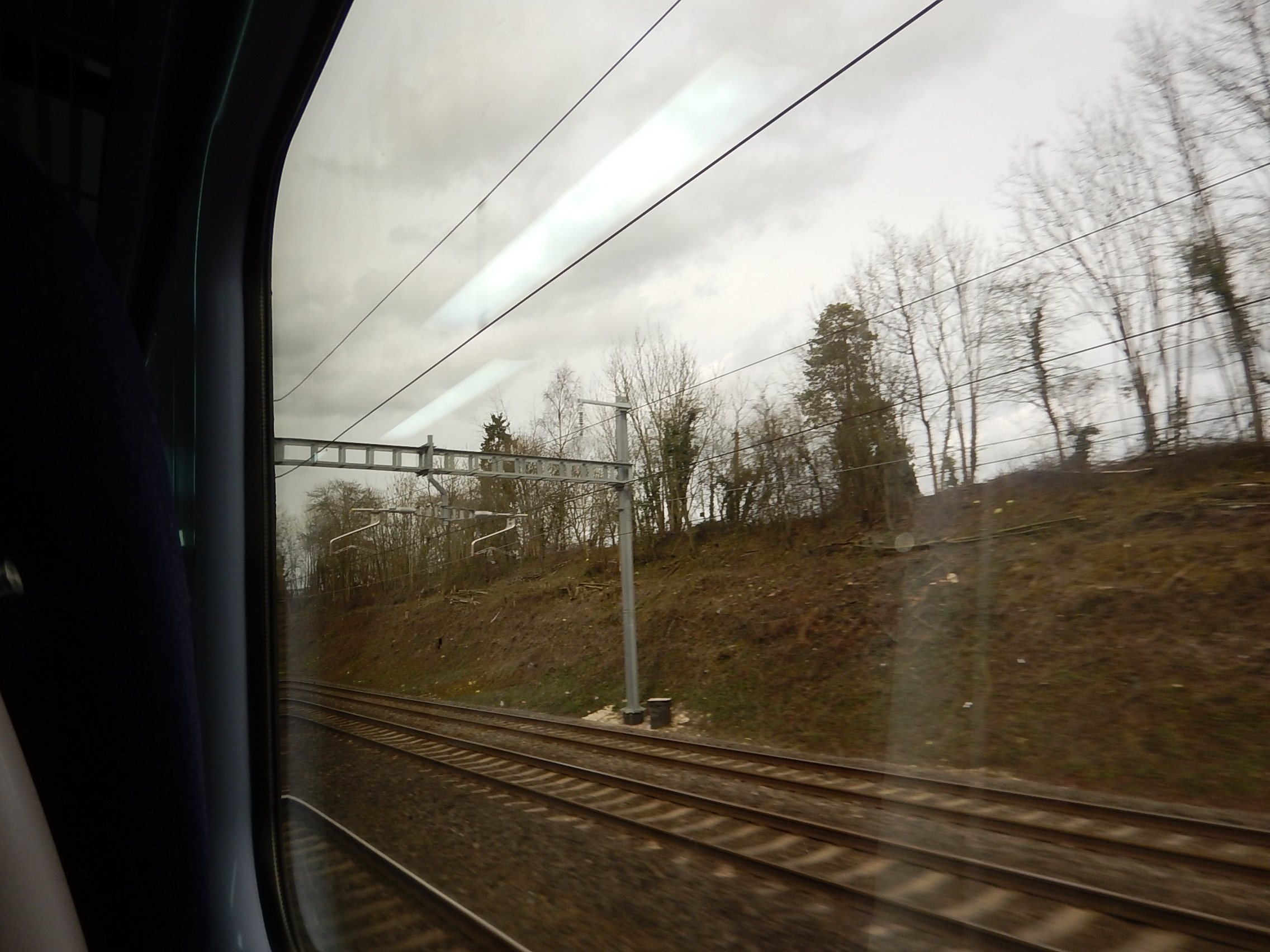
Wires Between Reading And Didcot
This picture shows the wires over the two slow or relief lines.
How Long Would An IPEMU Take From St. Leonard’s To St. Pancras International?
If an IPEMU is going to be used between St. Leonard’s and St. Pancras International station, there are two possibilities.
- A 110 mph IPEMU based on existing Class 387 trains.
- A 125 mph IPEMU based on a purpose-built Aventra. Ian Walmsley stated in the April 2016 Edition of Modern Railways that a 125 mph Aventra is possible.
This compares with the 143 mph and 100 mph speeds of a Class 395 train on high speed and classic lines respectively.
For this estimate, I will make the following assumptions.
- St. Leonards takes four minutes longer than Hastings.
- The baseline time from St. Pancras to Ashford is 38 minutes in a Class 395 train.
- Times on the high speed section are in proportion to the train speed.
- The baseline time from St. Leonard’s to Ashford is 46 minutes in a Class 171 train.
- All trains on the unelectrified section are limited to 100 mph.
Times From St.Leonards to Ashford
The Class 171 train takes 46 minutes, but it is only a benchmark, as few would go to Ashford and then get on a Class 395 train on High Speed 1.
The Class 395 train and the IPEMUs would be quicker as they would save a couple of minutes at each of the typical five stops, because of their faster acceleration.
Two minutes a stop would save ten minutes.
Times From Ashford to St. Pancras
Doing a simple calculation based on train speed gives the following times.
- Class 395 train – 38 minutes
- Class 387 IPEMU – 48 minutes
- Aventra IPEMU – 43 minutes.
Times from St. Leonards to St. Pancras
Adding the two times together gives.
- Class 395 train – 74 minutes
- Class 387 IPEMU – 84 minutes
- Aventra IPEMU – 79 minutes.
With Hastings it will be four minutes less.
In Wikipedia, there is a section called Future for the entry for the Marshlink Line. This is said.
The line is strategically important, as electrification and junction improvements would mean that High Speed 1 trains could travel directly from St Pancras International to Hastings. Amber Rudd, Member of Parliament for Hastings, has campaigned for electrification works to start by 2017. The aim is to reduce times to London from Hastings to 68 minutes, and from Rye to under an hour. This would require remodelling Ashford International station so the existing Marshlink line could connect to HS1, installing power systems, and adding a passing loop at Rye, all in addition to requiring new trains.
I think that the aim of 68 minutes from London to Hastings is a modest one, but as my crude estimate was only six minutes longer, I think the 68 minutes is totally attainable, especially as my times from St. Leonards to Ashford are just based on current timings and taking off a couple of minutes for each stop.
But if the Marshlink Line could be significantly improved, then time reductions of several minutes could well be achieved.
Electrification Of Bath Spa Station
Bath Spa Station could present a unique mix of electrification problems.
- It is a Grade II* Listed Building.
- It is situated in a World Heritage Site.
- The station sits on a viaduct between the River Avon and the City.
- Traditional electrification of the Great Western Main Line Through Bath, would be a challenge to the best engineers.
- Electrification will present aesthetic problems.
This Google Map shows the cramped location.
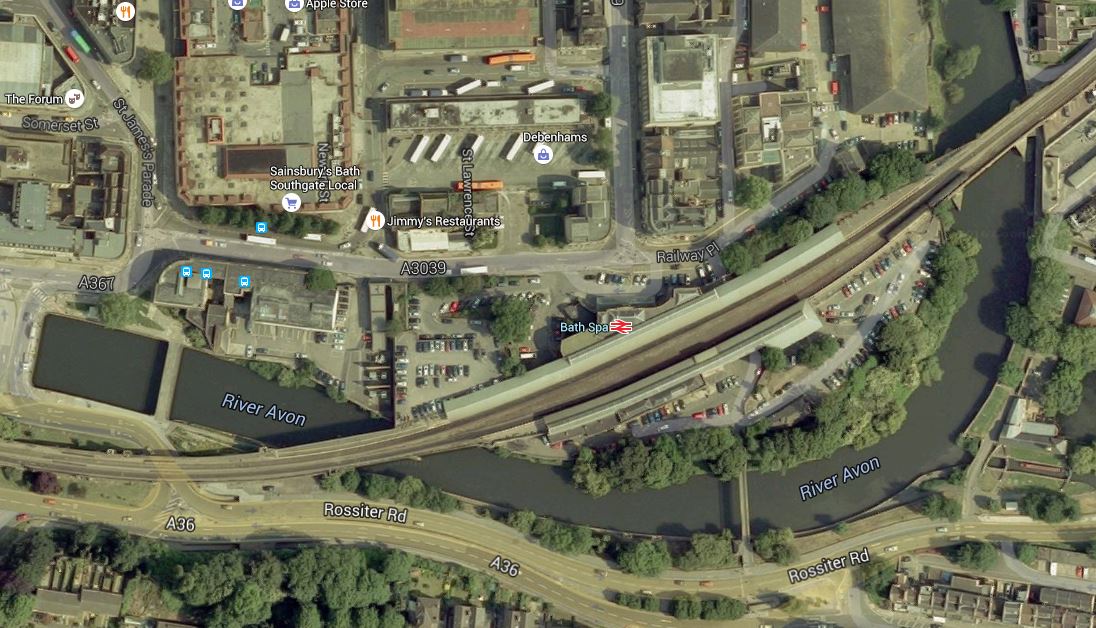
Bath Spa Station
At least it is close to the bus station, which can’t be said for that many stations.
As with Electrifying The Great Western Through Sydney Gardens, the engineers are thanking Brunel.
Look at this picture of the lines through the station.
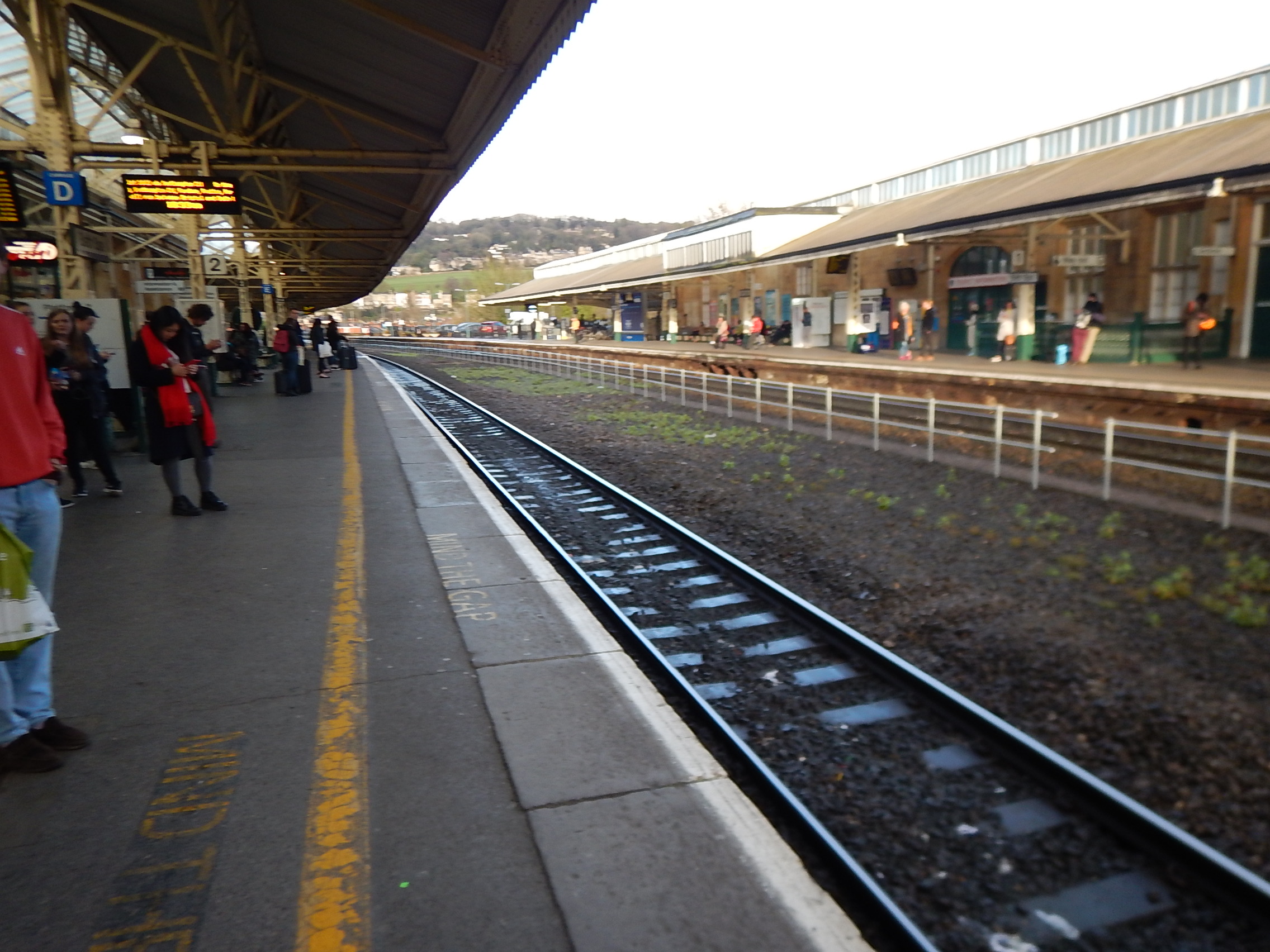
Lines Through Bath Spa Station
Engineers must surely be able to use some system to erect the wires on this wide viaduct, that was designed for Brunel’s broad gauge.
- A solution similar to that used in Paddington station could be used in the station.
- Central masts could be erected, with the overhead wires on either side.
No wonder that the Great Western Electrification is running so late, if every station is as difficult as this one.
These are a few pictures of Bath Spa station.





I’ll be looking forward to comparing them with pictures taken in a year or two, after the wires are in place.
Electrifying The Great Western Through Sydney Gardens In Bath Spa
The Great Western Railway runs i through Sydney Gardens in Bath. This picture shows an InterCity 125 running through the gardens.
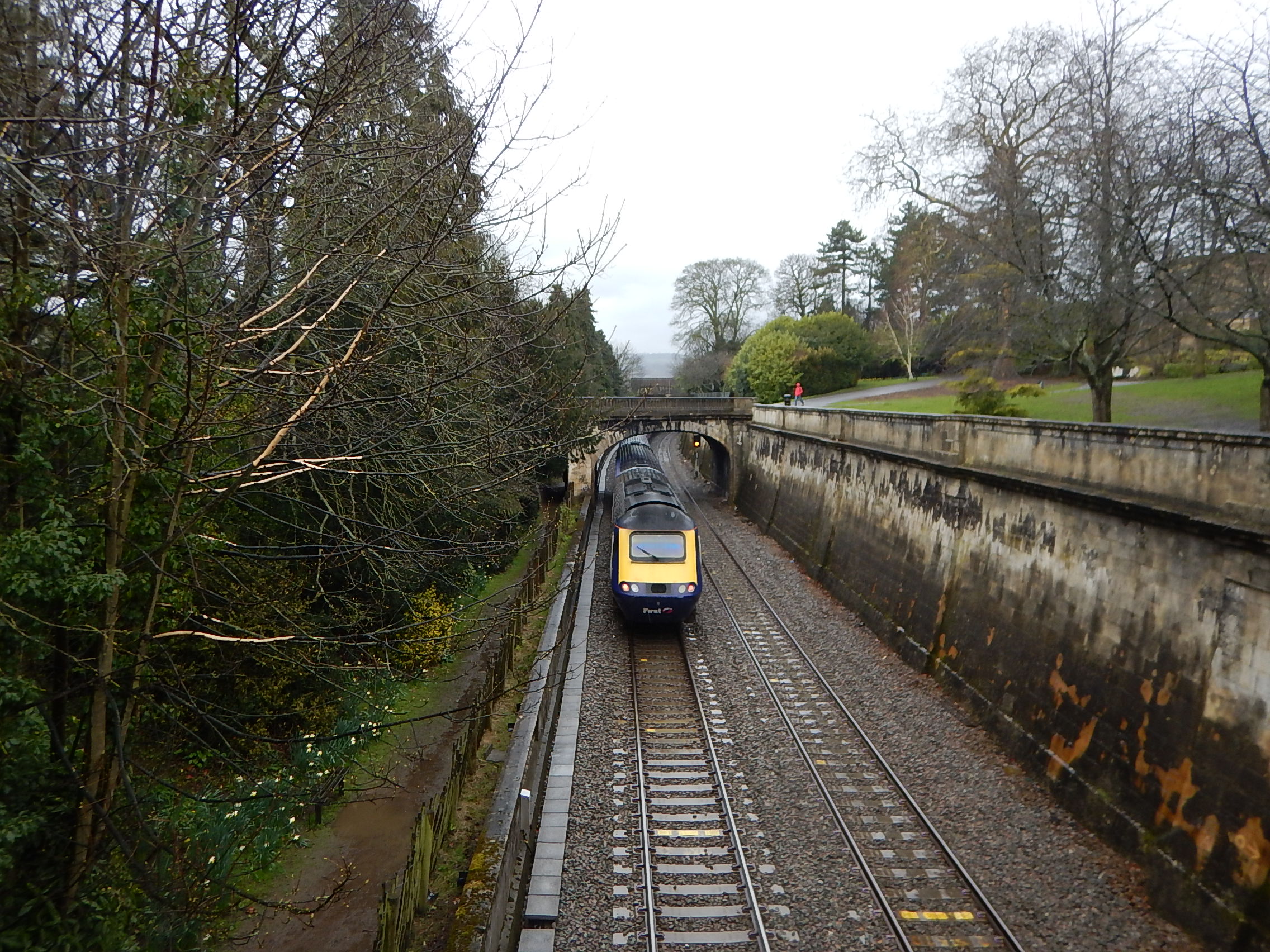
An InterCity 125 Passes Through Sydney Gardens
Note.
- There is plenty of width, as the line was built for broad gauge trains.
- Height might a bit tight, when you add in the pantograph.
- I would think that the structure under the track is pretty sound, as it’s had masses of pounding for years from Castles, Kings, Warships and InterCity 125s.
- I suspect that the bridges over the line have been fully surveyed and like most of Brunel’s structures are well designed.
So I suspect that the track could be arranged, so that it positioned the train in the right place, to allow a Class 800 train to pass through with absolute safety.
The tracks could be moved closer or further apart to match the geometry of the bridges.
The tracks could be lowered if required.
If necessary, as is often done in tunnels, a solid concrete slab track could be laid. But this can create more noise.
I wouldn’t be surprised to see an innovative rail system used in Sydney Gardens to make sure the trains run accurately, reduce noise and improve the look of the railway.
But then after Dawlish and some of the challenging situations, Network Rail has faced with tracks in the last few years, I suspect they’ll come up with a very acceptable solution.
The problem is the electrification.
Engineers will renew switches and crossings at Bathampton Junction, and will lower the track at Sydney Gardens, as well as at Hampton Mill and Meadow Farm bridges.
They will install specially designed electrification equipment in Sydney Gardens, which is classed as a World Heritage Site. Work on Box Tunnel will continue over the entire six-week period.
So as I thought height is tight.
This was a comment from the article.
When these plans were presented in the Guildhall last year, the Network Rail representative emphasised that the brackets hadn’t been finalised. The poor guy had the patient of a saint as he dealt with audience members insisting that trains be fitted with batteries to enable them to do without overhead lines in Bath as well as suggesting that they could coast through the city un-powered.
I don’t think it was a good meeting for Network Rail.
As an engineer, I agree with the comment about battery trains, but the Class 800 trains are not to my knowledge able to accept batteries at the present time. Although, judging by the way the industry is going, I suspect that within a few years, all electric trains will have provision for batteries, if the operator wants them.
In some ways, I feel that Brunel might be providing the solution.
To erect overhead wires for railway electrification, you need to support the wires every fifty metres or so.
This Google Map shows the gardens.
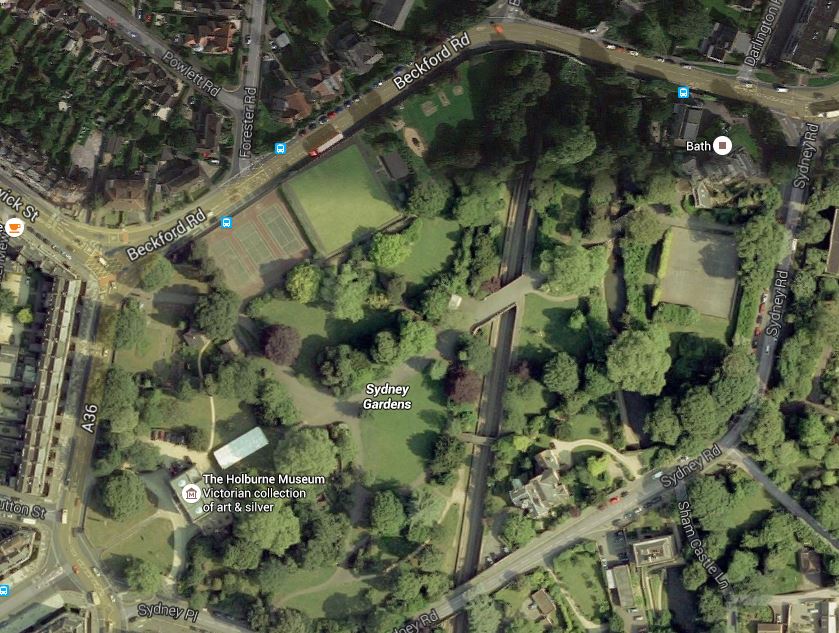
Sydney Gardens, Bath
Note there is a solid road bridge over the railway at both ends of the gardens, with Beckford Road in the North and Sydney Road in the South.
I estimate that the distance between the two road bridges is two to three hundred metres.
In the middle is the footbridge from where I took the picture of the InterCity 125 and another wider bridge.
As the trains will not be going flat out at 200 kmh through here, as they’ll probably be stopping at Bath Spa station, I suspect that the four bridges could be used as support for the overhead electrification.
This Network Rail visualisation shows the footbridge with a Class 800 train going underneath.
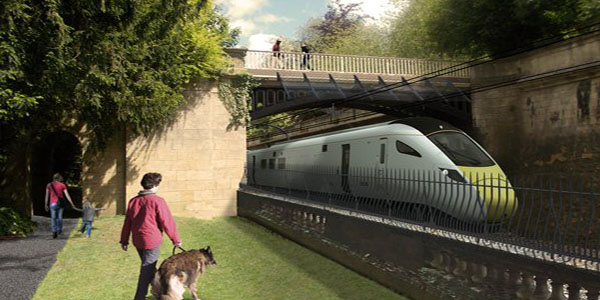
Sydney Gardens Bridge And A Class 800 Train
It looks to me, that the wires are attached under Brunel’s bridges and that by clever design tNetwork Rail can get an solution acceptable to all.
One of the problems, is of course making sure, that pedestrians on the bridge are safe, with 25KVAC overhead electrification underneath.
By lowering the track, they are increasing the safety distance and also making it less likely that naughty dogs can get on the track.
I have a feeling that this problem, will be one that will haunt Network Rail.
This picture was taken from the Sydney Road bridge and shows the area of the visualisation.
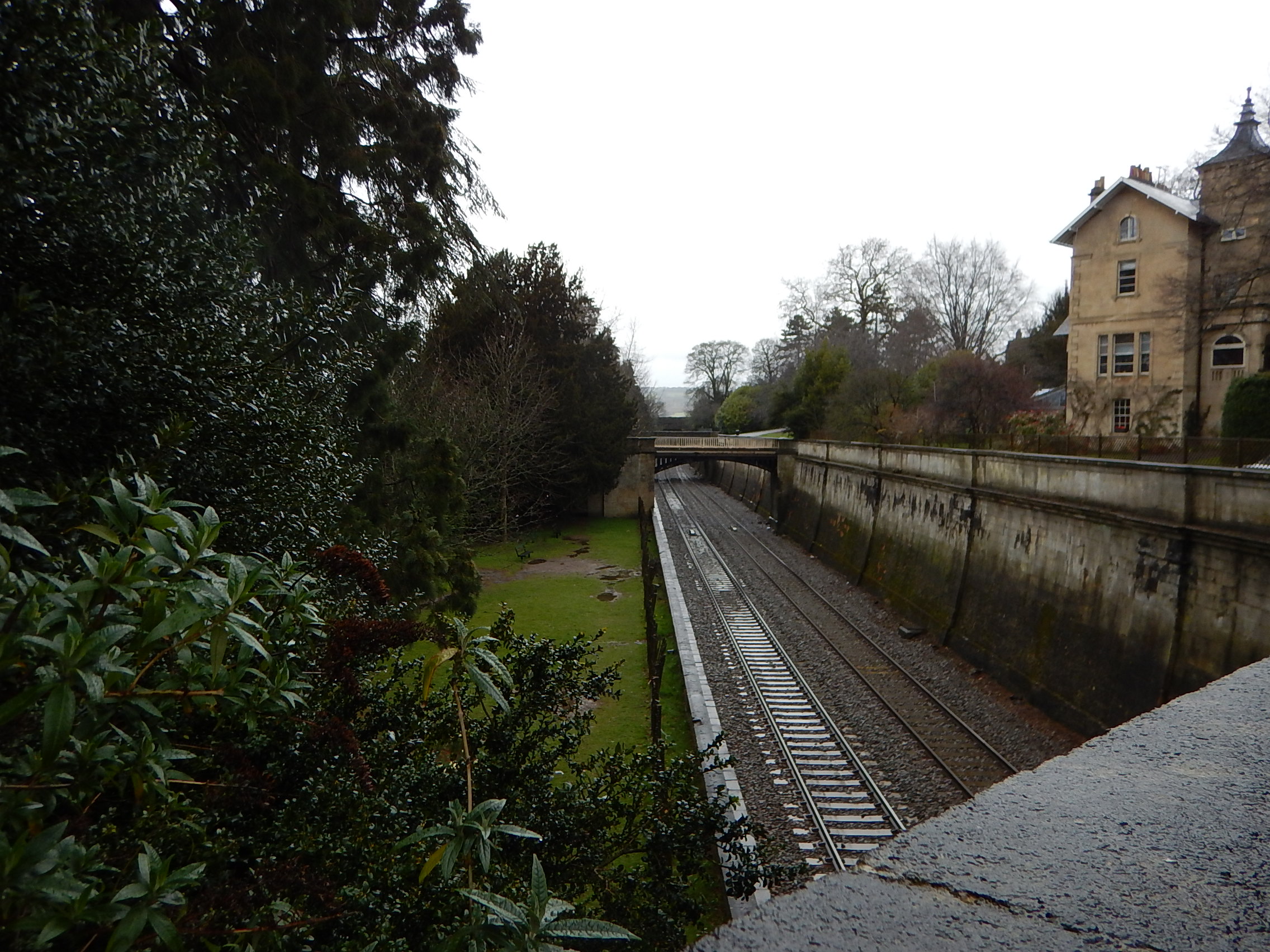
The Footbridge In Sydney Gardens, Bath
As the train appears to be on the left track, the visualisation actually shows the back of a train.
This is a gallery of pictures that I took in Sydney Gardens.



It would be a shame to ruin the gardens, by some less than adequate design.
Electrification At Paddington Station
I took this picture looking across the lines at Paddington station.
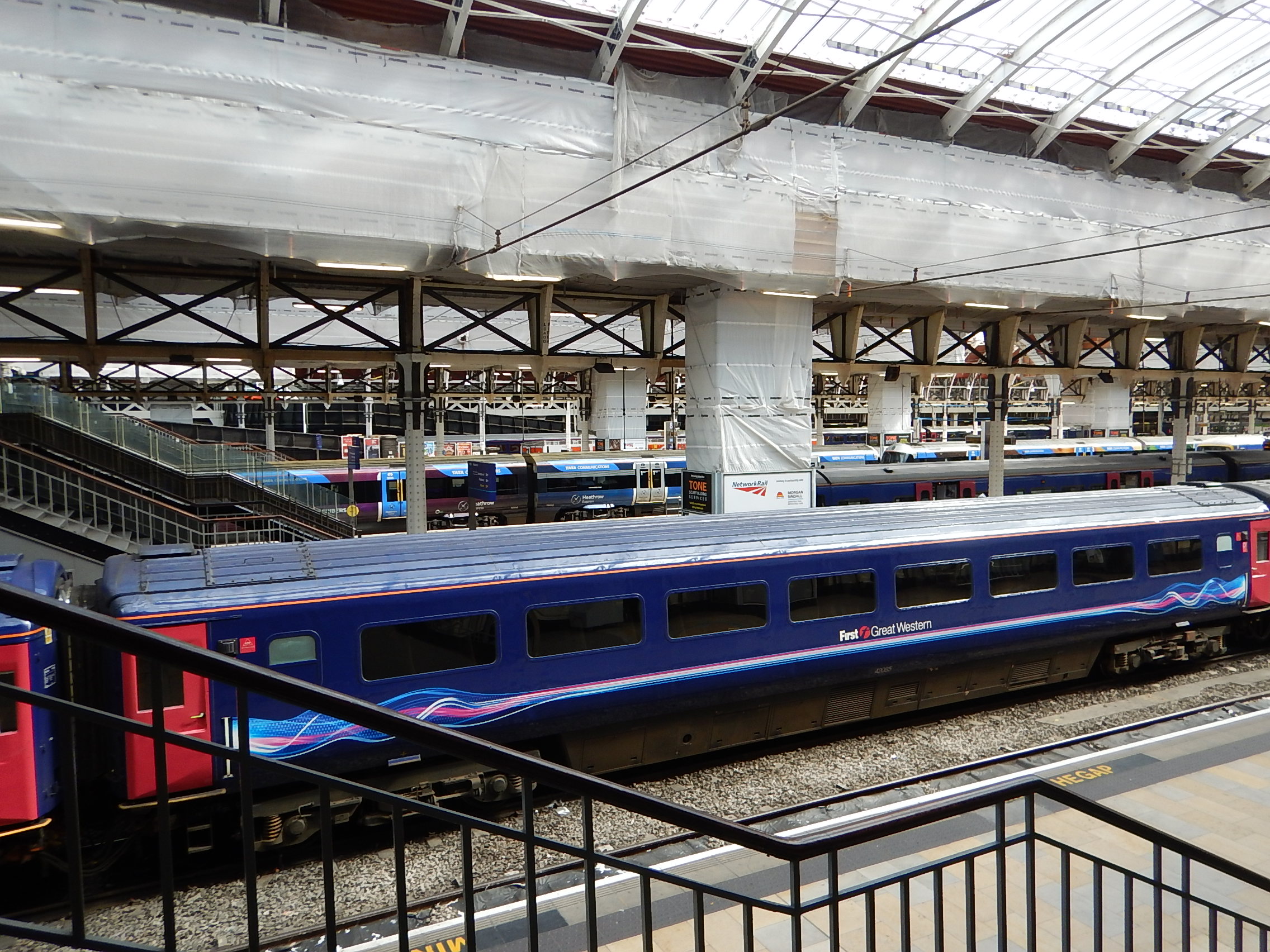
Electrification At Paddington
The nearest platform, which is number one, is not electrified yet. note the bar across the tracks which is used to support the wires.
This picture shows wires installed over platforms four and five.
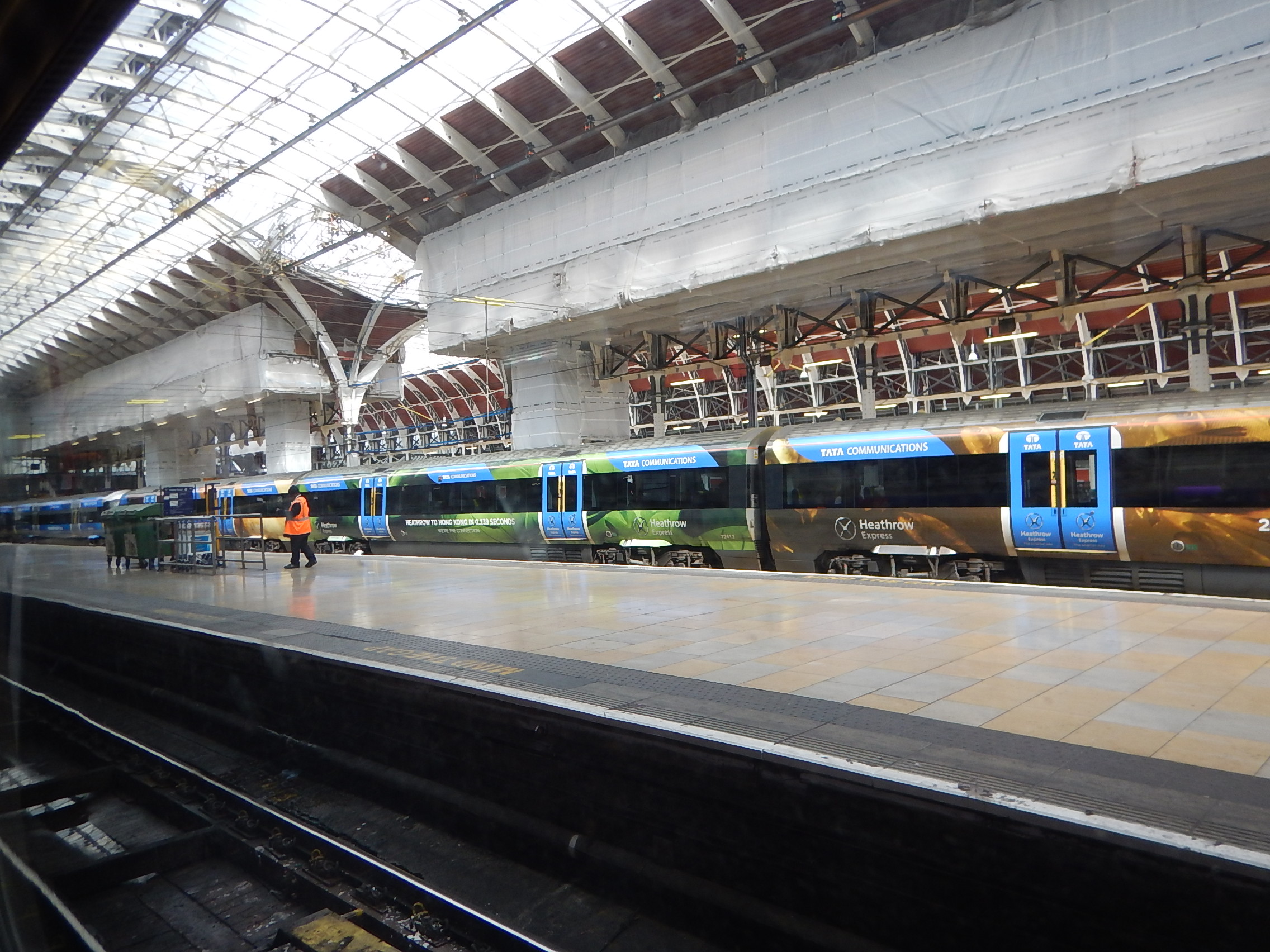
Electrification At Paddington
Note where the support is yellow, that you can just see a slim vertical support for the overhead wire.
It certainly seems to be more of a sympathetic design than the gantries I discussed in Aesthetic Problems With Overhead Wires On The Great Western
 The Anonymous Widower