Refurbishing A Northern Rail Class 319
There has been a bit of disquiet up North, about the new Liverpool to Manchester electrified service being run by late-1980s vintage Class 319 trains. I took a few pictures in October and they can be seen on this post.
I think it is best to charitably describe the interiors as something designed by a committee of accountants, with a love of pink!
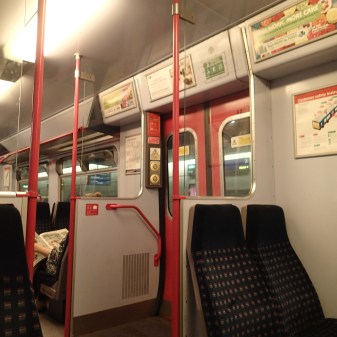
I would use the word dreadful liberally! Now look at this page on the Northern Rail web site and in particular this image.
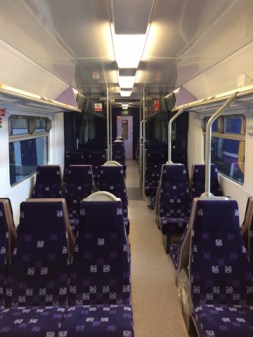
Inside A Northern Rail Class 319
Where’s all the pink gone? Or are Northern Rail applying a liberal use of Photoshop?
I doubt it’s the latter, but it does show how British Rail got the engineering right with the Mark 3 coach, on which the Class 319 is based.
On the page on the Northern Rail website, there’s a time-lapse video of the refurbishment, if you still think it’s all fake.
The proof of the pudding will be in the eating and I can’t wait to ride between Liverpool and Manchester on an electric train.
To be fair to the Class 319, it must be one of the ugliest trains on the UK network and I bet everybody wishes they’d got someone like Kenneth Grange to upsex the front end, as he did for the InterCity 125. But as an old Suffolk horseman said to me.
A good horse is never a bad colour.
The Class 319 is a good train, but the old colour isn’t the best.
Wandering On The Valley Lines
I took some of the Valley Line trains from Cardiff.


The weather was good, as you could see. I first went up to Risca and then after returning to Cardiff, I took a train up to Bargoed.
On this trip and my previous one some weeks ago, I encountered typical Welsh scenery with lots of clean and tidy stations, many of which were being upgraded with lifts and decent access.
But although the train to Risca was a decent Class 158, the other journeys were done in Pacers with more rattles than a large nursery.
The lines are crying out for electrification and a fleet of much better trains.
Will The Felixstowe Branch Be Electrified?
In the previous post on diesel-hauled freight trains on the Overground, I mentioned Network Rail’s Anglia Route Study.
This study says two things about the Felixstowe Branch.
There will be more double track to increase capacity and it is an aspiration to have two trains per hour on all branch lines from the Great Eastern Main Line.
If the latter is implemented on the Felixstowe branch, it will be a good thing, but it would need another train and the increased frequency would probably be opposed by the port.
If the line were to be electrified, the finding of a reasonable Class 313/315/317 train to work the branch shouldn’t be difficult and it would be faster and with better acceleration than the current Class 153, so it could keep out of the way of the freight trains.
As a lot of the line is to be double tracked, I wouldn’t be surprised if this work, at least makes electrification possible.
I sometimes think, that I can remember reports from the 1950s, saying that London to Ipswich and Norwich together with the Felixstowe branch would be electrified by 1964.
To Stourbridge And Back
I went to Stourbridge today essentially to see the town and the Parry People Mover, but I took these pictures on my way up by Chiltern from Marylebone and back on Virgin to Euston.
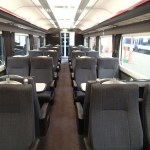
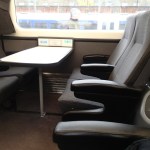
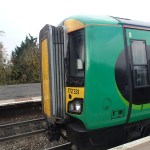
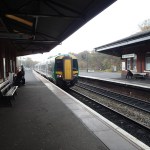
The trips illustrated the best and worst points of the two companies and their trains.
Chiltern has the more comfortable trains, with big windows and free wi-fi, but the journey takes longer.
One small thing that surprised me was the quality of both the Class 172 trains and the stations it passed through, on the way from Birmingham Moor Street to Stourbridge Junction. In some ways though it is a reasonably modern line, as it was only reopened in 1995 as the Jewellery Line Project, which created Birmingham’s cross-city passenger route between Moor Street and Snow Hill. Wikipedia says this about the Birmingham to Worcester via Kiderminster Line, on which Stourbridge Junction is located.
It is a future aspiration of Chiltern Railways and Network Rail to electrify the entire line, including the Chiltern Main Line to London Marylebone.
I’ve always thought that electrification of the Chiltern Line should be done before HS2, so that there is adequate capacity between London and Birmingham, whilst Euston is rebuilt.
Another reason to electrify the Snow Hill Lines sooner rather than later would be so that some of these Class 172 trains could be released for other routes.
How Many Diesel Multiple Units Might We Need?
in this post, I said that I wouldn’t be surprised if some new Class 172 diesel multiple units were ordered.
But how many might we need.
It is best to list all the smaller diesel multiple units that are running on the UK railways, with a few comments and thoughts.
Class 142
There are 96 two-car Class 142 trains. They were built in 1984 and Wikipedia says this about their use.
They were initially built for use on rural branch lines. However, as of September 2011 they are mainly used on busy commuter routes in the major cities in the north of England, with some also in use on local services around Cardiff and on Devon branch lines.
Regular readers of this blog, will know that I don’t have a very high opinion of these trains.
But their biggest problem is that they must be withdrawn by 2020 because of the disability regulations.
However because of the Liverpool-Blackpool-Manchester electrification and the possibility of electrification in the Welsh Valleys by the cut-off date, some of them might find other uses as scrap metal.
Currently Northern Rail has 79 and Arriva Trains Wales has 15, so some may need to be replaced by new diesel multiple units, as electrification won’t probably replace them all.
Class 143
There are 25 two-car Class 143 trains. They were built in 1985 and were refurbished in 2000. Like the Class 142, they will have to be withdrawn because of the disability regulations.
Arriva Trains Wales has 15 working the Welsh Valleys and therefore could be replaced, but the seven ran by First Great Western in the Exeter area, don’t have that happy conclusion.
As electrifying the Exeter local routes is probably a never-never, some new or cascaded stock must be found for these lines.
Class 144
There are 13 two-car and 10 three -car Class 144 trains. They were built in the late 1980s and also will have to be withdrawn.
All work for Northern Rail in the Leeds area on commuter routes. Some of the lines may be electrified by 2020, thus allowing some to proceed quietly to the scrapyard, but others might have to be replaced by new or cascaded trains.
Class 150
There are 135 two-car and 2 three-car Class 150 trains. They were built in the mid-1980s and can spruce up remarkably well, as this one has on the St. Ives branch. But I have been delayed by an unreliable Class 150.
A well-planned refurbishment of these trains could probably limp them on for a few years, provided they all receive the TLC that the unit on the St. Ives branch gets. Moving them to low-traffic routes would also help, as in some instances I’ve been on Class 150s, where two are needed.
Some in the Welsh Valleys and around Liverpool and Manchester, may also be released by electrification, so after updating, they might even be used to send the truly dreadful Class 142, 143 and 144 to the scrapyard.
Class 153
There are 70 of these 1-car Class 153 trains, which were created from Class 155 in the early-1990s.
Their main problem is capacity. When I lived in Suffolk, they used to work Ipswich to Cambridge and still work Ipswich to Felixstowe. But some like this unit on the Transwilts are reasonable transport if there aren’t many passengers.
I’m sure a lot of operators would like a nice refurbished Class 150 instead.
Class 156
There are 114 two-car Class 156 trains, which were built in the late 1980s.
In my view they are a better train than the Class 150 and 153 and there is only one serious problem with them. British Rail didn’t build enough!
Some are now being refurbished, with new disabled toilets.
Class 158 and Class 159
The classes 158 and 159 trains will soldier on for a couple of decades until they are replaced by electrification.
Some might even be replaced on long-distance services by that cavalry of the UK rail network, the InterCity 125.
Conclusion
If I come to a conclusion after all this, it is a complicated problem to decide how many trains are needed.
I think we can assume that the Class 15x will not be directly replaced, except possibly some Class 153. But many, perhaps displaced by electrification, will find themselves replacing 14x Pacers elsewhere.
I can’t do a detailed calculation, as I don’t have all the information. But it does seem that an order for say ten or twenty Class 172 trains from Bombardier could start the biggest game of musical trains ever seen.
Because of all the links, if say five sets were to be delivered before the May 2015 General Election, this could mean that many hard-pressed commuters and train passengers had greatly improved trains around the same time.
Is Blackpool On The Way Up?
In previous visits to Blackpool, I’ve found the place rather depressing and dirty. Generally, I’ve arrived by train, to give myself time to get to the match and then got the first train out afterwards. I have also called Blackpool the most pedestrian-unfriendly resort in the UK.
Also, when I mention I’ve been to Blackpool, like I did once to a lady on a bus in Leeds, I have often got a comment saying no-one goes there now!
But was it the fact that the sun was shining yesterday, that made the place seem so much better. But visitors and residents were adamant that the town had improved in the last few years.
The promenade is so much better and must rate architecturally with some of the best in Europe. Although, I would think that the obvious food offerings, are a bit too gluten-rich for me. If I go again, I might do a bit of searching, to see if anybody can cope.
But living in Dalston, an area of Hackney, that has been transformed by a refreshed North London Line, I would think that Blackpool’s refreshed tramway has done the same for the resort. After all, many of Blackpool’s visitors are like me and not in the best state they could be. Surely, a step-free low-floor tram is one of the best prescriptions, that isn’t available on the NHS.
I think to be fair, we haven’t seen the end of the rise of Blackpool. Just as Liverpool took more than a few years to rise from its nadir, Blackpool won’t get back to the top overnight.
The biggest thing that will happen is connecting the town to the electrified rail network as part of the North West Electrification. Network Rail’s report says this about progress in linking Blackpool to Preston by 2016.
A fully electrified route between Preston and Blackpool will connect the area to the west coast main line, the key rail artery linking the North West with London and Scotland.
We’ve upgraded all 15 bridges whilst carrying out safety improvement work to parapets. Overhead line equipment will be installed in 2015/16.
This electrification should improve the perception of the resort, as refurbished Class 319 trains are so much better and bigger than most of the trains working the line now.
It will also further improve the direct services to Liverpool, Manchester and London.
The tramway should also be linked to Blackpool North station in the next few years, as it should have been years ago. Nothing annoys me more, when I arrive by train in a town or city and find that the buses and/or trams are not connected to the station. Blackpool will rectify this omission, but I hope they get the tram capacity right, as many arriving by train will want to get straight on a tram to perhaps have a sightseeing run up and down the promenade.
One factor affecting the extension of the tramway to Lytham is the Open. Golf has staged its championship four times at Royal Lytham Golf Club in the last twenty-five years. As it last staged an Open in 2012, it should probably be due another. Ansdell and Fairhaven station is close to the course, so if another Open was to be staged at Lytham, then this station would probably play a large part in getting spectators to the event in a carbon-free manner.
I would suspect that Lytham are pushing hard for another Open and they are stressing the 2016-electrification to Preston in their bid. They can probably link an improved train or tram service to the course into the mix as well!
One interesting asset well connected to the trains and the tram is the old Blackpool International Airport, which recently closed. I’m sure that the town will use it to their advantage and I suspect various stakeholders have ideas in mind.
Blackpool has certainly had problems, but I would hope it is now on the rise!
Victoria Gets A Posh Umbrella
Manchester Victoria was a terrible station, with a difficult connection to Manchester Piccadilly. The connection improved with the Metrolink, but as they are now rebuilding Victoria, it’s got worse again. As I’m now familiar with the walking route, I was able to put a couple right about the way to go.
There must be something in the Manchester civic psyche, that likes to confuse people.
But Victoria seems to be getting on with its rebuilding, which includes a posh roof over everything and a new footbridge.
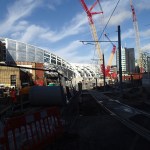
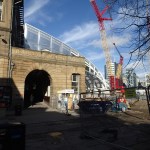

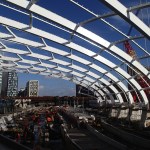
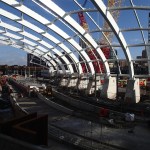
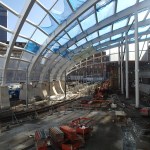
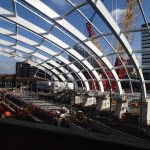
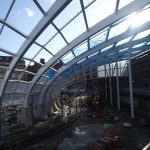
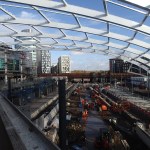


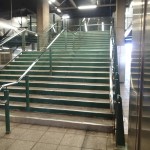
Unfortunately, the electrification to Liverpool Lime Street seems to be having problems and it will be some months before Class 319 electric trains are working the route, hopefully before next spring.
It does look to me, that when complete, anywhere on the tram routes in Manchester will have easy access to the electrified Trans-Pennine links at Manchester Victoria, which could become an architectural icon of the North. You’ll get the tram to Victoria and then totally under the new roof, you’ll go through the ticket gates and across the fully-accessible footbridges to the appropriate platform to await your train.
In addition, those who arrive from London and the South at Piccadilly and are perhaps going on to places like Burnley, Blackburn and Hebden Bridge from Victoria, will have a completely dry route, which is of course important in Manchester, using the trams. The trams must use contactless bank card tickerting though to be compatible with what other cities, like London, are doing.
This is Network Rail’s page on the £44million work.
I think everyone will agree that it’s all a bit different to the concrete crap that British Rail built forty to fifty years ago, like Euston and Manchester Piccadilly, when those with special access needs or advanced age didn’t exist, as everybody was adult and fit as a butcher’s dog.
I can remember meeting a friend in the newly-opened extension to Kings Cross station and looking with amazement at the structure that had been created.
Why shouldn’t other rail stations be given an added wow factor?
Especially now, when we have the architects, computers, techniques and materials to build them in an affordable manner. How many stations could be rebuilt using the same methods as New Cross Gate?
Good stations, like good clean electric trains, have one common problem. They are passenger magnets and very often attract so many extra paying passengers, that we have to expand the system.
I have a feeling that after they see the completed scheme, they’ll be wanting some of their other architectural disasters like Salford Crescent and Oxford Road stations, at least given the treatment that Network Rail have applied at Huyton.
The Rail Line Into London Gateway
I took this picture as my train to Stanford-le-hope passed the rail line into London Gateway.
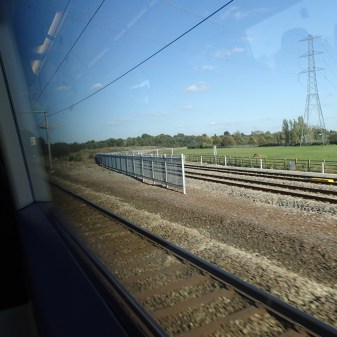
The Rail Line Into London Gateway
It shows the double-tracked rail line into the port.
I would assume it will be electrified, when the main routes through London, like the Gospel Oak to Barking Line, are also fitted with overhead wires, so that freight trains can use efficient electric haulage.
Should The Valley Lines Be Electrified?
I travelled about thirty percent, if that, of the Valley Lines that fan out from Cardiff. But it gave me a feeling of the strengths and weaknesses of the lines.
Stations
A Strength
If I compare the stations I saw on the Valley Lines most would score better than the average of those on the Lea Valley Lines, being taken over by the London Overground. The platforms seemed in good condition and most stations had some form of shelter, which was often new. They certainly didn’t have the same sense of abandonment of some stations on the Lea Valley Lines.
Platforms in some stations might also be big enough for a small kiosk. Obviously, coffee outlets work in London and probably Cardiff, but would they work in the valleys?
On the subject of stations, I hadn’t expected to find a ten million pound project at Pontypridd.
Footbridges
A Possible Weakness
I didn’t see any truly dangerous footbridges, that are very much the norm on the Lea Valley Lines, so hopefully they are not as common.
But some footbridges like Taff’s Well may well have to raised for electrification.
Step Free Access
A Possible Weakness
According to a Network Rail document on the Internet, several stations will have improved access.
On point on step-free access and lifts, is that Network Rail are installing this across the network and I have a feeling that they’re getting better at doing it, as some of the schemes in London, seem to have gone in extremely fast. Perhaps, their project management is getting better.
Road Bridges
A Strength
Network Rail’s documents don’t seem to mention any bridges being reconstructed.
An aside here, is that they are putting in extra tracks in places and this is mentioned.
So perhaps there isn’t work to do with the bridges to accommodate the overhead wires.
Signalling
A Strength
This looks like a separate project to the electrification, as unlike in many places you can do the signalling first and then electrify.
It’s all described in this Network Rail web page.
In one way, the signalling will give more train paths and capacity, before the electrification is complete. But where do you get the required diesel trains?
Interchanges
A Strength
I only did a couple of simple journeys on the Valley Lines, but like the East London Line, you can do same or cross platform changes in a lot of places.
Current Trains
A Weakness
The Class 142 trains that work the lines are clapped and in a few years time, they’ll have to be withdrawn because of the disability regulations.
The Class 150 trains may be possible to be updated, as some Class 153 have been. But would that be throwing good money after bad?
New Trains
A Weakness Or A Strength
New trains are expensive and these Valley Lines could require quiet a few sets.
But there are Class 315 and Class 317 trains available for cascade, as new trains arrive on Thameslink. Crossrail and the Overground in London in the next few years.
The Class 315s are nearly forty years old, but were refurbished between 2204 and 2008. In a section on their future Wikipedia says this.
As most duties of the 315s will be taken over by new Class 345 Aventra trains once Crossrail is built, it has been suggested that the 315s could be cascaded to Wales to be used on Valley Lines services in the Cardiff area following electrification.
I travel regularly on Class 315s and they certainly are a better ride than a Class 142. Their problems are the awful pink décor, dirty windows and lack of a passenger information system. Some might find the lack of toilets a problem too!
Information systems are apparently being fitted, but obviously not on the ones I’ve used and the dirty windows doesn’t seem to be a problem that affects Welsh trains, like it does Greater Anglia. They are all four car sets, which can be paired to make 8 car trains with seats for over 600.
The Class 317s are the electric cousins of the Class 150s operating on the Valley Lines now, are not quite as old as the Class 315s and some of them were refurbished to a high-standard in the 1990s. I used to travel on the latter regularly into London from Suffolk, and they’re certainly better than the 315s. They could also be fitted with better electrical equipment. A demonstrator is currently running round East London and Essex. South West Trains have recently refurbished their Class 455s, which are their version of the 317.
You have to remember that underneath the awful paint jobs and bad interior design of Class 317 and Class 455 trains is a legendary 100 mph Mark 3 carriage, which is struggling to get out. South West Trains have shown what is possible.
I suspect as there are large numbers of both classes, some will end up on the Valley Lines. I’d put my money on Class 317s as their 100 mph capability gives them the ability to run longer-distance stopping services on main lines.
Power Supply
A Strength
One of the high cost parts of railway electrification is getting the electrical feed to the the overhead lines. And our piecemeal policy of the last few decades has made things worse, as you can’t do clever and sensible things to make things simpler and cheaper. For example, the Great Western Main Line electrification, will not have its own power supply at the London end, but will share one with Crossrail.
So as the South Wales Main Line will be electrified all the way to Swansea, it should be possible to feed the Valley Lines off the infrastructure installed on the main line.
Conclusion
As I travelled around the Valley Lines yesterday, several railway staff were sceptical that electrification will go ahead.
I may be wrong, but it seems to me that if after the Great Western Main Line is electrified in 2017, it would actually be more expensive to not do the Valley Lines electrification, as you’d still have the problem of the trains and you’d have a series of lines with good stations, ready to electrify.
It does seem to me, that Network Rail have done their project management superbly well on the updating of the Valley Lines.
I have this feeling, that the scheme when completed will be a big success, as the Valley Lines have so much going for them in terms of location.
The more I look at the Great Western and its branches in Wales and the West Country, I just can’t understand, why these schemes we are doing now, weren’t carried out decades ago.
There are an awful lot of politicians of all parties, who should hang their heads in shame.
How Much Work Needs To Be Done On Footbridges?
I ask this question, as when we were waiting at Taff’s Well, a train went under the footbridge.

The Footbridge At Taff’s Well
If the line is to be electrified, then the bridge might need to be raised, as it looks that the clearance might be a bit small for the overhead wires.
And I suspect, some stations will need some form of step free means to cross the line.

