Should We Nuke Russia?
The title of this post is not a serious question in the way you think it is.
I was thinking about how we control Russia in its expansion into Ukraine and wondered how much gas we buy from the country. Google found me this article on the Forbes web site. It has the title of Nukes Best Option Against Russian Gas. It however did give some interesting facts about Russia and its gas, particularly with respect to the sale of the gas. The article contained the answer that I wanted in this sentence.
Russia gets about €300 billion a year (US$417 billion/yr) from fuel exports to Europe, almost 20% of its GDP
So it looks like that by its policies and purchases, the EU is strongly supporting Russia. The article also contained these paragraphs.
It is unfortunate that Germany closed down almost half of their nuclear plants in the wake of Fukushima, 8 out of 17. Nukes really come in handy during this kind of energy conflict. It would behoove Germany to rethink that decision and to postpone their plans to shut down the remaining nuclear plants over the next ten years, to give them more leverage to address the Russian aggression as they continue transitioning to alternatives.
Until recently, Germany’s 17 nuclear plants produced power exceeding the energy produced by all of the Russian gas entering Germany. With eight shut down, the amount of nuclear energy produced still offsets much of that produced by Russian gas. If Germany insists on prematurely shutting the rest of its nuclear fleet, then the amount of gas needing to be imported into the country will double, even with projected increases in renewables.
This explains the title of the article.
The writer has a point. Whether we like it or not, Europe and especially Germany is playing the Russian’s game, by buying more gas and giving Putin the funds to be aggressive.
The sooner we stop buying gas from Russia the better. We need to start fracking and build more nuclear power stations.
Changing From A Large To A Small Energy Supplier
I recently changed from a large energy supplier; NPower, to a small one; OVO.
So how has the experience been and would I change now, knowing what I now know?
1. Costs
If I compare my actual costs for 2013, when I was with NPower to the estimated costs for 2014 on OVO, they are about the same at £143-145 a month for both gas and electricity. I suspect that for a modern three-bedroomed house, where I cook by electricity, do one load of washing a week and have a deep bath every day, that these figures could be a bit low.
But it is surprising how close the two suppliers are in terms of costs. Partly, this is because OVO set the level of the standing order based on what I was paying NPower
2. Account Management
I am just getting to grips with managing my account to my benefit.
In the previous section, I said that OVO set my initial payments based on my NPower usage.
I have now adjusted my standing order to my usage , as OVO allow you to do. I estimate that when I get this adjusted correctly, my bill could reduce to about £120 a month.
One thing that happens with OVO, is that if you are in credit, they give you a small interest payment. It may only be pence, but it’s more than a big supplier would give. You can also request that the balance be withdrawn to your bank account.
3. The OVO Web Site
Like all new web sites, the OVO web site has a few problems and could be better. In their case, things like remembering your login ID and the general handling of passwords are areas I would improve.
As to the login, they could do a lot worse than look at how Zopa has created a secure login. Zopa’s is certainly one of the best!
I would also recommend that you login once a month and give it a good look around.
4. Customer Support
I don’t think I have any complaint in this area.
You phone them on an 0800 number.
5. Would I Change Again?
Not at the moment, but if I did want to change, I’ve got a single A4 piece of paper with all of my details and relevant numbers on it, so change would be easy.
So for that reason alone, I would advise anybody to change at least once to an energy supplier with good paperwork and web site.
An Insight Into Small Energy Companies
I found this article on a company called Contract Natural Gas in the Yorkshire Post. This section describes what they do.
CNG supplies commercial natural gas to businesses, from family firms to blue chip corporations, across sectors including retail, leisure and hospitality.
But it also provides technical services to independent gas providers such as Ovo Energy.
It seems that there is a lot of innovation going on in the provision of energy.
The energy companies live in interesting times!
Something New And Very Green In The Laundry
I’ve read about a company called Xeros in The Times today. Their washing machines use 80% less water, 50% less energy and 50% less detergent.
The technology has been spun (?) out of Leeds University and uses special beads to clean the washing. They’re also talking about a washing machine with no programmes ( i.e. a man button!)
They’re not available for domestic use! Yet!
But if all machines in the UK were this efficient, then the water saved would fill twenty million swimming pools!
British And French Engineers Can Work Together
In the Sunday Times today, they are talking about a £4billion project to import electricity into the UK from Iceland, It is called Icelink and it would appear to have the backing of both the UK and Iceland governments. There’s more about it in this article in Utility Week.
So it got me thinking about undersea electricity connections around the world. There is a list of them here. And there is forty-four of them
Perhaps the best known is the connection between Kent and France, which is called the HVDC Cross Channel. It is actually the second one and it has been running for nearly thirty years. A section in Wikipedia describes its significance.
Since the commissioning of the 2,000 MW DC link in the 1980s, the bulk of power flow through the link has been from France to Britain. However, France imports energy as needed during the summer to meet demand, or when there is low availability of nuclear or hydroelectric power.
As of 2005 imports of electricity from France have historically accounted for about 5% of electricity available in the UK. Imports through the interconnector have generally been around the highest possible level, given the capacity of the link. In 2006, 97.5% of the energy transfers have been made from France to UK, supplying the equivalent of 3 million English homes. The link availability is around 98%, which is among the best rates in the world. The continued size and duration of this flow is open to some doubt, given the growth in demand in continental Europe for clean electricity, and increasing electricity demand within France.
So it would appear it’s been successful and proves that we can work with the French on an engineering project.
It strikes me that we need to connect all of our power systems together in Western Europe. The UK is being connected to Ireland, Iceland and Norway and the Netherlands, Belgium and Germany are getting in on the act.
What you won’t find from reading about the cables, but you will in some newspaper articles, is that Norway will have the ability to store electricity in a pumped storage system in the future.
So when the wind is blowing and we have too much electricity, the Norwegians will pump water from a low to a high lake and when we want it back, the water will be released through a turbine. It’s like putting your KWh in a bank!
It’s Paid To Switch To OVO Energy
I just found this article in the Guardian about OVO Energy. Here’s the first two paragraphs.
An energy company has announced a 2.5% price cut for consumers, saying that the mild winter weather has meant that gas and electricity are cheaper.
Ovo Energy claimed that the reduction meant its bills were now about £180 a year cheaper than the average of the big six companies which supply the bulk of the UK’s households.
So it looks like I was right to swap!
The Energy Bill Of The Future?
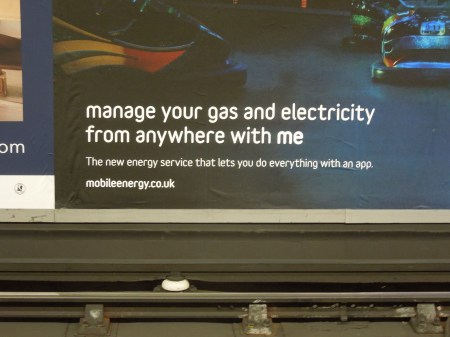
I saw this advert on the Tube yesterday.
The Energy Bill Of The Future?
After checking Mobile Energy’s web site, there are some nice features, but they don’t talk about a smart meter, which is what we all need.
Winning Over The Anti-Frackers
Edmund Marshall is a retired MP. In a letter to the Times today, he talks of his part in the Zetland County Council Act 1973 and the effect of the Act, on the Shetland Islands. This is talked about here on the Scottish Government web site, with this paragraph being the most relevant.
Closer to home, we have an example of the way in which one local community – Shetland – was able to accrue a legacy for its future on the back of oil and gas exploration. Shetland Islands Council showed foresight in securing via, primarily, the Zetland County Council Act 1974 a lasting revenue stream for the benefit of the islands from the development of the Sullom Voe terminal. The result of this Act and subsequent contractual negotiations is that Shetland today has a lasting legacy of around £216m. 7 This figure is over and above the funds contained in the Shetland Reserve Fund, administered by Shetland Islands Council.
30. The Shetland Charitable Trust, established in 1974 to manage the income stream accrued to Shetland, today provides funding to a number of charitable organisations and projects where there is a clear benefit to the Shetland community. Over the years, the Trust has made a contribution to creating a modern, positive and healthy community in Shetland. Shetland Charitable Trust’s financial strength has also given it the power to establish joint venture projects to move into the renewable energy generation market.
Dr. Marshall finishes his letter, by saying that fracking could be dealt with by similar provisions.
It would lead to some rather heated arguments in some councils, as to whether to accept the fracker’s shilling. It is a choice about whether you want lower Council Tax and new community facilities, or fracking.
I very doubt that a similar Act will happen in the greater UK, as payments like this really get the Treasury’s ire. I’m surprised that they allowed the Shetlands to get this independent finance! Perhaps none of the Treasury’s mandarins had been north of Watford and Shetlands meant Rockall to them.
 The Anonymous Widower