Switching Energy Suppliers In Twenty Four Hours
I was trained as a Control Engineer, and know that the quicker you can make adjustments to a system, the faster it will stabilise. So the aim of being able to switch energy suppliers in 24 hours, would have the effect of stabilising prices, at a level acceptable to both suppliers and customers. It is unlikely that prices would rise because of this, as why would a customer switch to a more expensive supplier?
So hopefully prices will fall.
I can also see, why the Big Six do not want 24-hour switching. It’s curtains for a CEO, who brings it in, as there would be tremendous resistance and instant flight on the part of customers to the raising of prices.
Labour Promises To Turn The Lights Out
Ed Milliban’s promise yesterday on energy prices is the sort of vote-grabbing bribe. that is typical of third-rate politicians. Judging by the response from the energy companies, If Red Ed gets power we’ll all be in for a hard time. It’s all here on the BBC. Even Britain’s worst Prime Minister of recent years; Gordon Brown, wouldn’t have issued such a cheap promise.
I think that this pledge could have serious effects.
Suppose you were in charge of planning at a large energy company. Would you be prepared to invest in an expensive new power station in the UK, until after the election of 2015?, I suspect that other countries with more certain energy policies and prices, would be a better place for the investment!
So the lights might go out, even if Labour doesn’t win the election!
I’ve just listened to the start of the phone-in on Radio 5.
They’ve started appealing for anyone in favour of Red Ed’s idea.
The Bunhill Energy Centre
I went to the Bunhill Energy Centre as it was one of sites in Open House.





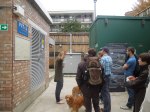


This centre provides enough heat and electricity for 700 homes.
We shall be seeing a lot more developments like this. I’ve always felt that small versions of the same system, using the same principles of a gas powered engine driving a generator, could be used to power and heat larger houses and small industrial premises. In fact Tomorrow’s World showed such a system based on a Fiat car engine in the 1980s.
We are just too conservative about how we generate electricity and heat.
Strangely, I met someone here, who was just a couple of years ahead of me at Minchenden.
Can We Delay Fracking?
Or any other new means of energy creation for that matter?
There has just been a very heated debate about fracking on BBC Radio 5 Live and the amount of hot air produced could power the whole of Sussex without doubt.
Most of the arguments on both sides were fact-free and full of emotion, with accusations of lying and wrong facts from both sides.
The most significant energy news of the day is this story from the Guardian. It says that domestic energy use has dropped by a quarter since 2005.
More work in this field could actually delay the crunch, when we need to build lots of new power stations, be they powered by whatever.
That delay is the time to use to research every method of obtaining energy fully.
The trouble is this would probably give engineers and scientists enough time, to find a solution that ended all the arguments, so a lot of protesters and believers in uneconomic technologies would be kicked soundly into the long grass.
If I’d had a pound for every scientifically incorrect argument about energy I’d heard, I’d be a very rich man.
Hydrogen – The New Green Superfuel
I found this article from one of my Internet trawls. It describes how in remote areas, excess energy from a local wind farm or solar panels can be used to create hydrogen, which is then stored and used as a fuel.
This is very much experimental at the moment, but it is a simple solution to the problem of providing continuous power in remote locations.
We will be seeing lots of sensible solutions like this in the future.
Should We have Built It In The First Place?
One of the dramatic news stories on BBC television this morning, is the blowing up of the tower of Inverkip power station chimney in Scotland. Out of curiosity, I looked up the power station on Wikipedia and found an article, which showed how building the station seems to have been an enormous waste of money. Here’s what they say on the use of the power station.
It was to be Scotland’s first oil-fired power station. However, the soaring price of oil as a result of the 1973 oil crisis meant that by the time construction was completed generation was uneconomical. It was never utilised commercially, with 1200 MW kept in reserve and the remaining capacity being used to satisfy peak demand. It was only used at peak capacity during the miners’ strike of 1984-85, when low coal supplies prompted operation. Generation ceased in January 1988 and although the plant was retained as a strategic reserve, it was never used as such. The plant was finally mothballed in the late 1990s, but was kept fully operational until 2006 when it was decommissioned.
No wonder our electricity bills are so expensive, with gold-plated elephants like this to support.
I suppose, at least a lot of people got a cheap thrill when they saw the chimney blown up.
London’s Hydrogen Buses
London has a few hydrogen-powered buses that run on route RV1 from Tower Gateway to Covent Garden via the South Bank of the Thanes.




I used this route to get back to North of the Thames, so I could get home, after visiting the Tate Modern.
There’s more about the technology between these hydrogen buses here. The buses would appear to be powered by fuel cells from Canadian company, Ballard, running on a Volvo chassis with a body by Wrightbus from Northern Ireland. There’s a lot of independent hybrid vigour there to go with the conservative bit from Volvo.
Trade Unions Living In The Past
I was listening to Radio 5 this morning and a couple of Trade Union leaders said that we should open up the mines again and burn coal using carbon capture technology.
Who do they think they’re kidding?
I have serious doubts about this technology and don’t think I’ll ever see it working in my lifetime on a large scale. I put a few thoughts here. But don’t listen to me. In these two posts, Wikipedia details the limitations and cost. So it looks like an exopensive dead end, if you believe Wikipedia. I definitely agree!
One thing though, if we started deep mining coal, I doubt there would be queues of people wanting to work in the mines. But then we can always get a few thousand willing immigrants to do the work!
The Other Upside To Fracking
If you believe that we can successfully solve the problems of extracting gas from the ground using fracking, it should give us enough gas for our needs for many years to come according to reports like this one.
In all of the discussions about fracking, no-one seems to mention how you transform this gas into useful electricity. You put it through an enormous gas turbine engine and this powers some form of electricity generator. Normally these days they work on a principle called combined cycle and you see the term CCGT (combined cycle gas turbine) used. But which British company is involved in this technology? Rolls-Royce is the answer. Unfortunately, their turbines don’t seem to be used in our numerous gas-fired power stations. But I know they could be.
I’ve found this link to a company, I’d never heard of before called Centrax, who integrate Rolls Royce Trent 60 WLE engines into power generation sets. Their web page is here. And this is their page on using the Trent 60 WLE .
So if we have all this gas, will it lead to extra jobs in the manufacturing sector?
It could do if we get it right!
Should We Have Unit Pricing For Energy?
Go back thirty years or more and you paid for what you used with energy. I’m not sure if you paid a standing charge, akin to a telephone line rental, but you knew exactly where you stood. If you used more electricity you paid more money.
Now it is not as simple and to be cynical, I think the energy companies like it that way, as customers find it hard to compare prices.
So when EDF suggests going back to simple pricing, as is stated in this report, do I think it is a good thing?
Of course I do!
But there is something we need even more urgently and that is a smart meter, so we can see how much electricity and gas we are using.
I haven’t seen any reports yet, but a smart meter connected to a smart phone and then linked back to smart heating controls, must save a lot of money. Just think of this simple case. Do you switch your central heating on and off, at the most optimum times. Without information you’re just fishing in the dark.
But I doubt I’ll ever see unit pricing and smart metering, as the energy companies will do all they can to delay its implementation.
 The Anonymous Widower