London’s Low-Key New Train Launch
To say that the launch of the new carriages for the London Overground on Thursday was low-key would be an understatement. I have only found one article on the web with a picture and that is in Rail Magazine. They say this.
The first five-car Class 378 for the London Overground network was unveiled at New Cross Gate depot yesterday (November 6).
All 57 EMUs in the fleet are receiving an extra carriage, as part of a £320 million investment boosting overall capacity by 25% – equivalent to an additional 170 passengers per train.
But where are the politicians in the photo?
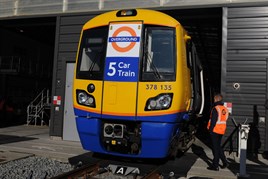
First Five-Car Class 378
It’s not like Boris to miss a photo-opportunity.
In some ways there is a very solid engineering principle behind these Class 378 trains. You should always make sure that anything you design can be adjusted to meet changing circumstances.
London Overground thought that three car trains would be enough for the limited number of passengers on the North and East London Lines. It quickly became obvious that these were inadequate. Either by good design or just plain luck, the trains had been originally built as two end cars with cabs and an unpowered trailer car in the middle. So to go from three to four they just built an extra trailer car and plugged it in, with a few small adjustments to the trains systems.
But even four cars have proved inadequate and now the process is being repeated to create five car trains. This is perhaps a little more complicated, as they have been unable to lengthen some platforms like Shadwell, so selective door opening has been implemented.
In the London Transport Infrastructure Plan for 2050, it states that these lines will have six cars at some point. So how long will it be before another car gets added?
Steel Flying Arches At Shadwell Station
These pictures show the steel flying arches at Shadwell station on the East London Line. They appear to be similar in form to the brick arches at Chorley.

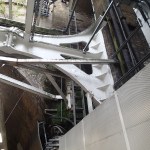
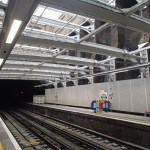
The purpose of these structures is to stop the walls of the cutting collapsing inwards.
They’re not pretty or elegant, but they seem to work!
Boring Television
It’s fascinating to read the heavyweight reviews on the BBC2 program, The Fifteen Billion Pound Railway, in the Independent and the Telegraph.
When did serious engineering programs get such coverage?
The Times has a report, if you’re a subscriber, but there’s nothing in the Guardian.
Redesigning The Ugly
There are lots of everyday common blots on the landscape, that are just downright ugly.
Take the electricity pylon. In all my years of travelling, I’ve never seen any that could be described as beautiful. If we didn’t want them to spoil the landscape, we’d bury them, as happens in most towns and cities.
However, there was a competition a few years ago with a £5,000 prize to find a better pylon. It’s all described in this report.
I’ve not seen any better ones yet!
So now it is time for the designers to look at the overhead lines used on railway lines. The thoughts and ideas are detailed here.
How many everyday objects can be improved by better design and materials?
Is This The Future Of Patient Monitoring?
As anybody who has spent time in hospital connected to a traditional heart, blood pressure, pulse and temperature monitor will know, it is not an easy process. Leads fall off, moving around is difficult and you are often in need of staff. I’ve only spent time recently in good hospitals, where they were enough staff to check on me regularly and that includes two NHS hospitals. But in one NHS hospital, I had a private room and a quick visual check as the nurse passed by wouldn’t have been possible.
In some ways the current system is like driving a car without a fuel gauge and every few miles, you have to get out to dip the tank to see if you’ve enough fuel to carry on.
But then enter the engineers!
I have just watched this story on BBC Breakfast Here’s the first three paragraphs.
The NHS is starting to test a sticking-plaster-sized patient-monitoring patch.
Placed on the chest, it wirelessly transmits data on heart rate, breathing and body-temperature while the patient is free to move around.
Independent experts say the system, developed in Britain, could ease pressure on wards and has the potential to monitor patients in their own home.
I think we all have to remember, that this is the first device. No-one would be able to predict how far this technology will go. And how a healthcare system like the will be able to use it in the future!
On the other hand, there is also this statement in the story.
But the Royal College of Nursing says there is no substitute for having enough staff.
In some ways that shows what a good system it must be, as the Luddites and Nimbys always try to stop good developments.
Read more about the company; Sensium Healthcare, behind the development here.
As it’s got one or more ultra-low power chips in there somewhere, is this another application of technology from ARM?
Could This Be The Key To Hydrogen Power?
Jerry Woodall has form as a scientist and inventor as he developed the first commercially-viable red LEDs that we see in car brake lights and traffic signals.
Last night I was searching for something else and came across this video on YouTube. This is the description to go with the video.
The actual process: gallium and aluminum combining, add water. stir – bubbles of hydrogen with only white aluminum oxide. as demonstrated by John Woodall – Jerry M. Woodall, National Medal of Technology Laureate, Distinguished Professor of School of Electrical and Computer Engineering, Purdue University, West Lafayette.
To put it simply, you add water to aluminium doped with gallium and the aluminium combines with the oxygen in the water and the hydrogen is released. The hydrogen can then be used to power a small engine.
There’s more description here on phys.org.
It’s early days yet, but could this simple process be the key to hydrogen power?
I always remember in the Electrical Engineering Department at Liverpool University in the 1960s, we were shown one of the first lasers. In some ways then, it was just a scientific curiosity and people were speculating about how they could be used. Now everybody has at least one, if they have a CD player. Many people reading this will be navigating the Internet using a laser mouse, as in fact I am with a Logitech M525.
It may not use Jerry Woodall’s invention, but at some time in the future, you’ll just put water in the fuel tank of your car and just drive away, emitting nothing more than water vapour.
There are many problems to solve, but the internal combustion engine will be here hundreds of years from now.
Think Quarts Into Pint Pots
London Underground’s Victoria line, may have been a technological triumph for 1968, when it opened as an automatic train line, where the driver doesn’t really drive the train. Although, he or she is the person in charge. Incidentally, when the line opened in 1968 a lot of the electronic control systems used valves rather than transistors. I can remember reading about the line in a copy of Simulation magazine when I worked at ICI around 1970. It was truly cutting-edge world-beating technology in its time.
But you can’t say much for some of the stations, which were built on the cheap and are very much sub-standard compared to the extensions to the Piccadilly Line built in the 1930s.
But now the trains are running at a maximum rate of 34 trains an hour for much of the day, as is reported in this article on Global Rail News. Here’s the first three paragraphs.
London Underground’s Victoria line is now operating 34 trains an hour – ‘the most frequent train service in the UK’.
Peak-time services have been incrementally increasing since the Victoria line upgrade was completed in 2012 from 28 trains an hour to 30, 33 and finally 34.
Passengers now only have to wait two minutes between trains and there are also more trains running the full length of the line from Brixton up to Walthamstow Central.
So in two years capacity has increased by over twenty per cent, mainly by good design and engineering.
I wonder what the engineers, who built the line in 1968, would think of their baby now!
You have to also wonder if by applying the principles used on the Victoria line. could be applied to other lines in the Underground. Upgrades on lines like the Piccadilly have been delayed, but I do think, we’ll see some more squeezed out of the current system.
There are of course things that are being done and as a regular Underground user you tend to feel that the system may be more crowded, but you seem to get fewer delays. Perhaps reliability of trains, power systems and escalators is getting better.
It will also be interesting to see what happens next Monday, when buses go cashless. It might be anywhere between a disaster and a triumph.
At the disaster end of the scale, it will load more passengers onto the Underground.
But if it is a triumph and speeds up the buses, as I think it could, will passengers who can, swap from the cramped and dark Underground to a lighter and more spaceous bus, if it only takes a couple of minutes longer. Living in Hackney with no Underground, I change my route according to which bus arives first. Since the 38 has been run by New Routemasters, it has been effectively cashless, with passengers using the closest and most convenient door and only the few who need to pay using the busier front door by the driver. Certainly, if I want to get to the Angel quickly, I’ll choose a 38, as against a 56, which goes the same way, but is often overtaken, by a succession of New Routemasters.
If cashless buses work well, this will surely hasten the removal of ticket offices on the Underground, with contactless bank cards, supplementing Oyster and Freedom Passes. What differences, will this make to the ridership on the Underground?
The only thing that is certain, is that more quarts will continue to be poured into pint pots all over London’s transport system.
Two Other Low Profile Rail Projects
Over the next few years there are a lot of projects being implemented on the UK Rail Network, as I listed here.
But two other projects that few have heard of, will have a significant effect on UK rail services.
Travel in or out of Kings Cross and you don’t realise the work what is going on underneath the lines going into the station.
The two Canal Tunnels are being fitted out, which will allow trains on the Thameslink route to go up the East Coast Main Line to Peterborough and Cambridge. These will probably be the most significant new tunnels to be fitted out and opened in the period between the Channel Tunnel and Crossrail. According to the provisional timetable for Thameslink, eight of the 24 trains each hour in each direction will go to and from the ECML. Of these eight trains, four will go to Cambridge. So many difficult cross-London journeys will become much simpler and will become either direct or will involve just a single change.
But think again!
Twenty-four trains an hour is a train every two and a half minutes between St. Pancras and Blackfriars. And to make matters more difficult, the trains will have to change electrical systems from overhead to third rail or vice-versa halfway through each journey.
How do they do that?
New signalling will be installed and the new Class 700 trains will take advantage of this to maintain the schedule. They will be fitted with ERTMS to aid in this task.
And this leads me to the other hidden project that is going to completely change the UK’s railways.
The project is ERTMS or European Rail Traffic Management System. Network Rails plan is here.
In simple words it means that all conventional signals will be removed from the tracks on the railway and the train drivers will have everything on a screen in the cab. This sounds very similar to the way airline pilots have worked for years.
This is Network Rail’s view of the benefits.
Installing ERTMS across the country as signalling becomes life-expired will save an estimated 40 per cent over conventional systems. Each train will run at an appropriate safe speed, allowing more trains onto the tracks. ERTMS will improve train performance and reduce energy consumption.
As an example of what it will mean, most high speed lines in the UK, will be limited to 140 mph instead of 125. This could mean thirty minutes off the journey time from London to Scotland.
A Timetable Of Major Projects On The UK Rail Network
This is for my own use at present and it will be updated as more information becomes available.
2014
2015
2016
Cambridge Science Park Station
Great Western electrification to Oxford and Newbury.
Introduction of Class 700 trains onto Thameslink.
Oxford to Marylebone
Preston to Blackpool electrification
2017
Great Western electrification to Cardiff
Introduction of Class 800 and 801 trains
Midland Main Line electrification to Corby
Modernisation and electrification of Great Western Main Line
2018
First trains start running on Crossrail.
2019
East-West Link – Oxford to Bedford
Midland Main Line electrification to Derby and Nottingham
2020
Midland Main Line electrification to Sheffield
Note that some projects have been left out, as they are not ones that particularly interest me. An example would be small stations that I am unlikely to use that are outside London. Some projects like HS2 and the Northern Line Extension To Battersea have been deliberately left out until the project timetables are firmed up.
 The Anonymous Widower