The High Speed Train Got Through
I’ve just found this clip of video on the BBC’s web site.
It just shows the sort of conditions that these trains of the 1970s can withstand. It also shows why they will never electrify this line between Exeter and Plymouth.
This other video shows the work going on to repair the line. Note the wall of shipping containers filled with ballast to give protection to the workings and properties by the railway line. But even these have been breached, as is reported here on ITV.
It’s all extreme engineering at its most way out. Hopefully the engineers will win, but it should lead to better techniques for the next set of problems.
Customer Service – First Great Western Style
Yesterday, as I said in this post, I missed my 09:07 train to Exeter, due to problems on the Metropolitan line.
I knew that to get to Exeter, I would have to get another ticket for the next train, which was the 10:07. One of their staff said to go to the ticket office and see what they would do.
I did and went to the First Class window, where after explaining the problem, they checked thoroughly and then endorsed my out of time ticket for travel on the 10:07. I should say, that I expected to have to buy another ticket and was at my politest. As there wasn’t a queue full of angry passengers, just a couple of anxious ones, this might have helped.
But it does go counter to the sort of Jobsworth behaviour reported on programmes such as Watchdog.
Coming back, there was a Travelling Chef on the train. And I ordered this smoked salmon salad.

A Salad From The Travelling Chef
Note the French dressing in a little bottle, with all the ingredients and allergy information on the outside. That is a good idea, that should be copied more often.
I also had two complimentary glasses of wine.
And how much did the salad cost? – Just nine pounds! As it was served at my seat, I think that was good value.
I asked if you could buy the meals in Standard Class. Apparently, you can and you get it in a plastic box with plastic cutlery.
So it would appear that the discrimination is in the service!
Will We Get HSW Before HS2?
In this post about the BBC’s knocking of HS2, I jokingly referred to the Great Western Main Line as HSW, for High Speed West or High Speed Wales.
But is it that far from the truth?
A high speed railway is defined as one where speeds of 200 kph or 125 mph are possible. The fastest lines run at 320 kph or 200 mph.
So what speed can we expect to see on the Great Western Main Line, after it is fully modernised in 2017?
Currently the fastest trains in the UK are the Class 373 ( 300 kph) used by Eurostar, the Class 390 ( 225 kph) used by Virgin and the InterCity 225 (225 kph) used by East Coast. The latter two trains are restricted to 200 kph, due to signalling restrictions on their lines and because they have to mix it with slower trains.
It is also interesting to note that the Class 395, which bring the high speed Kent commuter services into St. Pancras run at 225 kph.
The new trains for the electrified Great Western Main Line are based on the Class 395 and are called Class 800 and Class 801. These have a design speed of 225 kph, but will be limited to 200 kph on traditional lines.
But Brunel built the Great Western for speed and a lot of the route it is pretty straight and much has four tracks. It is also going to be resignalled to the highest European standards with in-cab signalling. The latter is necessary to go above 200 kph. So it shouldn’t be one of the most difficult tasks to make much of the line capable of 225 kph or even more.
The only real problem on the line is the Severn Tunnel. But as Crossrail has shown, we have some of the best tunnel engineers in the world. So just as the Swiss dealt with their railway bottleneck of the Simplon Tunnel, all we need to do to improve the Severn Tunnel is give the best engineers their head and let them solve the problems, whilst the politicians sit around and watch and wait. After all it’s only a baby compared to the massive twin bores of the Simplon.
As an aside here, I do wonder if one of the most affordable solutions might be to use a modern tunnel boring machine to create a new tunnel alongside the current one.
Conclusion
So I believe that even if it still goes slower on opening, trains to Bristol and Wales will be doing 225 kph before the end of this decade.
If that isn’t a high speed railway like HS1, I don’t know what is?
But whatever we call it, it’ll be here several years before HS2!
I think we need to call for three cheers for Brunel, who got the route right in the first place.
Are These Trains The Key To Improved Rail Services in The UK?
I must admit I’ve been critical of the Hitachi Super Express Train to be built in the North East of England.
As an engineer, I don’t like the idea of an electro-diesel version, that lugs diesel engines around, so it can be self-propelled on non-electrified lines.
I also feel, that the last government wanted the project for overtly political reasons and hence the decision to build the trains in the North East.
But now the orders are being made for both the Class 800 and Class 801 trains, I’m warming to the project.
This is partly because, I have travelled into Kent several times by the Class 395 trains, which are to a similar design by Hitachi, as proposed for the Class 800 and Class 801. Although, they are probably less grand, as they are essentially commuter trains. But even these humbler trains have a top speed of 225 kph, which is the same as the Inter City 225 units on the East Coast Main Line.
If all of the improvements to the East Coast Main Line detailed here are implemented, then the line could be a 225 kph four-track line all the way from London to Newcastle.
The major problems then to adding capacity and obtaining that speed most of the way, are the slower 160 kph trains, that run from London to Cambridge and Peterborough and share the lines to the north of York and Doncaster. But if these units like the current Class 365 and Class 185 were replaced with another electrical multiple unit from the same 800/801 family capable of working at 225 kph, this problem would be alleviated.
If we look at the West Coast Main Line, the Class 390 Pendelions could travel on a lot of the line at 225 kph with improved signalling, but again they are held up by other slower services. in fact, there is talk of ordering more mini-Pendelinos to serve places like Holyhead, Chester, Blackpool and Shrewsbury.
Once the Great Western Main Line is fully electrified to Bristol and South Wales, it should be a 225 kph railway, virtually run by the 800/801 family of trains, with a few Inter City 125s, still working down to Devon and Cornwall. So I suspect we’ll see the Oxford, Cheltenham and Worcester services run by faster trains to reduce capacity constraints.
But all this does show again, how by running more 225 kph trains under better signalling systems, with probably more selective quadruple tracking can greatly increase the capacity on our railways.
It could be argued than one of the successes of the Inter City 125s, is that because there are so many they can be moved between operators and reconfigured easily for changing circumstances. If ever there was a chameleon train, it is these.
i suspect that if we had a large number of 800/801 trains or in fact any other type, then this would make them cheaper to purchase and support and probably more reliable. We have too many one route only classes of trains.
So what other lines could benefit from 225 kph trains, such as the 800/801 family?
Obviously, the East Midland Main Line is a candidate, especially as there have been plans to make a lot of the line capable of speeds of 200 kph. It would be an easier and earlier way to substantially speed up journey times to Sheffield. Dual voltage versions of the 800/801 family aren’t proposed, but the closely related Class 395 can run on overhead wires or third rail. So could we see a high-speed service from Sheffield to Brighton, through the Thameslink tunnels, stopping in Central London and Gatwick Airport?
The Great Eastern Main Line on the other hand is probably not a candidate, as it is only a 160 kph line, as like most East Anglian infrastructure, it was built on the cheap. But the line is crying out for new trains and I have heard that electrical multiple units would save time to Ipswich and Norwich.
The Trans Pennine Lines are a disgrace and at least are scheduled for electrification. As the trains using these lines often travel over the East and West Coast Main lines, faster trains are needed for some routes like Liverpool to Newcastle and Glasgow to Manchester.
I would also electrify the Chiltern Line to Birmingham and replace the third rail systems south of London to perhaps, Brighton, Portsmouth, Southampton and Bournemouth. For freight purposes this is being done partly already.
So I think we’ll see lots of the 800/801 family of high speed trains.
Bus Pass On Rails
Modern Railways is reporting that the government is doing an experiment with First Great Western, whereby a concessionary bus-pass can effectively be used as a Senior Railcard.
I have both and it would be one less card to lose, if I had to carry just one card. The Freedom Pass also has a photograph and I have used it where a photo ID is required.
I also have to show both cards, when I go to Ipswich, by buying a ticket from the Zone 6 boundary to Ipswich, as I do the London end of the journey on my Freedom Pass.
I don’t know how many concessionary bus passes and Senior Railcards are in circulation, but abolishing the Senior Railcard and using the concessionary bus-pass wouldn’t be very affordable in these times of financial restraint.
But then the experiment may show that if those with bus-passes got rail travel with a third off, the extra revenue might pay for the scheme.
It certainly seems an idea that will eventually be implemented.
Especially, as it would be a real vote winner for the party that brought it in. Especially, if they tied up the rules, so that bus-passes worked under the same restrictions nationwide.
Branson Good, First Group Bad
You have to admire Richard Branson on the way he has marshalled the general public to stand up for Virgin Trains. I listened to a couple of phone-ins and the callers were generally behind Virgin. One caller virtually said that he like travelling on Virgin for the loyalty scheme.
As an extensive train user, there is little to choose between Virgin Trains and First Great Western, but both are much better than the state-run East Coast Trains.
Virgin’s main problem at the moment is a shortage of Pendolino trains. This is being rectified, with a few new ones coming into service and the existing fleet growing by a couple of coaches per train. Whoever got the franchise, would have benefited from the increased number of seats.
But as I said in an earlier post, I think that one of the keys to success for First Group, is its links in Scotland. This could cut costs and also bring about an integrated system to get passengers between the north of Scotland and the south.
Millennium and Wembley Stadiums Compared
I’m not comparing anything, but their use for football, as I’ve experienced both in the last few days.
I’d say Wembley is very Jaguar, whereas the much less expediently-built stadium in Cardiff is more Audi, with more concrete and wood and less marble.
On the other hand, the sight lines in Cardiff, may even be better to those at Wembley. You also seem to closer to the action. I wonder, if this is because it is a much squarer stadium than Wembley. Only an architect with experience of sports grounds would know.
Food in both stadia is the usual gluten-rich junk, but then as the Millennium Stadium is in the centre of Cardiff, anybody who like me is choosy with his food will eat off-stadium. That is not really an option at Wembley, so I always eat before I leave home or in the centre of London.
The Millennium Stadium does lose on access to the trains, whereas Wembley has improved greatly in the last ten years. I believe Cardiff Central station is being rebuilt, so hopefully, better access will come. But a nearly three hour wait for a train to London is unacceptable, even if First Great Western were their usual helpful self, even handing out bottled water.
High Speed Diesel Trains to the Rescue
The trains out of Paddington are some of the most overcrowded in the UK. So First Great Western are doing the sensible thing and adding an extra coach to their High Speed Diesel Trains. Currently, their trains have a two power car plus eight coach formation, whereas those on the East Coast are two plus nine.
So they have found a source of redundant buffet cars and these are being re-manufactured and fitted with seats, as reported here on the BBC.
Some reports are a bit sniffy about this approach and have called it rather stopgap.
But I would say it is a tribute to the design of the High Speed Diesel Train, that has always been capable of sandwiching any number of coaches up to nine between the two diesel power cars.
What puzzles me, is why wasn’t this simple idea, carried out sooner. But then those in the Department for Transport didn’t want anything to get in their way of their trips to Japan to clear the way for Hitachi.
Long after those civil servants have retired, High Speed Diesel Trains and their Mk III coaches will still be running.
92 Clubs – Day 27 – Oxford, Peterborough, Plymouth
If I’d chosen different trains to go to Oxford, this day could have been subtitled a day of six HSTs or Inter City 125s, but time was tight, if I was to get back to London at a reasonable hour.
Oxford, must surely be one of the most difficult stadia to get to from the town centre, even if you have a car. And if you do, you have to actually drive along the by-pass where there are queues of traffic. Of all the taxis I have taken to get to and from grounds, Oxford was by far the most expesive.

Oxford United’s Kassam Stadium
Oxford‘s stadium is just a rather anonymous pile stuck by the Science Park. I will not be sad, if I never ever go there again. It should be said, that Oxford is not noted for its wonderful traffic systems, as every time I go, it always seems to be totally gridlocked. A couple of years ago, I went there to play real tennis and walked to the court from the station. It would appear that or a bicycle is the only sane way to get about. If ever a city needed a second or parkway station it is Oxford.
Peterborough was a very different kettle of fish and it was just a short run in a High Speed Train to the city and then about 15 minutes walk.

Peterborough’s London Road Stadium
I should say that the walk could be made easier, but I suspect that as the ground is still not finished, that this will come later.
I was soon back on another HST to Kings Cross and then it was on the Circle Line to Paddington for Plymouth.
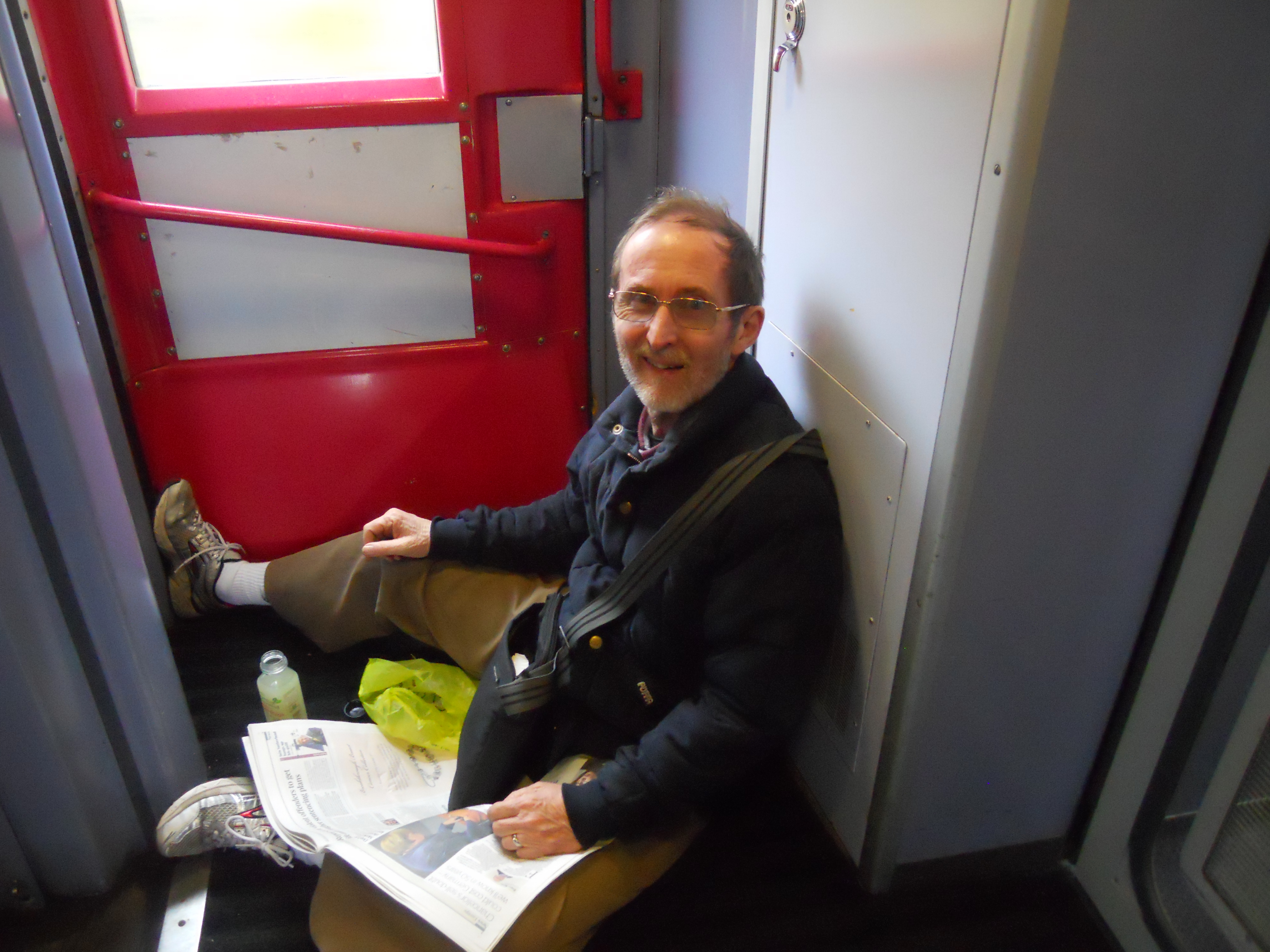
Sitting in Style on a First Great Western HST
I had been unable to get a seat online, so I just bought an Off Peak Return and made the best of what was available, as the picture shows.
I should say that it wasn’t that uncomfortable and I got a seat from Taunton, when the train started to clear. I wouldn’t like to sit like that in a Pendolino, as they certainly don’t ride like forty-year old HSTs.
It did look like it was all going to go pear-shaped, as the train had been delayed at Paddington for about fifteen minutes by a fault and this meant it had got stuck behind a stopping train along the Devon Coast. We were nearly thirty minutes late at Totnes and it was starting to look like I’d miss the 18:00 back to London. But then driver got a clear line and let the HST go, so much so that it was only twenty minutes late at Plymouth, giving me just ten minutes to get to the stadium and back.
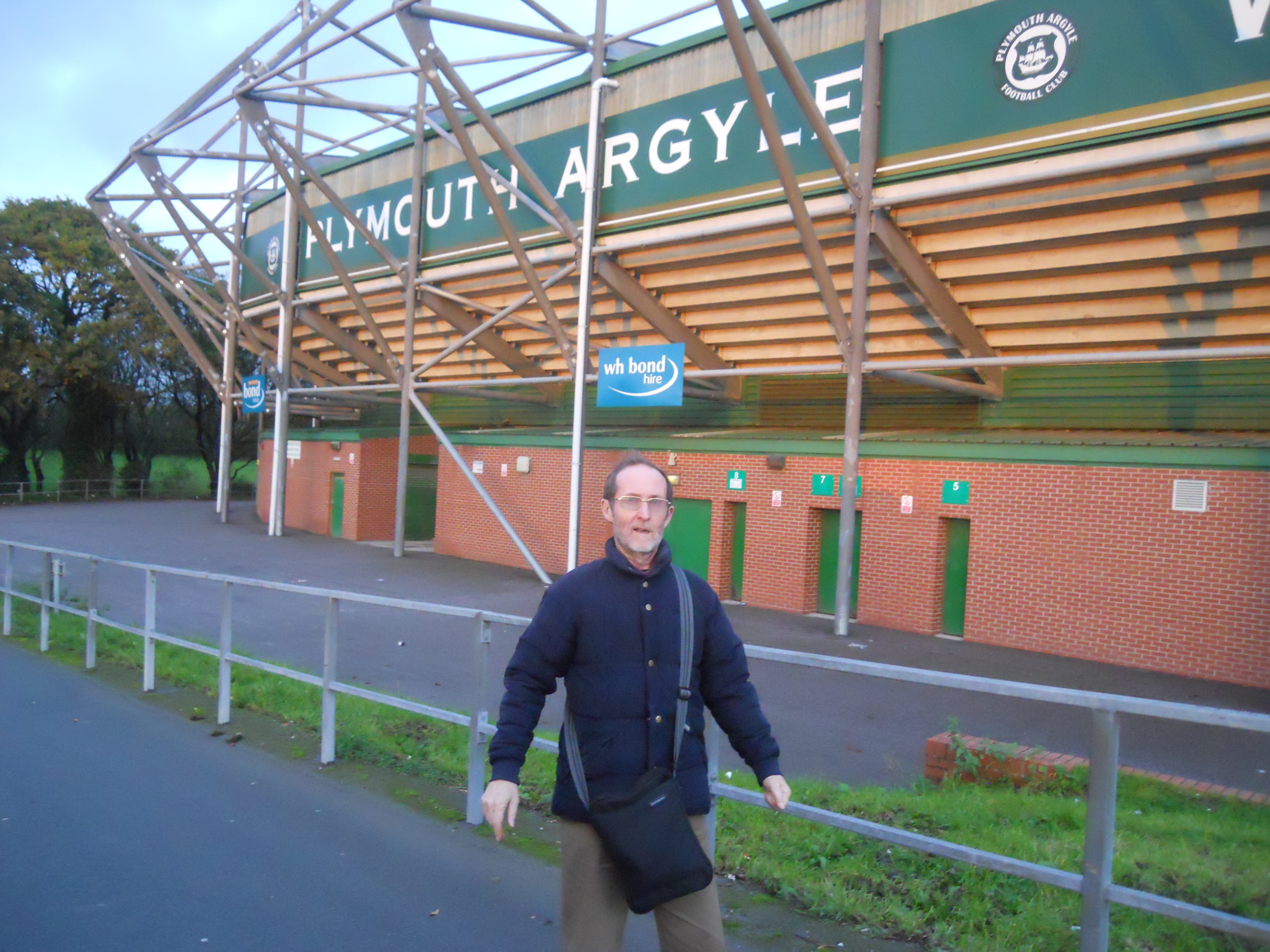
Outside Home Park
As you can see I made it.
I did get a seat all the way back, but the train was late due to someone falling under a train at Reading West station.
But if the day did prove one thing, it was that the stopgap Intercity 125 is a superb train. But then I know that, having been through the Highlands at 90 mph.
There are plans to make sure these trains continue for a few years yet. Who’s to say that in the 2060s, they won’t be a tourist attraction in their own right, as they speed passengers to the West Country. Probably to the consternation of politicians, who can find all sorts of reasons to not use a what would be then be a nearly ninety year old train. After all, I doubt that electrifying this line to Plymouth will ever be done.
Anastasia the Ambassador at Paddington
First Great Western have been one of the better train companies on this journey. On my way to Hereford yesterday, I was accosted by, Anastasia, one of their Customer Ambassadors at Paddington, whilst waiting for the train.
I said how pleased I was with the company, adding that I hope it wouldn’t upset the journey I was about to do. It didn’t! We then got talking about Inter City 125’s and how she and the customers preferred them. She also said, that quite a few people booked so they travelled in one.
All those proponents of the IEP would not have warmed to the conversations.
THe Inter City 125s will be replaced on the main line, but they’ll outlive most of us!
 The Anonymous Widower